Body Mechanics
 Call Kai
 Learn
Learn Practice Test
 Spaced Repetition
 Match
Match Flashcards
 Knowt Play
1/80

There's no tags or description
Looks like no tags are added yet.
Name | Mastery | Learn | Test | Matching | Spaced | Call with Kai | Chat |
|---|
No analytics yet
Send a link to your students to track their progress
81 Terms
What is body mechanics?
positioning the body in ways that prevent injury
What creates efficiency and safety?
organization
At the end of each treatment, what should you do?
clean up and prep for the next treatment
What must you anticipate?
safety issues (bed/wheelchairs unlocked, cords in the way, items out of reach)
What is mass?
amount of matter that makes up an object, body, or segment
Where should you keep the load?
close to your body
What is the center of mass (CoM)?
an object's balance point
What is the center of gravity (CoG)?
the central point at which gravity is action on the segment or body
Are CoM and CoG interchangeable?
yes
What is the measure of weight for SI?
kilograms
What is the measure of for force for SI?
newtons
What is the measure of distance/height for SI?
meters or centimeters
Where is the CoM when standing still?
the whole body
Where is the CoM when there is an external weight (having a leg cast)?
toward the addition of external weight
Where is the CoM when the distribution of body weight is changed (amputation)?
away from the removed weight
What is force?
a push or pull that creates an action of one object upon another
What is a linear force?
forces in a line through the objects axis
What is an angular force?
force around an axis
What is external force?
force that originated from outside the body
What is internal force?
force that is produced by the body itself
What is the line of action (LoA)?
the orientation of a force
What is the line of gravity (LoG)?
the line of action created by gravity as it acts on the whole body's CoM
What is another name for torque
moment or moment of force
What can moments do?
create movement or prevent it
What is a force couple?
forces that act together to move an object around an axis
What is moment arm?
distance from the linear force to the axis
What is resultant moment?
individuals moments added together on one object
What is loading?
the placing of one or more forces upon an object or stucture
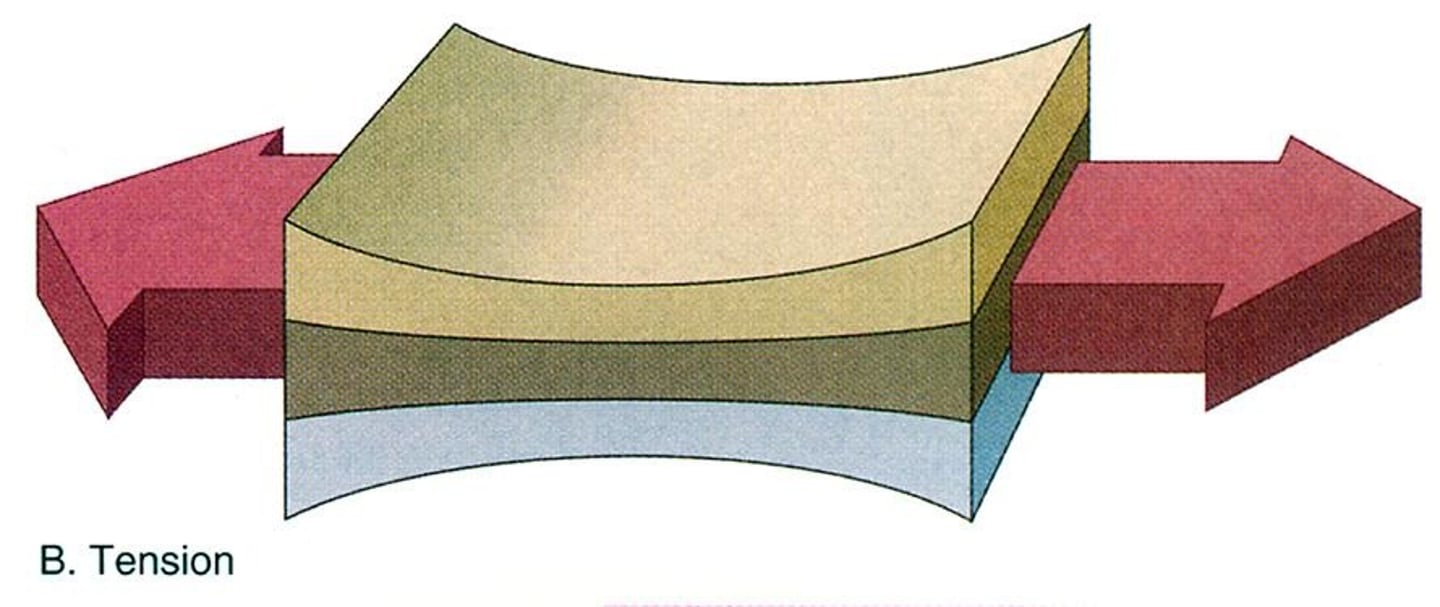
What is tension?
pulling on each end of a surface to stretch tissue
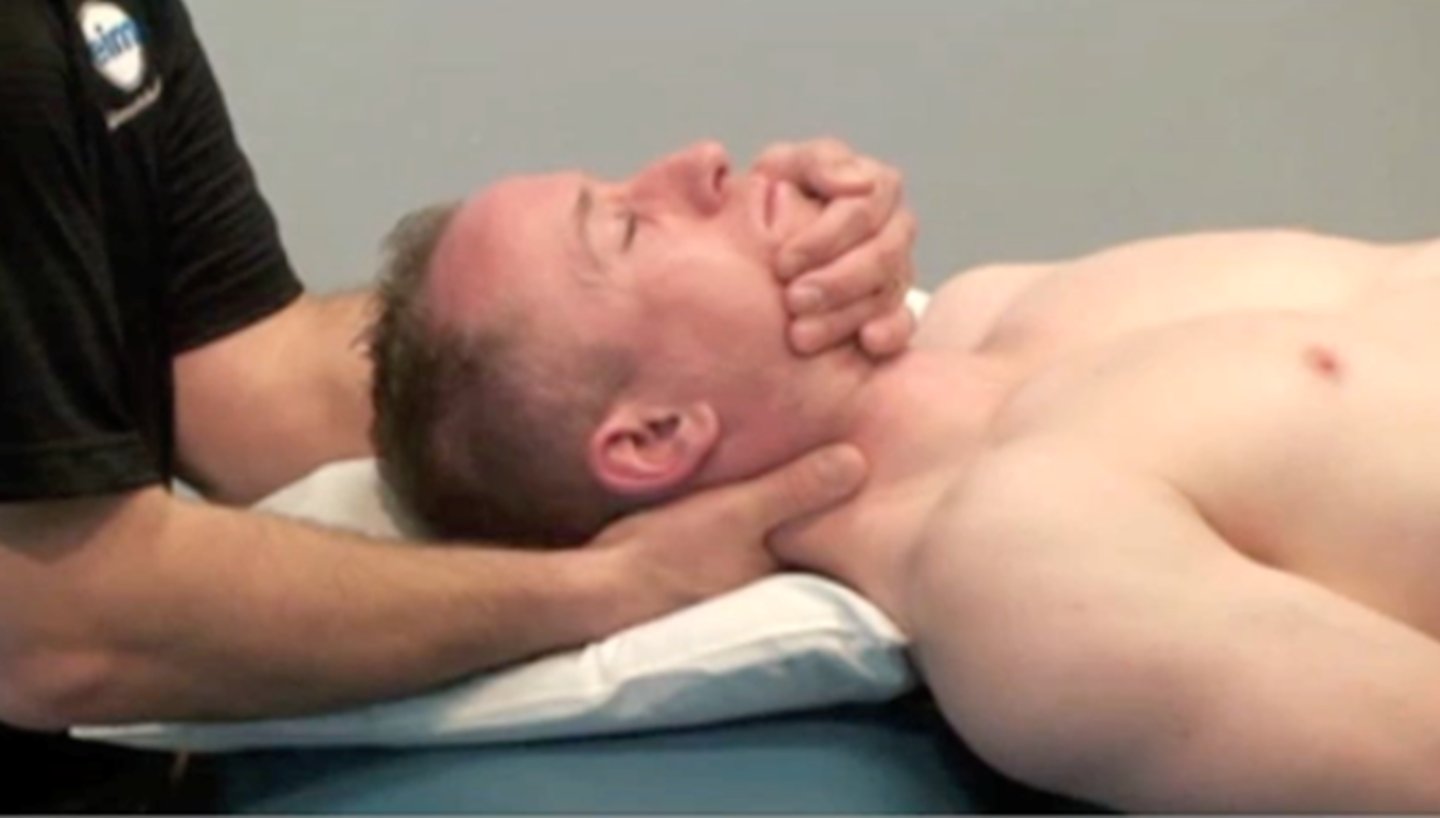
What is distraction?
pulling to separate two surface from each other
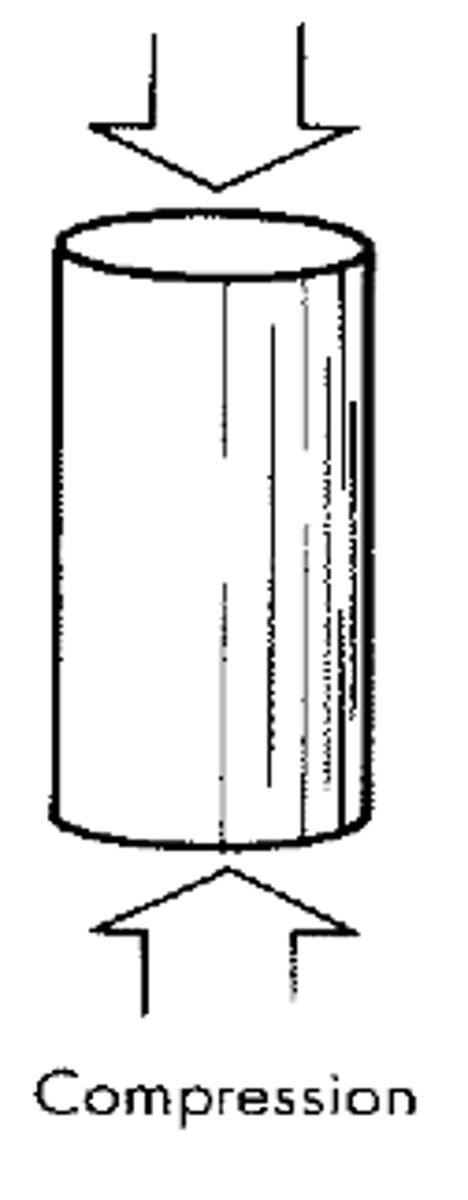
What is compression?
pushing two surfaces together
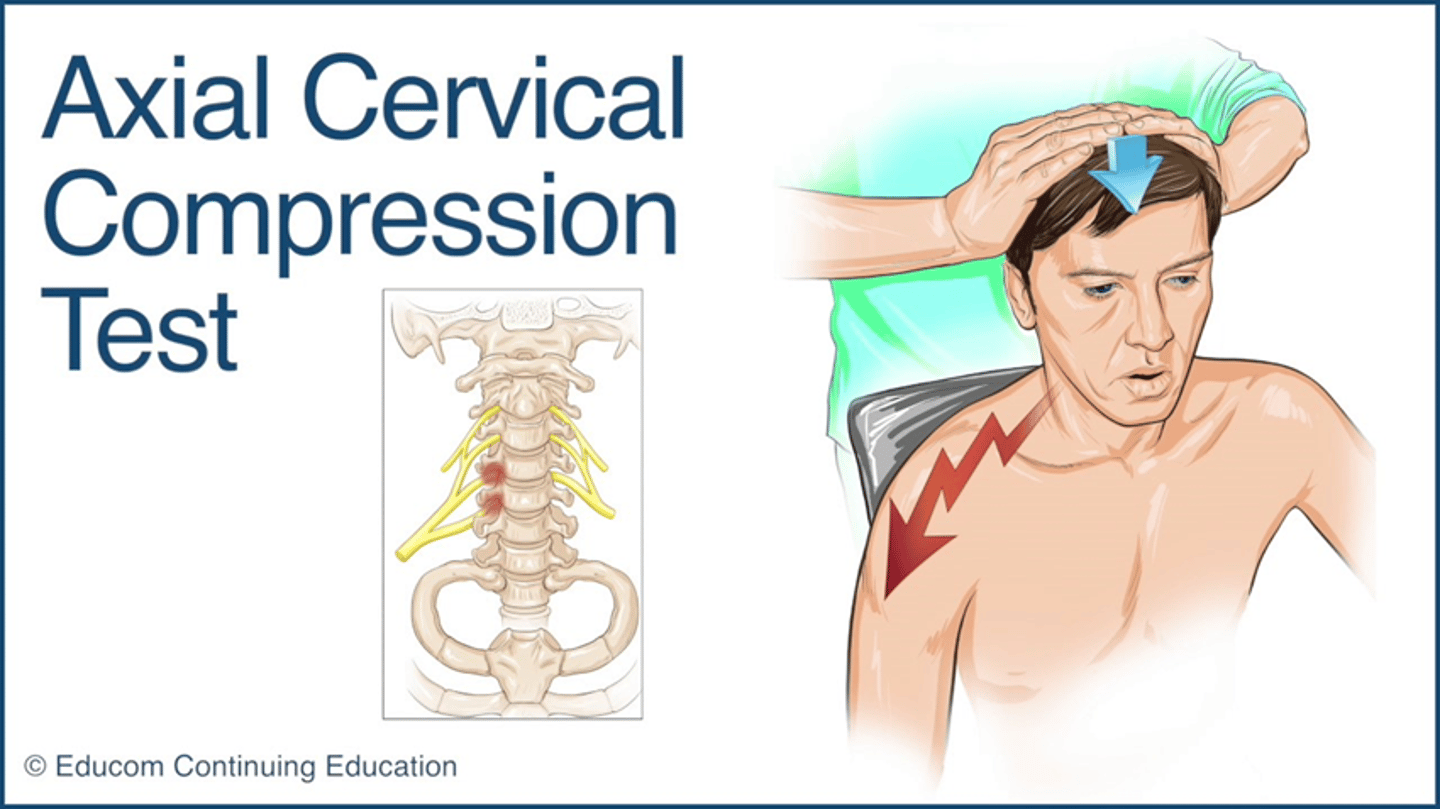
What is axial compression?
compressive force that is along the axis of the structure
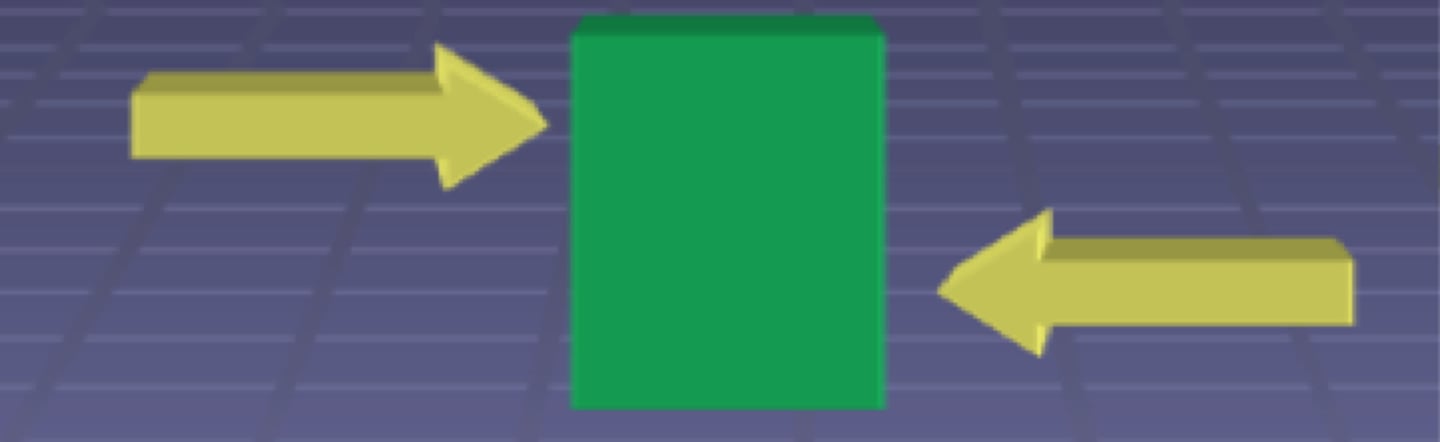
What is shear?
two forces parallel to contacting surface
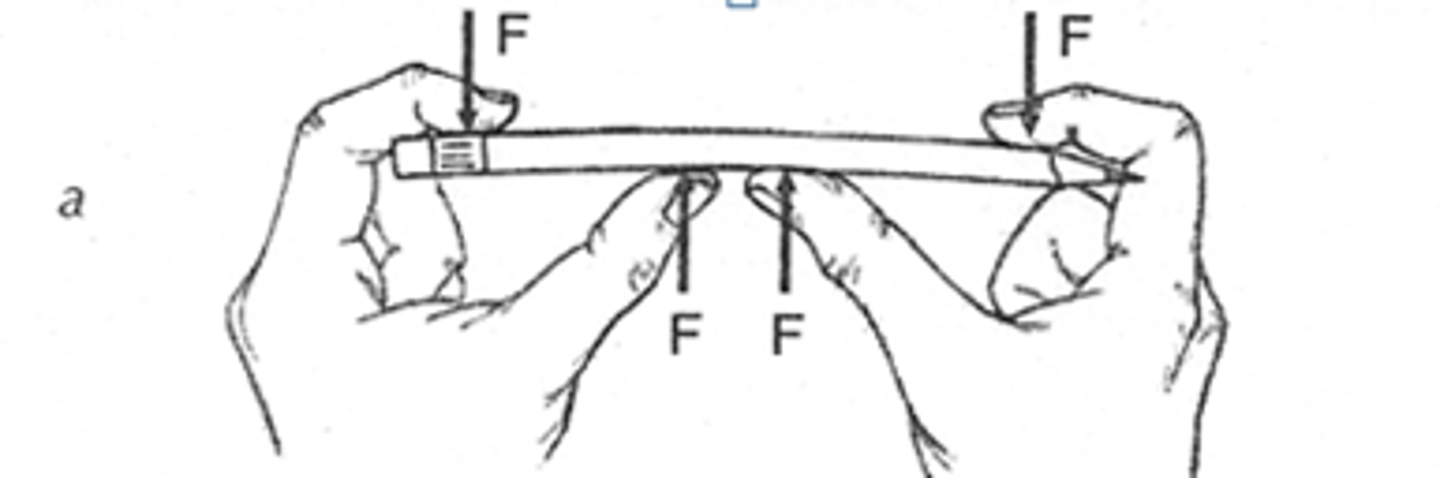
What is bending?
creating both tension and compression
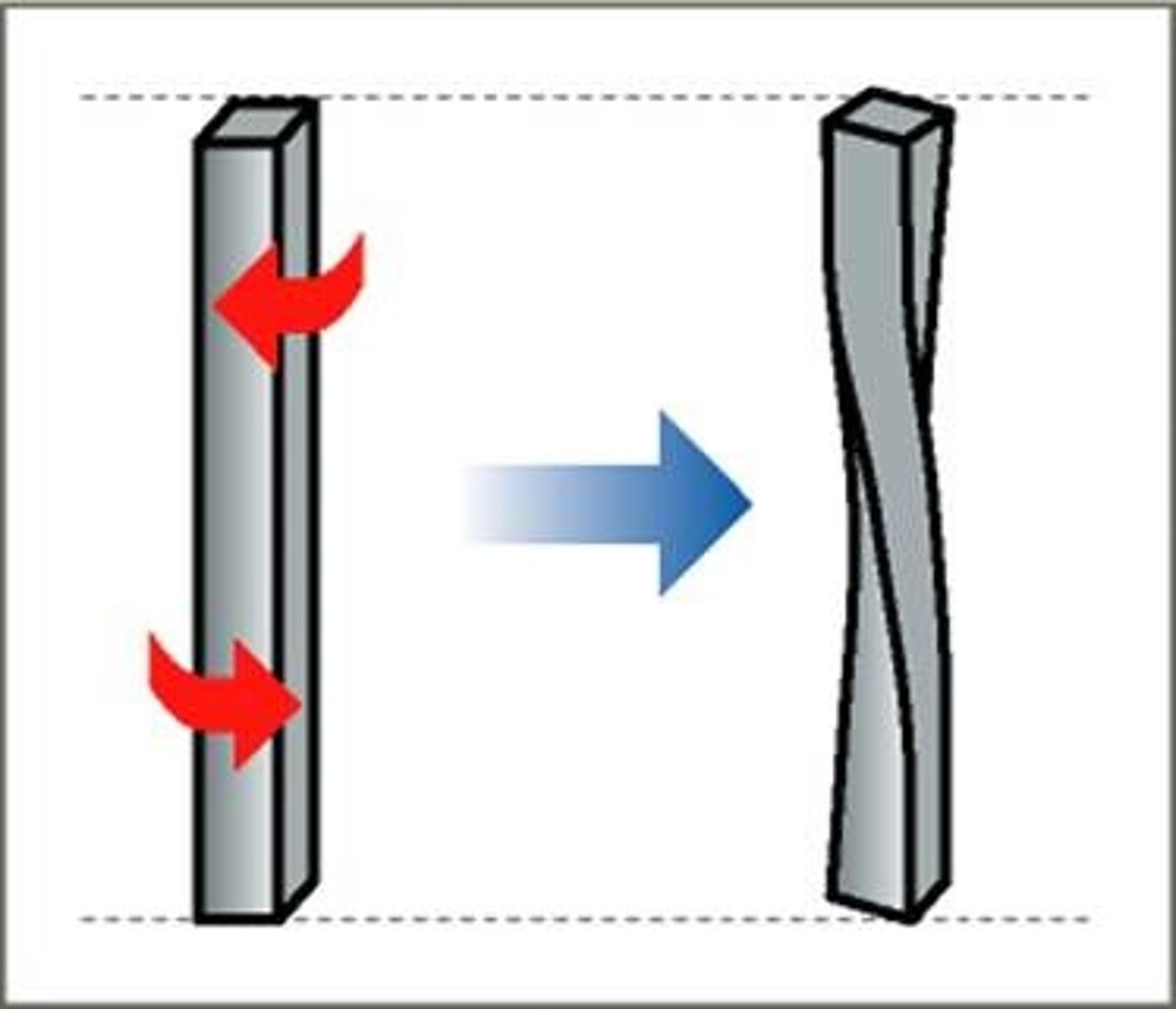
What is torsion?
twisting force around the structures axis
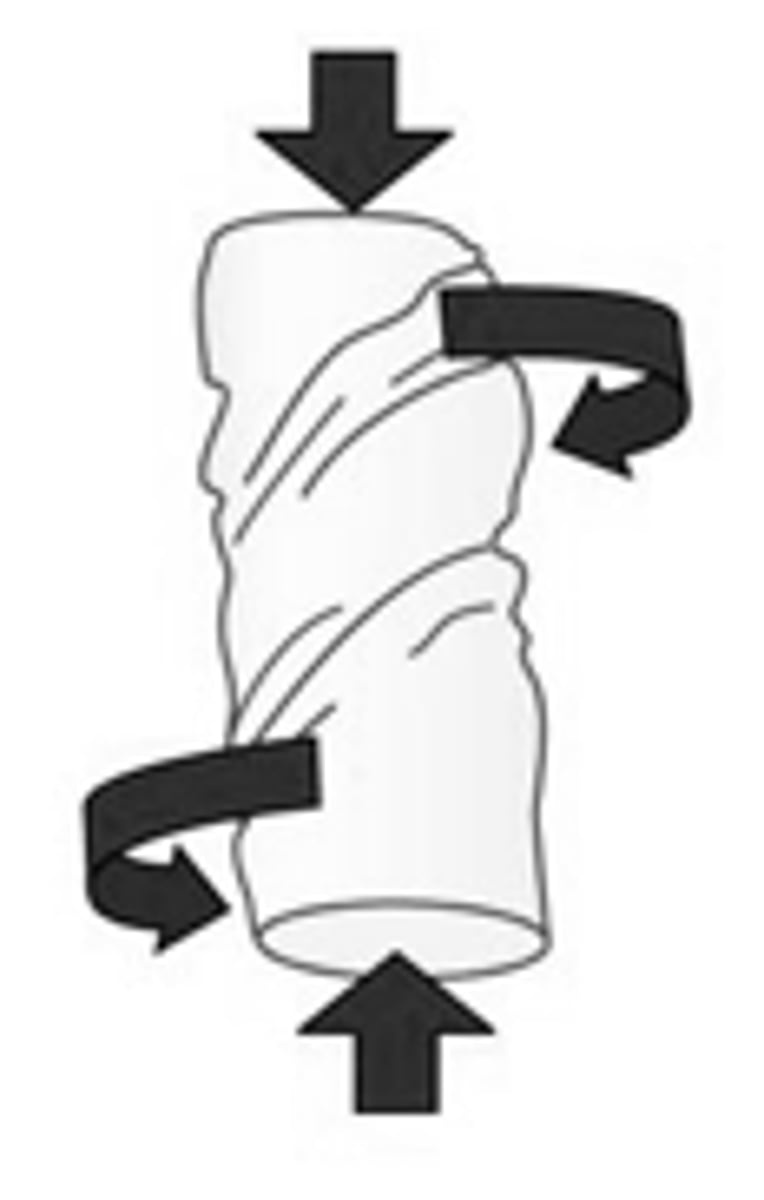
What is combined loading?
combination of more than one type of loading mode
What happens with too little load?
immobilization or decreased activity levels
What happens with too much load?
force exceeds the tissues' ability to accommodate it
What happens with just enough load?
amount of loading is necessary to maintain bone mass, allow tissue growth, and promote healing
What is stability?
resistance to disruption of equilibrium
What is mobility?
ability to move about freely
What should you avoid when picking up a heavy load?
valsalva maneuver
What is the valsalva maneuver?
Exhaling forcibly with the glottis closed
What should you lift with?
legs; don't twist
What is base of support (BoS)?
contact area of an object with its supporting surface
What promotes stability?
-greater BoS
-LoG is near the BoS
-shorter distance between CoM and BoS
What promotes mobility?
-smaller BoS
-LoG moves beyond the center ofBoS
-longer distance between CoM and BoS
What is stabilization?
ability to hold one attachment site while allowing another to move
What is static stability?
maintaining and controlling the body's orientation space
Is you body ever truly still or static?
no; there is always a force acting on it
What is dynamic postural control?
maintain alignment of body parts during movement
What is CCDD?
controlling centrally (move by their trunk), directing distally (direct by their limbs)
What is dynamic trunk (lumbar) stabilization?
maintaining the stability of the trunk and the lumbar spine within a safe range of movement
What does the lumbar do with anterior pelvic tilt?
extension
What does the lumbar do with posterior pelvic tilt?
flexion
What does the lumbar do with right pelvic tilt?
left lateral flexion
What does the lumbar do with left pelvic tilt?
right lateral flexion
What does the lumbar do with right forward rotation of the pelvis?
right lumbar rotation
What does the lumbar do with left forward rotation of the pelvis?
left lumbar rotation
What are lumbopelvic interactions used for?
finding the neutral zone for stability and mobility activities
What is controlled mobility?
the LoG intentionally moves beyond BoS and back
What is uncontrolled mobility?
the LoG moves so far outside the BoS that it cannot move back
How can you provide support when the patient is standing up?
apply an external force by "blocking the knee" by pushing posteriorly on the knee
What is a ground reaction force?
force of the surface reacting to the force we place on it
What are the lifting techniques?
-the squat lift
-the half-kneel lift
-the single leg stance lift
What is the squat lift?
flexing at the hips and knees, keeping eyes forward
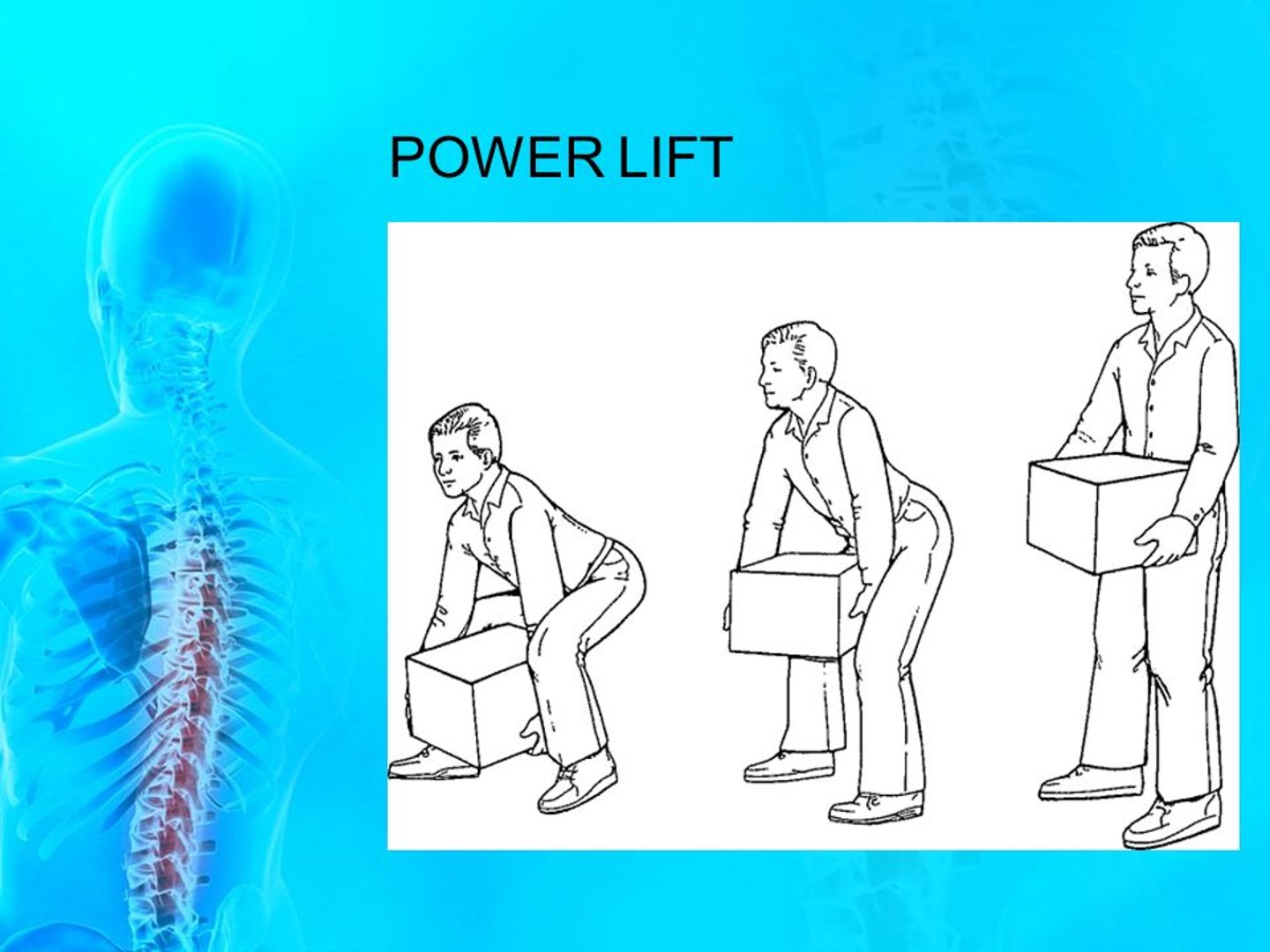
What creates a great risk of injury during the squat lift?
rounding the spine
In a static activity, what should you consider?
your body position
In a dynamic activity, what should you consider?
-decrease the moment arm
-use newton's laws of motion
-gravity
-joint movements
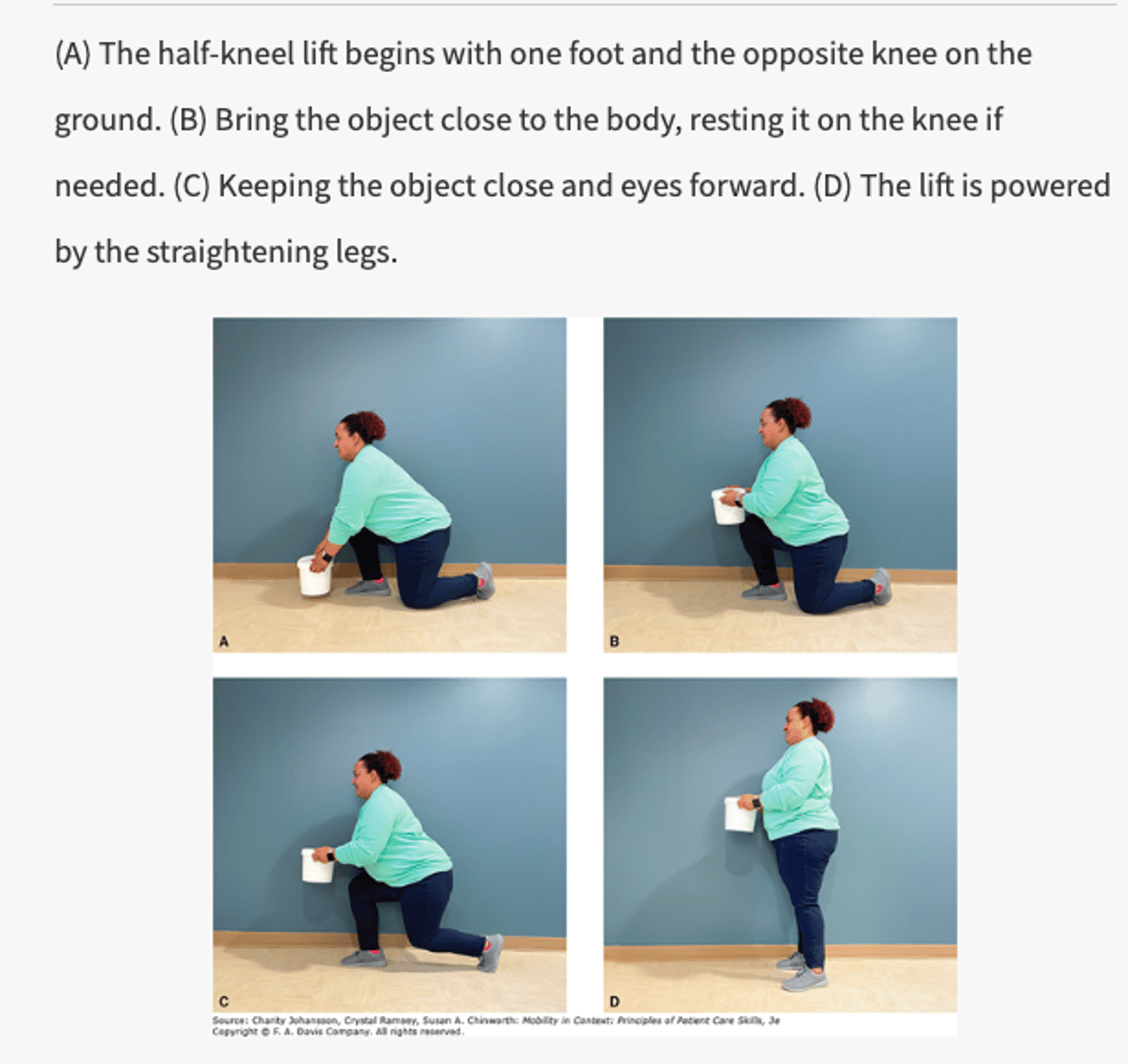
What is the half-kneel lift?
kneel directly behind the object with one knee on the ground and foot of the opposite leg on the ground, keep eyes and chest facing forward
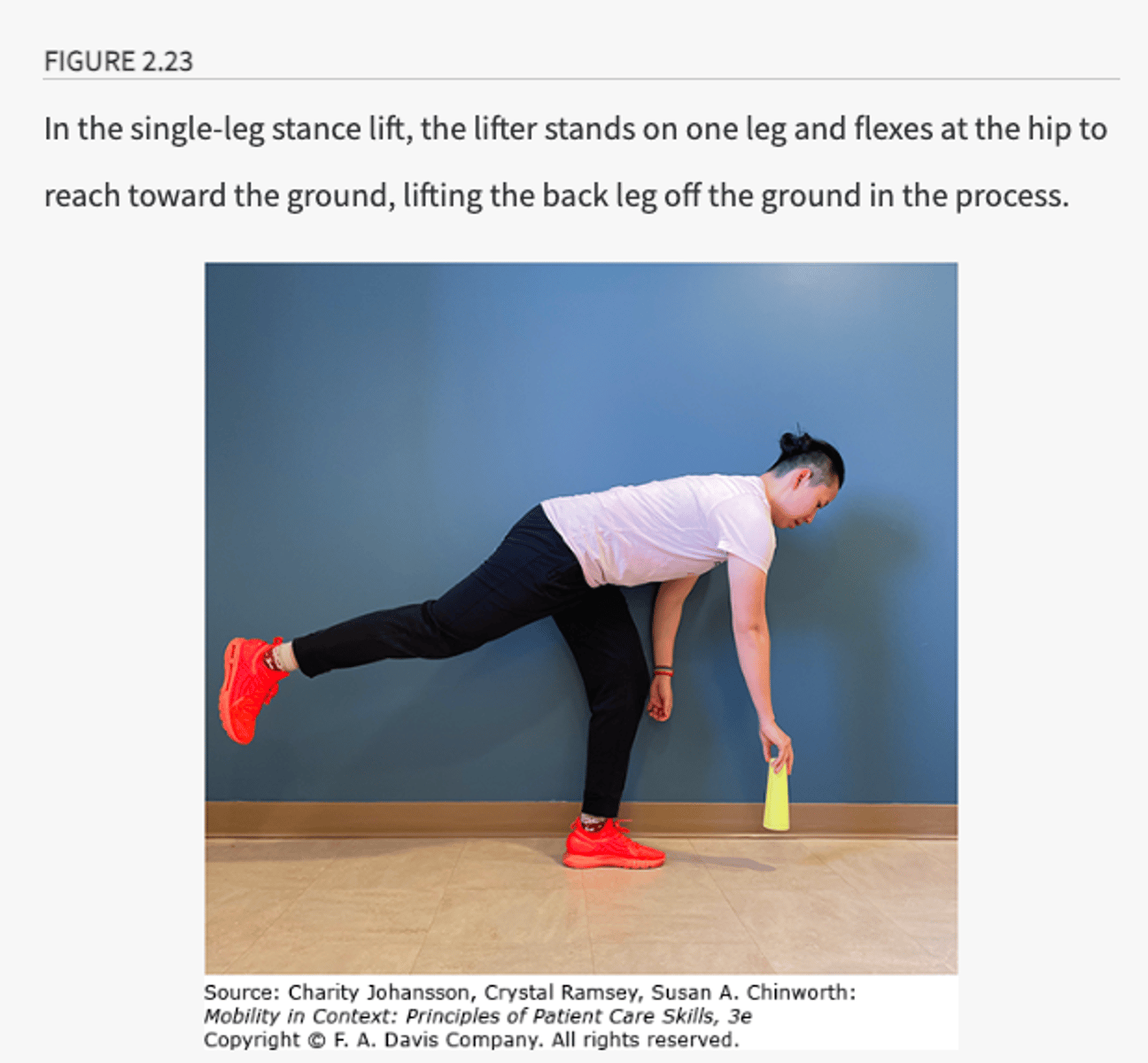
What is the single-leg stance lift
stand of one leg and flex at the hip to reach toward the ground while lifting back left off the ground, keep neutral spine
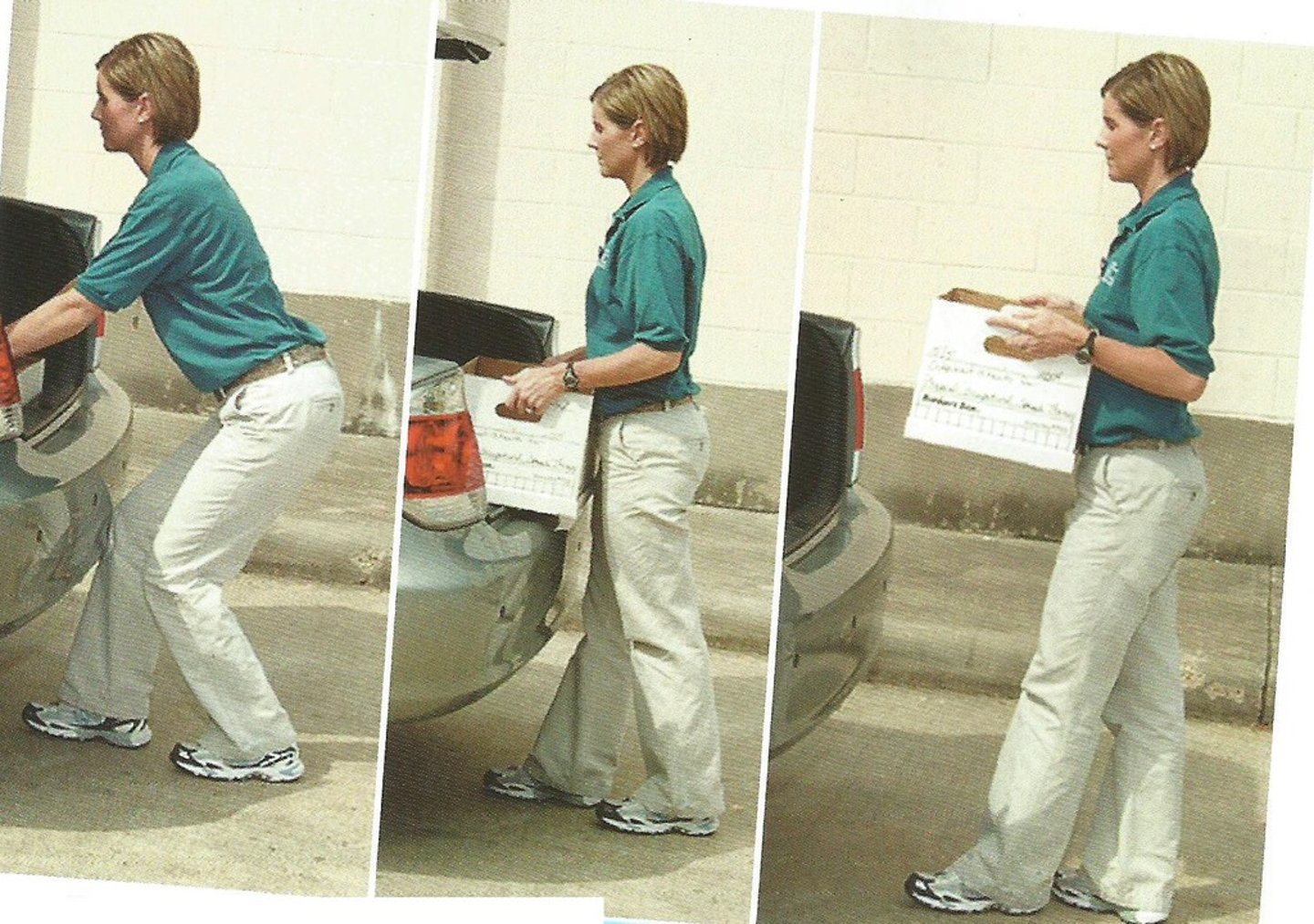
What is an alternative to the single-leg stance life?
the hip hinge
What is the hip hinge lift?
both feet remain on the ground with knees extended and spine neutral, flexion only at the hips
What are therapists often lifting?
people
When lifting a patient should you increase or decrease the distance between the patient and therapist?
decrease
Who should have good body mechanics? The patient or the therapist?
both
What is motor learning?
relatively permanent gains in motor skill capability
What does motor learning require?
practice and experience
What can educating other healthcare providers on body mechanics do?
positively affect patient care
How do you prepare the work with a patient?
-hand hygiene
-PPE
-gait belt
-check lines/tubes
-prepare for emergency protocols
How do you transport a patient?
gurney or wheelchair