Ultrasound Physics Chapter 4: Describing Pulses Waves
 Call Kai
 Learn
Learn Practice Test
 Spaced Repetition
 Match
Match Flashcards
 Knowt Play
1/42

There's no tags or description
Looks like no tags are added yet.
Name | Mastery | Learn | Test | Matching | Spaced | Call with Kai | Chat |
|---|
No analytics yet
Send a link to your students to track their progress
43 Terms
Pulsed Waves
A pulse is a collection of cycles that travel together.
This collection travels together as a single unit.

What are the 2 components of pulsed ultrasound?
Transmit time (aka "on" time or talking time) and Receive time (aka "off" time or listening time)
What are the 5 parameters for pulsed waves?
Pulse duration, pulse repetition period (PRP), pulse repetition frequency (PRF), duty factor, and spatial pulse length (SPL)
Pulse Duration
the time it takes from the start of a pulse to the end of that pulse

Units for Pulse Duration?
Microseconds / units of time
Typical Values for Pulse Duration?
0.3 - 2.0 microseconds
What is Pulse Duration determined by?
Sound Source
Is Pulse Duration Adjustable?
No
Pulse Duration Relationships
- Directly proportional to # of cycles in a pulse
- Directly proportional to period
- Inversely related to frequency
Formula for Pulse Duration
Pulse Duration = # of cycles X period
Pulse Duration = # of cycles / frequency
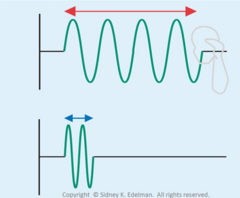
If we have a long pulse duration that means?
There are many cycles in the pulse, or individual cycles have long periods
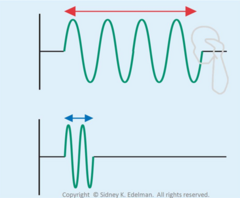
If we have a short pulse duration that means?
There are few cycles in the pulse, or the cycles have short periods
Why do we like short pulse duration's best?
because they improve our resolution (image accuracy)
Spatial Pulse Length (SPL)
the distance from the start of one pulse to the end of it.
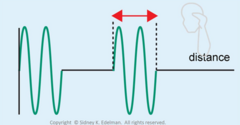
Units for Spatial Pulse Length (SPL)
units of distance, such as mm
Typical Values for Spatial Pulse Length (SPL)?
.1 - 1mm
What is Spatial Pulse Length (SPL) determined by?
Sound Source AND the Medium
Is Spatial Pulse Length (SPL) adjustable?
No
Formula for Spatial Pulse Length (SPL)
Spatial Pulse Length = # of Cycles X Wavelength
Pulse Repetition Period (PRP)
the time it takes from the start of a pulse to the start of the next pulse (includes "talking" AND "listening time"

Units for Pulse Repetition Period (PRP)?
Units of time
Typical Values for Pulse Repetition Period (PRP)?
100 microseconds - 1ms
What is Pulse Repetition Period (PRP) determined by?
Sound Source
is Pulse Repetition Period (PRP) adjustable?
Yes
What is being adjusted when we adjust Pulse Repetition Period (PRP)?
we change our imaging depth
Pulse Repetition Frequency (PRF)
the number of pulses transmitted per second
Units for Pulse Repetition Frequency (PRF)?
Hz
Typical values for Pulse Repetition Frequency (PRF)?
1-10KHz
What is Pulse Repetition Frequency (PRF) determined by?
Sound Source
Is Pulse Repetition Frequency (PRF) adjustable?
Yes (we adjust this by changing our depth)
When PRF is high
the image is shallow

When PRF is low
the image is deep

What is the relationship between PRP and PRF
PRP & PRF are reciprocals. When one goes up, the other goes down. PRP X PRF = 1
Duty Factor
the percentage of time that the system is transmitting a pulse
Units for Duty Factor?
None (it is a percentage)
Typical values for Duty Factor?
.2 - .5%
What is Duty Factor determined by?
Sound Source
Is Duty Factor adjustable?
Yes (we adjust this by changing our depth)
Formula for Duty Factor
Duty Factor (%) = Pulse Duration/PRP x 100
What us the maximum Duty Factor can be?
100%
What us the minimum Duty Factor can be?
0%
Shallow imaging=
-Less listening
-Shorter PRP
-Higher PRF
-Higher duty factor
Deep Imaging=
-More listening
-Longer PRP
-Lower PRF
-Lower duty factor