Sociology exam 1
0.0(0)
Studied by 0 people Call Kai
 Learn
Learn Practice Test
 Spaced Repetition
 Match
Match Flashcards
 Knowt Play
Card Sorting
1/58

Earn XP
Description and Tags
Last updated 11:51 PM on 9/26/22
Name | Mastery | Learn | Test | Matching | Spaced | Call with Kai | Chat |
|---|
No analytics yet
Send a link to your students to track their progress
59 Terms
1
New cards
What is sociology?
Study of social life and it's nature, structure, patterns, causes, and meanings
2
New cards
What is the sociological imagination?
the ability to see the relationship between individual experiences and the larger society
3
New cards
egoistic suicide
suicide that occurs when one is not well integrated into a social group
4
New cards
anomic suicide
suicide that occurs as a result of insufficient social regulation
5
New cards
altruistic suicide
suicide that occurs when one experiences too much social integration
6
New cards
fatalistic suicide
suicide that occurs as a result of too much social regulation
7
New cards
Rationality
the process by which traditional methods of social organization, characterized by informality and spontaneity, are gradually replaced by efficiently administered formal rules and procedures
8
New cards
iron cage of rationality
The dehumanizing aspects of bureaucracy. Max Weber saw bureaucracies as cages with people trapped in them, denied of their basic humanity.
9
New cards
What is McDonaldization?
policies of fast food organizations have come to dominate other organizations in society
- principles of efficiency, calculability, predictability, uniformity and control
- principles of efficiency, calculability, predictability, uniformity and control
10
New cards
Efficiency
using resources in such a way as to maximize the production of goods and services
11
New cards
Calculability
emphasis on things that can be calculated, counted, and quantified
12
New cards
predictibility
Routine, consistency, and a methodical operation. Makes working easier with less critical thinking
Reduces surprises and brings comfort.
Reduces surprises and brings comfort.
13
New cards
Control
Often replacing human labor with non-human technology. Aimed at both costumers and employees
14
New cards
Mechanical Solidarity (Durkheim)
social bonds present in premodern society; people in a simple agricultural society were bonded together by shared traditions, beliefs, and experiences
15
New cards
Organic Solidarity (Durkheim)
social bond in modern day society; people bond together based on tasks performed, interdependence, and individual rights
16
New cards
working class
A social class broadly composed of people working in blue-collar, or manual, occupations.
17
New cards
Ruling class
An elite who possess adequate resources to control a regime; in Marxist theory, the class that controls key sources of wealth in a given epoch
18
New cards
Commodification
The process through which something is given monetary value; occurs when a good or idea that previously was not regarded as an object to be bought and sold is turned into something that has a particular price and that can be traded in a market economy.
19
New cards
Alienation
the experience of isolation and misery resulting from powerlessness
20
New cards
How do Marx and Durkheim understand society differently?
Marx's theory is based on social critique and conflict. Marx was a conflict theorist. Durkheim emphasized social factors. Durkheim was a functionalist and believed that members of a society were in consensus with each other.
21
New cards
What is culture and its different aspects (ideology, values, symbols)?
•Values, ideas, practices, and symbols that give a social group its collective identity.
•Culture gives members of a group shared understanding
•Passed down through generations
•Culture is learned
•Culture gives members of a group shared understanding
•Passed down through generations
•Culture is learned
22
New cards
ideology of culture
•Shared beliefs about what the world is or how it should be
•Directs or motivates behaviors
•Ex: democracy, fascism, liberalism, conservatism, socialism, meritocracy, theocracy, technocracy, populism, etc.
•Directs or motivates behaviors
•Ex: democracy, fascism, liberalism, conservatism, socialism, meritocracy, theocracy, technocracy, populism, etc.
23
New cards
Values of Culture
•What is important to a culture?
•Culture is organized around its values and principles
•Example: What are important values to members of the United States?
•Culture is organized around its values and principles
•Example: What are important values to members of the United States?
24
New cards
Symbols of culture
•Representations of cultures
•Cultural markers
•Denote belonging
•Ex: sports team apparel
•Cultural markers
•Denote belonging
•Ex: sports team apparel
25
New cards
Folkways
norms for routine or casual interaction. If violated, social pressure is felt
•Ex: behaving in an elevator
•Ex: behaving in an elevator
26
New cards
Mores
norms that are widely observed and have great moral significance. Violating mores can lead to sanctions (sometimes severe)
Ex: cheating on spouse; Jews and Muslims eating pork; bribing a referee in sports
**But they can shift over time and can be different across cultures. Ex: Gay marriage, racism.
Ex: cheating on spouse; Jews and Muslims eating pork; bribing a referee in sports
**But they can shift over time and can be different across cultures. Ex: Gay marriage, racism.
27
New cards
Taboos
mores so strong that their violation is considered to be extremely offensive and even unmentionable. Ex: pedophilia, bestiality, child marriage, incest
28
New cards
Laws
society's values and standards that are enforceable in the courts. •Can encompass folkways, mores, and taboos.
•We require the state to deal with those who break laws
•We require the state to deal with those who break laws
29
New cards
Goffman's dramaturgical analysis
The social world as a theatrical performance (metaphor).
30
New cards
Front stage
in the dramaturgical perspective, this is where we play a role and use impression management to craft the way we come across to other people.
Every single social interaction is a performance
You are performing for an audience
-Different performances for different roles
The goal is to appear authentic/genuine; to give an effortless performance
Performances can be crucially important or very mundane
Every single social interaction is a performance
You are performing for an audience
-Different performances for different roles
The goal is to appear authentic/genuine; to give an effortless performance
Performances can be crucially important or very mundane
31
New cards
Back Stage
In the dramaturgical approach, the setting where players are free from their role requirements and not in front of the audience; back stage behaviors may not be deemed appropriate or acceptable and are thus kept invisible from the audience.
-No performance
-No audience
-Can be a place to "rehearse" a future performance
-You can only be back stage when you are alone
-No performance
-No audience
-Can be a place to "rehearse" a future performance
-You can only be back stage when you are alone
32
New cards
Cooley's looking-glass self.
1.You imagine how you appear to others
2.You imagine others' judgement of your appearance
3.You form an identity based on your perceptions of others' judgement of you
-This leads to either maintaining or changing your behavior
our identity is based on our own perceptions of how others view us
2.You imagine others' judgement of your appearance
3.You form an identity based on your perceptions of others' judgement of you
-This leads to either maintaining or changing your behavior
our identity is based on our own perceptions of how others view us
33
New cards
What is the scientific method?
A logical, systematic approach to the solution of a scientific problem
34
New cards
qualitative data
descriptive data or characteristics
35
New cards
Quantitative data
numerical data
36
New cards
What is deviance and the different perspectives of it?
Any action, speech, belief, or characteristic that violates the norms (folkways, mores, taboos, laws) of a group.
Different ideas on the nature of deviance, but no true consensus.
Four things needed for deviance:
1.Must be a rule or a norm
2.Need a violator of the norm
3.Need an audience
- People to judge the norm violator
4.Need a negative reaction
- Some kind of punishment
Different ideas on the nature of deviance, but no true consensus.
Four things needed for deviance:
1.Must be a rule or a norm
2.Need a violator of the norm
3.Need an audience
- People to judge the norm violator
4.Need a negative reaction
- Some kind of punishment
37
New cards
Absolutist perspective
Claims that deviance resides in the very nature of an act and is wrong at all times and in all places.
- Durkheim's idea that deviance is functional; it sets and reinforces boundaries
- Widespread consensus exists about what deviance is and is not
The act is considered deviant in and of itself
Deviance is decided by god or a product of human nature (objective)
Seen more in homogenous and traditional societies.
- Durkheim's idea that deviance is functional; it sets and reinforces boundaries
- Widespread consensus exists about what deviance is and is not
The act is considered deviant in and of itself
Deviance is decided by god or a product of human nature (objective)
Seen more in homogenous and traditional societies.
38
New cards
Secondary Deviance
deviance in which an individual's life and identity are organized around breaking society's norms. Results in being stigmatized. Often a harsh reaction from society, treated as an outsider.
Ex: Felon
Ex: Felon
39
New cards
Primary Deviance
the first act of rule breaking that may incur a label of "deviant" and thus influence how people think about and act toward you. Little to no reaction from society.
Ex: Underage drinking
Ex: Underage drinking
40
New cards
Relativist perspective
definitions of ethical behavior are derived subjectively from the experiences of individuals and groups.
-Deviance is created and decided by people (subjective)
- Multiple definitions of what is or what is not deviant can exist
-Marijuana, Illegal immigration, Killing: war, self defense
-Deviance is created and decided by people (subjective)
- Multiple definitions of what is or what is not deviant can exist
-Marijuana, Illegal immigration, Killing: war, self defense
41
New cards
Social Power perspective
Crime and deviance are not formed by just any group of "others".
-Society based on conflict (Marx)
-What is considered deviant is decided by powerful groups
-Laws (and their enforcement) reflect the interests and concerns of dominant classes in society
-Ex: vagrancy laws
-Ex: sentencing disparity between crack and powdered cocaine
-Society based on conflict (Marx)
-What is considered deviant is decided by powerful groups
-Laws (and their enforcement) reflect the interests and concerns of dominant classes in society
-Ex: vagrancy laws
-Ex: sentencing disparity between crack and powdered cocaine
42
New cards
Stigma
-Identity that significantly deviates from what is expected or considered normal
-Devalued stereotype
-Stigma exists in the relationship between the observed and observer.
-There are three types
-Devalued stereotype
-Stigma exists in the relationship between the observed and observer.
-There are three types
43
New cards
Abominations of the body
First type of stigma. Any part of our body that is different than the vast majority of people
Ex: facial deformities, amputees, plastic surgery, tattoos
Ex: facial deformities, amputees, plastic surgery, tattoos
44
New cards
Character Defects
Second type of stigma. Blemishes of the individual character that are perceived as the fault of the individual; weak willed.
Ex: drug and alcohol addicts, felons, patients in mental institutions.
Ex: drug and alcohol addicts, felons, patients in mental institutions.
45
New cards
Tribal Stigma
Third type of stigma. Stigma based on race, religion, national origin, etc. Not just felt individually, but can stigmatize families, generations, or groups of people in the same way
46
New cards
Strain theory
theory that deviance is more likely to occur when a gap exists between cultural goals and the ability to achieve these goals by legitimate means.
When common goals and aspirations are not met (e.g. "American Dream", having a high paying job, having a good education, etc.) leading to pressure and stress, which leads to a higher likelihood of committing crime
When common goals and aspirations are not met (e.g. "American Dream", having a high paying job, having a good education, etc.) leading to pressure and stress, which leads to a higher likelihood of committing crime
47
New cards
Social control (bond) theory
Assume people will commit crime if they are not socially controlled or "shaped" into conformity; that something exists that compels people to follow the rules and laws.
People are more likely to commit crimes when their bonds with society are weak or non-existent
•Bonds like: marriage, having a job, being a member in a church, friends and peers at school, being part of a sports teams, etc.
People are more likely to commit crimes when their bonds with society are weak or non-existent
•Bonds like: marriage, having a job, being a member in a church, friends and peers at school, being part of a sports teams, etc.
48
New cards
Self-control theory
The theory of delinquency that holds that antisocial behavior is caused by a lack of self-control stemming from an impulsive personality. People with low self-control have a higher likelihood of committing crime
Focus is on childhood upbringing, where parents/guardians are responsible for teaching the child self-control
Focus is on childhood upbringing, where parents/guardians are responsible for teaching the child self-control
49
New cards
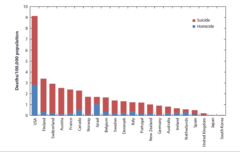
Understand where the U.S. homicide rate is and how it relates to other countries
U.S homicide rate is distinctively higher than similar countries.
50
New cards
Who commits violence in society?
Violence is typically committed by young men in society.
51
New cards
How common is intimate partner violence?
Intimate partner violence occurs to 1/4 women and 1/9 men. Intimate partner sexual violence occurs to 1/5 women and 1/12 men.
52
New cards
What did the Asch experiment and the Milgram experiment show?
It showed that individual behavior is likely to be subjected to group behavior as individuals are more likely to conform to group perspective's despite the perspective being incorrect.
53
New cards
What are the stages of "becoming human"
The stages of becoming human consist of the pre-play stage, play stage, and game stage
54
New cards
pre-play stage "I"
¬Birth to 2 years old
¬At this stage there is only an "I", no "me" or "generalized other"
¬They don't care what others think of them
¬At this stage there is only an "I", no "me" or "generalized other"
¬They don't care what others think of them
55
New cards
Play stage "Me"
¬2 - 6 years old
¬At this stage, the "Me" starts to develop
¬Children start to take on roles of people in their life.
¬Mimicking and imitating
¬But they cannot yet see their role-playing in a larger social context
¬At this stage, the "Me" starts to develop
¬Children start to take on roles of people in their life.
¬Mimicking and imitating
¬But they cannot yet see their role-playing in a larger social context
56
New cards
Game Stage "Generalized Other"
¬Ages 6 and up
¬Learn to understand multiple roles and take on more than one
¬Begin to develop a sense of others' roles and how your role fits within the group
¬Learn to understand multiple roles and take on more than one
¬Begin to develop a sense of others' roles and how your role fits within the group
57
New cards
"I"
¬The acting part of the self
¬Immediate
¬Creative
¬Can be surprising, impulsive
¬Immediate
¬Creative
¬Can be surprising, impulsive
58
New cards
"Me"
¬The thinking part of the self
¬Organized set of expectations
¬Knows what your responsibilities are
¬Associated with habits, conformity
¬Organized set of expectations
¬Knows what your responsibilities are
¬Associated with habits, conformity
59
New cards
"Generalized Other"
¬Attitude of the entire group /society
¬If an individual "takes on" the generalized other, they are seeing themselves as an element within a group... they look at themselves from the perspective of the group
¬Ability to put yourself in others' shoes
¬If an individual "takes on" the generalized other, they are seeing themselves as an element within a group... they look at themselves from the perspective of the group
¬Ability to put yourself in others' shoes