Synapses
 Note
Note Call Kai
 Learn
Learn Practice Test
 Spaced Repetition
 Match
Match Flashcards
 Knowt Play
1/25

There's no tags or description
Looks like no tags are added yet.
26 Terms
Resting Potential
The electrical potential across the membrane of a neuron when not transmitting an impulse, typically around -70mV.
Sodium-Potassium Pump
A mechanism that actively transports 3 Na⁺ ions out of the neuron and 2 K⁺ ions into the neuron, maintaining resting potential.
Depolarization
The phase in action potential where the membrane potential reaches the threshold (-55mV), causing Na⁺ ions to flood into the neuron.
Repolarization
The phase in action potential where Na⁺ channels close and K⁺ channels open, restoring the negative charge inside the neuron.
Hyperpolarization
An overshoot phase in action potential where the inside of the neuron becomes more negative than the resting potential due to slow closing of K⁺ channels.
Continuous Conduction
The method of action potential propagation in unmyelinated neurons, moving in a wave-like manner along the axon.
Saltatory Conduction
The rapid transmission of action potentials in myelinated neurons, where impulses "jump" between Nodes of Ranvier.
Synapse
The junction between two neurons or between a neuron and an effector cell, crucial for communication in the nervous system.
Chemical Synapses
A type of synapse where neurotransmitters are released in response to an action potential reaching the axon terminal.
Neurotransmitter Release
Triggered by the influx of Ca²⁺ ions at the axon terminal, leading to the release of neurotransmitters into the synaptic cleft.
Enzyme Breakdown
The process by which neurotransmitters are broken down by enzymes (e.g., acetylcholinesterase) after their action.
Absolute Refractory Period
A phase during which a neuron cannot fire another action potential regardless of stimulus strength due to inactivated Na⁺ channels.
Relative Refractory Period
A phase where a stronger-than-normal stimulus is required to initiate another action potential.
Role of Sodium (Na⁺)
Essential for depolarization during action potential.
Role of Potassium (K⁺)
Essential for repolarization during action potential.
Role of Calcium (Ca²⁺)
Triggers the release of neurotransmitters at synapses.
Axon Diameter
A factor affecting the speed of transmission; larger diameter fibers conduct impulses faster due to reduced resistance.
Temperature
A factor that influences the speed of transmission; higher temperatures increase ion diffusion rates.
Myelination
The presence of myelin sheaths around axons, which speeds up impulse transmission through saltatory conduction.
Excitatory Neurotransmitters
Chemicals that increase the likelihood of an action potential (e.g., acetylcholine, glutamate).
Inhibitory Neurotransmitters
Chemicals that decrease the likelihood of an action potential (e.g., GABA, glycine).
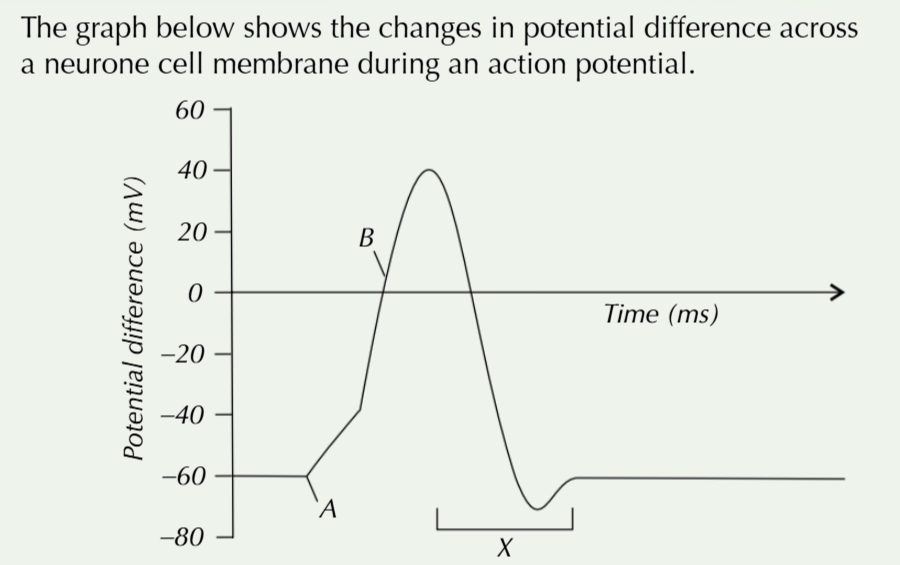
Describe the different events occurring at points A and B
A - Neurone is stimulated
B - Depolarisation/ VG Na ion channels are open, Na ions are diffusing into the neurone
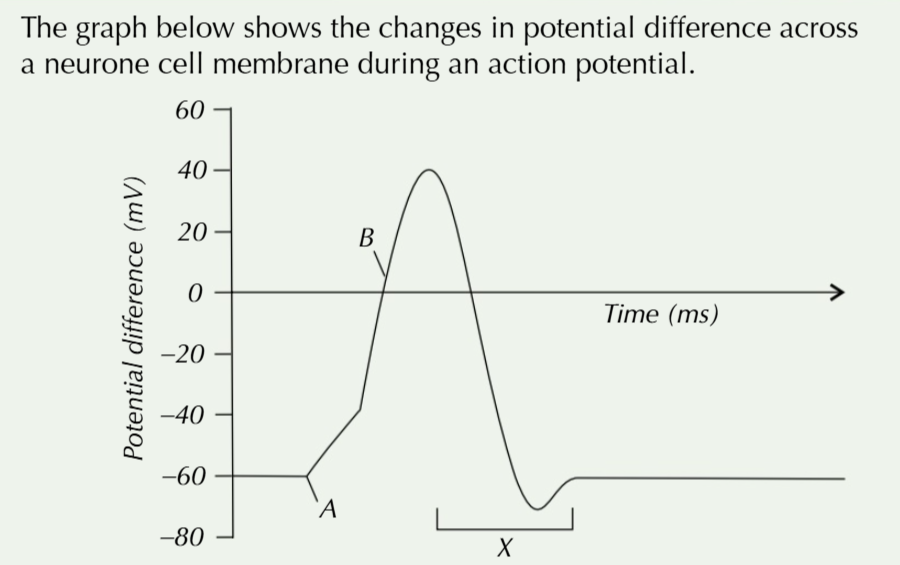
What is the threshold level for this action potential
-40mV
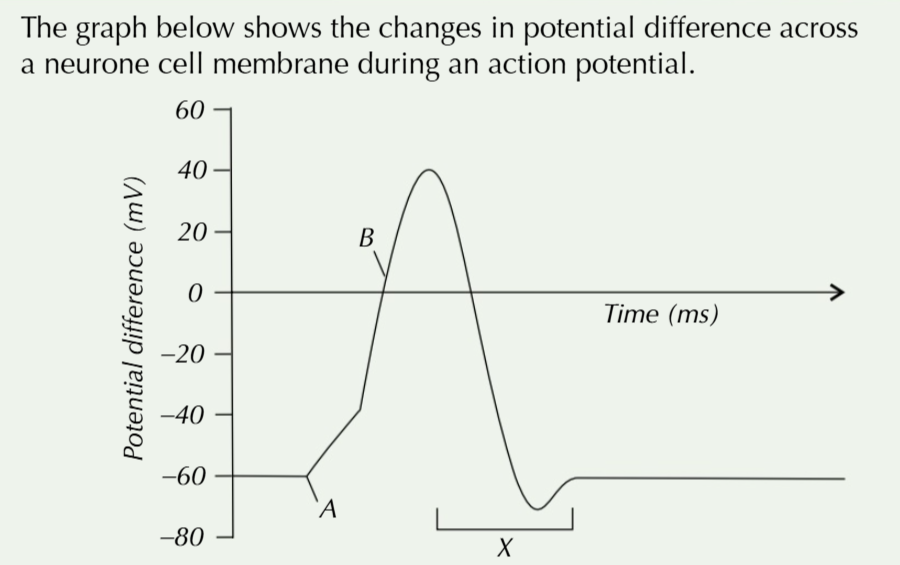
What is the resting potential of this neurone cell membrane
-60mv
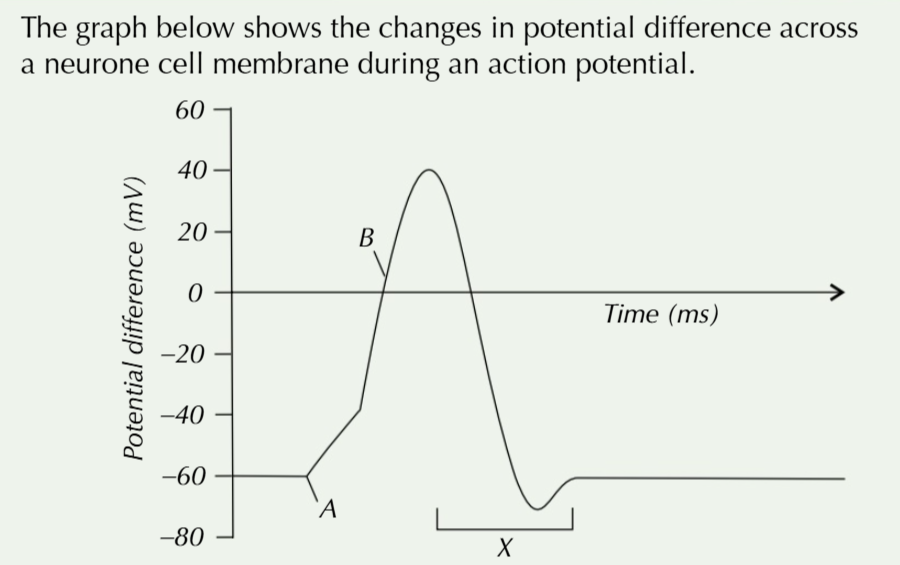
Explain the shape of the curve during the period marked X
What is the given name to the period marked X
Pd of +40mV, Na ion channels close and K ion channels open
Refractory Period
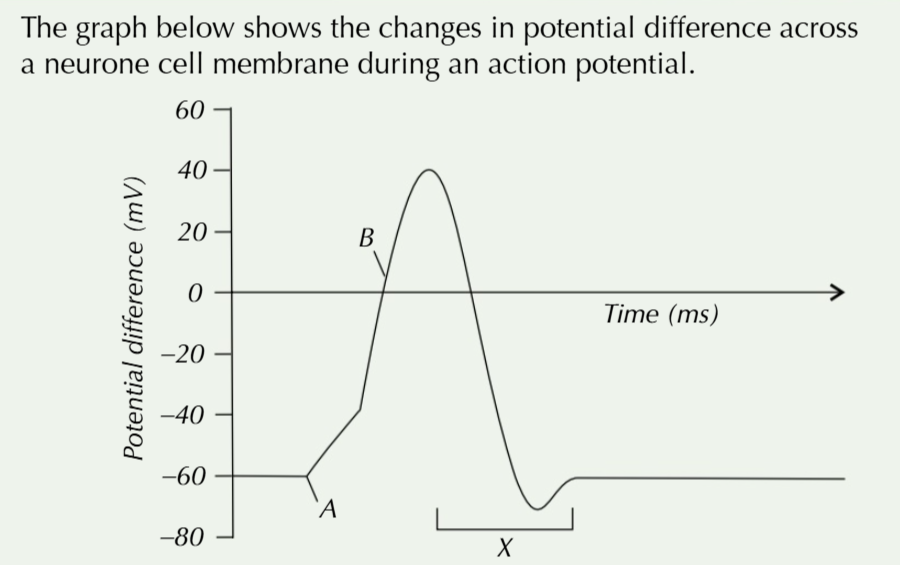
How would the graph look is a bigger stimulus triggered the action potential?
Action Potential will have the same pd values as the graph shown cuz once the threshold is reached an action potential will always fire with the same change in voltage