3.2.3 Group 7 - the halogens
 Call Kai
 Learn
Learn Practice Test
 Spaced Repetition
 Match
Match Flashcards
 Knowt Play
1/34

There's no tags or description
Looks like no tags are added yet.
Name | Mastery | Learn | Test | Matching | Spaced | Call with Kai | Chat |
|---|
No analytics yet
Send a link to your students to track their progress
35 Terms
What are the formulas, colours, physical states & electron configuration of the first 4 halogens?

What is the trend in boiling point down group 7?
Increases:
the strength of the Van der Waals forces increases as the size & relative mass of the molecules increases → this trend is shown in the changes of physical state from fluorine (gas) to iodine (solid)
What is the definition of electronegativity?
The ability for an atom to attract electrons towards itself in a covalent bond
What is the trend in electronegativity down group 7?
Decreases:
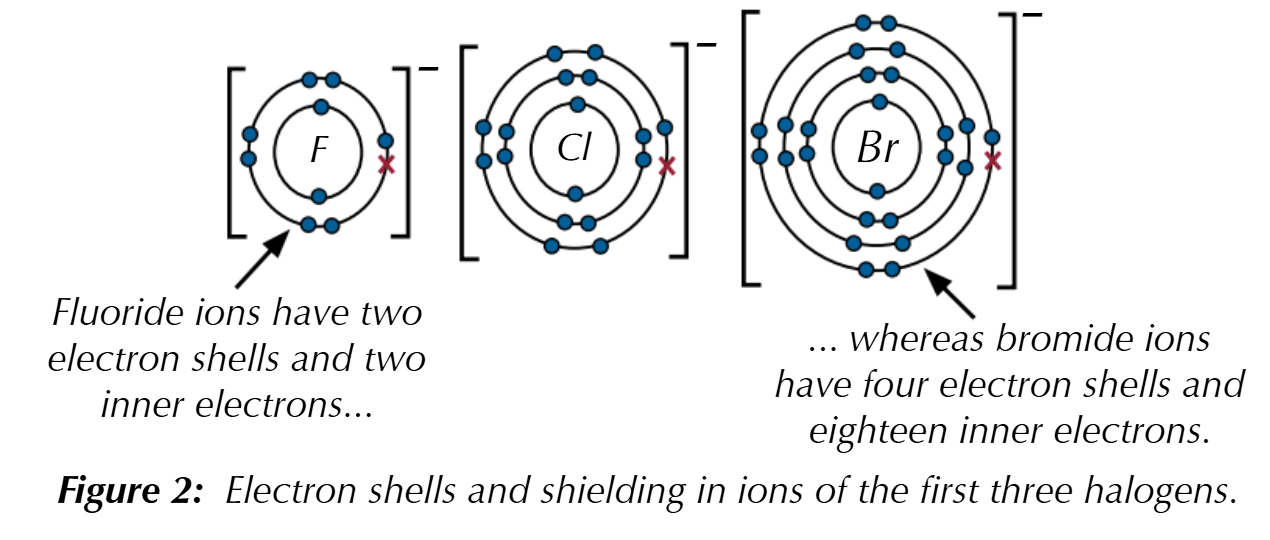
atoms gets larger, so the distance between the positive nucleus & the outer electrons increases, due to increased electron shielding
larger atoms attract electrons less than smaller ones as their outer electrons are further from the nucleus & are more shielded, as they have more inner electrons
What will a more reactive halogen do in a displacement reaction?
A more reactive halogen will displace a less reactive halide ion from its compound in solution
Are halogens more or less oxidising down group 7 & why?
Less oxidising:
when halogens react, they gain an electron (oxidising agents)
they get less reactive down the group, as the atoms become larger & the outer shells gets further from the nucleus
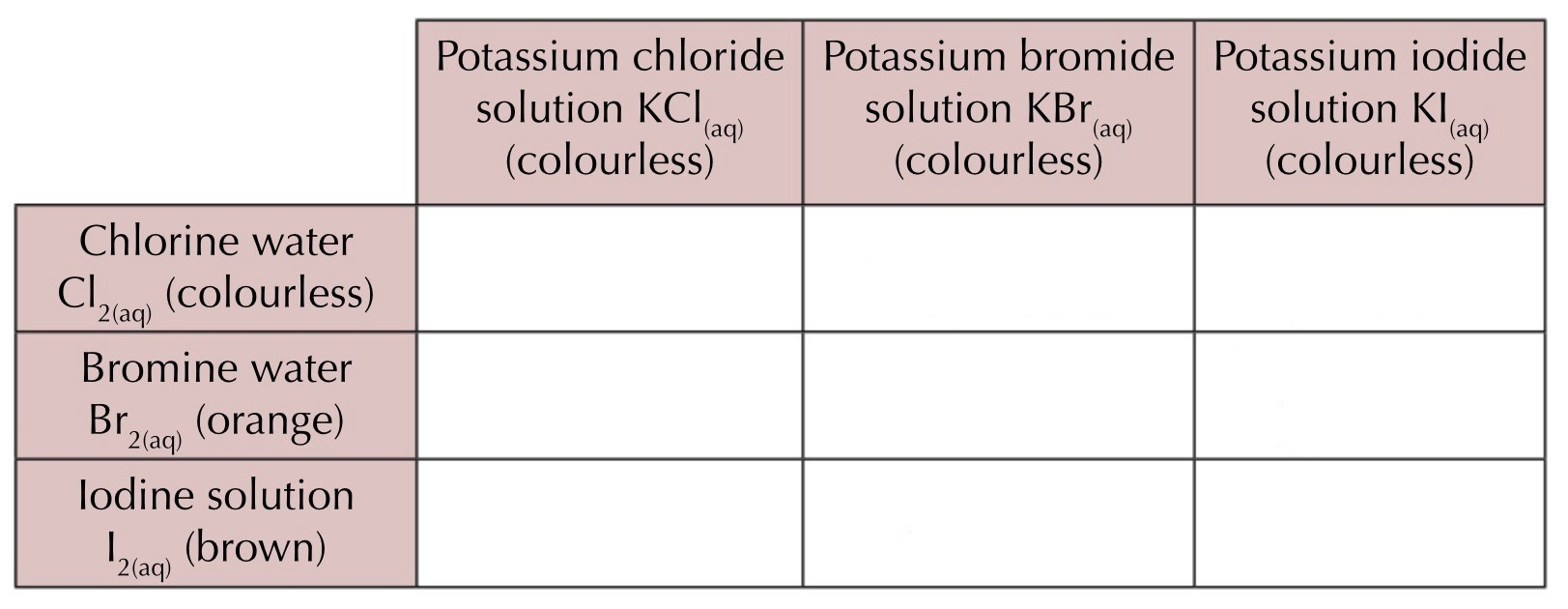
Complete this table of the displacement reactions
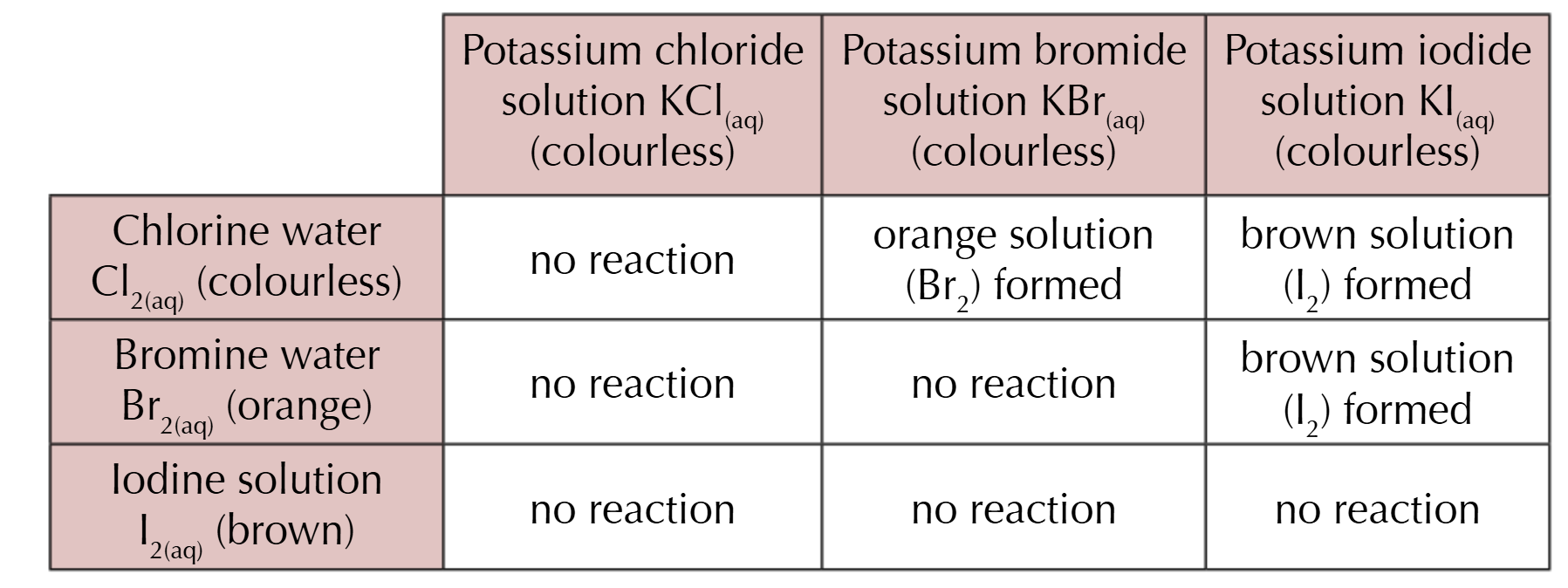
How can displacement reactions be used to help identify which halogen (or halide) is present in a solution?
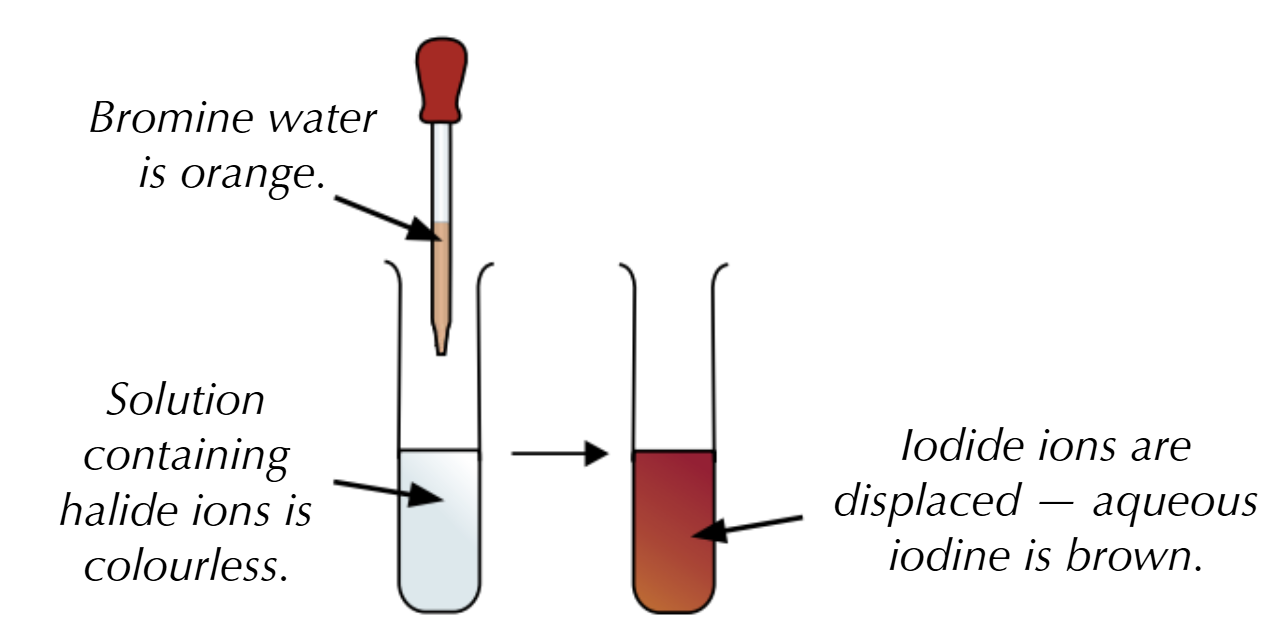
Halide ions are colourless in solution, but when the halogen is displaced it shows a distinctive colour
bromine: orange
iodine: brown
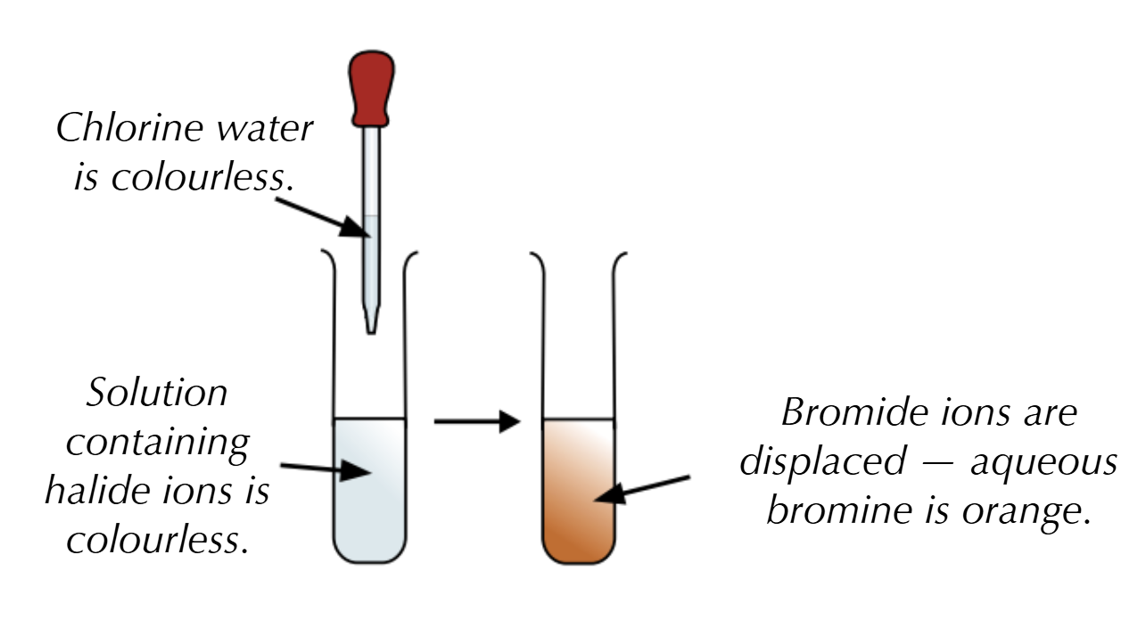
What would happen if chlorine is added to a solution containing bromide ions (e.g. potassium bromide) ?
Chlorine will displace the bromide ions, resulting in a colour change from colourless to orange:
the equation for this reaction is: Cl2 (aq) + 2KBr (aq) → 2KCl (aq) + Br2 (aq)
the ionic equation for this reaction is: Cl2 (aq) + 2Br- (aq) → 2Cl- (aq) + Br2 (aq)
What would happen if chlorine is added to a solution of potassium iodide ions?
Chlorine will displace the iodide ions, resulting in a colour change from colourless to brown:
the equation for this reaction is: Cl2 (aq) + 2KI (aq) → 2KCl (aq) + I2 (aq)
the ionic equation for this reaction is: Cl2 (aq) + 2I- (aq) → 2Cl- (aq) + I2 (aq)
What would happen if bromine is added to a solution of potassium iodide?
Bromine will displace the iodide ions, resulting in a colour change from colourless to brown:
the equation for the reaction is: Br2 (aq) + 2KI (aq) → 2KBr (aq) + I2 (aq)
the ionic reaction for the equation is: Br2 (aq) + 2I- (aq) → 2Br- (aq) + I2 (aq)
Why is there no reaction if bromine water is added to a solution of chloride ions?
Chlorine is above bromine in group 7, so is more reactive & can’t be displaced
Why won’t iodine displace neither chlorine nor bromine?
Iodine is below chlorine & bromine in group 7, so it’s less reactive than them & won’t displace either halide
How is bleach made & what is the equation for the reaction?
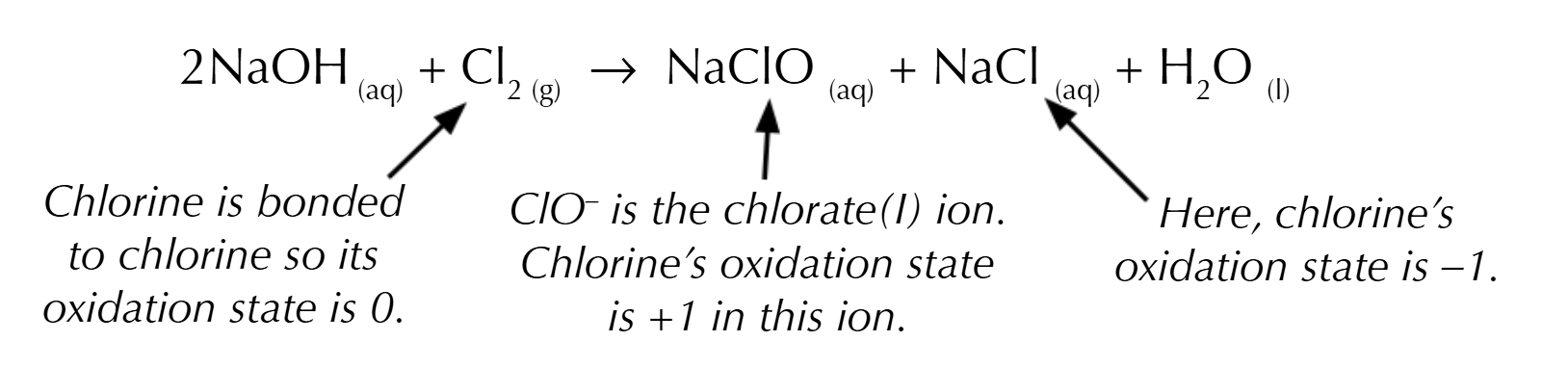
Mix chlorine gas with cold, dilute NaOH solution at room temperature to form sodium chlorate(I) solution (NaClO):
2NaOH(aq) + Cl2(g) → NaClO(aq) + NaCl(aq) + H2O(l)
chlorine is both oxidised & reduced (0 to +1 & -1), so this is a disproportionation reaction
What are some uses of sodium chlorate(I) solution (bleach) ?
Water treatment
Bleaching paper & fabrics
Cleaning agents
What is the equation for the reaction of chlorine with water?
Cl2 + H2O ⇌ HCl + HClO
How is water treated in the UK?
Chlorate(I) ions kill bacteria, so adding chlorine or a compound containing chlorate(I) ions is added to water to kill to make it safe to drink or swim in:
chlorine kills disease-causing microorganisms & some chlorine persists in the water, preventing reinfection further down the supply
it also prevents the growth of algae, removing bad tastes & smells, as well as removing discolouration caused by organic compounds
What are the risks from using chlorine to treat water?
Accidents involving chlorine can be really serious, even fatal:
chlorine gas is very harmful if it’s breathed in → it irritates the respiratory system
liquid chlorine on the skin or eyes causes severe chemical burns
water contains a variety of organic compounds & chlorine reacts with these to form chlorinated hydrocarbons (e.g. chloromethane) → many of these chlorinated hydrocarbons are carcinogenic
Why do the benefits of chlorinating drinking water outweigh its toxic effects?
The risk of not chlorinating water could lead to a cholera epidemic, which could kill thousands of people
Why are halide ions reducing agents?
They lose an electron in reactions, becoming oxidised themselves & reduce something else
how easy it is for a halide ion to lose an electron depends on the attraction between the nucleus & the outer electrons
What is the trend in the reducing ability down group 7?
Increases:
as you go down group 7, the attraction gets weaker as the ions get bigger, so the electrons are further away from the positive nucleus
there are extra inner electron shells too, so there’s a greater shielding effect
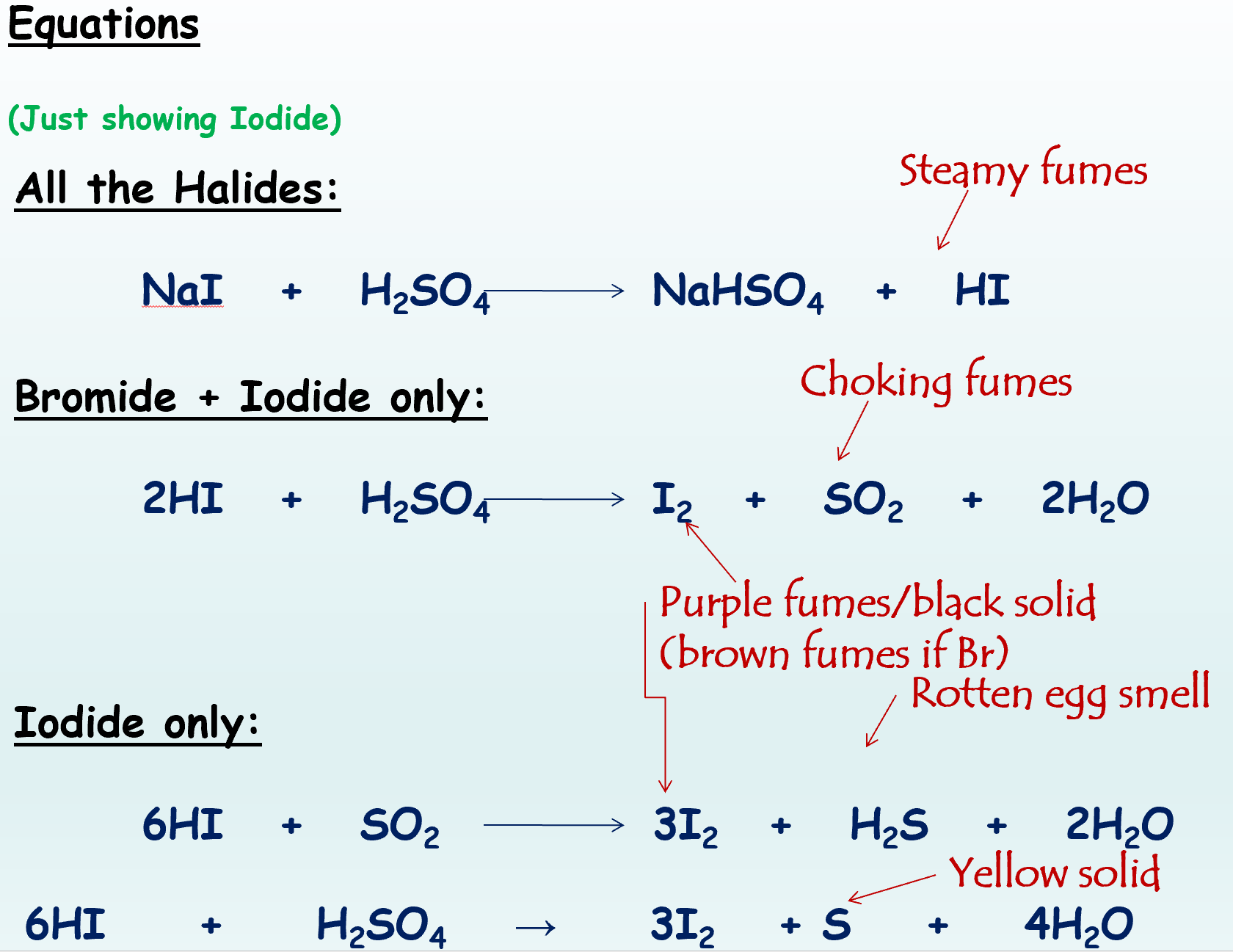
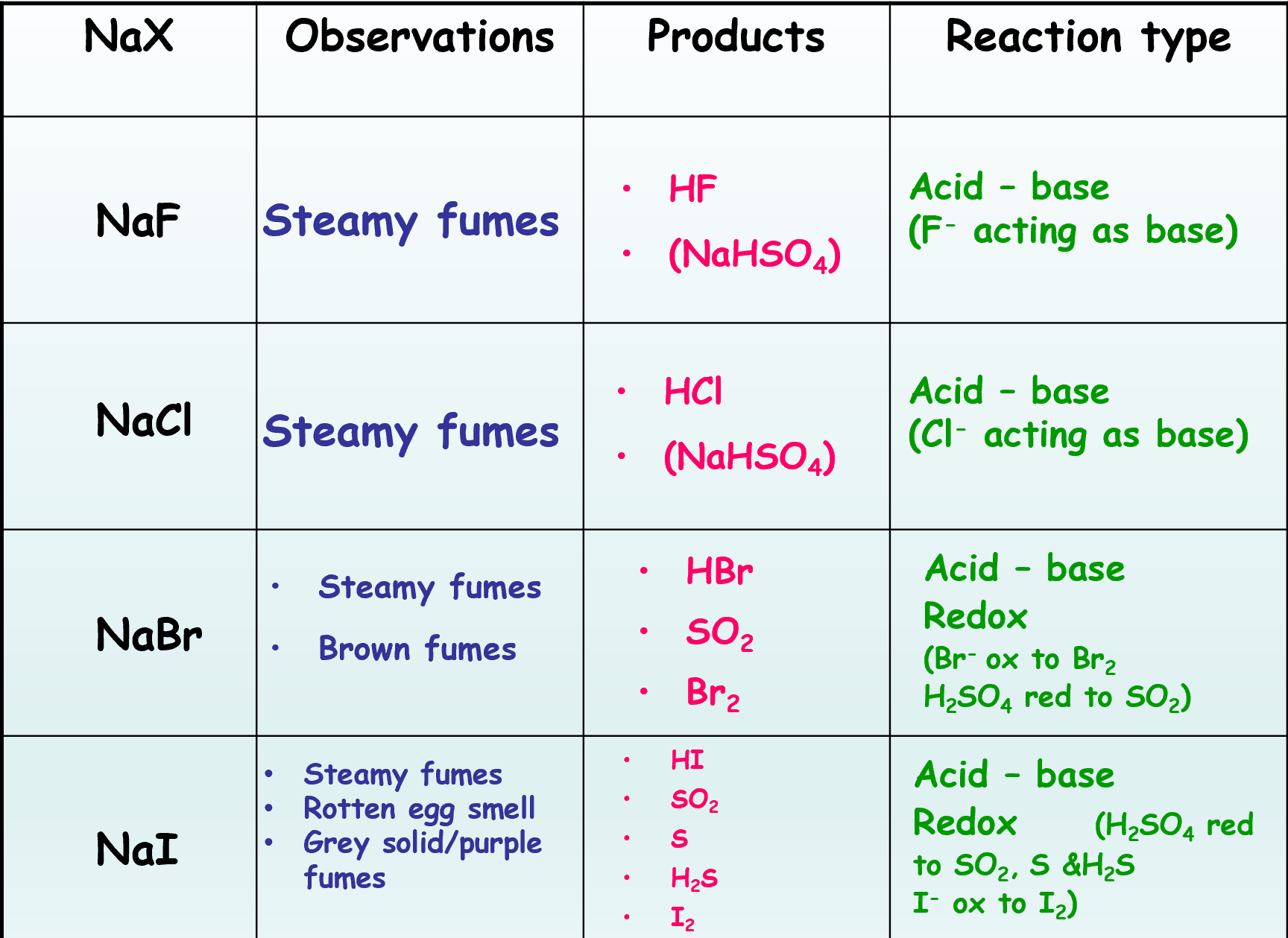
What are the equations to show how:
all the halides react with concentrated H2SO4
how only bromide & iodide react with concentrated H2SO4
how only iodide reacts (as it’s a strong enough reducing agent)
Complete this table
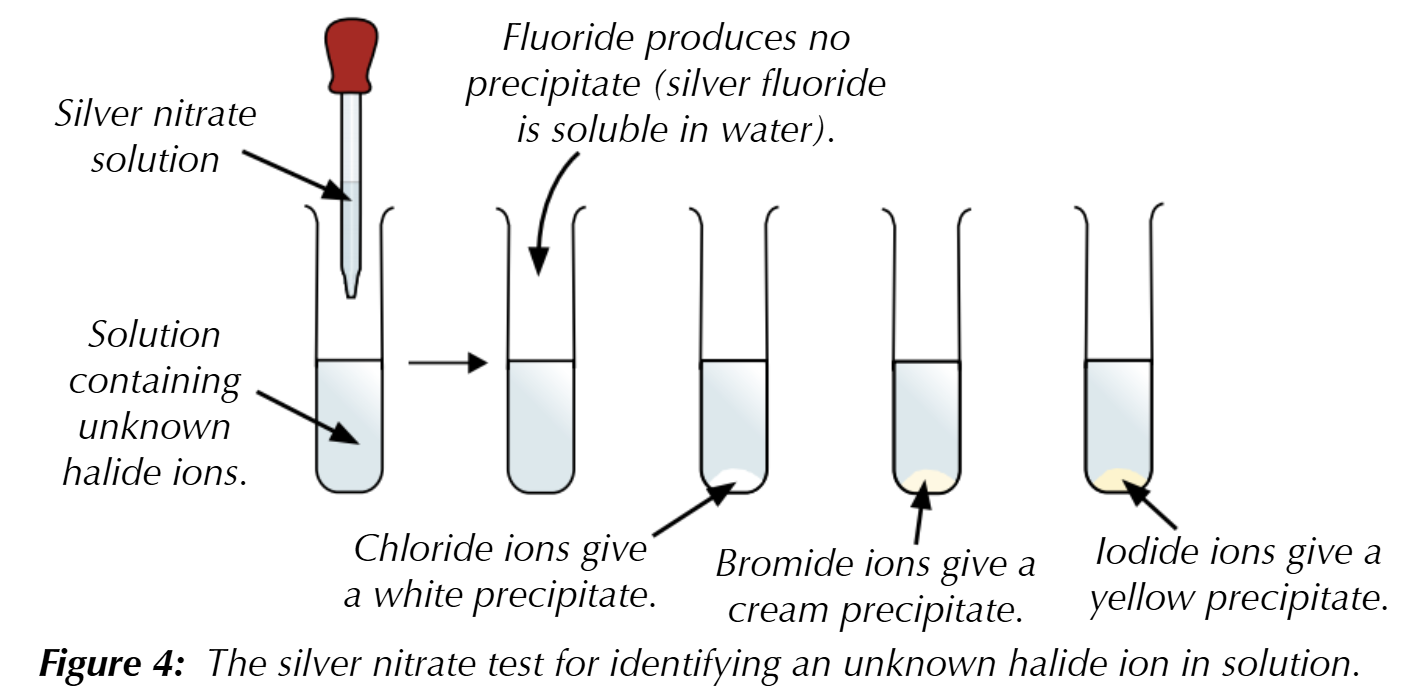
What is the method to test for halide ions?
Add a small spatula of the halide salt to a test tube
Dissolve the salt in dilute nitric acid (HNO3)
Add a few drops of acidified silver nitrate (AgNO3) to make a silver halide
Record any colour/precipitate
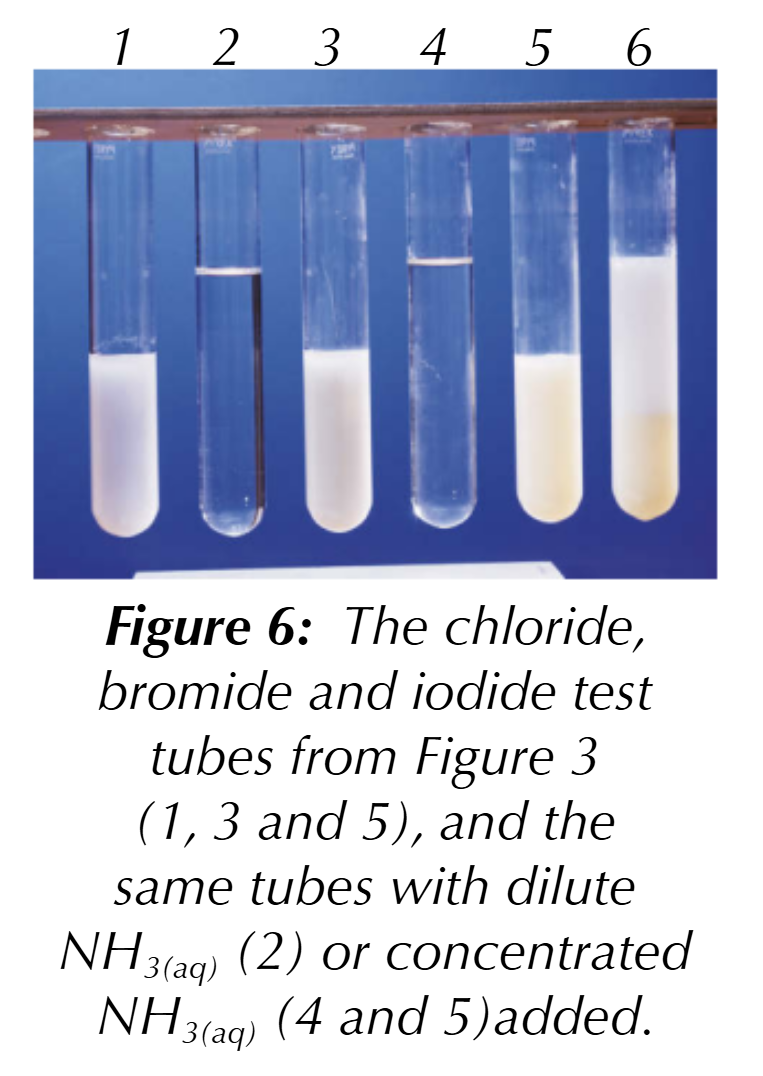
Add some dilute ammonia & record any changes
Add a few drops of concentrated ammonia & record any changes
Why is nitric acid added when testing for halide ions?
Nitric acid reacts with any anions other than halides (e.g. carbonates) which could give a false positive result otherwise
What are the observations in the tests for halide ions & what are the equations?
Fluoride ions:
soluble, so does not form a precipitate
Chloride ions:
white precipitate forms (silver chloride)
Ag+(aq) + Cl-(aq) → AgCl(s)
Bromide ions:
cream precipitate forms (silver bromide)
Ag+(aq) + Br-(aq) → AgBr(s)
Iodide ions:
yellow precipitate forms (silver iodide)
Ag+(aq) + I-(aq) → AgI(s)

What are the results of the silver halide precipitates when ammonia solution is added?
Chloride Cl- → precipitate dissolves in both dilute & concentrated NH3 (most soluble)
Bromide Br- → precipitate only dissolves in concentrated NH3
Iodide I- → precipitate is insoluble in concentrated NH3 (least soluble)
How are group 2 ions in a compound identified & what are the flame colours of Ca, Sr & Ba?
Flame test:
Dip a nichrome wire loop in concentrated HCl to clean it
Dip the wire loop into the unknown compound
Hold the loop in the clear blue part of a Bunsen burner flame & observe the colour change in the flame
Flame colours:
Calcium, Ca2+ → brick red
Strontium, Sr2+ → red
Barium, Ba2+ → pale green

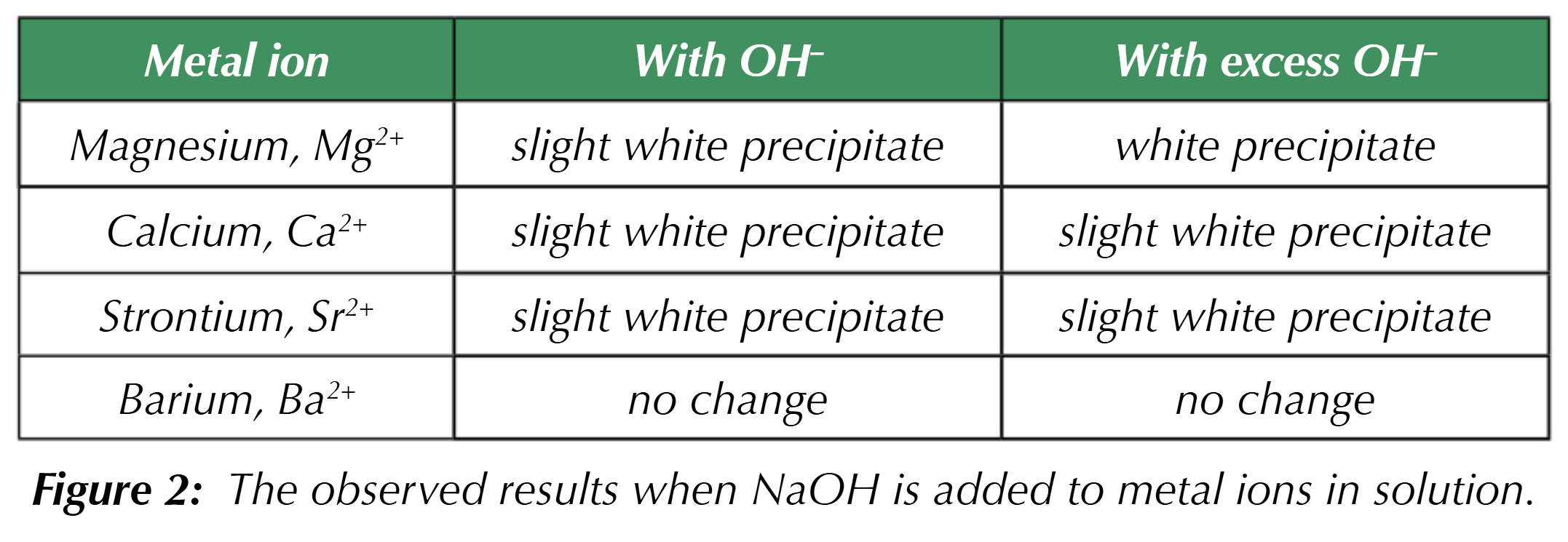
How can dilute NaOH solution be used to identify group 2 ions?
Add NaOH dropwise to a test tube containing the metal ion solution & observe the precipitate that forms (if there is one)
Keep adding the NaOH until it is in excess & record any changes that are observed
(all start off as colourless solutions)
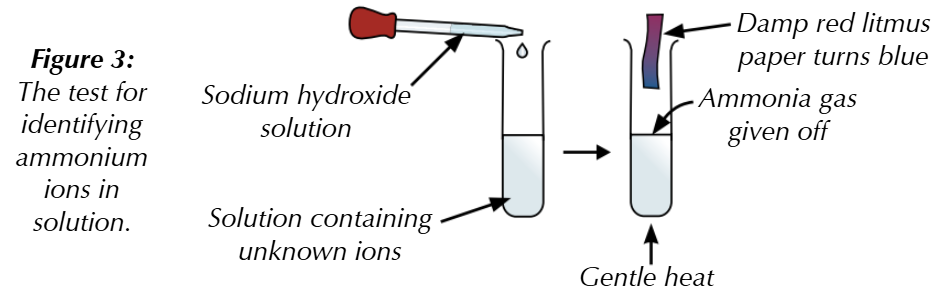
What is the method to test for ammonium ions (NH4+)?
Ammonium ions can be tested for either in a solid or in solution by adding NaOH solution & warming gently
If the compound contains ammonium ions, ammonia gas will be produced which can be tested with damp red litmus paper which turns blue
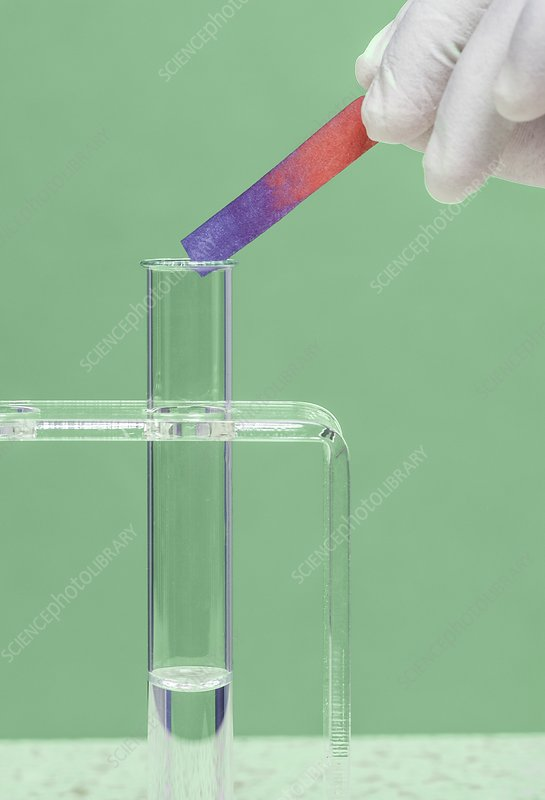
What is the method to test for hydroxide ions (OH-) ?
Hydroxide ions make solutions alkaline:
use a pH indicator to test the unknown solution
if a piece of red litmus paper is dipped into the solution & hydroxide ions are present, the paper will turn blue
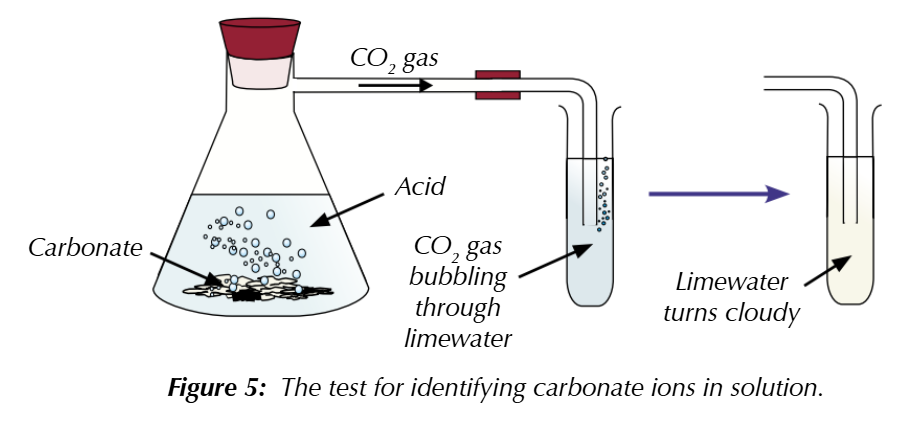
What is the method to test for carbonate ions (CO32-) ?
Add dilute HCl acid to the unknown solution & if carbonate ions are present, the solution will fizz (effervescence)
The carbonate ions react with the hydrogen ions in the acid to make carbon dioxide
CO32- (aq) + 2H+ (aq) → CO2 (g) + H2O (l)
Carbon dioxide can be tested using limewater → bubble the gas through a test tube of limewater & if the limewater goes cloudy, the solution contains carbonate ions
What is the method to test for sulfate ions (SO42-) ?
Add a little dilute HCl to remove any carbonates which could precipitate out after adding barium chloride, giving a false positive result
Add barium chloride solution, BaCl2 (aq)
If a white precipitate of barium sulfate forms, the original compound contained a sulfate: Ba2+(aq) + SO42-(aq) → BaSO4(s)
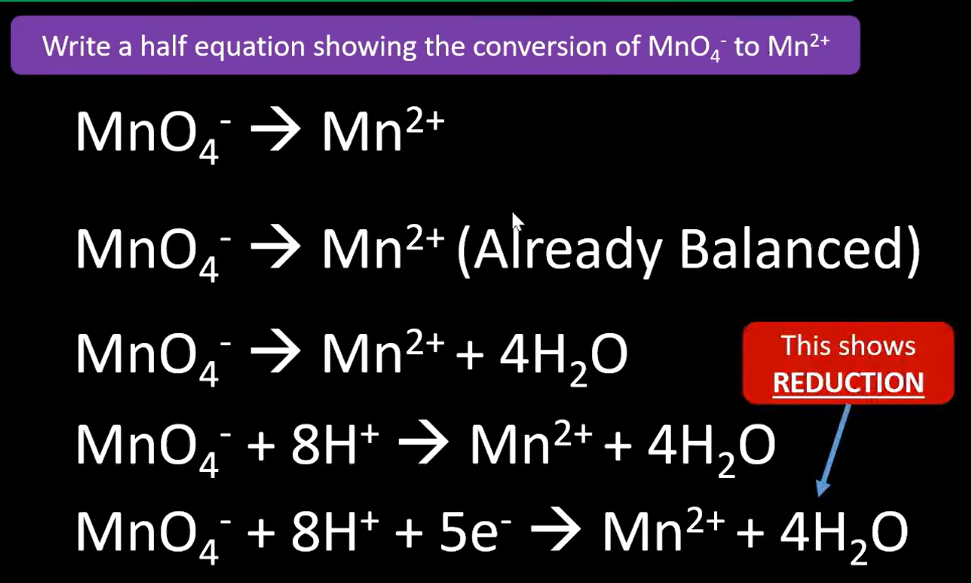
How do you balance half-equations?
Write the species before & after a reaction
Balance any atoms apart from oxygen & hydrogen
Balance any oxygens with H2O
Balance any hydrogens with H+ ions
Balance charges with electrons (e-)
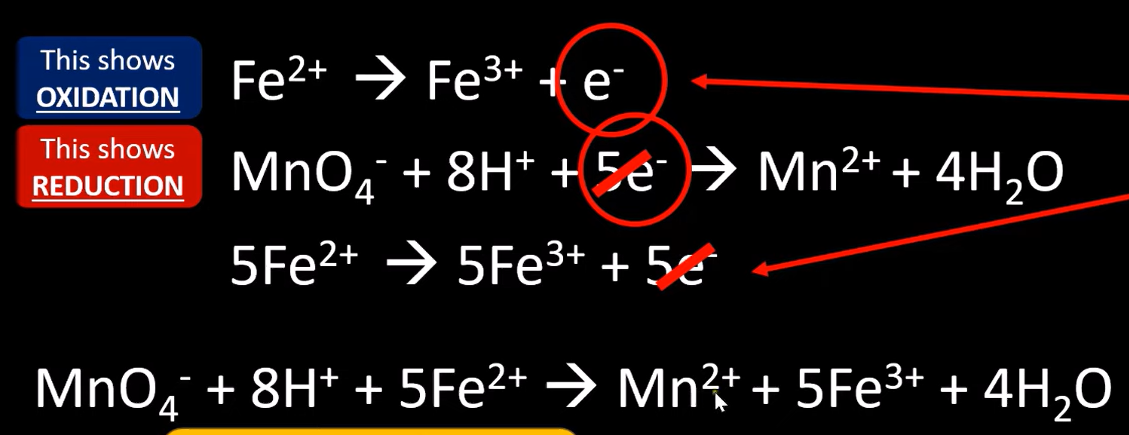
How do you combine half-equations to make a full ionic equation?
Balance the electrons by finding lowest common multiple
Times everything in both equations by that number
Cancel out the electrons & combine the two equations