Microbiology - Ch. 10 Classification of Microorganisms - flashcards
 Call Kai
 Learn
Learn Practice Test
 Spaced Repetition
 Match
Match Flashcards
 Knowt Play
1/51

There's no tags or description
Looks like no tags are added yet.
Name | Mastery | Learn | Test | Matching | Spaced | Call with Kai | Chat |
|---|
No analytics yet
Send a link to your students to track their progress
52 Terms
Why do we need to classify microorganisms?
Helps with quick identification — being able to name the living thing
What is identification of microbes useful for?
Diagnosis = Name of DZ.
Treatment — has to be specific.
Prevention — in the form of education, vaccines.
How is classification of microorganisms accomplished?
Through taxonomy
What is taxonomy?
The science of classification
What is a taxonomist?
A scientist who studies classification
What is a taxon/taxa?
Taxon = singular, taxa = plural
A class, group, or category of something being classified — an individual unit of something
They get organized/ranked by some order (ex: ranked from large groups to small groups)
What is phylogeny?
Evolutionary relationship/history between organisms in a group — shown via evolutionary trees, compares similarities/differences (e.g., humans vs. apes).
What is the taxonomic hierarchy used for?
Naming, classifying, and identifying living things (taxonomy)
How many taxa are in the taxonomic hierarchy and how are they arranged?
8 taxa, ranked in some order for the purpose of classifying/identifying living things (broadest to most specific).
What are the 8 levels of the taxonomic hierarchy in order (largest to smallest)?
Domain → Kingdom → Phylum → Class → Order → Family → Genus → Species
Dear Kids Prefer Chocolate Over Fresh Green Salad
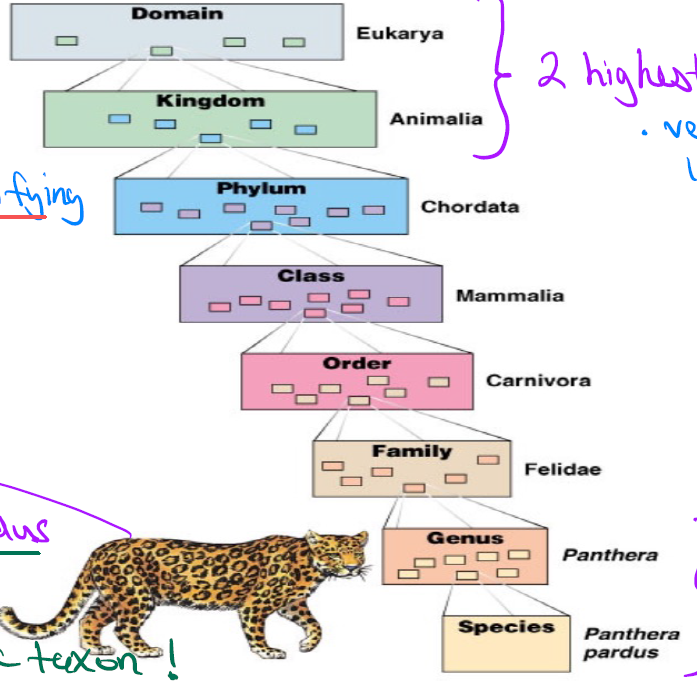
What are the 2 highest taxa and what makes them unique? = (most inclusive or least specific).
Domain & Kingdom
Very broad, large groups/categories
What are the 2 lowest taxa and what makes them unique?
= (least inclusive or most specific)
Genus & Species
Very specific, small groups
What is the scientific name of a leopard and what does each part represent?
Panthera pardus
Panthera = Genus (first letter capitalized)
pardus = Species (no capitalization)
What is binomial nomenclature?
A two-part naming system used to identify living things
Consists of Genus name + species name (spell out both in full)
What are examples of binomial nomenclature?
Escherichia coli, Helicobacter pylori = bacteria (E. Coli)
Penicillium chrysogenum = fungus (mold)
Homo sapiens = humans
What is the Three Domain System?
A type of biological classification system developed in 1990; Domain is the highest taxon
What are the three Domains of living organisms?
Domain Archaea
Domain Bacteria
Domain Eukarya
What are domains based on?
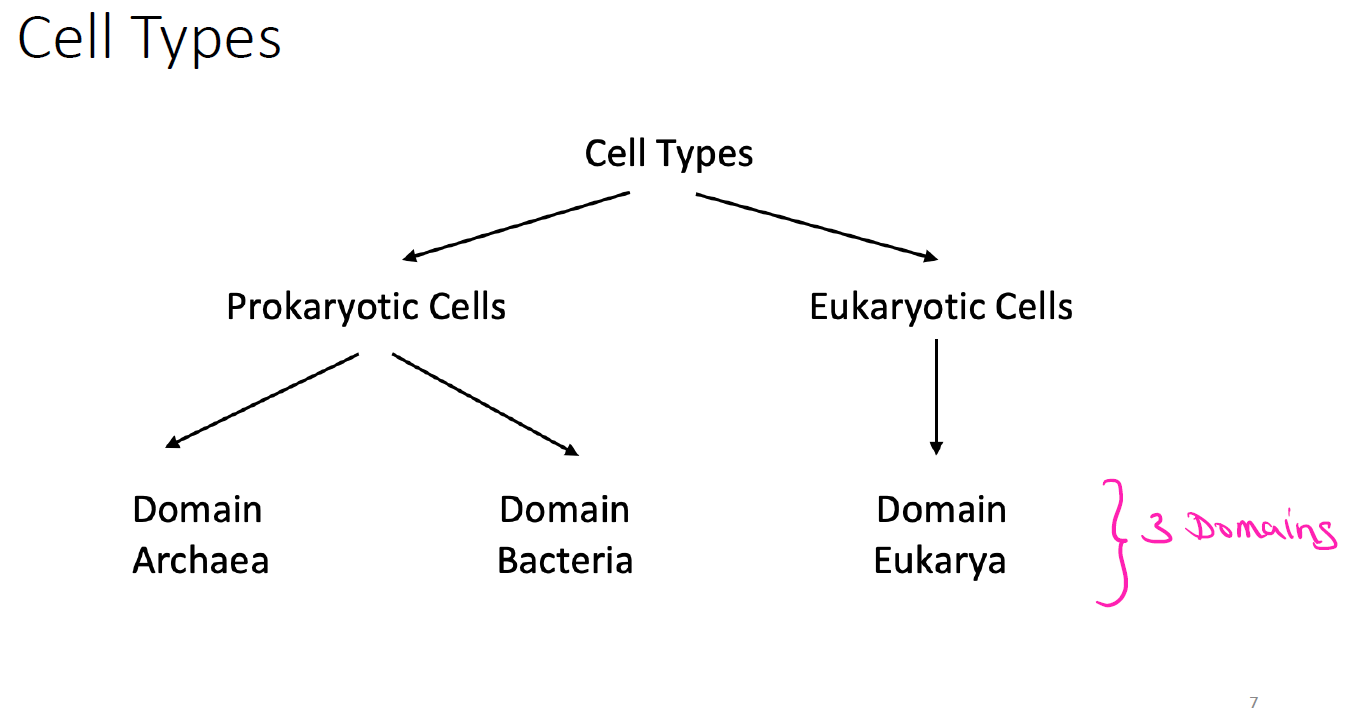
Cell type — prokaryote vs eukaryote
All cellular life exists as either prokaryotic or eukaryotic cells
Prokaryotes → placed into 2 different Domains
Eukaryotes → placed into 1 Domain
Cell types (visual tree map)
What is the origin of all prokaryotic and eukaryotic cells?
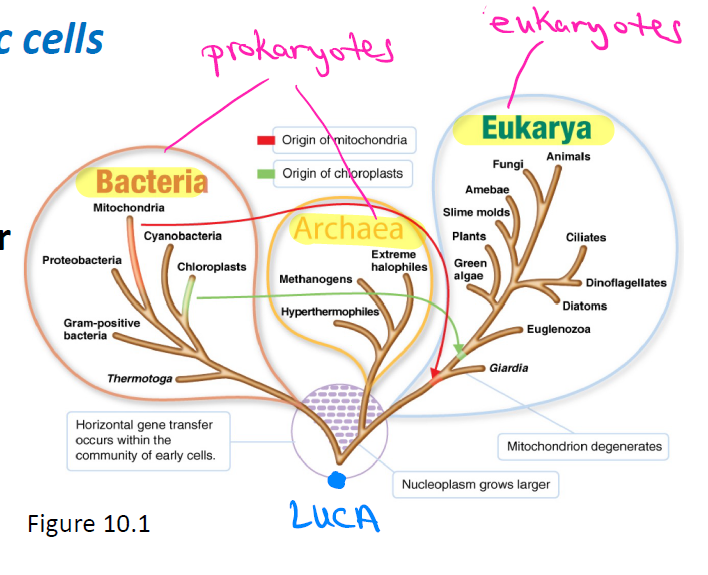
All cells came from a common ancestor called the Last Universal Common Ancestor (LUCA)
LUCAs eventually evolved into 3 different cell groups = the 3 Domains (Bacteria, Archaea, Eukarya)
What kingdoms do the 3 Domains contain?
Domain Archaea & Domain Bacteria → contain all members of Kingdom Monera
—
Domain Eukarya → contains the other 4 Kingdoms:
1. Kingdom Protista
2. Kingdom Fungi
3. Kingdom Plantae
4. Kingdom Animalia
—
Monera — no nucleus (bacteria)
Protista — single-celled, has nucleus, "leftover" category
Fungi — decomposers (mushrooms)
Plantae — makes own food (sunlight)
Animalia — eats others, moves
How do you distinguish between Domain Archaea and Domain Bacteria?
Cell wall differences
Habitat differences
What do Domain Archaea and Domain Bacteria have in common?
All members are prokaryotic cells
All members belong to Kingdom Monera
Compare Domain Archaea vs Domain Bacteria — cell walls & habitat
Archaea | Bacteria | |
|---|---|---|
Cell wall | No peptidoglycan | Yes, peptidoglycan (gives structure & rigidity) |
Habitat | "Extreme" habitats | "Normal" habitats |
Type | Thermophile, halophile, methanogens. |
What are examples of Domain Archaea organisms?
Thermophiles
(hot loving microbes) hot springs & volcanoes.
Halophiles
(Salt loving microbes) in ocean, on skin.
Methanogens
(Produce & tolerate methane gas)
What is another name for Kingdom Monera?
Kingdom Prokaryotae or Kingdom Bacteria
What are the characteristics of Kingdom Monera?
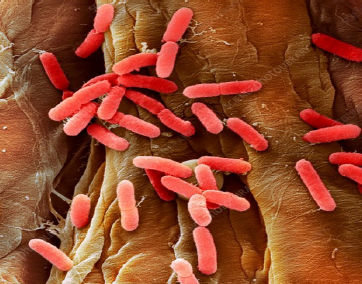
Prokaryotes
Unicellular
Example: Bacterium (E. coli)
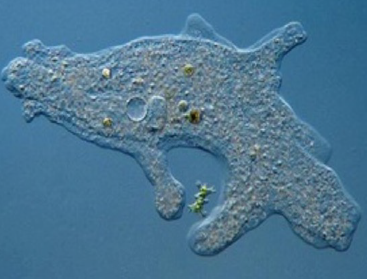
What are the characteristics of Kingdom Protista?
Simplest eukaryotes.
Mostly unicellular, some multicellular.
Example: Amoeba (Amoeba proteus).
Algae.
What are the characteristics of Kingdom Fungi?
Eukaryotes
Some unicellular, others multicellular
Examples: Yeast & Mold

Compare Yeast vs Mold
Yeast | Mold (M for multicellular) | |
|---|---|---|
# of cells | Unicellular | Multicellular |
Temp requirement | Warm/hot | Cold |
Example | Saccharomyces cerevisiae | Penicillium chrysogenum |
What are the characteristics of Kingdom Plantae?
Eukaryotes
Multicellular, has cell wall, autotroph “self feeders”
Example: Plant (Sequoiadendron giganteum - Giant Redwood)

What are the characteristics of Kingdom Animalia?
Eukaryote
Multicellular, complex, heterotroph (rely on other organisms as food source)
Examples:
Large round worm (Ascaris lumbricoides)
Common house fly (Musca domestica)
Compare Autotrophs vs Heterotrophs
Autotrophs | Heterotrophs | |
|---|---|---|
Produce own food? | Yes | No |
Definition | Produce their own food (self feeders) | Rely on consuming other organisms |
Types | Photoautotrophs, Chemoautotrophs | Photoheterotrophs, Chemoheterotrophs |
Examples | Plants, Algae (Plantae, Protista) | Herbivores, Carnivores, Omnivores (Animalia) |
What is the difference between "photo—" and "chemo—" energy sources?
Photo = energy from sunlight used to make food
Chemo = energy from chemicals used to digest food
What 3 kingdoms can photosynthesize?
Kingdom Plantae = plants.
Kingdom Protista = algae.
Kingdom Monera = cyanboacteria.
What is a species and what are the two types?
Lowest taxon; species name always spelled with lowercase letter
Divided into:
Prokaryotic species (bacterial species)
Eukaryotic species (non-bacterial species)
What is a eukaryotic species?
A group of organisms that differ from each other but are closely related genetically
Several related species form a Genus (Genus → Species #1, #2, #3, etc.)
Ex: Homo neanderthalensis, Homo erectus, Homo sapiens
Is subspecies a taxon Y/N?
No — subspecies is NOT a taxon
What is a prokaryotic species?
Prokaryotic species = Bacterial species
A population of bacterial cells with similar characteristics
Ex: Streptococcus pneumoniae & Streptococcus pyogenes (both in genus Streptococcus)
What are clones in microbiology?
Prokaryotic/Bacteria:
A population of bacterial cells derived from a single parent cell
All are genetically identical
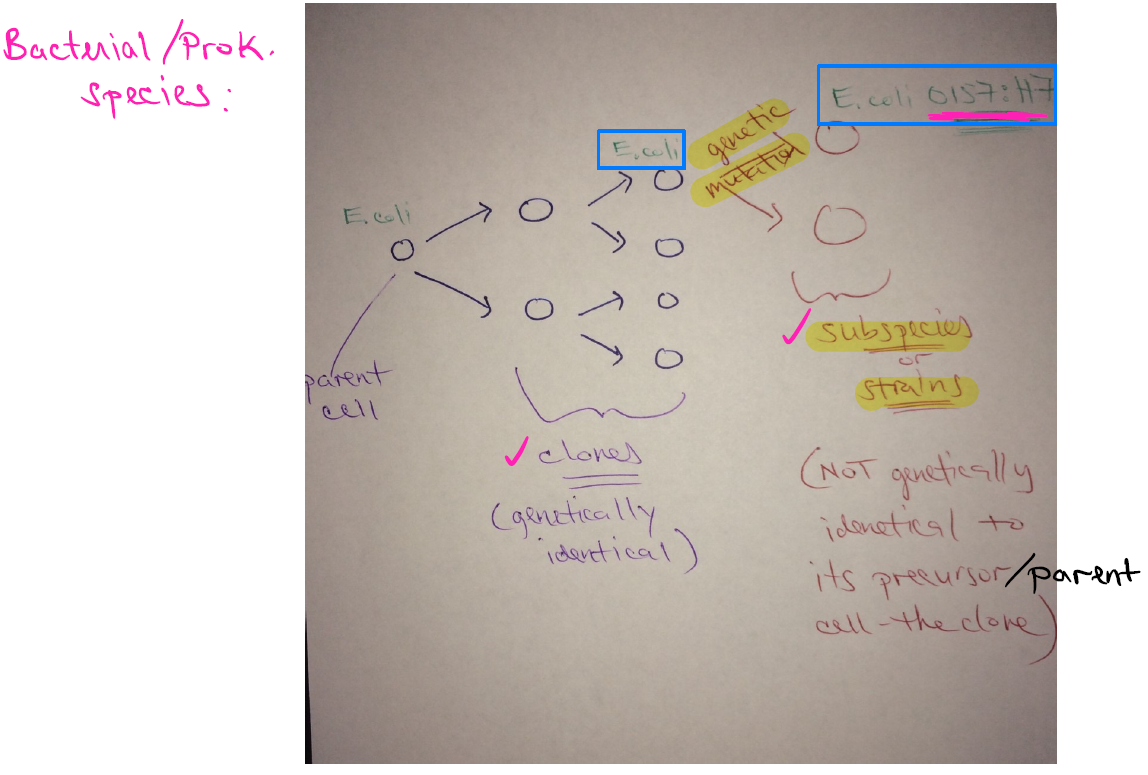
What is a subspecies/strain/serovar?
Members of a clone that are NO longer genetically identical
Clones that genetically diverged over time through genetic mutations (DNA CHANGE)
Gene = DNA.
Mutation = Change.
==
Identified by numbers/letters that follow the species name
Ex: E. coli O157:H7, Influenza A virus H1N5
Why are viruses not classified under any Domain or Kingdom?
Are viruses living things? Yes or no?
Viruses are acellular (not cellular) — NOT prokaryotic or eukaryotic
Do NOT have cell membrane or cytoplasm
Therefore → no Domain, no Kingdom
No, viruses are not living things.
What does it mean that viruses are obligate intracellular parasites?
They MUST invade a host cell in order to multiply
Viruses do not reproduce.
How are viruses classified?
By Family, Genus, and Species
Family = highest taxon for viruses; family name ends in "-viridae"
Ex: Retroviridae ("Retrovirus family"), Herpesviridae
Can also have viral subspecies/strains identified by letters & numbers
Example: Influenza A virus → H1N1 (Swine Flu), H1N5 (Avian Flu)
What are the 6 methods of classifying & identifying microbes?
Morphological Characteristics
Differential Staining
Biochemical Tests
Serology
PCR
Textbooks/Manuals (Bergey's Manual)
What is the morphological characteristics method of identifying microbes?
Look at shape, arrangement & size of bacteria (structural)
Bacteria can exist as single, pairs, or groups
What is differential staining and what is an example?
Using dyes to identify microbes
Ex: Gram staining of bacterial cell wall
Differentiates Gram-positive vs Gram-negative bacteria
Based on cell wall differences — specifically the amount of peptidoglycan present (varies between bacteria)
What are biochemical/physiological tests for identifying microbes?
Using yes/no questions to determine metabolic characteristics of bacteria
Ex: "Can this bacterium break down glucose?"
Yes → E. coli
No → H. pylori & S. pneumoniae
What is serology and how is it used to classify microbes?
Serology = study of blood serum (clear part of blood)
Serological testing differentiates among strains within a species by analyzing the DNA sequence of the microorganism
Ex: pathogenic E. coli (O157:H7) vs non-pathogenic E. coli (normal microbiota type)
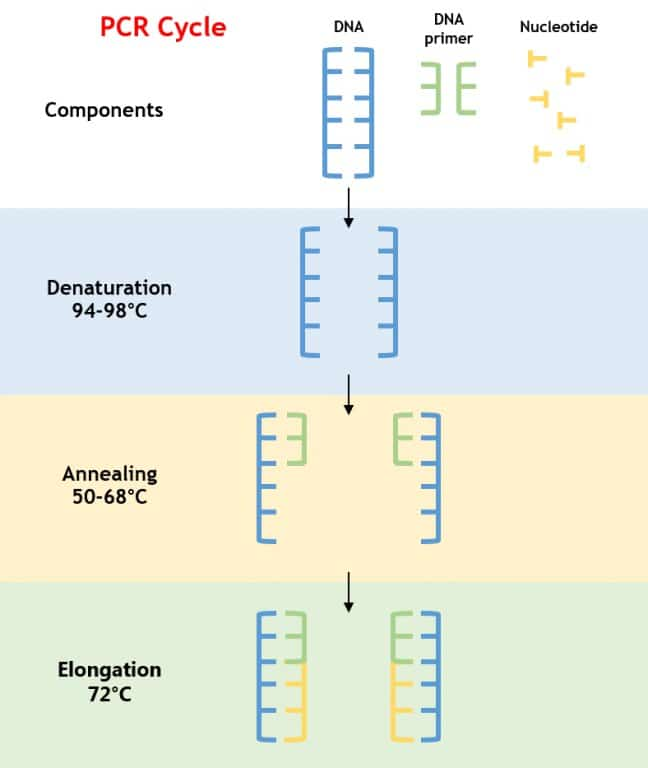
What is PCR (Polymerase Chain Reaction)?
PCR (Polymerase Chain Reaction) = DNA amplification
Method used to make many copies of (amplify) a specific DNA segment from a single copy of a DNA sequence
1 DNA → 2 DNAs → 4 DNAs (exponential copying)
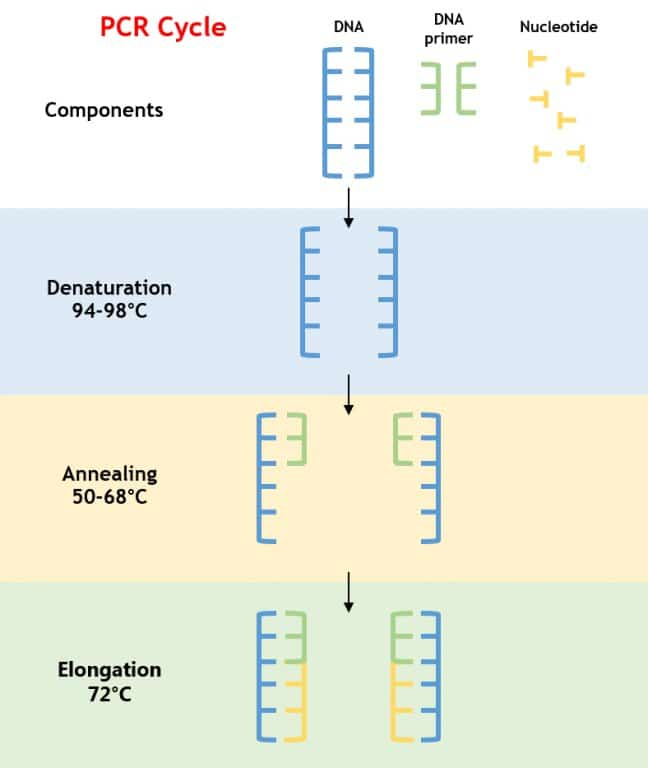
What are the 3 steps of PCR?
(prof said not to worry about the 3 steps but know what PCR is)
Denaturation — at 94-96°C
Annealing — at ~68°C
Elongation — at ~72°C
What is Bergey's Manual of Determinative Bacteriology?
A textbook ("Bible of Bacteria")
Provides systematic schemes for identifying unknown bacteria