Sociology Exam 1
 Call Kai
 Learn
Learn Practice Test
 Spaced Repetition
 Match
Match Flashcards
 Knowt Play
1/179

There's no tags or description
Looks like no tags are added yet.
Name | Mastery | Learn | Test | Matching | Spaced | Call with Kai | Chat |
|---|
No analytics yet
Send a link to your students to track their progress
180 Terms
Empirical inquiry
a form of investigation that involves looking to the world for evidence
research questions
queries about the world that can be answered empirically
Research Methods
approaches that social scientists use for investigating the answers to questions
Qualitative Research
tools of sociological inquiry that involve careful consideration and discussion of the meaning of nonnumerical data
Quantitative Research
tools of sociological inquiry that involve examining numerical data with mathematics
human subjects research
research involving data collected from people
research ethics
the set of moral principles that guide empirical inquiry
informed consent
a clear understanding on behalf of a research subject of what their participation in a research study entails
confidentiality
a guarantee that a research subject's participation in and contributions to a research study will be known only to the researchers
Vulnerable Populations
groups that are at a relatively high risk of being harmed if they are included as research subjects
institutional review boards
panels of professionals at colleges that evaluate research proposals to ensure they comply with the moral principles outlined in codes of ethics
professional ethics
a set of moral principles that guide sociologists' everyday activities
correlations- spurious vs causal
Spurious is a statistical relationship between two variables that appears because both correlate with a third variable; causal is the opposite.
Why mixed methods?
Sociologists use a wide range of methods because no one method can answer every type of research question. Each method has its advantages and its limitations.
triangulate
The strategy of seeking an answer to a question from multiple angles
Example of a study using multiple methods to "triangulate"
A research study on how hooking up had become common among college students. First, ethnography was used when 72 students immersed themselves in a college party to gather observations of hooking up. Then, 2 sociologists used in-depth interviews to ask 87 students about hooking up. Lastly, sociologists used surveys of 20,000 students and asked questions about hooking up and well-being.
Academic literature
the empirical and theoretical writing that scholars have previously produced
Peer Review
a step in the publication process in which editors solicit feedback on a scholar's work from other researchers with related expertise
Personal Troubles vs Social Issues
personal troubles are private problems that connect to social issues which are issues that negatively impact a large population.
Give examples of how personal troubles and social issues are connected in your own life.
In college, personal troubles are tuition, making friends, and time management. These connect to social issues of tuition being higher, tax funding being lower, wages falling and social media.
The Sociological Imagination as connection between History and Biography
the ability to see how an individual's personal life (biography) is shaped by larger social and historical forces (history). Shifts blame away from individual failure and toward societal structures.
The Sociological Imagination as connection between History and Biography (pt.2, quote)
"The sociological imagination enables us to grasp history and biography and the relations between the two within society. That is its task and its promise."
Connect the sociological imagination with the concept of intersectionality
Personal life and societal history cannot be understood without one another. Intersectionality identifies which specific structural lines (like race crossing with sexism) shape individuals' place in history.
CW Mills sociological definition of "freedom"
Freedom is not just doing what you please or picking from an elite-approved menu of options. True freedom requires the ability to participate in shaping the social conditions that affect your life.
How "freedom" entails the use of the sociological imagination and collective action
In order to experience true freedom, we have to use the sociological imagination to acknowledge that some things are beyond our control. Then use collective action with others to change what choices are given to us and choose our own options.
Premodern thought
a belief in supernatural sources of truth and a commitment to traditional practices (supernatural, traditional, pre-given)
modern thought
a belief in science as the sole source of truth and the idea that humans can rationally organize societies and improve human life (scientific, rational-legal, discoverable)
postmodern thought
a rejection of absolute truth (whether supernatural or scientific) in favor of countless partial truths, and a denunciation of the narrative of progress (personal experience, no ultimate authority, always in flux)
rationalization
the process of embracing reason and using it to increase the efficiency and effectiveness of human activities
comparative sociology
a research method that involves collecting and analyzing data about two or more cases that can be usefully compared and contrasted
case
an individual about whom or which we have data
social organization
the order established in social groups at any level
division of labor
complicated tasks broken down into smaller parts and distributed to individuals who specialize in narrow roles
how bureaucracies represent changes in forms of authority
Authority went from "this is how we've always done things" to "this is the best way to do things"
social institutions
widespread and enduring patterns of interaction with which we respond to categories of human need
ideology
shared ideas about how human life should be organized
social structure
the entire set of interlocking social institutions in which we live
Structural position
the features of our lives that determine our mix of opportunities and constraints
How structural position shapes our experience of Social stratification
-Structural positions determine a person's access to resources, determining factors like health and wealth, and where they stand in the social stratification system.
-Ex. Capitalism causes poverty, but the people in poverty steal and affect those at the top of capitalism; it all works together.
Social Stratification
a persistent sorting of social groups into enduring hierarchies
institutional discrimination
widespread and enduring practices that persistently disadvantage some kinds of people while advantaging others
Examples of social research methods applied to understanding the role of interlocking boards in creating a "corporate community"
1) Historical Sociology- got data through public information
2) Social Network Analysis- found that banks are at the center of corporate boards
3) In-Depth Interviews- asked qualitative questions on why banks are at the center.
How do changes in the social structure of the corporate community reflect changes, or lack thereof, in social stratification and institutional discrimination?
-even when women are at the center of corporate networks and are on multiple boards, they still get paid less
-most company directors are men and white
Microsociology example of research
Mead introduced the idea that humans have the capacity to be both the subject and object of thinking, or to be an "I" that contemplates a "me."
Macrosociology example of research
Marianne Weber's criticism of the systematic oppression of women
distinction
active efforts to affirm identity categories and place ourselves and others into their subcategories
in-group bias
preferential treatment of members of our own group and mistreatment of others
social identity theory
People are inclined to form social groups, incorporate group membership into their identity, take steps to enforce group boundaries, and maximize positive distinction and in-group success.
5 steps of social construction
1) Invent
2) Divide
3) Stereotype
4) Perform
5) Rank
sexual minorities
groups of people whose sexual orientation or gender identity differs from that of the majority of the population
Race vs. Ethnicity
Race is physical, like skin color, ethnicity is cultural, like how one dresses
One-drop vs blood quantum as reflection of power and construction of race
-One drop: limited the number of people who could be considered white (1 drop of black means black)
-Blood quantum: expanded the number of people who could be considered white (limits american indians)
sex vs gender
sex is a physical difference in the body, gender is the traits and interests of males and females
intersex vs non-binary
intersex is people with both male and female parts at birth, while non-binary refers to people who identify as both genders or neither at all.
Cisgender vs transgender
cisgender is identifying with your assigned sex at birth, while transgender is not identifying with your assigned sex at birth.
stereotype
clusters of ideas attached by social convention to people with specific social identities.
conspicuous consumption
spending elaborately on items and services with the sole purpose of displaying one's wealth
stigma
a personal attribute that is widely devalued by members of one's society
implicit vs explicit prejudice
Explicit attitudes are beliefs that we choose to have, or at least know we have. Implicit attitudes are beliefs we have that we're mostly unaware of, ones that our brains retrieve without our conscious participation.
interpersonal discrimination and how it differs from prejudice
Prejudicial behavior displayed by individuals. Prejudice is more ones attitude; discrimination is more the action one takes.
status vs status elite
high or low esteem or honor or respect vs. people who carry multiple positively regarded identities.
status beliefs
collectively shared ideas about which social groups are more or less deserving of esteem
Intersectionality and examples of how this concept shapes experience
The recognition that our lives are shaped by multiple interacting identities. (ex. study of white vs. black men and jobs, or study of men vs. women who are arab in jobs)
content analysis
Counting and describing patterns of themes in media
meta-analyses
a method of statistically joining a pool of studies to aggregate their results to produce a more conclusive finding.
computational sociology
Using computers to perform tasks that cannot—or cannot without great difficulty—be performed by humans
achieved vs ascribed status
An achieved status is an earned status, while an ascribed status is an inherited status.
insitituions
widespread and enduring patterns of interaction with which we respond to categories of human need
Hunting and Gathering Societies
societies whose mode of subsistence is gained from hunting animals, fishing, and gathering edible plants
Horticultural Societies
societies based around the cultivation of plants
agricultural societies
societies that rely on farming as a way of life
Industrial Societies
societies characterized by a reliance on mechanized labor to create material goods
Post-Industrial Societies
Societies where technology supports a service- and information-based economy
How changes between the different societies affect identity and hierarchy
Fatness used to be desired, and now it is frowned upon because it is easily accessible. At one point, only the rich were fat.
Social interaction
moments we share with other people
folkways
-loosely enforce norms
-separate right from rude
mores
-tightly enforced norms
-separate right from wrong
taboos
social prohibitions so strong that the thought of violating them can be sickening
laws vs policies
Rules that are made and enforced by cities, states, or federal governments. vs. Rules that are made and enforced by organizations
Social sanctions: positive and negative
reactions by others aimed at promoting conformity
ex. waving, flipping someone off
accounts
an excuse that explains our rule breaking but also affirms that the rule is good and right
Face- losing, saving
A version of ourselves that we want to project in a specific setting. Losing is breaking character, and saving is protecting yourself with the character you put on.
dramaturgy
the practice of looking at social life as a series of performances in which we're actors on metaphorical stages
Impression Management
efforts to control how we're perceived by others
Front Stage vs. Back Stage
A space in which we are aware of having an audience vs. spaces in which we can relax or rehearse.
Marked vs unmarked identities
marked- different than the "norm"- almost as if to say "less than". (women, asian america, gay marriage, disabaled people)
unmarked- more of the norm (man, white people, cisgender, able-bodied)
Ethnomethodology
a type of research aimed at revealing the underlying shared logic that is the foundation for social interaction.
Breaching experiments
purposefully breaking a social rule in order to test how others respond
Field Experiments
a test of a hypothesis outside the laboratory.
deviance
behaviors and beliefs that violate social expectations and attract negative sanctions
deviance social vs criminal
violation of norms, mores, folkways, and taboos, vs. breaking the law.
stigmatization
is a process by which physical traits or social conditions become widely devalued
criminalization
involves collectively defining a trait or condition as criminal.
medicalization
involves collectively defining physical traits or social conditions as an illness
strain theory
the idea that deviance is caused by a tension between widely valued goals and people's ability to attain them
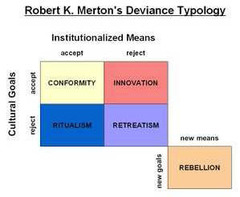
conformity
believing that hard work will eventually bring you to your goals
innovation
involves accepting the valued goals but doing something deviant to attain them (usually crime)
ritualism
accept the failure to achieve your goal.
retreatism
the rejection of valued goals and a decision to opt out of trying to attain them
rebellion
also reject valued goals, but instead of simply opting out of society altogether, rebellion involves working to change societies by replacing the existing social goals with different ones.