Comprehensive Anatomy, Radiographic Positioning, and Bone Structure Guide
 Call Kai
 Learn
Learn Practice Test
 Spaced Repetition
 Match
Match Flashcards
 Knowt Play
1/89

There's no tags or description
Looks like no tags are added yet.
Name | Mastery | Learn | Test | Matching | Spaced | Call with Kai | Chat |
|---|
No analytics yet
Send a link to your students to track their progress
90 Terms
What is the definition of anatomy?
The science of the structure of the body.
What is physiology?
The study of the function of the body organs.
What are body planes?
Imaginary planes that subdivide the body in reference to anatomic position.
What is the midsagittal plane?
A specific sagittal plane that passes through the midline and divides the body into equal right and left halves.

What does the coronal plane do?
Passes through the body vertically from side to side, dividing it into anterior and posterior parts.

What is the function of horizontal planes?
They pass crosswise through the body at right angles to the longitudinal axis, dividing it into superior and inferior portions.

What are oblique planes?
Planes that pass through a body part at any angle between the previous three planes.
What is the thoracic cavity?
The cavity that contains the lungs, heart, and major blood vessels.
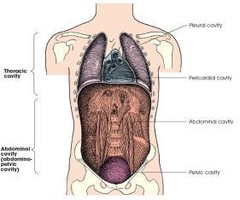
What does the abdominal cavity contain?
Contains organs such as the liver, gallbladder, pancreas, and intestines.
What is the pelvic cavity?
Contains the rectum, urinary bladder, and part of the reproductive system.
How is the abdomen divided into quadrants?
By two horizontal and two vertical planes.
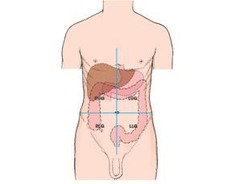
What are the four quadrants of the abdomen?
Right upper quadrant (RUQ), Left upper quadrant (LUQ), Right lower quadrant (RLQ), Left lower quadrant (LLQ).
What are the nine regions of the abdomen?
Right hypochondrium, Epigastrium, Left hypochondrium, Right lateral, Umbilical, Left lateral, Right inguinal, Hypogastrium, Left inguinal.
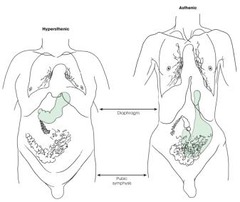
What is body habitus?
Common variations in the shape of the human body that affect the size, shape, and position of organs.
What are the four major types of body habitus?
Sthenic, Hyposthenic, Asthenic, Hypersthenic.
What is osteology?
The detailed study of the body of knowledge relating to the bones of the body.
What are the functions of bones?
Attachment for muscles, mechanical basis for movement, protection of internal organs, support frame for the body, storage for minerals, and production of blood cells.
How many bones are in the adult human body?
206 bones.
What are the two main divisions of the skeleton?
Axial skeleton and appendicular skeleton.

What is the difference between compact bone and spongy bone?
Compact bone is a strong, dense outer layer, while spongy bone is an inner, less dense layer containing trabeculae.
What is the significance of surface landmarks in radiography?
They help radiographers accurately and consistently position patients by locating unseen anatomy.
What is the occlusal plane?
The plane formed by the biting surfaces of the upper and lower teeth with jaws closed.
What is the interiliac plane?
A plane that transects the body at the pelvis at the top of the iliac crests.
What is the peritoneum?
A membrane that lines the abdominal cavity and covers the abdominal organs.
What is the role of the diaphragm in the body?
It separates the thoracic cavity from the abdominal cavity and plays a key role in respiration.
What is the significance of the abdominal cavity being referred to as the abdominopelvic cavity?
It encompasses both the abdominal cavity and the pelvic cavity.
What is the appendicular skeleton?
The appendicular skeleton consists of 126 bones that provide means for movement.
What does red marrow produce?
Red marrow produces red and white blood cells.
What is the function of yellow marrow?
Yellow marrow stores fat cells.
What is ossification?
Ossification is the term that applies to the development and formation of bones.
When does ossification begin?
Ossification begins in the second month of embryonic life.
What are the two processes of ossification?
The two processes are intramembranous ossification and endochondral ossification.

What is the medullary cavity?
The medullary cavity is the central cylindrical cavity of long bones.
What is the periosteum?
The periosteum is a tough, fibrous connective tissue that covers bone, except at articular ends.
What is the endosteum?
The endosteum lines the marrow cavity of bones.
How are flat bones formed?
Flat bones are formed by intramembranous ossification.
What is the epiphyseal plate?
The epiphyseal plate is the piece of cartilage that separates the end of a developing long bone from the central shaft.
What occurs at the epiphyseal line?
The epiphyseal line marks the area where full ossification occurs between the ends and the central shaft of long bones.
What are the five classifications of bones by shape?
The classifications are long, short, flat, irregular, and sesamoid.
What are sesamoid bones?
Sesamoid bones are very small and oval bones that develop inside and beside tendons.
What is arthrology?
Arthrology is the study of joints, or articulations, between bones.
What are the two classifications of joints?
Joints are classified as functional and structural.
What are the three subdivisions of functional classification of joints?
The subdivisions are synarthroses (immovable), amphiarthroses (slightly movable), and diarthroses (freely movable).
What are fibrous joints?
Fibrous joints do not have a joint cavity and are united by various fibrous and connective tissues.
What is a syndesmosis joint?
A syndesmosis joint is an immovable or very slightly movable joint united by fibrous sheets.
What is a suture joint?
A suture joint is an immovable joint found only in the skull.
What is a synchondrosis joint?
A synchondrosis joint is an immovable joint united by rigid cartilage.
What are synovial joints?
Synovial joints permit a wide range of motion and are enclosed by an articular capsule.
What are the six types of synovial joints?
The six types are gliding, hinge, pivot, ellipsoid, saddle, and ball-and-socket.

What is a gliding joint?
A gliding joint permits slight movement, examples include intercarpal and intertarsal joints.
What is a hinge joint?
A hinge joint permits flexion and extension only, examples include the elbow and knee.
What is a pivot joint?
A pivot joint allows rotation around a single axis, an example is the atlantoaxial joint.
What is a saddle joint?
A saddle joint allows movement similar to an ellipsoid joint, an example is the carpometacarpal joint.
What is a ball-and-socket joint?
A ball-and-socket joint permits the widest range of motion, examples include the hip and shoulder joints.
What is a condyle?
A rounded process at an articular end of a bone.
Define coracoid process.
A beaklike or crownlike process extending from the main body of a bone.
What is a crest in bone anatomy?
A ridgelike process.
What is an epicondyle?
A projection above a condyle.
What is a facet?
A small, smooth-surfaced articular process.
Define hamulus.
A hook-shaped process.
What is a malleolus?
A club-shaped process.
What does the term 'head' refer to in bone anatomy?
The expanded end of a long bone.
What is a protuberance?
A projecting prominence on a bone.
Define a horn in bone markings.
A hornlike process.
What is a spine in bone anatomy?
A sharp process.
What is a styloid process?
A long, pointed process.
Define fissure in bone anatomy.
A cleft or deep groove.
What is a trochanter?
One of the two large, rounded, and elevated processes of the proximal femur.
What is a foramen?
A hole in a bone for transmission of vessels and nerves.
What does fossa refer to in bone anatomy?
A pit, fovea, or hollow space.
Define tubercle.
A small, rounded, and elevated process.
What is a groove in bone markings?
A shallow linear channel.
What is a tuberosity?
A large, rounded, and elevated process where muscles and tendons attach.
What is a meatus?
A tubelike passageway.
Define notch in bone anatomy.
An indentation in the border of a bone.
What is a sinus in bone anatomy?
A recess, groove, cavity, or hollow space.
What is a sulcus?
A furrow or trench.
What are the common classifications of fractures?
Compression, compound (open), comminuted, greenstick, impacted, transverse, spiral or oblique.
What is a closed fracture?
A fracture that does not break through the skin.
What is an open fracture?
A serious fracture in which the broken bone projects through the skin.
What is a nondisplaced fracture?
A fracture where the broken bone retains its normal alignment.
What is a displaced fracture?
A serious fracture in which bones are not in anatomic alignment.
What does 'anterior' refer to in anatomical terms?
The forward or front part of the body.
Define 'posterior' in anatomical terms.
The back part of the body.
What does 'superior' mean?
Nearer the head or situated above.
What does 'inferior' mean?
Nearer the feet or situated below.
What is the meaning of 'medial'?
Toward the median plane of the body or toward the middle of a body part.
Define 'lateral'.
Away from the median plane or away from the middle of a part.
What does 'proximal' refer to?
Nearer to the point of attachment or origin.
What does 'distal' mean?
Farthest from the point of attachment or origin.