Speech Science
 Call Kai
 Learn
Learn Practice Test
 Spaced Repetition
 Match
Match Flashcards
 Knowt Play
1/47

Earn XP
Description and Tags
LEC 1 + 2
Name | Mastery | Learn | Test | Matching | Spaced | Call with Kai | Chat |
|---|
No analytics yet
Send a link to your students to track their progress
48 Terms
helium
airflow changes acoustic output and frequency leading to increased frequency than normal
sinewave speech
synthesizer; machine creates speech signal, not perfect
(used to create vocal harmonics and simulate speech sounds through varying frequencies.)
cochlear implants
speech is filtered, doesnt sound clear, frequencies
problems with speech:
1) segmentation
2) streaming
3) lack of invariance
segmentation
speech is continuous even if it’s perceived as discrete (like if ur hearing a foreign lang and cant tell where one word starts/ends without breaks)
streaming
hearing listeners can separate sounds easily (relevant sounds vs background noise)
lack of invariance
acoustic signal does not always show exact same patterns for two perceptually identical segments (same word/sound does not always sound the same even if said the same way)
(speakers differ from each other; coarticulation: the articulation of speech sounds are affected by other sounds near them)
movement made audible
speech is nothing but change of pressure in the air
speech is
tangible/concrete (can be measured/manipulated due to acoustic output; strings of sounds reflect movement of articulators)
3 major areas of study
1) physiologic arena/articulatory phonetics
2) acoustic arena/acoustic speech
3) perceptual arena/speech perception
measurement in clinical evaluations
Qualitative: pitch, loudness, roughness
quantitative: fundamental frequency, amplitude
no mass/weight
sound has no mass/weight
something needs to
vibrate for something to happen
longitudinal wave
sound travels in a longitidunal wave
movement made visible
speech is movement made visible
force
push/pull (displacement/restorative); measured by effect upon an object
newton 1st law of motion (law of inertia)
object at rest stays at rest, object in motion stays in motion (change in motion is not the same as no motion)
2 things needed to vibrate
inertia, elasticity
inertia
tendency for mass at rest to remain at rest
elasticity
ability to spring back after deformation (all solids are elastic; gases also behave like it)
friction
impedes/opposes movement
newtons 3rd law of motion
for every action (force) there exists an equal or opposite reaction (air molecules hitting another)
solid
holds shape + volume
liquid
maintains volume, takes shape of container
gas
does not retain shape or volume
(molecules in gas collide with each other)
density
amount of material packed in given volume
density equals
mass/volume (not weight but state)
_ volume _ density
larger volume lower density; lower volume larger density
pressure
force exerted by collision of molecules with each other and the wall of the container
_ volume _ pressure
higher volume lower pressure; higher pressure lower volume
maximum point of displacement
as far as they can go
inertia and elasticity have
inertia and elasticity have inverse relationship
period
time to complete 1 cycle (every cycle same time)
ex: 5 secs for 1 cycle so then 2nd cycle is also 5s ecs
amplitude
depends on amount of force used to start movement (strong push makes swing go further)
what travels forward? molecule or wave?
disturbance (wave) travels forward not the molecule/particle
waves
disturbance composed of vibration
medium
interconnected particles
compression
increased pressure
rarefaction
decreased pressure

longitudanal wave
movement of particle is parallel to movement of wave
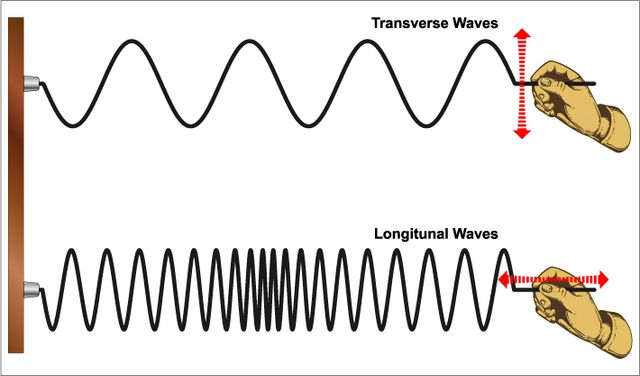
transverse wave
movement of particle is perpendicular to movement of wave
Simple Harmonic Motion
pure tone (one frequency)
Frequency
cycles per sec Fo
cycle
one alternating compression + rarefaction
period and frequency
period and frequency are inversely related
mathematically
Freq= 1/period Period= 1/freq
ex: if freq= 20Hz then period is 1/20th of a second
if freq= 200Hz then period is 1/200th of a second
the higher the frequency the ___ the period
shorter
the lower the frequency the ___ the period
longer