Shadwick Exam 3 Questions, Exam 3 Retake POB, POB Exam 3 Retake
 Call Kai
 Learn
Learn Practice Test
 Spaced Repetition
 Match
Match Flashcards
 Knowt Play
1/170

There's no tags or description
Looks like no tags are added yet.
Name | Mastery | Learn | Test | Matching | Spaced | Call with Kai | Chat |
|---|
No analytics yet
Send a link to your students to track their progress
171 Terms
Alternative forms of a gene that influence the same trait and are found at the same location in homologous chromosomes are called
A. alleles.
B. phenotypes.
C. genotypes.
D. incomplete dominance.
A. alleles.
Which of the following represents the physical characteristics of the individual?
A. phenotype
B. genotype
C. alleles
D. dominance
A. phenotype
What are alleles?
A. genes for different traits, such as hair color and eye color
B. alternative forms of a gene for a single trait, such as blue eyes or brown eyes
C. the locations of genes on a chromosome
D. recessive forms of a kind of characteristic carried by genes
B. alternative forms of a gene for a single trait, such as blue eyes or brown eyes
The _____ indicates the gene combination of an individual.
A. phenotype
B. loci
C. genotype
D. homozygous
C. genotype
Which of the following is NOT correct concerning the law of independent assortment?
A. It is based upon the process of meiosis.
B. Each pair of factors separates independently.
C. All possible combinations of factors can occur in the gametes.
D. It follows the observation that all maternal chromosomes end up in the egg.
D. It follows the observation that all maternal chromosomes end up in the egg.
Which is NOT true according to Mendel's law of segregation?
A. Each individual contains two alleles for each trait.
B. An individual can have either both dominant alleles, both recessive alleles, or a dominant and recessive allele.
C. Alleles separate from each other during gamete formation.
D. Each gamete contains one copy of each allele.
E. Fertilization restores the presence of two alleles.
B. An individual can have either both dominant alleles, both recessive alleles, or a dominant and recessive allele.
Mendel's law of segregation implies that the two members of an allele pair
A. are distributed to separate gametes.
B. are distributed to the same gamete.
C. are assorted dependently.
D. are segregated pairwise.
A. are distributed to separate gametes.
In a Mendelian monohybrid cross involving two homozygous genotypes, the ____ generation is always completely heterozygous.
A. F1
B. F2
C. P
D. P2
A. F1
What will the genotypic ratio be of a monohybrid cross of two individuals who are both heterozygous for a trait? Use the link in the instructions to an online Punnet square frame.
A. 100% homozygous dominant
B. 50% homozygous dominant, 50% homozygous recessive
C. 25% homozygous dominant, 50% heterozygous, 25% homozygous recessive
D. 50% homozygous dominant, 50% heterozygous
C. 25% homozygous dominant, 50% heterozygous, 25% homozygous recessive
A pheasant breeder starts with two birds in the P generation, one of which is AA and the other is aa. If he takes two of the birds from the F1 generation and breeds them together, what can he expect in his F2 offspring?
A. AA and Aa.
B. Aa and aa.
C. AA, Aa, and aa.
D. Aa only.
C. AA, Aa, and aa.
A woman who can roll her tongue (presumably dominant) is married to a man who cannot. Two of their four children can roll their tongues and two cannot. If A = roll tongue and a = cannot roll tongue, then what is the genotype of the parents?
A. woman Aa; man Aa
B. woman AA; man aa
C. woman Aa; man AA
D. woman Aa; man aa
D. woman Aa; man aa
Some plants fail to produce chlorophyll, due to a recessive trait. If we locate a pea plant that is heterozygous for this trait, self-pollinate it, and harvest the seeds, what are the likely phenotypes of the resulting offspring?
A. All will be green with chlorophyll since that is the dominant trait.
B. About one-half will be green and one-half white since that is the distribution of the genes in the parents.
C. About one-fourth will be white and three-fourths green since it is similar to a monohybrid cross.
D. About one-fourth will be green and three-fourths white since it is similar to a monohybrid cross.
C. About one-fourth will be white and three-fourths green since it is similar to a monohybrid cross.
A cross is made between two parents with genotypes AaBB and aabb. If there are 32 offspring, how many of them would be expected to exhibit both dominant characteristics?
A. 32
B. 24
C. 16
D. 8
E. 0
C. 16
In guinea pigs, B = black, b = brown, S = short hair, s = long hair. A heterozygous black, short-haired animal reproduces with a brown, long-haired animal. What is the expected phenotypic ratio of the offspring?
A. 1 black short hair, 1 black long hair, 1 brown short hair, 1 brown long hair
B. 9 black short hair, 3 black long hair, 3 brown long hair, 1 brown short hair
C. 9 black short hair, 3 black long hair, 3 brown short hair, 1 brown long hair
D. 9 black short hair, 6 black long hair, 3 brown long hair, 1 brown short hair
A. 1 black short hair, 1 black long hair, 1 brown short hair, 1 brown long hair
In humans, aniridia, a type of blindness, is due to a dominant allele A. Migraine headaches are due to another dominant allele M. If a man who suffers from both conditions (AaMm) marries a woman who suffers from both (AaMm), what are the chances of an offspring expressing both traits.
A. 9/16
B. 3/16
C. 1/2
D. 1/16
A. 9/16
In which kind of cross could you expect to find ratios of 1:1:1:1 among the offspring?
A. monohybrid cross
B. dihybrid cross
C. one-trait test cross
D. two-trait test cross
D. two-trait test cross
In guinea pigs, B = black, b = brown, S = short hair, s = long hair. Two heterozygous individuals reproduce. The expected results are
A. 9 black long hair, 3 black short hair, 3 brown long hair, 1 brown short hair.
B. 9 black short hair, 6 black long hair, 3 brown long hair, 1 black short hair.
C. 9 black short hair, 3 black long hair, 3 brown short hair, 1 brown long hair.
D. 9 brown short hair, 3 black long hair, 3 brown long hair, 1 black short hair.
C. 9 black short hair, 3 black long hair, 3 brown short hair, 1 brown long hair.
What genetic disorder is associated with the lack of an enzyme necessary for the normal metabolism of the amino acid phenylalanine?
A. phenylketonuria (PKU)
B. Huntington disease
C. sickle cell disease
D. cystic fibrosis (CF)
A. phenylketonuria (PKU)
Which genetic disorder is associated with an irregular shape of the red blood cells?
A. sickle cell disease
B. Marfan syndrome
C. Huntington disease
D. cystic fibrosis (CF)
A. sickle cell disease
What are the chances that two individuals with wavy hair (an incomplete trait) will have a curly-haired child? Curly hair and straight hair exhibit incomplete dominance.
A. none
B. 25%
C. 50%
D. 75%
B. 25%
The four o'clock flower is an example of incomplete dominance: R = red, r = white, and Rr = pink. If two hybrids are crossed, what are the chances that an offspring will have pink flowers?
A. 0%
B. 25%
C. 50%
D. 75%
E. 100%
C. 50%
Traits that are controlled by several sets or pairs of alleles, such as skin color and height in humans, are the result of what form of inheritance?
A. polygenic
B. incomplete dominance
C. simple Mendelian inheritance
D. codominance
A. polygenic
Which of the following is an example of the blending of phenotypes?
A. codominance
B. polygenic inheritance
C. simple Mendelian inheritance
D. incomplete dominance
D. incomplete dominance
You have two true-breeding rose bushes, one with red flowers and one with white flowers. A cross between these two roses yields a bush with pink flowers. What condition does this demonstrate?
A. codominance
B. incomplete dominance
C. environmental effects
D. polygenetic inheritance
B. incomplete dominance
When two or more genes with multiple alleles affect the same trait in an additive fashion, it is termed
A. a double-trait cross.
B. codominant.
C. incomplete dominance.
D. polygenic inheritance.
D. polygenic inheritance.
You have two true-breeding rose bushes, one with red flowers and one with white flowers. A cross between these two roses yields a bush with white flowers that have red splotches. What condition does this demonstrate?
A. codominance
B. incomplete dominance
C. environmental effects
D. polygenetic inheritance
E. monohybrid inheritance
A. codominance
Cold weather can change the ______ of a Himalayan rabbit.
A. genotype
B. phenotype
C. alleles
D. sex
B. phenotype
Hydrangeas are a flowering plant with large showy blooms. When a plant is grown in aluminum-rich soil it has blue flowers. If the same plant is transplanted into soil that is lacking aluminum, the flowers produced will be pink. This is an example of
A. codominance.
B. incomplete dominance.
C. environmental effects.
D. polygenetic inheritance.
C. environmental effects.
In peas, yellow is dominant over green in seeds. With which of these is it best to cross a yellow-seeded pea plant to determine whether it is homozygous or heterozygous?
A. a green-seeded plant
B. a heterozygous yellow-seeded plant
C. a pure yellow-seeded plant
D. a heterozygous yellow-seeded plant or a pure yellow-seeded plant
A. a green-seeded plant
In a testcross, an organism with a dominant phenotype, but unknown genotype is crossed with which of the following to establish its genotype?
A. homozygous dominant
B. heterozygous
C. homozygous recessive
D. heterozygous dominant
C. homozygous recessive
Common fruit flies, Drosophila melanogaster, have been used as model organisms to study inheritance in animals for many years. Flies with the yellow body phenotype make no melanin. Look at the image above to see diagrams representing the "wild-type" and "yellow body" flies. In an experiment, Karen crossed a true-breeding line of wild-type flies with yellow body flies. All the offspring of those crosses were wild-type. Then Karen crossed the offspring with each other. She got 328 yellow body flies and 1014 wild-type flies. What is the probably inheritance pattern for the yellow body allele?
A. Yellow body is recessive to wild-type.
B. Wild-type is recessive to yellow body.
C. Wild-type and yellow body are incompletely dominant.
D. Wild-type and yellow body are codominant.
A. Yellow body is recessive to wild-type.

This pedigree documents an autosomal recessive trait. Remember, affected individuals are represented by filled in shapes. What is the genotype of individual 6 at generation II?
A. Homozygous Dominant
B. Homozygous Recessive
C. Heterozygous
D. There is not enough information given to tell.
C. Heterozygous
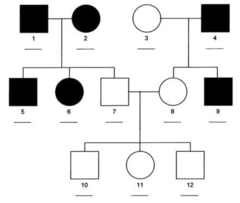
What type of inheritance is represented by the above pedigree? Remember, affected individuals are represented by filled in shapes.
A. Autosomal Dominant
B. Autosomal Recessive
A. Autosomal Dominant
A man with AB blood type can have a child with type O.
A. True
B. False
B. False
The location of a gene on a chromosome is called
A. a locus.
B. a linkage map.
C. a linkage group.
D. an allele.
A. a locus.
Considering that males can have Klinefelter (XXY) syndrome, XYY, and normal XY chromosomal combinations, and females can have Turner (XO) syndrome, poly-X (XXX, XXXX), and normal XX combinations, it is obvious that
A. maleness results from the presence of only one X chromosome.
B. maleness results from the absence of two or more X chromosomes.
C. maleness results from the minimal presence of one Y chromosome.
D. femaleness results from the presence of two or more X chromosomes.
C. maleness results from the minimal presence of one Y chromosome.
Genes on the ___ chromosome determine if the sex of a child will be male or female.
A. X
B. Y
C. 21st
D. 5th
B. Y
A normal male marries a color-blind woman. What percent of their female children will be color-blind?
A. 0%
B. 25%
C. 50%
D. 75%
E. 100%
A. 0%
Color-blindness is inherited as an X-linked recessive trait. A male who is color-blind marries a heterozygous woman. What percent of their total children will be color-blind?
A. 0%
B. 25%
C. 50%
D. 75%
E. 100%
C. 50%
A color-blind (recessive trait) woman will pass the allele to
A. her sons only.
B. all her children.
C. her daughters only.
D. none of her children.
E. her husband.
B. all her children.
If a woman is a carrier for the color-blind recessive allele and her husband has normal vision, what are their chances that a son will be color-blind?
A. None, because the father is normal.
B. 50%, since the mother is only a carrier.
C. 100% because the mother has the gene.
D. 25% because the mother is a hybrid.
E. None since the son will also be just a carrier.
B. 50%, since the mother is only a carrier.
Which of the following sex-linked diseases is characterized by the absence of a clotting factor?
A. hemophilia
B. color-blindness
C. Duchenne muscular dystrophy
D. None of the answer choices is true.
A. hemophilia
Which refers to the loss of a complete chromosome?
A. inversion
B. translocation
C. deletion
D. monosomy
D. monosomy
A person who has an extra copy of a chromosome is said to have
A. monosomy.
B. trisomy.
C. nondisjunction.
D. duplication.
B. trisomy.
Generally, it is not possible to determine whether nondisjunction failed to occur in oogenesis or spermatogenesis. However, it is possible to assert that _____ resulted in nondisjunction in ____.
A. XXY; oogenesis
B. XYY; spermatogenesis
C. XXX; oogenesis
D. XXY; spermatogenesis
B. XYY; spermatogenesis
When homologous chromosomes fail to separate during meiosis, this is termed
A. linked genes.
B. nondisjunction.
C. crossover.
D. monosomy.
B. nondisjunction.
An individual who has an XXY combination of sex chromosomes is said to have _____ syndrome.
A. Klinefelter
B. Turner
C. Down
D. cri du chat
A. Klinefelter
A person with an XO genotype is classified as having
A. Down syndrome.
B. Turner syndrome.
C. Klinefelter syndrome.
D. a poly-X state.
B. Turner syndrome.
Which refers to the loss of a portion of a chromosome?
A. inversion
B. translocation
C. deletion
D. duplication
C. deletion
Which refers to the movement of a piece of one chromosome to another nonhomologous chromosome?
A. inversion
B. translocation
C. deletion
D. duplication
B. translocation
If a chromosomal segment appears more than once in the same chromosome, it is termed a(n)
A. translocation.
B. duplication.
C. deletion.
D. inversion.
B. duplication.
Which refers to the addition of a repeat segment of a chromosome?
A. inversion
B. translocation
C. deletion
D. duplication
D. duplication
If a chromosomal segment is turned around 180°, the chromosomal mutation is termed a(n)
A. translocation.
B. duplication.
C. deletion.
D. inversion.
D. inversion.
All cases of Down syndrome are caused by trisomy of chromosome 21.
A. True
B. False
B. False

The above pedigree pertains to colorblindess. What is the genotype of the individual indicated by the asterisk?
A. XB Xb
B. XB XB
C. Xb Xb
D. XB Y
A. XB Xb
According to Lamarck, which variable would have the greatest influence on the evolution of an organism?
A. the environment
B. the genetics of the individual
C. Both the environment and genetics are equally responsible for the evolution of an organism.
D. Neither the environment nor the genetics of an organism play a role in its evolution.
A. the environment
Lamarck's proposal of the inheritance of acquired characteristics included the idea that
A. the continual stretching of giraffe's necks to reach leaves led to longer necks in offspring.
B. local catastrophes cause mass extinctions of species.
C. species are fixed and unchanging over time.
D. organisms are acted on by the environment.
A. the continual stretching of giraffe's necks to reach leaves led to longer necks in offspring.
When he arrived at the Galápagos Islands, Darwin did not observe the amazing tool-using "woodpecker finch" that can modify twigs to pry out grubs. Because there are no true woodpeckers on the Galápagos Islands, this behavior allows this finch to exploit an untapped food source. However, not all members of this species exhibit this behavior, which is probably learned from watching other finches. Therefore, which of the following is NOT true?
D. This "learned" behavior will not lead to evolutionary change in the woodpecker population.
Which piece of evidence did Darwin observe during his 5-year journey aboard the HMS Beagle?
A. A South American species of finch is most likely the ancestor of the Galápagos Island finches.
B. Species do not change over time.
C. All species share the same basic genetic and molecular makeup.
D. The earth is approximately 4.6 billion years old.
A. A South American species of finch is most likely the ancestor of the Galápagos Island finches.
What evidence would NOT be studied by a biogeographer?
A. continental drift or the movement of tectonic plates over time
B. ocean currents and wind patterns
C. ranges of animals and ability to migrate
D. the genetic makeup of organisms that evolved in separate but similar conditions
D. the genetic makeup of organisms that evolved in separate but similar conditions
Which evidence for evolution uses impressions of plants and animals pressed into sedimentary rock?
A. fossil record
B. biogeography
C. comparative embryology
D. comparative biochemistry
A. fossil record
Anatomical features that are fully developed and functional in one group of organisms but reduced and functionless in a similar group are called
A. vestigial.
B. homologous.
C. analogous.
D. sympatric.
A. vestigial.
Which of these conditions is NOT among the requirements of the Hardy-Weinberg equilibrium?
A. no net mutations
B. no net migration of alleles into or out of the population
C. small population with genetic drift
D. no selection of one genotype over another
C. small population with genetic drift
If the Hardy-Weinberg equilibrium is met, what is the net effect?
A. evolution leading to a population better adapted to an unchanging environment
B. evolution leading to a population better adapted to a changing environment
C. very slow and continuous evolution with no increased adaptation
D. no evolution because the alleles in the population remain the same
D. no evolution because the alleles in the population remain the same
Which statement is NOT true about the founder effect?
A. It is a form of genetic drift.
B. It produces a high frequency of some rare alleles in a small isolated population.
C. Founding members contain a tiny fraction of the alleles found in the original population.
D. The founder effect occurs when a population is subjected to near extinction and then recovers, so that only a few alleles are left in survivors.
D. The founder effect occurs when a population is subjected to near extinction and then recovers, so that only a few alleles are left in survivors.
When only a few individuals survive unfavorable times, thereby losing the majority of genotypes in the next generation, it is called
A. natural selection.
B. a bottleneck effect.
C. a founder effect.
D. industrial mechanism.
B. a bottleneck effect.
Which of the following is true about genetic drift?
A. It may lead to an allele becoming fixed in a population when its alternative allele is lost from the population.
B. It increases the number of heterozygotes in a population.
C. It increases the level of rare alleles in a population.
D. It reduces the chances of mutation in a population.
A. It may lead to an allele becoming fixed in a population when its alternative allele is lost from the population.
A random alteration in the sequence of DNA nucleotides that provides a new variant of the gene is
A. gene mutation.
B. gene frequency.
C. disruption.
D. allele frequency.
A. gene mutation.
Movement of alleles between populations such as by the migration of breeding individuals is called
A. genetic drift.
B. gene flow.
C. nonrandom mating.
D. natural selection.
B. gene flow.
Which of the following conditions does NOT contribute to evolution?
A. mutations
B. gene flow
C. genetic drift
D. unchanging environmental conditions
D. unchanging environmental conditions
Inbreeding within a population is an example of
A. genetic drift.
B. gene flow.
C. nonrandom mating.
D. natural selection.
C. nonrandom mating.
Disruptive selection is described in the text with the case of British land snails. In the grassy fields, the light-banded snails escape bird predators. In the darker forest, the dark snails survive and the light-banded snails are eaten. As long as the snails continue to cruise across the British landscape mating at the same season and having access to each other, why doesn't this "disruptive selection" eventually lead to two separate species?
There is no reproductive isolation to prevent gene flow.
Which type of natural selection occurs when an intermediate phenotype is favored?
A. disruptive selection
B. directional selection
C. stabilizing selection
D. genetic drift selection
E. adaptive radiation
C. stabilizing selection
Which type of natural selection increases the frequency of one extreme phenotype?
A. directional
B. stabilizing
C. disruptive
D. nonrandom
A. directional
The model of speciation that requires some time with geographic barriers between two populations, allowing evolution of reproductive isolation, is
A. allopatric speciation.
B. phyletic gradualism.
C. sympatric speciation.
D. punctuated equilibrium.
E. prezygotic isolation.
A. allopatric speciation.
During sympatric speciation
A. evolution ceases for a time.
B. wide phenotype differences disappear between subpopulations.
C. reproductive isolation between certain subpopulations occurs.
D. a geographic separation occurs between certain subpopulations.
E. mutations begin to appear, making the subpopulations distinctly different.
C. reproductive isolation between certain subpopulations occurs.
During allopatric speciation
A. gene flow continues between subpopulations.
B. reproduction between all subpopulations is impossible.
C. a geographic separation occurs between subpopulations.
D. wide phenotype differences appear between subpopulations.
E. subpopulations are still able to interbreed.
C. a geographic separation occurs between subpopulations.
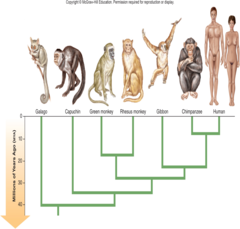
Consider the above phylogenetic tree. Which of the following species are most closely related?
A. human and green monkey
B. gibbon and capuchin
C. green monkey and capuchin
D. galago and green monkey
A. human and green monkey
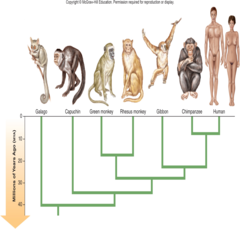
Consider the above phylogenetic tree. Which of the following species are most closely related?
A. chimpanzee and rhesus monkey
B. gibbon and capuchin
C. rhesus monkey and capuchin
D. galago and green monkey
A. chimpanzee and rhesus monkey
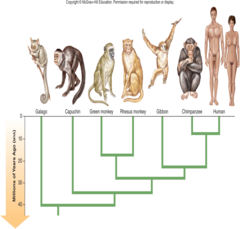
Consider the above phylogenetic tree. Which of the following species are most closely related?
A. gibbon and green monkey
B. gibbon and capuchin
C. green monkey and capuchin
D. galago and capuchin
A. gibbon and green monkey
The fin of a tuna and the flipper of a dolphin are
A. analogous structures.
B. homologous structures.
C. homogeneous structures.
D. reciprocal structures.
A. analogous structures.
Lizards on a small island are more likely to have to mate with close relatives. The form of microevolution is
A. the founder effect.
B. mutation.
C. gene flow.
D. natural selection.
A. the founder effect.
Cheetahs are very genetically similar, meaning there is not a lot of genetic diversity in their gene pool. It appears that at least 2 times in the last 10,000 years cheetah populations crashed to very low numbers. The present day low genetic diversity is due to _____________.
A. the bottleneck effect.
B. the founder effect.
C. natural selection.
D. non-disjunction.
A. the bottleneck effect.
A population of mice live in a grassy area near a stream. Some individuals have alleles that give them white fir while others have alleles for brown fur. A family of hawks move in and nest nearby. The hawks catch the white mice at a higher rate because those mice do not blend in to the surroundings so well. This changes the genetic makeup of the population and a higher percentage of the next generation of mice have brown fur. This is an example of _______.
A. Natural Selection
B. Genetic Drift
A. Natural Selection
A population of mice live in a grassy area near a stream. Some individuals have alleles that give them white fir while other have alleles for brown fur. One day the stream floods killing a higher percentage of mice wtih the brown alleles basically at random. This changes the genetic makeup of the population and a higher percentage of the next generation of mice have white fur. This is an example of
A. Natural Selection
B. Genetic Drift
C. Mutation
D. Gene Flow
B. Genetic Drift
A population of mice live in a grassy area near a stream. Some individuals have alleles that give them white fir while others have alleles for brown fur. One day a mouse is born in which an allele for brown fur has change and causes the mouse to be tan. This is an example of
A. Natural Selection
B. Genetic Drift
C. Mutation
D. Gene Flow
C. Mutation
In Arkansas, the gray tree frog breeds in March, while the closely related species Harpers frog breeds at the end of May. This is an example of a ___________________ isolating mechanism.
A. habitat
B. temporal
C. behavioral
D. mechanical
E. post zygotic
B. temporal
Two species of peas are visited by the same species of bee. Each species of pea has its stamens positioned to place pollen on different parts of the bee's body. Upon visiting other flowers, the pollen from the bee can only get on the female parts of the same species. This is an example of a ___________________ isolating mechanism.
A. habitat
B. temporal
C. behavioral
D. mechanical
E. post zygotic
D. mechanical
In peacock spiders, a male displays before a female. If the male is of the wrong species then the female will reject him because he does not do the correct courtship display or have the correct color patterns. This is an example of a ___________________ isolating mechanism.
A. habitat
B. temporal
C. behavioral
D. mechanical
E. post zygotic
C. behavioral
Red-legged frogs and Bullfrogs can interbreed in the lab. However, Red-legged frogs only breed in fast-moving streams and Bullfrogs only breed in ponds. This is an example of a _______________ isolating mechanism.
A. habitat
B. temporal
C. behavioral
D. mechanical
E. post zygotic
A. habitat
Two individuals are heterozygous for a gene on an autosomal chromosome. If they were crossed, what would be the genotyping ratios of their offspring?
A. 1 homozygous dominant, 1 homozygous recessive
B. 1 homozygous dominant, 2 heterozygous, 1 homozygous recessive
C. 1 homozygous dominant, 1 heterozygous
D. 1 heterozygous, 1 homozygous recessive
B. 1 homozygous dominant, 2 heterozygous, 1 homozygous recessive
A man with type O has a child with a woman with type AB blood. What is the probability that their child will have type B?
A. 0.75
B. 0.5
C. 0
D. 0.25
E. 1
B. 0.5
If an allele is recessive then
A. It is the less common allele in a population
B. It is not the allele causing the phenotype in a heterozygous individual
C. If shows a phenotype in females more often than males
D. It is worse than the dominant allele
B. It is not the allele causing the phenotype in a heterozygous individual
Alternative forms of a gene that influence the same trait and are found at the same location in homologous chromosomes are called
A. Phenotypes
B. Genotypes
C. Alleles
D. Incomplete dominance
C. Alleles
In Himalayan rabbits, the nose, feet, and ears are dark brown, while the body of the animal is white. This is an example of
A. Codominance
B. The influence of the environment
C. Simple dominance
D. Incomplete dominance
B. The influence of the environment
The ABO blood group refers to antigens than can be found on red blood cells. Some people have AB blood. This is an example of
A. Pleiotropy
B. Incomplete dominance
C. Sex-linked
D. Codominance
E. Complete dominance
D. Codominance
The pigeon is a bird that lives in cities and in the wild in Europe and North America. People capture them and breed them for certain traits, like a certain feather color. All black feathers for example. The genetic differences between pure-bred pigeons and wild pigeons is likely that
A. Pure-bred pigeons will be less likely to have genetic disorders
B. Pure-bred pigeons are heterozygous for more alleles
C. Wild pigeons are heterozygous for more alleles
C. Wild pigeons are heterozygous for more alleles
Traits that are controlled by several sets or pars of alleles, such as skin color and height in humans, are the result of what form of inheritance
A. Polygenic
B. Incomplete dominance
C. Codominance
D. Simple Mendelian inheritance
A. Polygenic
A snapdragon with red flowers is homozygous for the red flower allele and is crossed with a snapdragon with homozygous for the white color allele. This results in all the offspring having pink flowers. This is an example of
A. Sex-linked
B. Incomplete dominance
C. Complete dominance
D. Codominance
E. Pleiotropy
B. Incomplete dominance
Hunting disease
A. Is an autosomal recessive neurodegenerative disorder caused by buildup of lysosomes in nerve cells due to lack of an enzyme
B. Is autosomal recessive disorder in which mucus is abnormally thick, leading to lung infections. It is caused by a faulty gene for a chloride ion channel protein
C. Is an autosomal dominant neurodegenerative disorder caused by a faulty gene for a protein. The protein caused other proteins to clump with it damaging nerve cells
C. Is an autosomal dominant neurodegenerative disorder caused by a faulty gene for a protein. The protein caused other proteins to clump with it damaging nerve cells