The Urinary System, Chapter 24
 Call Kai
 Learn
Learn Practice Test
 Spaced Repetition
 Match
Match Flashcards
 Knowt Play
1/69

Earn XP
Description and Tags
https://quizlet.com/415119887/the-urinary-system-chapter-24-flash-cards/
Name | Mastery | Learn | Test | Matching | Spaced | Call with Kai | Chat |
|---|
No analytics yet
Send a link to your students to track their progress
70 Terms
A
1) Which of the following is NOT part of the urinary system?
A) spleen
B) ureter
C) urethra
D) kidney
C
2) The right kidney sits ________ to the left kidney due to the position of the liver.
A) posterior
B) superior
C) inferior
D) medial
B
3) Urine is transported from kidney to the urinary bladder by the:
A) urethra.
B) ureter.
C) aorta.
D) inferior vena cava.
D
4) What is NOT a major function of the kidneys?
A) regulation of acid-base balance
B) removal of metabolic wastes
C) regulation of blood volume and blood pressure
D) hematopoiesis
B
5) Erythropoietin is produced by the kidneys to:
A) regulate removal of metabolic wastes.
B) regulate red blood cell production by the bone marrow.
C) conserve or eliminate hydrogen and bicarbonate ions.
D) regulate blood solute concentration.
D
6) What external covering protects the kidney from physical shock?
A) renal fascia
B) renal capsule
C) renal pelvis
D) adipose capsule
B
7) The indentation on the medial surface of the kidney is the:
A) pelvis.
B) hilum.
C) pyramid.
D) calyx.
A
8) What are the three main regions of the kidney?
A) renal pelvis, renal medulla, renal cortex
B) renal sinus, renal pelvis, renal cortex
C) renal sinus, renal medulla, renal cortex
D) renal pelvis, renal sinus, renal fascia
C
9) The functional units of the kidneys are:
A) renal pyramids.
B) renal sinuses.
C) nephrons.
D) glomeruli.
B
10) In which kidney region are the renal pyramids located?
A) renal cortex
B) renal medulla
C) renal pelvis
D) renal sinus
C
11) Urine drains from a major calyx into:
A) the renal tubule.
B) a minor calyx.
C) the renal pelvis.
D) a papilla.
B
12) A glomerulus is:
A) attached to the collecting duct.
B) a set of capillaries within the renal corpuscle.
C) the source of erythropoietin.
D) a hairpin loop segment of the renal tubule.
C
13) Where does blood in the arcuate artery travel next on its journey toward the glomerulus?
A) interlobar artery
B) segmental artery
C) interlobular (cortical radiate) artery
D) renal artery
A
14) Place these vessels in the correct order as blood flows into and through the kidney.
1. afferent arteriole
2. arcuate artery
3. efferent arteriole
4. glomerulus
5. interlobar artery
6. interlobular (cortical radiate) artery
7. renal artery
8. segmental artery
A) 7, 8, 5, 2, 6, 1, 4, 3
B) 7, 8, 6, 2, 5, 1, 5, 3
C) 7, 8, 2, 5, 6, 3, 4, 1
D) 7, 5, 8, 6, 2, 4, 3, 1
B
15) Which of the following is the capillary bed fed by the afferent arteriole and drained by the efferent arteriole?
A) peritubular capillaries
B) glomerular capillaries
C) vasa recta
D) macula densa cells
B
16) Which vessel is present in the arterial pathway but missing from the venous pathway?
A) interlobular
B) segmental
C) interlobar
D) arcuate
A
17) What are the two main subdivisions of the nephron?
A) renal corpuscle and renal tubule
B) renal cortex and renal medulla
C) glomerulus and peritubular capillaries
D) renal pyramids and renal columns
B
19) What increases the permeability of the glomerulus by making the capillaries "leaky"?
A) microvilli
B) fenestrations
C) desmosomes
D) tight junctions
A
20) The portion of the renal tubule through which filtrate initially flows is known as the:
A) proximal tubule.
B) collecting duct.
C) distal tubule.
D) nephron loop (loop of Henle).
D
21) Which portion of the renal tubule has a brush border created by the presence of many microvilli?
A) descending limb of the nephron loop (loop of Henle)
B) distal tubule
C) ascending limb of the nephron loop (loop of Henle)
D) proximal tubule
A
22) Simple squamous epithelium is located in the:
A) descending limb of the nephron loop (loop of Henle).
B) distal tubule.
C) proximal tubule.
D) ascending limb of the nephron loop (loop of Henle).
C
23) Filtrate traveling through the renal tubule travels from the thick ascending limb to the:
A) proximal tubule.
B) thick descending limb of the nephron loop (loop of Henle).
C) distal tubule.
D) thin ascending limb of the nephron loop (loop of Henle).
C
24) The cells of the macula densa and the juxtaglomerular (JG) cells form the:
A) renal corpuscle.
B) filtration membrane.
C) juxtaglomerular apparatus (JGA).
D) nephron loop (loop of Henle).
A
25) What is NOT a true statement about the cortical nephrons?
A) Cortical nephrons are wrapped by the vasa recta.
B) Cortical nephrons are the most numerous type of nephron in the kidneys.
C) Cortical nephrons have a short nephron loop (loop of Henle).
D) The renal corpuscle of a cortical nephron sits in the renal cortex.
B
26) The process of filtration occurs at the:
A) proximal tubule.
B) renal corpuscle.
C) distal tubule.
D) collecting duct.
D
27) What should NOT be found in filtrate?
A) electrolytes
B) glucose
C) water
D) albumin
A
28) Items reclaimed during tubular reabsorption are moved to the interstitial fluids and then to the:
A) blood.
B) renal pelvis.
C) minor calyx.
D) collecting system.
A
29) Which statement best describes the function of tubular reabsorption?
A) Tubular reabsorption reclaims items from filtrate and returns them to the blood.
B) Tubular reabsorption moves items from the peritubular capillary blood into the filtrate.
C) Tubular reabsorption removes toxins from the blood that was not filtered.
D) Tubular reabsorption moves blood plasma through the filtration membrane of the glomerular capillaries.
C
30) Fenestrated glomerular capillaries are typically impermeable to:
A) amino acids.
B) glucose.
C) albumin.
D) nitrogenous wastes.
B
31) Determine the correct order of the structure of the filtration membrane from deep to superficial.
A) basal lamina, podocytes, fenestrated glomerular capillary endothelial cells
B) fenestrated glomerular capillary endothelial cells, basal lamina, podocytes
C) podocytes, basal lamina, fenestrated glomerular capillary endothelial cells
D) fenestrated glomerular capillary endothelial cells, podocytes, basal lamina
B
32) What is the normal value for the glomerular filtration rate (GFR) in mL/min?
A) 75
B) 125
C) 275
D) 500
C
33) The main force that promotes filtration in a nephron is:
A) colloid osmotic pressure (COP).
B) glomerular colloid osmotic pressure (GCOP).
C) glomerular hydrostatic pressure (GHP).
D) capsular hydrostatic pressure (CHP).
B
34) Glomerular colloid osmotic pressure (GCOP) is created by:
A) systemic blood pressure.
B) proteins such as albumin in the blood.
C) fluids in the blood plasma.
D) filtrate in the capsular space.
C
35) What is net filtration pressure (NFP) in the glomerular capillaries, in mm Hg?
A) -5
B) 0
C) 10
D) 25
B
36) The glomerular filtration rate is defined as:
A) the percent of blood plasma that passes through the filtration membrane.
B) the amount of filtrate formed by both kidneys in one minute.
C) the amount of filtrate that is reabsorbed during a 24-hour period.
D) the rate at which the kidneys remove a substance from the blood.
A
37) What effect does high blood pressure have on the glomerular filtration rate (GFR) in the absence of regulatory mechanisms?
A) GFR will increase.
B) GFR will decrease.
C) GFR will not change.
D) GFR will decrease, then increase.
A
38) How does the afferent arteriole vessel diameter change in order to decrease glomerular hydrostatic pressure (GHP) and restore the glomerular filtration rate (GFR) to normal?
A) The afferent arteriole will vasoconstrict.
B) The afferent arteriole will vasodilate.
C) The afferent arteriole has no effect on GHP and GFR.
D) The afferent arteriole will vasoconstrict, then vasodilate.
B
39) The myogenic mechanism acts to restore glomerular filtration rate (GFR) by changing:
A) tubular secretion of metabolic wastes.
B) vessel diameter.
C) blood pH.
D) blood pressure.
B
40) What do the macula densa cells regulate in their role as part of the tubuloglomerular feedback loop?
A) changes in blood pH
B) changes in glomerular hydrostatic pressure (GHP)
C) changes in the glomerular colloid osmotic pressure (GCOP)
D) changes in renal clearance
A
41) Jasmine has high blood pressure and an increased glomerular filtration rate (GFR). How does the tubuloglomerular feedback mechanism restore normal pressure in her glomerulus?
A) The juxtaglomerular (JG) cells decrease production of renin.
B) The afferent arteriole vasodilates.
C) The juxtaglomerular (JG) cells increase production of renin.
D) The efferent arteriole constricts.
A
42) What will NOT stimulate the renin-angiotensin-aldosterone system (RAAS)?
A) an increase in systemic blood pressure
B) sympathetic nervous system stimulation
C) low glomerular hydrostatic pressure (GHP)
D) stimulation from the macula densa cells
D
43) What chemical is necessary for the transformation of angiotensin-I (A-I) into active angiotensin-II (A-II)?
A) atrial natriuretic peptide (ANP)
B) renin
C) angiotensinogen
D) angiotensin-converting enzyme (ACE)
B
44) Which of the following is an effect of angiotensin-II (A-II)?
A) A-II decreases systemic blood pressure.
B) A-II promotes thirst.
C) A-II decreases blood volume.
D) A-II dilates efferent arterioles.
C
45) A drug that inhibits angiotensin-converting enzyme (ACE) may lead to:
A) increased blood volume.
B) increased secretion of aldosterone.
C) decreased blood pressure.
D) increased sodium reabsorption.
A
46) What is a renal mechanism that raises systemic blood pressure?
A) increase secretion of renin by the juxtaglomerular (JG) cells
B) decrease secretion of aldosterone
C) increase release of angiotensin-II (A-II)
D) increase filtration into the glomerular capsule
B
47) How does atrial natriuretic peptide (ANP) contribute to a decrease in blood volume and systemic blood pressure?
A) ANP constricts the afferent arteriole and dilates the efferent arteriole.
B) ANP dilates the afferent arteriole and constricts the efferent arteriole.
C) ANP dilates both the afferent and efferent arterioles.
D) ANP constricts both the afferent and efferent arterioles.
D
48) Sympathetic stimulation of the kidney can do all of the following, EXCEPT:
A) increase renin secretion.
B) increase blood concentration of angiotensin-II (A-II).
C) constrict both the afferent and efferent arterioles.
D) increase the glomerular filtration rate (GFR).
A
49) Which of the following is NOT true about tubular reabsorption?
A) Tubular reabsorption is entirely a passive process.
B) Tubular reabsorption occurs via paracellular or transcellular routes.
C) Tubular reabsorption may involve hormonal control.
D) Tubular reabsorption moves items from the filtrate into the blood.
D
50) What is coupled with glucose reabsorption using a symporter in the early part of the proximal tubule?
A) hydrogen ions
B) bicarbonate ions
C) amino acids
D) sodium ions
B
51) The reabsorption of bicarbonate ions in the proximal tubule helps regulate:
A) blood pressure.
B) blood pH.
C) blood solute concentration of sodium ions.
D) blood volume.
B
52) Which of the following enhances obligatory water reabsorption?
A) ATP
B) aquaporins
C) presence of high levels of glucose in the filtrate
D) presence of aldosterone in the distal tubule
D
53) In the ascending limb of the nephron loop (loop of Henle), the:
A) movement of water and solutes is passive.
B) thick segment is permeable to water but impermeable to sodium and chloride ions.
C) thin segment is not permeable to sodium ions, chloride ions, or water.
D) thick segment is impermeable to water but permeable to sodium and chloride ions.
B
54) Where are creatinine, ammonium ions, small amounts of urea, and drugs such as penicillin typically secreted?
A) collecting duct
B) proximal tubule
C) distal tubule
D) ascending limb of the nephron loop (loop of Henle)
C
55) Reabsorption of filtered glucose from the filtrate into the cells of the proximal tubule is by:
A) facilitated diffusion.
B) diffusion.
C) secondary active transport.
D) antiport.
A
56) Which hormones promote facultative water reabsorption?
A) aldosterone and antidiuretic hormone (ADH)
B) aldosterone and atrial natriuretic peptide (ANP)
C) antidiuretic hormone (ADH) and atrial natriuretic peptide (ANP)
D) atrial natriuretic peptide (ANP) and parathyroid hormone
A
57) Which statement is TRUE regarding antidiuretic hormone (ADH)?
A) ADH increases the permeability of the late distal tubule and cortical collecting ducts to water.
B) ADH causes the kidneys to produce very dilute urine.
C) ADH is secreted in response to low potassium ions in the blood.
D) ADH promotes water loss and increases urine output.
C
58) How much urine, in liters, is typically produced in a 24 hour period?
A) 0.5
B) 0.9
C) 1.8
D) 4.3
A
59) Dilute urine is more likely to be produced when:
A) the collecting duct is impermeable to water.
B) antidiuretic hormone (ADH) is present in the distal tubule.
C) the distal tubule is permeable to water.
D) sodium and chloride ions are reabsorbed from the descending limb of the nephron loop (loop of Henle).
D
60) What does the countercurrent mechanism accomplish in the nephron loop?
A) production of very dilute urine
B) constriction of the arterioles to increase blood pressure
C) secretion of water and electrolytes into the filtrate
D) creation of a steep concentration gradient for continued water reabsorption
A
61) Each of the following is typical of urine EXCEPT:
A) a pH of 3.0.
B) yellow color.
C) translucency.
D) mild odor.
C
62) The yellow color of urine comes from the presence of:
A) ammonia.
B) sodium ions.
C) urochrome.
D) glucose.
D
63) Renal clearance is defined as:
A) the percent of blood plasma that passes through the filtration membrane.
B) the amount of filtrate formed by both kidneys in one minute.
C) the amount of filtrate that is reabsorbed during one day.
D) the rate at which the kidneys remove a substance from the blood.
B
64) Substances used to measure renal clearance should be:
A) filtered, reabsorbed, and secreted.
B) filtered but neither reabsorbed nor secreted.
C) secreted but neither filtered nor reabsorbed.
D) filtered and reabsorbed, but not secreted.
C
65) What is renal clearance used to estimate?
A) net filtration pressure (NFP)
B) glomerular hydrostatic pressure (GHP)
C) glomerular filtration rate (GFR)
D) countercurrent exchange
B
66) What process propels urine from the kidney to the urinary bladder in the ureters?
A) osmosis
B) peristalsis
C) segmentation
D) secondary active transport
B
67) The trigone of the urinary bladder is created by:
A) the internal and external urethral sphincters.
B) the openings to the two ureteral orifices and the internal urethral orifice.
C) the internal and external urethral orifices.
D) the prostatic, membranous, and spongy urethra.
C
68) Compared to the male urethra, the female urethra:
A) has no external urethral sphincter.
B) consists of the prostatic, membranous, and spongy regions.
C) is shorter.
D) transports both urine and semen.
D
69) What initiates the micturition reflex?
A) The external urethral sphincter relaxes.
B) Parasympathetic efferent fibers stimulate the contraction of the detrusor muscle.
C) The internal urethral sphincter relaxes.
D) Stretch receptors in the wall of the urinary bladder signal the sacral region of the spinal cord.
A
70) Voluntary neural control is necessary for:
A) relaxation of the external urethral sphincter.
B) contraction of the detrusor muscle.
C) contraction of the internal urethral sphincter.
D) relaxation of the internal urethral sphincter.
D
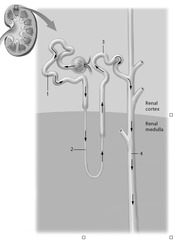
18) Identify the structure marked as "3."
A) collecting duct
B) proximal tubule
C) renal corpuscle
D) distal tubule