Lexicology Final
 Call Kai
 Learn
Learn Practice Test
 Spaced Repetition
 Match
Match Flashcards
 Knowt Play
1/95

Earn XP
Description and Tags
based on presentations fullver
Name | Mastery | Learn | Test | Matching | Spaced | Call with Kai | Chat |
|---|
No analytics yet
Send a link to your students to track their progress
96 Terms
what is lexicology?
study of vocab in a language
branches of lexicology?
semantics, phonology, lexicography, psycholingustics, sociolinguistics, syntax, historical linguistics, morphology
two types of lexicology
general (common features of all langs) and special (specific language)
lexicon synonyms
lexis, word stock, vocabulary
word amounts in personal lexicon
active (5k words), passive (25-60k)
what is a lexeme?
the basic thing that the others stem from (do = lexeme, doing/did/does = word)
how do we know which thingy is the lexeme?
it’s the bare infinitive (bear infinity 👿)
what is a sememe
the meaning of a lexeme (lexeme “move” means to move, to roll, jump, turn etc.)
what is the morphological process?
ask (lexeme) → ask + ing → asking (word! how cool!)
loaded lexeme (no, it doesn’t have a billion dollars)
a lexeme highly charged with connotations (capitalism, politician, facism…)
what is a word?
an unit of the language system (langue) and an unit of speech (parole), meaning is subject to context
are words auditory or visual?
visual (can’t hear the diff betw see and sea, but you can SEA it 🌊)
segmentation/pausing
leaving gaps between words so it’s not gobbledygook
simple vs complex word
simple has 1 morpheme, complex has more
grammatical meaning of a word
unites words into big groups (e. g. “girls” and “tables” have a common element, plurality)
lexical meaning
conceptual (what it is), associative (connotations), stylistic (register), expressive (emotion), collocative (idioms)
what is vocab?
a set of interconnected phenomena that influene each other
centre vs periphery vocab
centre = words we use all the time, periphery = the opposite (tech terms, slang, dialects, nonce words)
extralinguistic reality
everything outside of lang itself (chléb vs bread), basically our lang has words for things we have, not for the things we don’t have, e. g. there’s no tapas in czechia so we use… tapas :D
what are content words?
full words: nouns, adj, adverbs, main verbs
what are function words:
empty words: auxillary verbs, modal verbs, pronouns, prepositons, determiners, conjunctions
lexical density calc
(L / N) x 100 where L is number of full words and N is number of words in total. You get a % of how lexically dense the text is.
what are core words?
days of the week, months, seasons, numbers, colors, fam members, body parts, common professions etc.
syntagmatic relation
the relationship with the words next to the word (collocational stuff)
paradigmatic relation
relation w/ words vertically like a dropdown menu (what word can we put ther instead?)
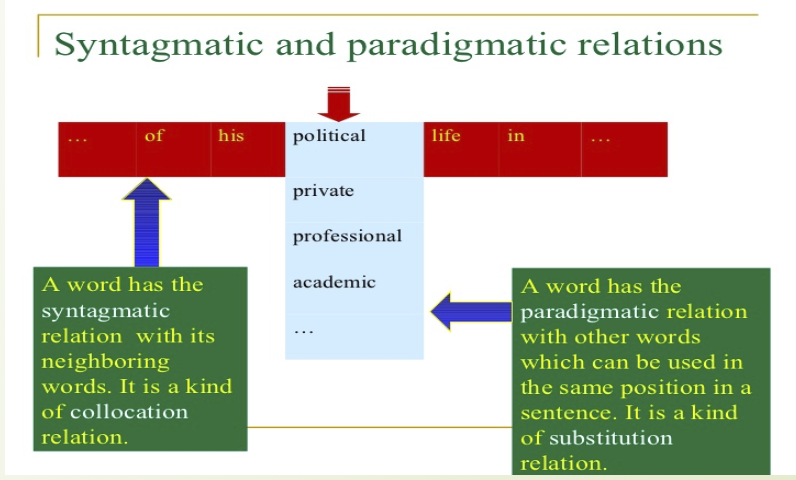
which paradigmatic relations do we have?
synonyms, antonyms, homonyms, hypo/hypernyms
which syntagmatic relations do we have?
collocations, idioms, phrases
synonyms are based on…
formality, slang, emotion, borrowing (time x epoch), dialects
spelling variants
color vs colour (NOT synonymy)
where do we get synonyms?
borrowing (from diff languages), inter-borrowing (same language, e. g. elevator x lift), word formation (popular x pop), semantic change
which words can be antonyms?
qualitative adj (good x bad), nouns, verbs, adverbs, prepositions
gradable antonyms
basically where you can scale them (good x bad → better x worse)
complementary antonyms
you’re either this or that, never both. (male x female, above x below)
relational antonyms
relationships yayyy! cute! (husband x wife, speak x listen, parent x child, buy x sell)
reverse antonyms
opposite direction (come x go, in x out)
MORE antonym types are u kidding me
root (nothing is the same, clean x dirty)
derivatioinal (some resemblance, like x dislike)
mixed (more than one thing, correct x incorrect x wrong)
what is polysemy?
one word = more meaings that are RELATED
what is monosemy
the word only has one meaning (tech terms like vowel)
what is homonymy?
homophones or homographs but their meanings are DIFFERENT (die x dye)
lexical ambiguity
need more context, wthelly do u mean “the student pointed at the foot and the teacher did too” WHICH FOOT? …exactly. you got it. that’s what it means. <3
false friends
fabrika vs fabric (two languages, similar words, waaaay different)
also, opposite of you 🌸
paronymy
similar sounding, way different, same language tho (cosmic x cosmetic)
meronymy (the part) and holonymy (the wHOLE thing)
like synecdoche but in linguistics (hand x finger, house x roof)
remember that “wHOLONYMY” is the whole thing
how can vocab grow?
new words, word formation, new meaning of old words, more meanings of one word, changing meaning
exmaple of changing meaning
gay meant cheerful, now it means ur homosexual
why do words change meaning?
objective reasons (extralinguistic reality changes) or subjective reasons (word seems boring, let’s make a more fashuuuunable one)

narrowing
word’s meaning gets more specific
widening
word’s meaning gets more general
deterioration
word’s meaning gets worse (witch meant wise woman, now means muhaha evil potion evil muhaha)
amelioration
word gets more yippie (nice meant ignorant, now it’s you.. you’re a nice person, love that smile!!)
branching
head = most improtant part of body
so it also started to be “head of household” etc.
figurative language
normal talk, not sticking to the literal meaing of the word (why the long face? …imagine if that was literal lmao)
metaphor
applying a word in a situation where it’s not literally applicable (time is a thief)
types of metaphors
dead metaphor (used everyday)
mixed (mixing two metaphors)
conceptual (explaining one concept by metaphoring another concept, if that makes sense…e. g. “love is war”)
metonymy
referring to sth by an item closely associated with it (crown = king, sword = war etc.)
synecdoche
lend me an ear (listen to me yap)
oxymoron
combining contradictions
understatement
“dani is an alright person” WYM ALRIGHT SHE’S THE COOLEST PERSON EVER
synthesia
one sense described in another (sweet touch)
folk etymology
i mishear “cucuracha” and i think “yeah cockroach sounds cool, let’s use that” (so… change in interpretation because people are silly and mishear stuff)
neologisms
newly coined words not yet accepted into everyday speech
nonce words
words created for one-time use (excaliburger lmao)
archaisms
words no longer used, unless its for artistic purposes
historisms
names for things no longer in use (prairie schooner)
obsolete words
completely out of use (lunting)
you’ve reached the halfway point, take a 10min break, you’re doing well.
also the previous card was 67 (sorry…)
ways of adding new words into vocab
making new words, borrowing and adding new meaing to old words
what is compounding?
two words smashed together: armchair, passer-by
which is the headword in compounds?
the rightmost (armCHAIR, blackBIRD)
coordinative compounds
equal status of the words (Czech-English dictionary)
subordinative compounds
modifier and head (bedROOM… which room? the room with the BED)
what is affixiation?
adding an affix to a word (watch → watched → rewatched)
dissociation vs consociation
eye → ocular (not the same language) vs found → founder (the same word + affix)
what is conversion?
changing the world class to make a word (a saw → to saw off)
what is clipping?
making it shorter (pornography → porn)
acronym vs initalism
acronyms are pronounced as words (NATO), initialisms as letters (HQ or TBU)
hypocorism
John → Johnnie, bag → baggie
Blending
telecast = television broadcast, modem = modulator demodulator
back-formation
from a complex word, we make a simple one (beggar → beg)
reduplicaton
walkie-talkie (similar-sounding words in a sequence)
coinage
inventing new words for new inventions (Aspirin, Cleenex)
borrowing
from another language (rendezvous, soigné)
how are collocations structured?
the node (main word) + the collocate (word that frequently occurs with the node) + span (their distance from each other)
example: set boundaries, city boundaries
set and city = collocates, boundaries = main word
what are idioms?
fixed combos of words (sell like hotcakes)
what are binomials?
sayings that have 2 related words (hugs and kisses, win or lose)
what are trinomials?
the same thing but three words (signed, sealed, delivered)
where are catch phrases from?
movies and popular shows and books
what are euphemisms?
words to say something in a nicer way (die → pass on)
what are dysphemisms?
the opposite… (die → kick the bucket)
what are ethnonyms?
names of members of a nation (Chinese, Czech…) and names of residents there (Londoner)
why would we have loanwords and not just native?
roman invasion, christianity, norman invasion, French conquest, colonization… but also need and prestige (rendezvous sounds cool as fuck)
what the helly is codeswitching?
switching between two languages in conversation (jsi bozi doufam ze to vis i love ur music taste and personality te amoooooooooo!!!!!! → czech to english to spanish)
what is lingua franca?
language used for comms between people who don’t share a native language (so… english :D)
CONGRATS U DID IIIIITTTT
knowt ma dobrou learn funkci, je free, zkus ji a otestuj jestli to umis <3 thanks for trusting me to do ur flashcardsss