Heart Failure Review Flashcards
 Call Kai
 Learn
Learn Practice Test
 Spaced Repetition
 Match
Match Flashcards
 Knowt Play
1/46

Earn XP
Description and Tags
A set of 45 vocabulary flashcards covering heart failure categories, causes, symptoms, diagnostics, and pharmacological treatments based on the lecture notes.
Name | Mastery | Learn | Test | Matching | Spaced | Call with Kai | Chat |
|---|
No analytics yet
Send a link to your students to track their progress
47 Terms
Most common cause of HFrEF
Ischemic heart disease.
Most common cause of HFpEF
Hypertension.
HFrEF Ejection Fraction cutoff
A measurement of ≤40%.
BNP (Brain Natriuretic Peptide)
A hormone released due to ventricular stretch.
The first-line medication used for fluid overload in heart failure.
Loop diuretic
Four pillars of HFrEF therapy
ARNI (/ACE/ARB), beta blocker, MRA, and SGLT2 inhibitor.
ACE Inhibitor Adverse Effects
Cough, hyperkalemia, and angioedema.
Spironolactone Adverse Effects
Hyperkalemia and gynecomastia.
Beta blockers proven to reduce mortality in Heart Failure
Carvedilol, metoprolol succinate, and bisoprolol.
When should beta blockers be avoided in heart failure
Acute decompensated Heart Failure
SGLT2 inhibitors provide benefits for which type of heart failure
Both HFrEF and HFpEF
Digoxin toxicity symptoms and treatment
Visual disturbance, nausea, arrhythmias; activated charcoal
HF medications contraindicated in pregnancy
ACE inhibitors, ARBs, and ARNI.
Classic CXR finding in Heart Failure
Pulmonary vascular congestion (kerley B lines, etc), cardiomegaly, pleural effusion
Acute decompensated HF pulmonary edema treatment
A combination of diuretics, oxygen, and nitrates (if the patient is hypertensive).
A condition in which BNP levels may be falsely low.
Obesity
Conditions in which BNP levels may be elevated (other than HF)
Renal failure, atrial fibrillation, COPD, ARDS, sepsis, liver cirrhosis, hyperthyroidism, chemotherapy.
Most common cause of Right Heart Failure
Left heart failure.
RAAS activation effect on Heart Failure
Promotes sodium retention and cardiac remodeling.
ARNI for Heart Failure
Sacubitril/ valsartan.
MOA and use of Ivabradine
Reduces rate of SA node; use in HFrEF sinus rhythm with HR still >70 bpm on maximum tolerated beta blocker
HFpEF mechanism
Diastolic dysfunction (CO dependent on preload)
HFrEF mechanism
Systolic dysfunction.
Classic description of sputum in pulmonary edema.
Pink frothy sputum
Most common arrhythmia in chronic HF
Atrial fibrillation
Goal of diuretics in HF
Mainly for symptom relief. No proven mortality benefit
Best diagnostic test/imaging study for HF
Echocardiogram
What electrolyte needs monitoring with ACEi and MRA use
Potassium
How do most HF meds work
Blocking maladaptive neurohormonal activation like RAAS
Breathing pattern associated with advanced Heart Failure
Cheyne-Stokes respirations.
Does elevated BNP diagnose Heart Failure
Supports but is nonspecific
Digoxin toxicity and electrolyte monitoring
Hypokalemia most critical, promotes binding to myocardial cell membrane; also monitor serum creatinine as drug primarily excreted by kidneys
NSAIDs and HF
Contraindicated, can worsen symptoms ie fluid retention
What class of diabetes medication is contraindicated in HF
Thiazolidinediones ie pioglitazone & rosiglitazone
Pulmonary artery wedge pressure
Measurement used to indirectly estimate left atrial pressure and left ventricular end-diastolic pressure, essential for determining if pulmonary edema is due to cardiac or non-cardiac cause (high indicates cardiac cause)
How to measure pulmonary artery wedge pressure
Swanz-Ganz catheter.
What diabetic drug should be avoided in acute decompensated HF
Metformin, due to risk of lactic acidosis (increased risk from tissue hypoxia).
High output heart failure
Condition where the heart pumps an adequate volume of blood but cannot meet the body's demands (hyperdynamic state).
Causes of high output heart failure
Hyperthyroidism, beriberi, AV fistula, Paget disease, severe anemia, pregnancy.
Low output Heart Failure
Condition characterized by inadequate cardiac output, leading to insufficient blood supply to meet the body's needs.
Causes of low output heart failure.
Most commonly caused by decreased EF, dilated cardiomyopathy, chronic HTN, valvular heart disease.
Red flags in weight monitoring in HF
Rapid weight gain is defined as 2-3 lbs in 24 hours or 5 lbs in 1 week.
Preload dependent states in which nitroglycerin should be avoided.
Aortic stenosis, volume depletion/ hypotension, RV infarct, hypertrophic cardiomyopathy (HCM).
Risk factors for CHF.
Smoking, alcohol, PMH cardiomyopathy, familial heart disease, rheumatic heart disease, hyperthyroidism, dyslipidemia, diabetes mellitus (DM), HTN, sleep apnea, peripheral arterial disease (PAD), substance use, chemo or radiation to the chest.
Physical exam findings in HFrEF
Pulsus alternans (alternating strong and weak peripheral pulses), laterally displaced apical impulse, S3 heart sound, elevated jugular venous pressure.
Pulmonary edema lung auscultation.
Crackles/ rales that do not clear with coughing.
What is the most sensitive/ specific exam finding with best positive and negative predictive value in HFrEF
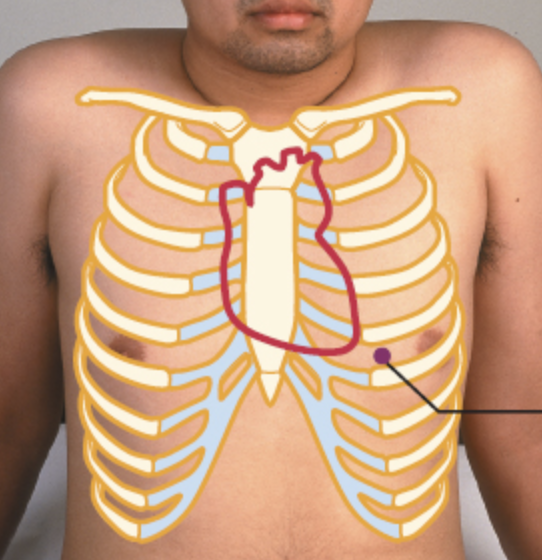
Displaced apical impulse (normally 5th intercostal space).