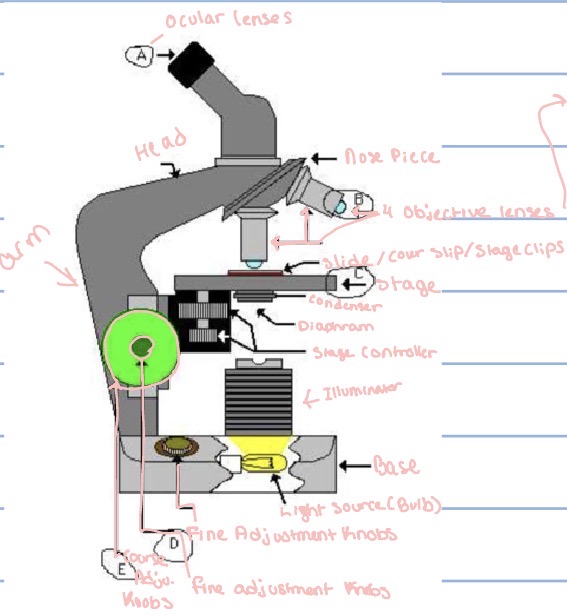
Biology Microscope Lab
 Call Kai
 Learn
Learn Practice Test
 Spaced Repetition
 Match
Match Flashcards
 Knowt Play
1/25

There's no tags or description
Looks like no tags are added yet.
Name | Mastery | Learn | Test | Matching | Spaced | Call with Kai | Chat |
|---|
No analytics yet
Send a link to your students to track their progress
26 Terms
Microscope
Laboratory Instrument used to examine objects that are too small to be seen by the naked eye
Optical Microscope
Uses lenses to refract visible light that passed through thinly sectioned sample to refract light reflected from the surface of an object to produce an observable image
Major Microscopes
Fluoresence Microscope, Electron Microscope, and Scanning Probe Microscope
Microscopy
The Science of investigating small objects and structures using a microscope
Microscopic
Being invisible to the eye unless aided by a microscope
Robert Hooke
Curator of Experiments of Royal Society of London whom created Micrographia and coined the term “cells” when discovering plant cells in a slice of cork
Virtuoso
Able to contribute findings of major importance in any field of science
Micrographia
Book created by Robert Hooke that contained detailed record of observations from magnified drawings of studied organisms
Antonie Van Leeuwenhoek
Dutch microbiologist & Microscopist known as father of microscopy as first to observe and experiment with microbes using self-made single lense microscope & publishes letters in Royal Society’s Philosophical transactions
Magnify
To make something appear larger than the original size
Resolve
The ability of an optical instrument to distinguish 2 closely spaced objects as separate entities
Parfocal
Different objective lenses or eyepieces share same focal plane
Total magnifying power
is the degree to which an optical system enlarges an object, calculated by multiplying the magnifications of the objective and eyepiece lenses.
TMP
Objective lense power x Ocular lense power
Transmission Electron Microscope
Microscopy technique where a beam of electrons is transmitted through an ultra-thin speciment
Scanning Electron Microscope
Instrument that generates highly modified 3D images of sample surfaces by scanning them with focused beam of electrons
Compound Light Microscope
Optical Instrument that uses visible light and a system of multiple lenses to magnify specimens.
FOV
Field of view
The 4 Objective Lenses
Scanning Power Objective(4x), Low Power Objective(100x), High Power Objective(400x), Oil Immersion Objective(1000x)
Oil Immersion Objective
Lens designed to be used with drop of immersion oil between lens & specimen, emulating opacity & refractory properties of glass in lens and slide so light doesn’t bend and cause blurred image
Steps for using a microscope
Clean all objective & Ocular Lenses
Observe scope for damage
Check that light bulb & dimmer are set-up and work
Make sure objective lenses are set to initial scanning power objective(4x)
have ocular lense at 10x and scanning power in conjunction
Increase microscope magnification by switching “up” in power to higher objective lens use - rotate nose piece to next magnification objective
Consider reversal in all observations - left is right, up is down
Clean all lenses when finished
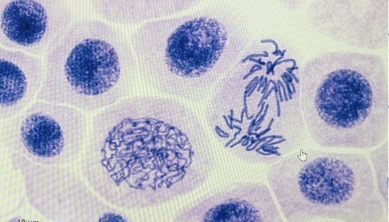
Light Microscope Cell Imagery
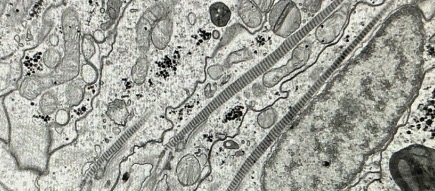
TEM(Transmission Electron Microscope) Imagery
SEM(Scanning Electron Microscope) Imagery
Compound Microscope
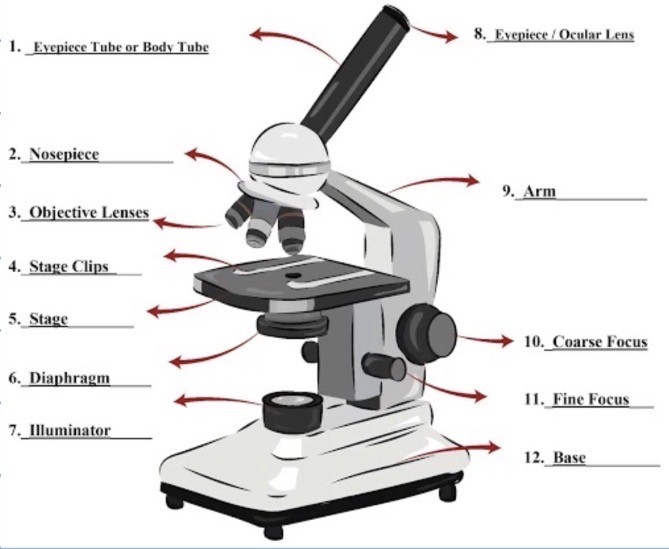
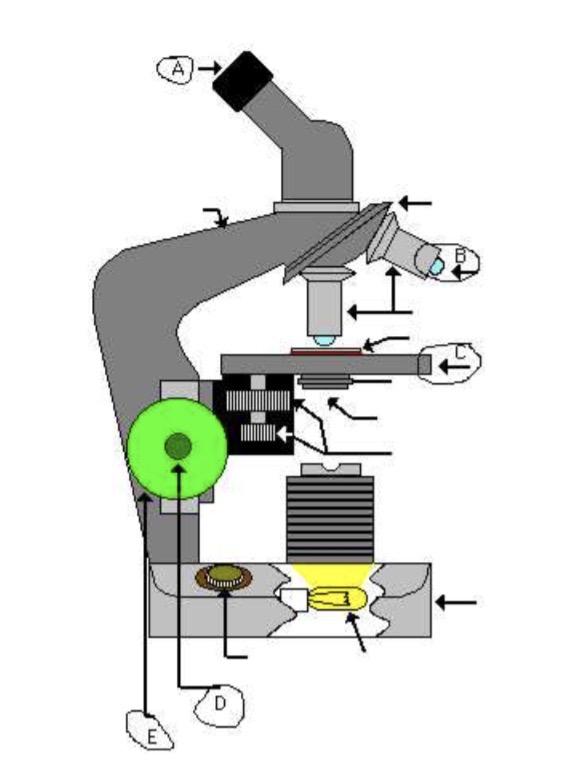
Parts of the Compound Microscope