Topic B - Bacteriophage Life Cycle
 Call Kai
 Learn
Learn Practice Test
 Spaced Repetition
 Match
Match Flashcards
 Knowt Play
1/36

There's no tags or description
Looks like no tags are added yet.
Name | Mastery | Learn | Test | Matching | Spaced | Call with Kai | Chat |
|---|
No analytics yet
Send a link to your students to track their progress
37 Terms
Phases of Lytic Life Cycle
Adsorption - Bacteriophage binds to receptor on bacterial cell surface
Injection - Injection of genetic material into the cell
Early gene expression
DNA replication
Late gene expression
Morphogenesis
Host Cell Lysis
Adsorption
Phage binds to specific receptors on the bacterial surface
-Receptor binding protein found on tail (for tailed phages)
-Every phage targets its own receptor
-Receptor not the intended function, just exploited by the phage
Examples of receptors on Gram-negative bacteria:
Outer-member proteins
LPS
Injection
Phage genome is passed from the capsid → through the bacterial envelope → into the cytoplasm of the host cell
-Mechanisms of Injection:
Contractile tail
Enzymes digest peptidoglycan
Outer membrane transport proteins
Pilus retraction
Injection T4 Genome into E.coli
Tail fibers bind to LPS
Tail fibers retract
Tail pins bind tightly to bacterial cell surface → stable association with bacterial cell surface
Tail sheath contracts → tail tube shoots out through membrane into peptidoglycan, end of the tube contains lysozome
T4 lysozyme digests small hole in PG → tail tube moves past PG through the inner membrane
DNA is injected into cytoplasm
Early Gene Expression
Promoters of early genes look like host cell promoters
-Transcribed by host RNA polymerase
Early genes encode;
Proteins that prevent host-cell gene expression
Enzymes that degrade bacterial chromosome
Enzymes for phage DNA replication (some) (ex; enzymes that make hydroxylmethylcytosine)
Transcription factors needed for transcription of late gene promoters
Phage DNA Replication
Uses combination of host cell and phage-encoded DNA replication proteins
-hundreds of copies of phage DNA produced
Late Gene Expression
Promoter of late genes do not look like host cell promoter
-Require;
Phage transcription factors to help host RNA polymerase, or
Phage RNA polymerase that recognizes late promoters
Late genes encode:
-Structural proteins (capsid and tail)
-Morphogenesis proteins
-Enzymes for host cell lysis
Morphogenesis
Assembly of new phage particles:
-Capsid is assembled
-DNA is inserted
-Tail is attached
Process is different for every phage:
-Some assemble spontaneously
-Some require viral proteins to assist in packaging
Assembly of T4 Phage
Capsid assembled on a protein scaffold
Motor protein attached to capsid
DNA is injected into the capsid (ATP dependent)
Scaffold and motor proteins are removed
Tail assembly and attachment occurs spontaneously
Host Cell Lysis
Bacterial host cell bursts open to release new phage particles:
-Burst size - average number of phage released per bacterial cell
Requires phage enzymes encoded by late genes:
Holin - Disrupts cytoplasmic membrane and allows release of enzymes that degrade peptidoglycan
Lysozyme/Endolysin - breaks bond between sugars in peptidoglycan
Spanin (gram-negative hosts) - creates holes in the envelope by fusing the inner and outer membranes
One end of Spanin anchors into the outer membrane, the other anchors into the inner membrane
Spanin pinches together, fusing the two membranes together; fusion creates a hole
Regulation of the Lytic Cycle
Phage gene expression is controlled by a regulatory cascade
-Early genes active expression of late genes
-Late genes repress expression of early genes
Regulation occurs at the promoters
Prophage, Lysogen and Lysogeny
Prophage - Phage DNA integrated into the host chromosome
Lysogen - Bacterium containing one or more prophage
Lysogeny - Lysogenic life cycle
Stages of the Lysogenic Life Cycle
Adsorption
Injection
DNA circularizes
Lysogeny decision
Integration
Replication
Induction of the lytic cycle
DNA Circularizes
Linear phage genome contains complementary single-stranded ends called Cos Sites
-These will base-pair to each other to circularize the linear phage DNA molecule
Lysogeny Decision
Phage use chemical signals to assess the conditions within the host cell
-If conditions are bad, phage start the lytic cycle
DNA damage
Few phage in the environment (low MOI)
-If condition are good, phage starts lysogeny
Host cell is healthy
Lots of phage in the environment (high MOI)
MOI - Multiplicity of Infection, ratio of bacteria to bacteriophage
Lysogency Decision - Lambda Repressed (cl)
Lambda Repressor (cl) is expressed if conditions are favourable for lysogeny
-Repress the expression of lytic genes from the phage genome by binding to promoters of early genes and block transcription
-Prevents the lytic cycle from starting
Integration
-Integration occurs through site-specific recombination
Integrase - Enzyme that facilitates integration of the phage DNA into the host Bacterial chromosome
-Site-specific DNA recombinase
Catalyzes recombination between the attP in the phage genome and attB in the bacterial chromosome
-NOT homologous recombination because the two DNA sequences are NOT the same
Integration of Lambda Phage into E.Coli Chromosome
attB is located in a non-essential region of bacterial chromosome so integration doesn’t result in an insertion mutation
-After integration, attB and attP sites are halved into two new combinations
-Hybrid sequences (attpB/P and attp/B) found on either side of the prophage

Attp vs Cos Site
Attp site is for inserting the circularized phage genome into the host chromosome
Cos site is for circularizing phage DNA during infection
Replication
Prophage DNA is replicated along with the bacterial chromosome as the lysogen divides
-uses bacterial host’s energy and replication machinery
-Every daughter cell will contain the prophage
Over many generations, lysogen can take over the bacterial population
Induction of the Lytic Cycle
Phage DNA is removed from the bacterial chromosome and lytic cycle starts
-Triggered by cell stress, repression of the lytic genes by cl is lost
-Phage genes are expressed, including:
Excisionase - Enzyme that helps cut prophage DNA out of bacterial chromosome
Early genes of the lytic cycle
DNA Damage and Prophage Excision
DNA damage can induce prophage excision
-DNA damage results in ssDNA fragments
-RecA protein binds to ssDNA creating a protease
-RecA-ssDNA cleaves the cl repressor
-Integrase (int) and excisionase (xis) are expressed once cl is removed
Integrase in the Lytic Cycle
Integrase can’t recognize attB/P or attP/B
-Integrase and excisionase form a complex
Excisionase helps integrase bind to attB/P and attP/B
Promotes site-specific recombination between attB/P and attP/B
Phage DNA is excise and recircularized

Final Stage of Induction
Once prophage is removed from the bacterial chromosome, normal lytic phage replication begins
-Early gene expression → DNA replication → Late gene expression → Morphogenesis → Host cell lysis
Lysogenic Conversion
Some prophage contain additional genes not involved in lysis or lysogeny
-These genes can alter host characteristics/capabilities
Examples: Cholera toxin and Shiga toxin
Cholera Toxin - Lysogenic Conversion
-Nonpathogenic vibrio is infected by two phages to produce cholera toxin
TCP Phage - Encodes genes for the toxin co-regulated pilus (TCP pilus)
CTXo Phage - Uses the TCP as a receptor, will encode genes for cholera toxin production
-Turns the nonpathogenic vibrio into a pathogenic strain
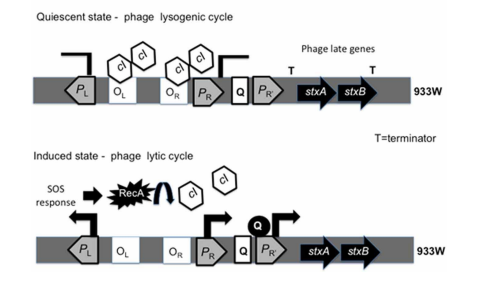
Shiga Toxin - Lysogenic Conversion
Encoded on the Stx phage genome
-Expression of shiga toxin is repressed by a cl-like protein during lysogeny
Superinfection Immunity
Existing prophage prevents another phage from infection a lysogen (superinfection)
-Prevents entrance or replication of a superinfection phage
-Can modify cell-surface receptors to prevent phage binding or entry
Repressors expressed by prophage can prevent gene expression from superinfecting phage
Types of Phages
Virulent Phage/Lytic Phage - Phage that undergoes only lytic growth
-Ex; T4 phage
Temperate Phage - Capable of both lytic growth and lysogeny
-Ex; bacteriophage lambda
Efficiency of Plating (EOP)
Fraction of phage particles in a stock that can form a plaque
EOP = 1 → All phage form plaques
Lytic Phage - EOP is high, all correctly formed phages should form a plaque
Lysogenic Phage - EOP is much less than 1, most phage integrate, few plaques form spontaneously
Multiplicity of Infection (MOI)
Ratio of phage:bacteria in a culture
-One bacterium can be infected by more than one phage particle
-Determines how many bacterial will be infected in a culture:
MOI < 1 = Not all bacteria will be infected
MOI > 1 = each bacterium will be infected by multiple phage
Co-Infection
Infection of a susceptible bacterial culture with two different mutant phage at a high MOI
-some bacteria will be infected by both phages
-two different mutant phage will interact in host cell → Allows the study of mutations
Recombination - interaction of mutant genes
Complementation - interaction of mutant proteins
Host Range
Type of host bacteria that can be infected
-Phage infection shows host specificity due to
Bacterial and phage receptor compatibility
Receptor modification systems of bacteria
Cell machinery compatibility
Ex; Phage P22 infects Salmonella but not E.coli
Host Range Mutants
Extended Host Range Mutant - Mutant phage that can infect bacteria that wildtype phages cannot
Phage Therapy
Phage infect bacteria causing illness, which are then lysed/killed
Advantages of Phage Therapy
-Works against antibiotic resistant bacteria
-Specific — will not destroy microbiome
-Replicate during treatment
-Very few side effects
Disadvantages of Phage Therapy
-Specific - need to know exactly what is causing the infection
-Bacteria can evolve phage resistance
-Hard to claim intellectual property
-PR problems