Economics (Terms)
 Call Kai
 Learn
Learn Practice Test
 Spaced Repetition
 Match
Match Flashcards
 Knowt Play
1/23

There's no tags or description
Looks like no tags are added yet.
Name | Mastery | Learn | Test | Matching | Spaced | Call with Kai | Chat |
|---|
No analytics yet
Send a link to your students to track their progress
24 Terms
The size of the bid-offer spread that the dealer offers to clients depend on what factors
Primary Factors
1. The currency pair involved: Liquidity in major currency pairs is generally higher than that in less popular pairs.
2. The time of the day: The interbank market is most liquid when major trading centers are open.
3. Market volatility: If market volatility is high, bid-offer spreads will be high.
Secondary Factors
1. The size of the transaction: The larger the transaction size, the wider the bid-offer spread.
2. The relationship between the dealer and the client: In order to secure regular business from the client in foreign exchange as well as in other asset classes, the dealer may offer tight bid-offer spreads.
3. Client’s credit profile: If the client has a poor credit history, the dealer may offer a wider bid-offer spread.
International parity conditions
Covered interest rate parity
Uncovered interest rate parity
Forward rate parity
ex-ante version of PPP
international Fisher effect
Covered interest rate parity
states that an investment in a foreign money market instrument that is completely hedged against exchange rate risk should yield exactly the same return as an otherwise identical domestic money market investment.
Uncovered interest rate parity
States that the expected return on an un-hedged foreign currency position should equal the return on a similar domestic currency investment
Forward rate parity
States that the forward exchange rate will be an unbiased predictor of the future spot exchange rate if covered interest rate parity and uncovered interest rate parity hold
ex-ante version of PPP
states that ‘expected’ changes in spot exchange rates are driven by ‘expected’ inflation differentials:
In short, absolute PPP looks at absolute price levels at a single point in time, while relative PPP looks at the rate of change (inflation) over time.
relative version of PPP, the percentage change in the spot exchange rate will be completely determined by the difference between the foreign and domestic inflation rates.
absolute version of PPP asserts that the equilibrium exchange rate between two countries is determined entirely by the ratio of their national price levels.
International Fisher effect
States that if uncovered interest rate parity and ex ante PPP hold, the foreign-domestic nominal yield spread is determined solely by the foreign domestic expected inflation differential.
The flow supply/demand channel (LOOKS AT LONG TERM)
A current account surplus indicates high demand for the domestic currency which would cause the currency to appreciate. Over time the currency would lose its competitiveness resulting in a decline in exports and rise in imports, making the surplus hard to maintain. The opposite would be true in the case of deficits
The portfolio balance channel (LOOKS AT LONG TERM)
Current account balances result in a shift of wealth from deficit running countries to surplus running countries. As countries with significant surpluses realize that their level of foreign reserves is much higher than required, they may attempt to reduce their foreign currency reserves, putting them under downward pressure
The debt sustainability channel (LOOKS AT LONG TERM)
Countries that run persistent current account deficits will see their foreign debt levels rising gradually. However, there should be an upper limit to the amount of foreign debt a country can take. If investors see the foreign debt levels of a country rising to unsustainable levels, they would see a currency depreciation necessary in order to narrow the current account deficit and take the foreign debt to a more manageable level.
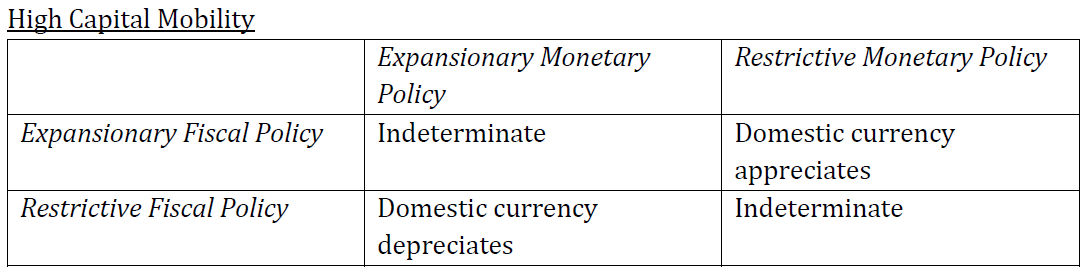
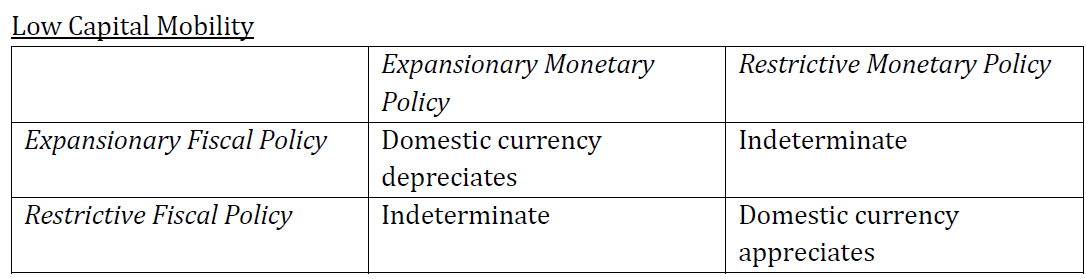
Under the mundell fleming model, is fiscal/monetary more effective in high/low capital mobility?
Monetary → High Capital Mobility
Fiscal → Low Capital Mobility
The Mundell-Fleming model - High Capital Mobility (LOOKS AT SHORT TERM)
The Mundell-Fleming model - Low Capital Mobility (LOOKS AT SHORT TERM)
Warning signs of a currency crisis
In the period leading up to a crisis:
1. liberalization of capital markets
2. Large inflows of foreign capital (relative to GDP)
3. Banking crises
4. Countries with fixed or partially fixed exchange rates are more susceptible.
5. FX reserves tend to decline precipitously as a crisis approaches.
6. Currency has risen substantially relative to its historical mean.
7. The ratio of exports to imports (known as “the terms of trade”) often deteriorates.
8. Broad money growth and the ratio of M2 (a measure of money supply) to bank reserves.
9. Inflation tends to be significantly higher in pre-crisis.
The portfolio balance approach
The Mundell-Fleming model focuses on the short-run; it does not consider the long-run impact of budgetary imbalances. The portfolio balance approach addresses this limitation
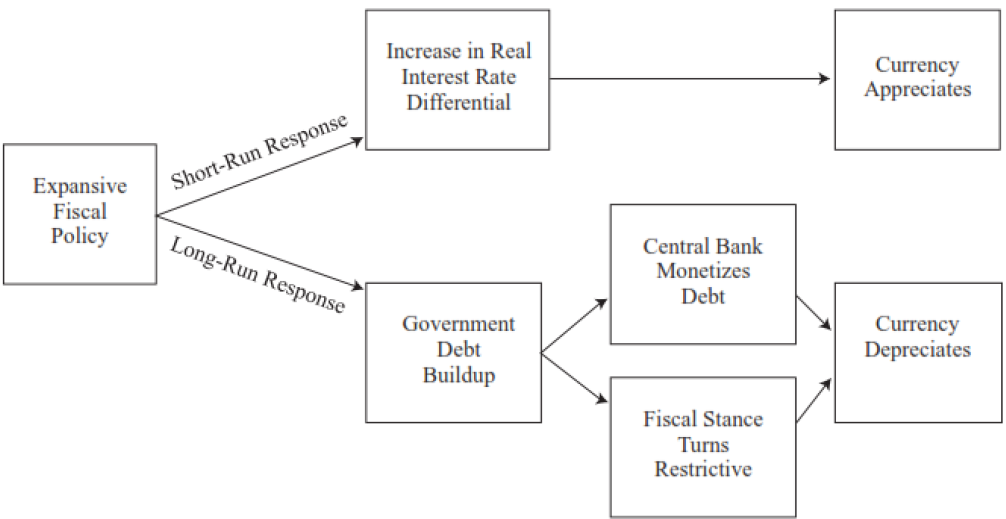
The effectiveness of government intervention depends on
the ratio of central bank FX reserves and FX turnover. If the ratio is low (developed market) then government intervention will have low impact.
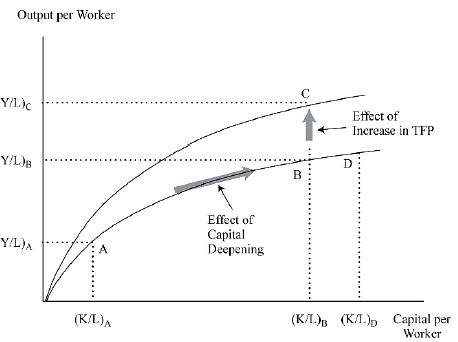
Capital deepening
means an increase in the capital to labor ratio. It is shown by a move along the production function from point A to point B. Adding more and more capital to a fixed number of workers increases per capita output but at a decreasing rate.
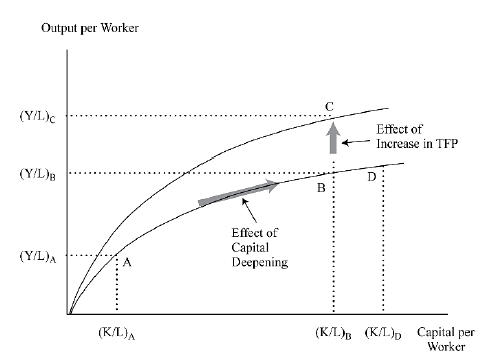
Technological progress
represented by an increase in total factor productivity, causes an upward shift in the entire production function. As a result, the economy can produce higher output per worker for a given level of capital per worker. This is shown by the move from B to C
Absolute convergence
implies that developing countries, regardless of their particular characteristics, will eventually catch up with the developed countries and match them in per capita output
Conditional convergence
implies that convergence is conditional on the countries having the same saving rate, population growth rate and production function. If these conditions hold, the model implies convergence to the same level of per capita output as well as the same steady state growth rate.
Club convergence
implies that only rich and middle-income countries that are members of the club (countries which develop appropriate legal, political and economic systems; open trade and capital flow)are converging to the income level of the richest countries of the world. Countries with the lowest per capita income in the club grow at the fastest rate. However, countries outside the club without appropriate institutional structures may fall into a non-convergence trap
Classical Model (also called Malthusian Theory)
• Growth in real GDP per capita is temporary.
• Rise in real GDP per capita above subsistence level results in a population explosion.
• And the real GDP per capita returns to subsistence level.
Neo-Classical Model
• In the steady state, ‘capital per worker” and “output per worker” grow at equal sustainable rates.
• Long-run per capita growth depends on exogenous technological progress.
• Capital deepening has no impact on growth rate or on the marginal product of capital.
• There will be a convergence of per capita income in developing and developed countries.
Endogenous Growth Theory
• Focus on explaining technological progress rather than treating as exogenous.
• It states that there is no reason why incomes of developed and developing countries should converge.
• A higher saving rate can lead to a permanently higher growth rates