RP5: Dissection of animal or plant gas exchange or mass transport system or of organ within such a system
 Call Kai
 Learn
Learn Practice Test
 Spaced Repetition
 Match
Match Flashcards
 Knowt Play
1/10

There's no tags or description
Looks like no tags are added yet.
Name | Mastery | Learn | Test | Matching | Spaced | Call with Kai | Chat |
|---|
No analytics yet
Send a link to your students to track their progress
11 Terms
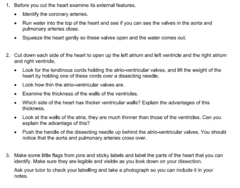
What is the basic method instructions for this experiment? (6)
You don't have to know the steps, just appreciate and understand them!
Describe the rules for a scientific drawing. (6)
- Only use continuous lines (no sketching).
- Add labels with horizontal ruled lines (no arrowheads, label lines should not cross over).
- State the magnification.
- Draw all parts to the same scale.
- Do not use shading or hatching.
- Use at least 50% of the available space.
Describe two precautions the student should take when performing the dissection. (5)
- Wear a disposable apron or a lab coat.
- Cover any cuts with a waterproof dressing.
- When using a scalpel, cut away from yourself and use forceps to hold tissue whilst cutting.
- Wear disposable gloves.
- Cut on a hard surface.
Describe two precautions the student should take when clearing away the dissection. (4)
- Disinfect hands.
- Disinfect instruments and surfaces.
- Carry sharp instruments by pointing down.
- Put gloves, paper towels, or the organ in a separate bag/bin to dispose of.
Describe what an eyepiece graticule is and explain its purpose. (3)
- A glass disc with a scale on it but no units.
- The eyepiece graticule is inserted into the eyepiece of the microscope.
- Used to measure the size of specimens viewed under the microscope.
Explain how an eyepiece graticule should be calibrated. (4)
1. Place a stage micrometer on the stage of the microscope.
2. Align the scales of the eyepiece graticule and stage micrometer while looking through the eyepiece.
3. Count the number of eyepiece graticule divisions that fit into one division on the stage micrometer (each division is usually equal to 100 µm).
4. Calculate the length of one eyepiece division.
Explain why an eyepiece graticule needs to be calibrated. (2)
- When the objective lens is changed, the magnification changes.
- The eyepiece graticule needs to be recalibrated to calculate the distance between each division at that particular magnification.
Discuss the ethical issues involved in dissecting animals. (3)
- It is morally wrong to kill animals just for dissection → use animals that have already been killed for meat.
- Animals raised for dissection may be subject to overcrowding or lack of food.
- If animals are being raised for dissection, they should be looked after properly and killed humanely.
Describe how a piece of lower epidermis could be prepared to observe using an optical microscope. (5)
1. Add a drop of water to a clean glass slide.
2. Peel off the lower epidermis using tweezers or forceps.
3. The epidermis is thin because it is a single layer of cells.
4. Lay the epidermis on top of the slide.
5. Place the coverslip at an angle of 45° to the specimen and lower it onto the slide using a mounted needle to avoid trapping air bubbles.
A student does not have an eyepiece graticule or a stage micrometer.
Describe how they could use a ruler with mm divisions to find the area of the field of view using the lowest-powered objective lens. (4)
1. Put the ruler on the stage.
2. Focus the microscope.
3. Look through the eyepiece and measure the diameter of the field of view using the divisions on the ruler.
4. Use πr² to calculate the area of the field of view
Describe how an eyepiece graticule could be used to determine the mean diameter of stomata on a leaf. (3)
1. Calibrate the eyepiece graticule against a stage micrometer.
2. Measure a large number of stomata using the eyepiece graticule.
3. Calculate a mean diameter.