History - WW1 and WW2
 Call Kai
 Learn
Learn Practice Test
 Spaced Repetition
 Match
Match Flashcards
 Knowt Play
1/45

There's no tags or description
Looks like no tags are added yet.
Name | Mastery | Learn | Test | Matching | Spaced | Call with Kai | Chat |
|---|
No analytics yet
Send a link to your students to track their progress
46 Terms
Name the key Concepts:
Imperialism
Nationalism
Militarism
Fascism
What is Imperialism?
belief that a nation can control & exploit another country’s people and resources.
consists of policies allowing for expansion beyond own territories to acquire an overseas empire, increasing influence : colonisation
In both WW1 and WW2, aggressive countries were imperialists
e.g the French colonising Africa.
What is Nationalism?
Describes the pride in belonging to one’s own country, is patriotic, leading to the championing of own country over others.
At extreme level: an individual/group sees themselves as more important and deserving of rights compared to other countries.
As a political movement: a country asserting authority over other nations, often by force.
Nationalist: individual who is devoted to country’s interests, putting them above other countries, even possibly compromising their own values in the process. E.g. Hitler.
What is Militarism?
When military commanders exert excessive influence on gov. and policies, civilians have limited control.
Militant: a person/the use of systemic violence to achieve political change.
Main principles: keeping large armies, navies ready for battle and regarding military efficiency as the most instrumental segment of a government.
E.g. Japan had a militaristic gov. in the 1930s
What is Fascism?
‘Fascism’ - refers to the Italian political movement established by Mussolini in 1919.
‘fascism’- general term referring to political movements that share a radical political philosophy, has extreme nationalism, anti-communism, and anti-liberalism, often taking on racism.
Characterised by:
Militarised aesthetic - politics becomes a military campaign through united rallies, symbols of violence, and uniforms to erase individuality and sense of power, discipline and order.
Revolutionary outlook - wants to completely erase the old political system to build a new society, by claiming the nation is dying, weak, corrupt and often promises a golden ‘New Age’ from extreme actions.
Hyper-masculinity - dependant on strict and exaggerated ideas of manhood to drive its aggressive goals, rejecting ‘weak’ traits like empathy, promotes patriarchal control and strict gendered hierarchies.
What are short term and long term causes:
Short term: they are immediate and specific events and factors, that occur relatively close in time to the event they influence.
Long term: they are underlying conditions or trends that develops over years, decades, or centuries as a foundation for a major event.
What are WW1’s short term causes:
The assassination of Archduke Franz Ferdinand by Gavrilo Princip (Bosnian Serb and member of the Black Hand Nationalist group) in 1914, motivated by Princip’s desire to ‘free’ Bosnia from Austro-Hungarian rule. As, Austria-Hungary annexed Bosnia (1908), angering Bosnian Nationalists who wanted to unify all Southern Slavic nations under one government.
The July Crisis was a month-long period of political and military escalations, where Austria-Hungary issued an intentionally humiliating and harsh ultimatum to Serbia to justify a military invasion, with the support of Germany (July 23rd). Russia mobilised on the 25th to support Serbia before they responded. Austria-Hungary declared war on Serbia on the 28th, 1914. Germany then declares war on Russia and France after the French mobilise their forces. Great Britain wages war on Germany, A-H starts conflict with Russia and France and Great Britain wages a war with Austria-Hungary.
What are WW1’s long term causes: M
Militarism: Militarism acted as a primary catalyst for World War I by transforming European competition into a volatile arms race. European powers equated prestige and power with military strength, leading to several nations becoming a part of an industrialised arms race, as seen through the vicious naval race between Germany and Britain. Competition led to tension, lack of diplomacy and large scale mobilisation plans to be made. Therefore when the 1914 crisis began, governments pushed for war instead of diplomacy due to fear of other nations striking first and the fact that they were all prepped for conflict.
What are WW1’s long term causes: A
Alliances: The European alliance system drove World War I by transforming a localised Balkan crisis into a continental war through a system of mutual fear and rigid obligations. By dividing Europe into the Triple Alliance (Germany, Austria-Hungary, Italy) and the Triple Entente (Britain, France, Russia), nations surrendered their diplomatic independence to automatically back up their allies, out of fear of geopolitical isolation, national pride and to survive. This collective insecurity empowered Austria-Hungary to recklessly declare war on Serbia, knowing Germany had to support them, triggering the domino effect. Russia mobilised to protect its Slavic ally, forcing Germany to launch a preemptive attack on Russia and France, which subsequently dragged Britain into the war. Ultimately, alliances drove the conflict because they stripped European leaders of diplomatic flexibility, ensuring that a single regional spark was structurally guaranteed to drag every major power into an existential survival test.
What are WW1’s long term causes: I
Imperialism drove the outbreak of World War I by transforming global territorial expansion into a struggle for national power, destabilising European diplomacy. As industrial economies grew dependent on foreign markets and raw materials, European powers equated imperial expansion with geopolitical security. This economic imperative turned Africa and Asia into arenas of fierce competition, epitomised by the Moroccan Crises, where Germany’s aggressive attempts to disrupt French and British colonial dominance backfired. Instead of expanding German influence, these moves triggered anxiety and hostility, forcing Britain and France to secure their overseas territories more fiercely. Ultimately, imperialism drove the war because the race is to colonise swiftly left no more "free" land to claim and diplomacy was broken from the fight to gain more influence. This saturation point increased European rivalries and what started as independent processes to accumulate influence became an explosive, existential struggle for global dominance.
What are WW1’s long term causes: N
Nationalism drove the outbreak of World War I by acting as an explosive force that crushed regional stability in the Balkans and manufactured public consensus for war across Europe. For Slavic minorities trapped within the Austro-Hungarian Empire, nationalism fuelled the existential struggle for independence. This fierce desire for a pan-Slavic state led the Serbian nationalist group, the Black Hand, to assassinate Archduke Franz Ferdinand in Bosnia, aiming to break Austrian rule. However, nationalism also drove the response of the great powers. In Vienna, it manifested as imperial pride, forcing Austria-Hungary to issue a humiliating ultimatum to Serbia to crush Serbian nationalism and shatter resistance of their empire. Simultaneously, state-driven nationalism in Russia, Germany, and France had conditioned the European public to view war not as a catastrophe, but as a glorious test of national supremacy. Ultimately, nationalism drove the war because it created a dual crisis: it provided the radical violent spark in Sarajevo that disrupted the balance of power, and it generated the fierce patriotic enthusiasm that prevented European leaders from backing down or appealing to diplomacy.
What are WW2’s short term causes:
Anschluss: Nazi Germany’s annexation of Austria in March 1938. This went against the Treaty of Versailles and without much military or political resistance from other European powers, Hitler became encouraged to further expand Germany’s territory.
Germany’s invasion of Poland on 1st of September 1939 also emboldened Nazi aggression due to little resistance again.
Both of these conquests provided Nazi Germany with manpower, military equipment, raw materials all were valuable resources that helped build up its military.
What are WW2’s long term causes?
The Treaty of Versailles (1919) forced Germany to accept full responsibilities of WW1, pay massive reparations and lost land. This resulted in economic devastation and public resentment towards the Weimar Republic, facilitating Hitler and the Nazi Party’s rising.
The weakness of the Weimar Republic and The Great Depression led to desperate voters supporting extremist factions and government blame on economic downfall.
Appeasement: inability of major European powers and the failure of the League of Nations to combat aggression and expansion of Nazi Germany, fascist Italy, Imperial Japan etc.
WWII Long Term Causes - What was the ‘Stab-in-the-back’ myth and its significance?
False Propaganda Belief: Claimed the German military did not lose WWI on the battlefield.
Betrayal Accusation: Blamed civilians, socialists, and Jews for ruining the war effort.
Homefront Traitors: Argued a "stab in the back" at home caused defeat.
SIGNIFICANCE:
Damaged Weimar Republic: Left the new democracy hated from its very start.
Versailles Anger: Linked democracy directly to the humiliating peace treaty.
Fueled Nazi Rise: Provided Hitler with highly effective propaganda.
Justified Persecution: Scapegoated Jewish people, setting up future genocide.
Drove Revanchism: Created a national obsession with getting revenge.
WWII Long Term Causes - the ‘diktat’
Dictated Peace: A term used by Germans to describe the Treaty of Versailles.
No Representation: Germany was completely excluded from the peace negotiations.
Forced Signature: Germany was given no choice but to sign the humiliating document.
SIGNIFICANCE - short term - why did germans resent it?
Unfair Punishment: regular Germans felt blamed for a war started by the Kaiser and military.
Zero Legitimacy: The document was never viewed as morally or legally valid.
Siege Mentality: Created an "us against the cruel world" attitude (Historian Peter Hayes).
SIGNIFICANCE: - long term - how did it lead to the rise of Hitler, Nazism and WW2?
Birth of Nazism: The bitter post-war atmosphere directly fueled radical right-wing politics.
Hitler's Opportunity: Adolf Hitler took advantage of this deep national resentment.
Weaponised Anger: The Nazi party promised to tear up the illegitimate treaty and get revenge.
What is Arno Mayer’s view on the Treaty of Versailles? (1967)
Core Argument: The peacemakers were driven by greed and revenge rather than fair diplomacy, described as “imperialistic and selfish”
Key Target: France is blasted for being overly harsh, while Lloyd George is seen as too weak.
Easy Quote: "Predatory and punitive" (describing the French approach).
What is A.J.P. Taylor’s controversial view on Versailles? (1961)
Core Argument: The treaty failed because it left Germany powerful enough to seek European dominance.
Shocking Claim: The Treaty of Versailles was actually not harsh enough.
Easy Quote: "The 'German problem' unsolved... to be solved only by a second World War."
How does Jay Winter link Versailles to World War II? (1996)
Core Argument: The peace conference focused entirely on retribution instead of global stability.
Direct Link: The toxic quest to revenge directly paved the path to the next war.
Easy Quote: "More about punishment than peace… The road to World War II started here."
What is Sally Marks’ view on the Treaty of Versailles? (2013)
Core Argument
Defended its terms: The treaty was not overly harsh or economically impossible for Germany to fulfill.The failure of the treaty lay in the Allies' lack of political will to enforce it, creating an "illusion of peace."
Key Challenge
Dismantle myths: Historians must abandon the long-standing German propaganda narrative that painted the treaty as a vindictive, destructive peace.
Easy Quote
"Time... to abandon old myths and simplistic propaganda-driven explanations."
What is Jürgen Tampke’s revisionist view on Germany and Versailles? (2017)
Core Argument: Germany manipulated facts, lied about economic losses, and intentionally misinterpreted the peace terms.
Key Defense: The outbreak of WWII cannot be blamed on the Allied peacemakers.
Easy Quote: "That was not the fault of the peacemakers."
How does Alan Sharp balancedly view the peace settlements? (2018)
Core Argument: The treaty was deeply flawed and dangerous, yet it simultaneously offered a real chance for peace.
Dual Nature: It held both the ingredients for a future war and the framework for a better world.
Easy Quote: "Contain many potential seeds for future conflict, but yet also the potential for a more hopeful world"
What was Woodrow Wilson's view of the Treaty of Versailles? (1917)
Core Argument: Imposing harsh, humiliating terms on a defeated nation guarantees future conflict.
Key Insight: Lasting peace requires mutual agreement between equals rather than victor's terms.
Easy Quote: "Leave a sting, a resentment, a bitter memory upon which terms of peace would rest... only as upon quicksand."
What was Ferdinand Foch's view of Versailles? (1919)
Core Argument: The treaty was far too lenient and failed to permanently neutralise Germany's power.
Tragic Accuracy: His prediction proved exactly right, as WWII broke out 20 years and 64 days later.
Easy Quote: "This is not a peace. It is an armistice for twenty years."
How did the monarchy fall?
Kaiser Abdicates: Kaiser Wilhelm II gave up his throne and fled the country to Netherlands.
End of Empire: This officially marked the collapse of the German monarchy.
New Leadership: A new socialist government took power, led by Friedrich Ebert.
Armistice Signed: This new government signed the ceasefire to officially stop the fighting.
Unfair Blame: This action inadvertently linked the new democratic leaders to Germany's defeat
How did the post-war crisis destabilise the Weimar Republic - economically and socially?
Virtual Bankruptcy: Nation broke, families devastated, and industrial output crashed.
Claims of Decadence: Frivolous spending and poor financial management from politicians widened social class gaps and fuelled anger towards government.
Deep Divisions: Massive gaps in living standards alongside severe workers' unrest.
Extremist Threats: Armed groups like the Freikorps actively plotted against the state.
Incomplete Revolution: Bitter political fractures left the new democracy fundamentally unstable.
Weakness of the Weimar - Voting system
Maths of Voting: Seats in the Reichstag matched the exact percentage of votes won nationwide.
No Clear Majorities: Because votes were split across so many viewpoints, it was mathematically impossible for a single party to win a majority.
Fragmented Parliament: This allowed tiny, radical fringe parties to win seats and gain a voice.
Weak Coalition Governments: Big parties were forced to team up with rivals to rule, leading to constant gridlock, infighting, and collapse.
Weakness of the Weimar - Constitution
Emergency Decrees: Granted the president total power to bypass parliament and rule by law-making decree.
Hindenburg's Abuse: Used by President Hindenburg after 1930 to install unpopular chancellors which he could control.
Authoritarian Pathway: Normalised ruling without a parliamentary majority, eroding democracy from within.
Article 48: Under Article 48 of the Weimar Constitution, the Chancellor could rule by decree in an emergency.
Which political party was on the very left?
Communists (KPD):
Supporters: Working class
Policies: Promoted Germany’s function as a Communist country run by worker’s councils, not Parliaments.
Which political party was on the very right?
The Nationalist Socialist German Worker’s Party/Nazi (NSDAP):
Supporters: unemployed (mostly ex-soldiers) and some from the upper class who feared Communism.
Policies: Wanted Germany to be strong again with a powerful government led by one man (hated communism and democracy).
Historians analysing the fall of the Weimar Republic:
Fritz Stern: "Born in defeat, humiliated by Versailles."
What he argued: The republic was fundamentally broken from the start because internal enemies constantly mocked it.
Why useful: Perfect for proving that a total lack of public legitimacy doomed the democratic system.
Gerhard Ritter: Blame on WWI and its consequences, not the collective failing of the German psyche
What he argued: Weimar's failure was caused by structural wartime trauma, not a flawed German psychology.
Why useful: Ideal for counter-arguing that external, historical disasters destroyed the state rather than public choices.
Detlev Peukert: Tensions created by the 1920s’ revolutions.
What he argued: The collapse wasn't just basic left-vs-right politics, but overwhelming friction from rapid modernisation.
Why useful: Great for a sophisticated analysis showing how fast-changing technology, business, and social values broke society.
Long term cause of WWII: Ruhr Occupation
Missed Payments: Germany fell behind on the crushing, impossibly heavy financial reparations demanded by the Allies.
Industrial Takeover: In response, foreign armies seized the Ruhr valley—Germany's core industrial engine for economic generation.
Passive Resistance: Local German workers went on strike, completely halting production to deny the occupiers any goods.
Geographical Violation: The Ruhr was located deep within sovereign German territory —> invasion by foreign troops feel like a direct, humiliating violation of the nation’s borders.
Ethnic and Cultural Clashes: The occupying forces included French colonial troops, sparking intense racist and nationalist outrage among local Germans.
Severe Civil Disruption: Frequent, violent clashes erupted between the local German population and the foreign occupiers over curfews, food shortages, and control of the railways.
The WWII Connection: This intense humiliation inside their own borders created a deep desire for revenge (revanchism) and fuelled the Nazi promise to build a strong military that could never be bullied again.
Long Term Causes of WWII: Hyperinflation
Overprinting Money: The state printed vast amounts of unbacked paper currency to pay welfare to the striking Ruhr workers.
Currency Collapse: Bounded by zero industrial production, the value of their national currency disintegrated, wiping out middle-class savings overnight.
The WWII Connection: The total destruction of financial security radicalised ordinary voters, cementing a permanent hatred for Western powers and helping the Nazis gain popularity.
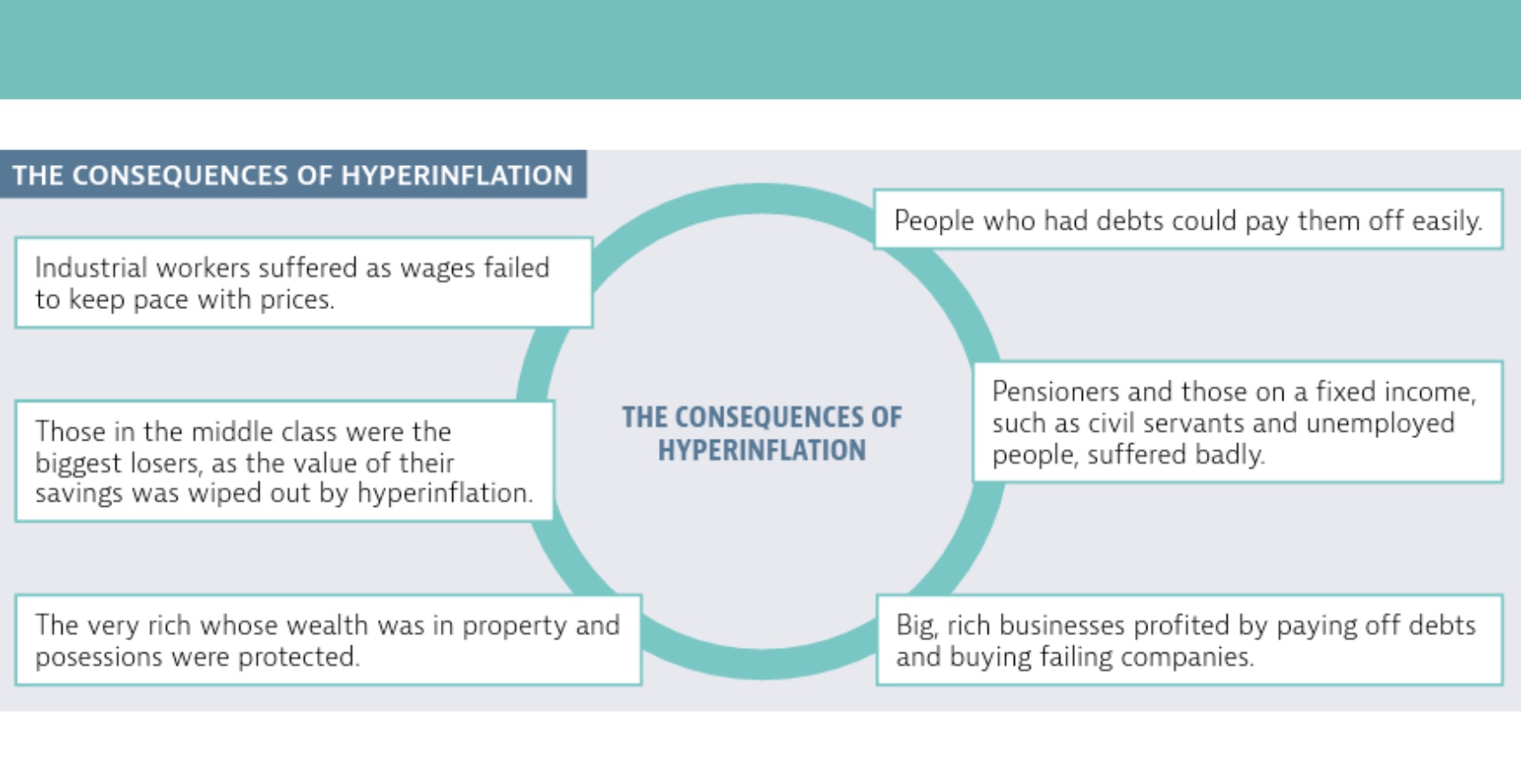
CONSEQUENCES ARE IN IMAGE
How was Hyperinflation Resolved
cured by the introduction of the new currency in 1924 - the Rentenmark
however, the loss of values in savings hit middle class families hard, causing lasting generational damage.
Long Term Causes of WWII - ‘The Golden Era’
American Loan Lifeline: Germany’s economic boom was entirely funded by massive financial loans from the United States - 1924 Dawes Plan
Agricultural Crisis: The farming sector never shared in the boom, crippled by low prices and heavy competition from Canada and the US.
Hidden Danger: The apparent stability was completely dependent on foreign money that could be withdrawn at any moment.
Long Term Causes of WWII - The beginning of The Great Depression
Terrible Timing: The US stock market crash instantly triggered a global economic collapse known as the Great Depression.
Loans Recalled: Panic-stricken American banks abruptly recalled all the money and financial loans they had lent to Germany.
Instant Collapse: Deprived of its financial backbone, the fragile German economy immediately shattered, ending the "Golden Era".
Long Term Causes of WWII - What was the economic cycle of the Great Depression?
Oversupply Trap: Factories and farms produced an oversupply of materials, causing market prices to plummet.
Crushed Profits: Falling prices meant manufacturers made less profit, forcing them to slash industrial production.
Vicious Cycle: Lower production triggered massive unemployment —> less consumer spending —> the massive oversupply remained stuck, worsening the crisis.
Long Term Causes of WWII - Consequences of the Great Depression
Skyrocketing Unemployment: Jobless numbers exploded exponentially from under 2 million in 1928, to nearly 3 million in 1929, peaking at over 6 million by 1932.
Democratic Breakdown: Desperate economic misery completely shattered public faith in the Weimar Republic, rendering democracy totally broken.
Extremist Appeal: Starving and desperate citizens abandoned mainstream politicians and turned directly to extreme political solutions.
Nazi Rise to Power: Hitler successfully took advantage of this chaos, using appealing promises to seize power in 1933, rapidly slash unemployment, and launch the aggressive rearmament that led to WWII.
The Rise of the Nazi Party: F(f)acism
CHARACTERISTICS:
nation led by an authoritarian leader who embodies the nation’s will.
the nation is ultranationalistic, has an authoritarian political philosophy, militaristic and believes in economic self -sufficeny, and totalitarianism.
Opposes communism, socialism, pluralism, individual rights and equality, democracy.
values nation and community above all else - Volksgemeinschaft
Violence is accepted —> hypermasculinity
National Socialism and Nazism
form of fascism adopted by hitler and nazis in 1930s
characterised by secret police, territorial expansion, extreme nationalism and lack of personal freedom.
Intense and brutal discrimination against those who didn’t fit the ideal German: Jewish peoples, queer, Sinti, Romani (Gypsies), disabled people and Polish.
What was Hitler’s Worldview/ Weltanschauung
Versailles = great betrayal: Germans wer victims of WWI.
History has always been an existential struggle of biology and race, believing that only the strongest and racially ‘pure’ communities survived, becoming the most evolved victors (Aryans)
He believed that reversing WWI was not enough, Germany needed to be ‘sanitised internally’ - the Holocaust.
Success was judged on fertility, military strength, racial purity
Hitler had a god complex: believed that only he can understand the laws and processes of history.
Believed that a healthy race must expand territory: Lebensraum.
Volksgemeinschaft: “Peoples Community” - class, religious and regional divisions had no meaning, as they were all a unified within the Volk.
Hitler on Jewish Peoples
Jewish people were at the bottom of the racial hierarchy
Persecution of Jews = act of self defence, and essential to Nazi policy justification (eugenics etc.)
Primary Source example: Hitler’s letter to Gemlich, Sep 16th 1919: “ruinous impact on our nation” (Jewish question is a national one), and the solution is the “removal of Jews all together”.
He believed Jews had to be dealt with internally before addressing the living space - Jewish people were not a part of the racial struggle, as he viewed them to be subhuman
What did Hayes and William Sheridan Allen say about antisemitism?
Antisemitism is a result, not a cause of Hitler’s rise to power.
Rise to Power: Beer Hall Putsch 9th Nov 1923
Hitler attempts Mussolini’s method to seize power, but coup failed
engaged in treason and put in prison for a year and starts writing Mein Kampf here ( a manifesto of his beliefs).
Used trial as a national megaphone to spread ideologies and condemn the Nov. criminals
Strategic move: he became a household name, gets press recognition and popularity after trial.
Tactics of Legality
decides to overthrow the government legally —> shifts attention to rural regions