Joint and Connective Tissue (EXAM 1)
 Call Kai
 Learn
Learn Practice Test
 Spaced Repetition
 Match
Match Flashcards
 Knowt Play
1/24

There's no tags or description
Looks like no tags are added yet.
Name | Mastery | Learn | Test | Matching | Spaced | Call with Kai | Chat |
|---|
No analytics yet
Send a link to your students to track their progress
25 Terms
Cells
Role: produce ECM
Fibroblast = basic cell
Differentiates to become a more specialized connective tissue cell
▪ Chondroblast/cyte
▪ Tenoblast/cyte
▪ Osteoblast/cyte
Collagen
Type I
is found in most/all connective tissues
most of the body’s total collagen
Resists tensile stress
Type II
▪ Mainly found in cartilage and nuclei of IV discs
▪ Gives compressive strength
Elastin
Found in tissues that require more deformation and elasticity
Arteries (30% elastin)
Ligamentum Nuchae (75% elastin)
Achilles Tendon (4% elastin)
ECM
most of vol in tissue
proteins + water
Has Both Fibrillar (collagen + elastin) and Interfibrillar (H2O, PGs, GAGs) things
PGs + GAGs
Proteoglycans (PG’s)
protein w/ carb linked to it
Glycosaminoglycans (GAG’s)
▪ Carb portion of the PG
▪ Responsible for water content in the ECM
****Increases in # PGs + GAGs → increases water****
which will make it easier to resist compressive loads (cartilage + interverbral discs)
ex: Hyaline cartilage
Ligament (cell, fibrillar component, nutrition source, and optimal mechanical stressor)
Cell: Fibroblast
Fibrillar Component: Type I Collagen w/ varying amount of Elastin
fibrils are organized in line w/ the applied tensile forces (from joint movement or external forces)
****(not very good @ resist tensile forces)***
changes based on joint position
NOT uniform in the structure
ratio (Collagen/Elastin) depending on role of ligament (stability or mobility)
Nutrition source: blood supply (even though not very vascular)
Optimal mechanical stressor: tension + shear
Tendon (cell, fibrillar component, nutrition source, and optimal mechanical stressor)
Cell: Fibroblast, Tenoblasts, Tenocytes
Fibrillar Component: Mainly type I collagen (more than ligament)
Fibers are uniform and in the SAME direction of tensile loading (contrast to ligament)
****( very good @ resist tensile forces)***
***force produce by muscle = strain experience by tendon***
Nutrition source: blood supply (limited → hard for tendon to heal)
Optimal mechanical stressor: tensile loading to stay healthy
Impacts collagen content and cross-linking
Hyaline Cartilage (cell, fibrillar component, nutrition source, and optimal mechanical stressor)
Cell: Chondroblast, Chrondrocyte
Fibrillar Component: 90-95% Type I collagen
Fibers are uniform and in the SAME direction of tensile loading (contrast to ligament)
Interfibrillar Components: PG’s (aggrecan), GAG’s, (chondroitin sulfate/keratin sulfate, hyaluronan)
Nutrition source: diffusion for nutrition (synovial fluid) via compression
Optimal mechanical stressor: compression
Bone
Cell: Fibroblasts, osteoblasts, osteocytes, osteoclasts, progenitor cells
Fibrillar Component:
Type I Collagen w/ hydroxyapatite crystals (helps give more compressive strength)
Interfibrillar Components: PG’s (aggrecan), GAG’s, (chondroitin sulfate/keratin sulfate, hyaluronan)
Nutrition source: blood supply
Optimal mechanical stressor:
Wolff’s law
bone loading (via weight bearing + muscle contraction)
load bones → stronger bones
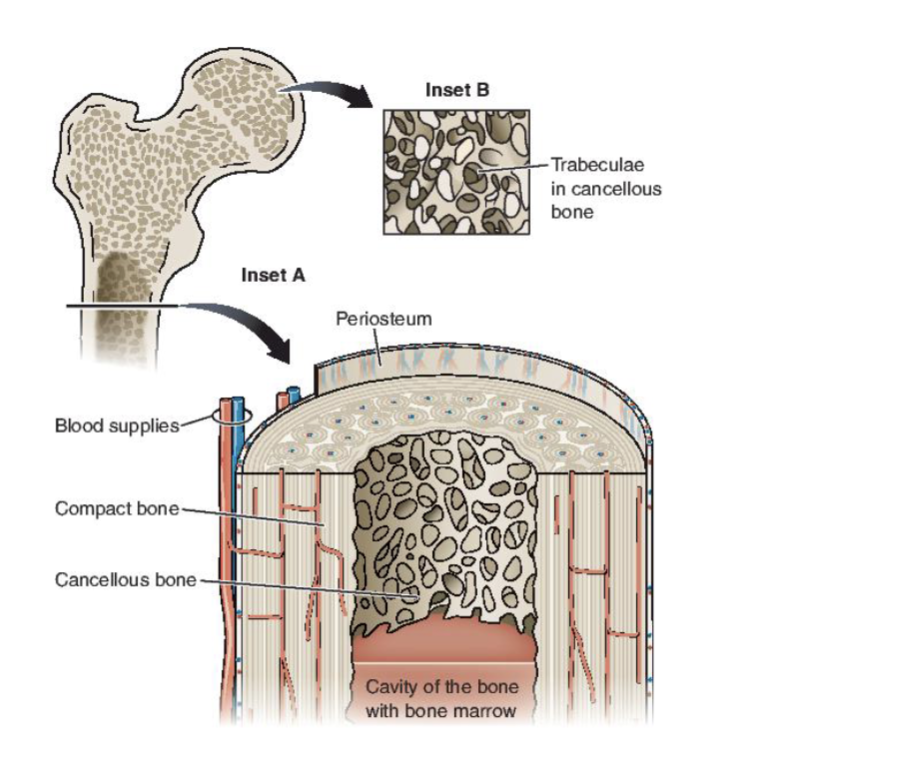
Bone structure
Cancellous Bone
Spongy inner layer
Trabeculae (calcified tissue) are laid down according to loading patterns
placed on the boneForm Follows Function”
Cortical Bone
Outer layer
Thin but dense and compact
Periosteum
Fibrous
Covers bone except for articular surface
has undifferentiated cells that can turn into OB/OC as well as a capillary network
Common changes occurring with injury, exercise, and immobilization for each
connective tissue
Tendon
exercise: daily activity is in toe region or early parts of elastic region
strengthens tendon
injury: happens w/ repeated loading plastic region w/ NOT enough recovery
immobilization: bad for tendon
Ligament
exercise: become stronger + stiffer (strengthens ligament)
injury:
immobilization: bad for ligament
Hyaline cartilage
exercise: compression helps deliver nutrients (strengthens hyaline cartilage)
resists shear forces
injury: osteoarthritis
immobilization: bad for cartilage
Bone
exercise: moderate compressive load/stress → bones = stronger + denser
more stress and less strain compare to tensile load/stress
injury: fracture
immobilization: bad for cartilage
More examination into injury of Tendon, Ligaments, and Bone
Tendon injury:
Tendonitis: Repetitive loading into the plastic region of the curve without
sufficient recovery before the next bout of loading (repeated microfailure)Tendon rupture: Single bout of excessive loading that results in macrofailure
Ligament injury:
Instability: Repetitive sub-maximal loading into the late elastic region of the curve without sufficient recovery before the next bout of loading
Sprain: A bout of loading into the plastic region (early, grade 1; late, grade 2)
some part of ligament is injured
Rupture: (e.g. ACL tear)= Single bout of excessive loading that results in
macrofailurewhole ligament is injured
Bone injury:
Stress fracture: Repeated low loads/creep strain into plastic region of the curve causes microdamage of stress/strain curve
Fracture: single bout of high stress into macrofailure of stress/strain curce
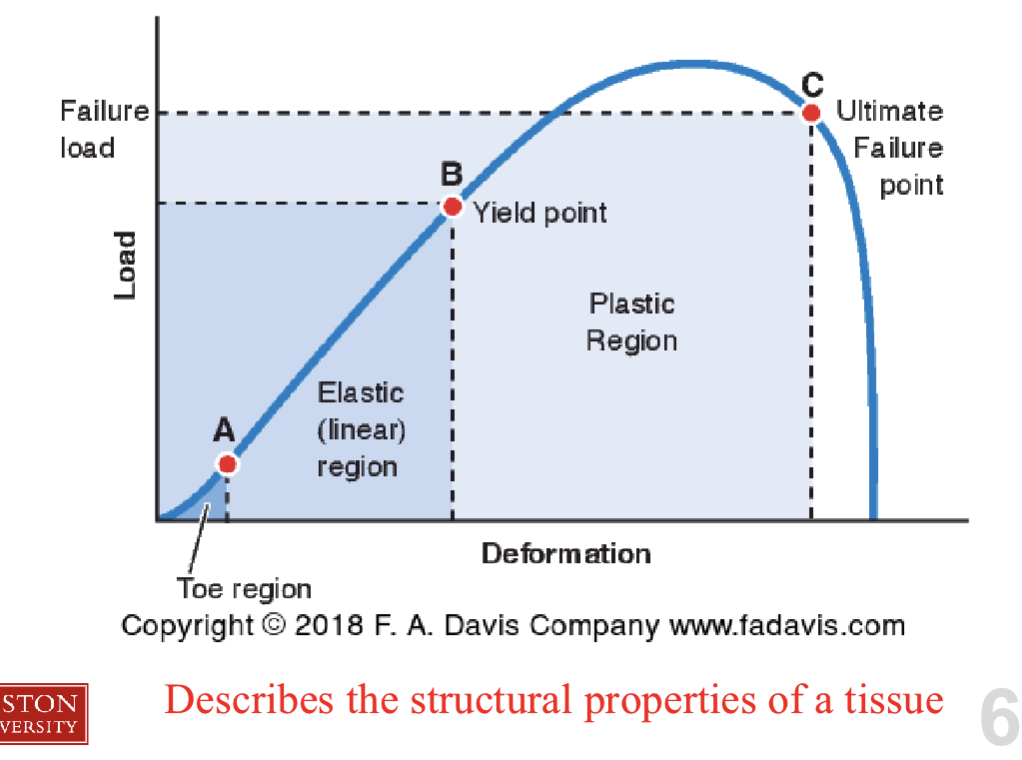
Mechanical properties of connective tissue (load/deformation )
Describes the properties of tissue
Toe region: taking rest or slack
Elastic region:
steep slope = high load and small deformation —> stiff
more horizontal = small load and high deformation —> more compliant
Plastic region:
more deformation for small load → microfailures in tissue
removing load does NOT stop failure, need to reintroduce ECM for healing
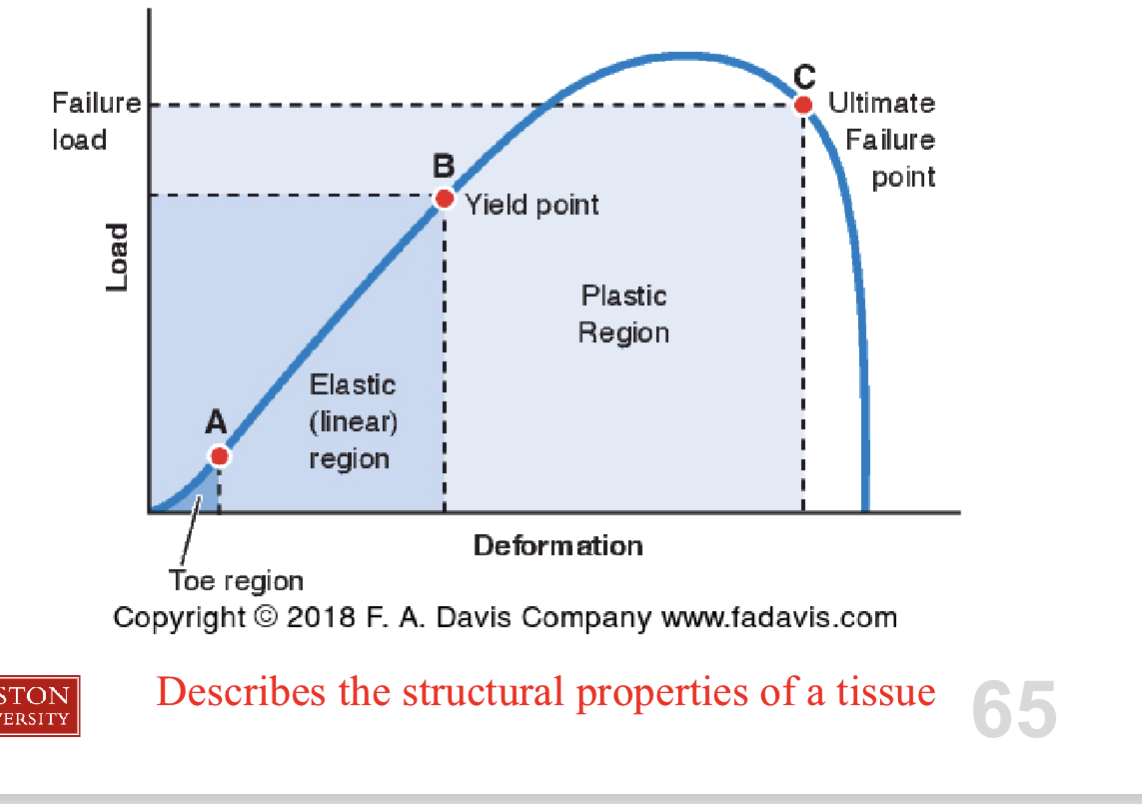
Mechanical properties of connective tissue (load/deformation ). w/ elongation
relies on structural size
increase in Cross-Sect area (thickness) —> increase in stiffness
increase in # long fibers —> decrease in stiffness (more compliant)
Mechanical properties of connective tissue (stress/strain curves)
Describes material properties/qualities of tissue
curve changes based on speed of load, injury/immobilization, and tissue type
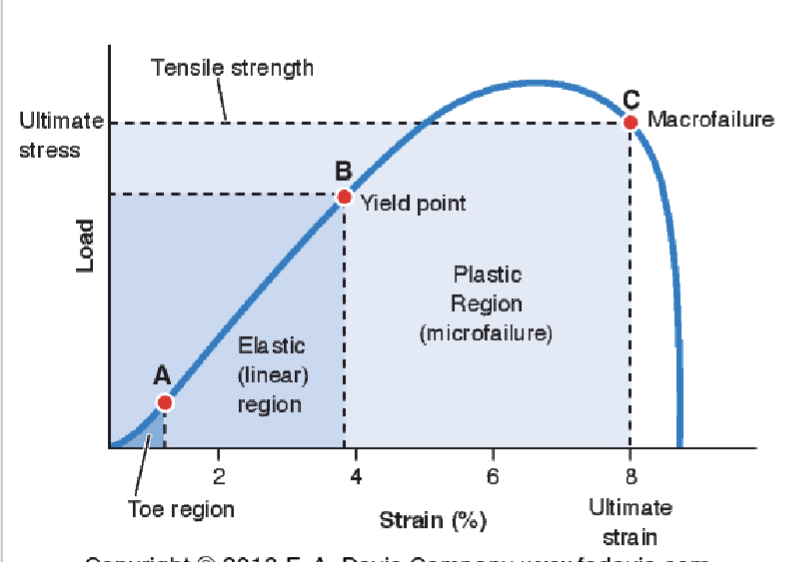
Mechanical Properties terminology
Load: any force applied to a tissue
Deformation: the result of an applied force
Tensile loads create elongation
Compressive loads create compression
Stiffness: resistance to deformation
Compliance: ease of deformation
Stress: Force per unit area (S= F/A)
Strain: % change in length (L2-L1)/L1
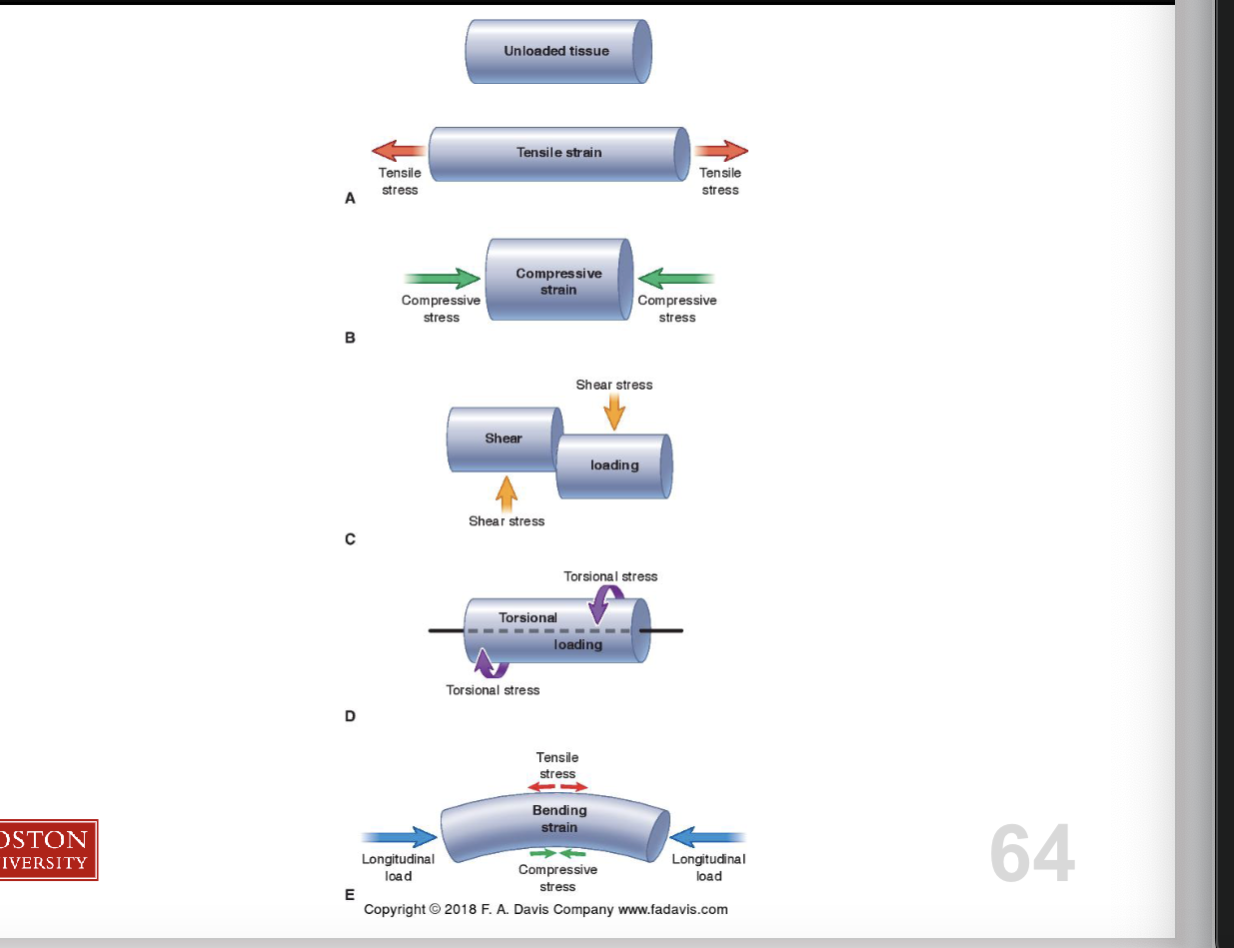
Relationships between CSA, length, and material (EXCEPTION)
Increased CSA should increase stiffness but depends on material a well
An injured tendon can be thicker but weaker (b/c not having good material)
How does the stress/strain curve change in the presence of injury or immobilization?
look at the graphs
Viscoelastic properties of connective tissue (creep, stress-relaxation, strain
rate sensitivity)
Creep: force sustained while length/deformation changes over time
Stress-Relaxation: force to maintain a certain strain decreases over time
try less hard over time to keep deformation
Strain Rate Sensitivity: stiffness increases when loaded quickly
Fast calf raises v. slowed and controlled calf raises
Viscoelasticity in PT is used by stretching, joint mobilization, tendon loading, and plyometrics
Synovial joints
Uniaxial joints (1 dg of freedom —> flex/ext)
Hinge joint
Pivot joint
Biaxial joints (2 dg of freedom —> flex/ext, deviations)
Condyloid joint
Saddle joint
Triaxial joints (3 dg of freedom —> flex/ext, abd/add, med/lat rotation)
Plane joint
Ball-and-socket joint
Joint types
Fibrous: more for stability
sutures + syndesmotic joints
Cartilagenous: more for weight-bearing and more mobile than fibrous
pubic symphysis + intervertebral joints
Synovial:
more for mobility
Use the Physical Stress Theory to predict changes in connective tissue based on the
intensity and frequency of applied stimulus?
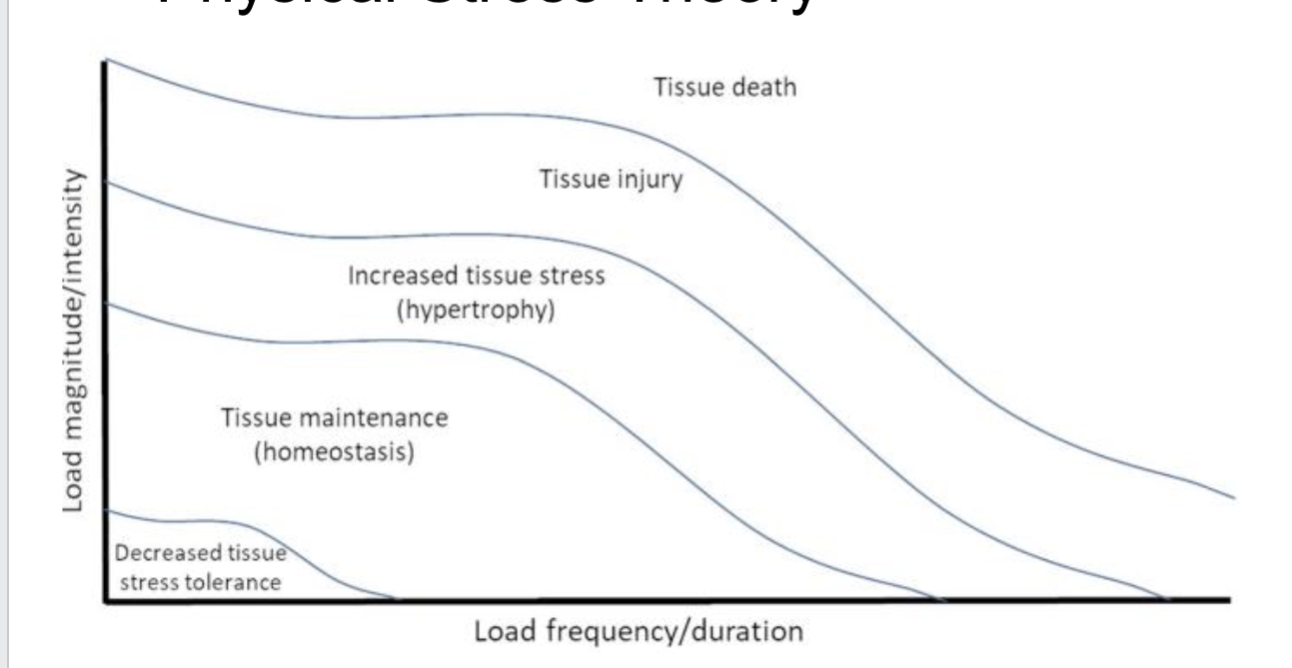
more stuff on Bone
Cortical bone
Can bear greater stress with less strain
Strain of just 2% will result in failure —→ vertical slope)
Cancellous bone
▪ Less stiff (less stress for the same amount of strain)
▪ Can bear strain of up to 75%
Increased Tendon strained is linked to what?
increased production of force by the muscle
Bone can take that much deform til it break