15. Myopia Control - Vision of Children Summer 2026
 Call Kai
 Learn
Learn Practice Test
 Spaced Repetition
 Match
Match Flashcards
 Knowt Play
1/50

There's no tags or description
Looks like no tags are added yet.
Name | Mastery | Learn | Test | Matching | Spaced | Call with Kai | Chat |
|---|
No analytics yet
Send a link to your students to track their progress
51 Terms
When should you start to introduce "myopia control"?
Start the discussion upon the diagnosis of myopia, regardless of age
What should you gauge when examining the child that may determine when to start the process of myopia control?
Gauge the child's reaction to eye drops and touching the eyelids

What are the pharmacologic options for myopia control in children?
Low dose atropine
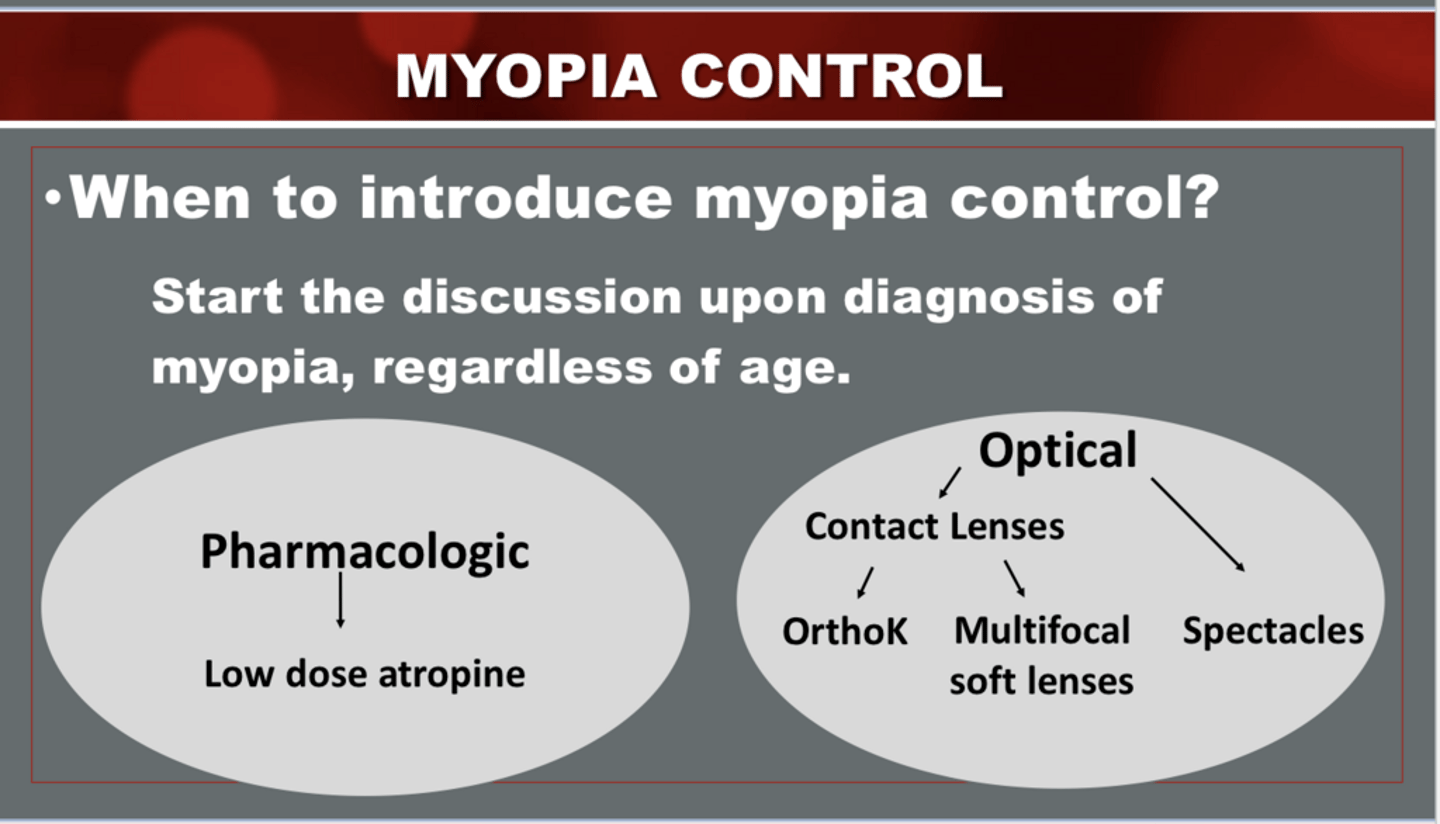
What are the optical options for myopia control in children?
-contact lenses
-Ortho K
-Multifocal lenses
-Specs
How to approach myopia control topic for adults?
"If you are thinking about contact lens or glasses wear -- why not use something that can slow the progression of myopia?"
Monitoring myopia generally requires what?
multiple visits / yr
Children should be wearing vision correction ______ for optical correction to be effective
full time
If choosing CLs for myopia control, what is needed?
multiple visits for fitting, children must be able to apply and remove the lenses themselves in the office before lenses can be dispensed
What is the important topics of discussion for the risks vs benefits of myopia control?
Ocular health and vision is more important than the prescription number. As an eye doctor, our goal is to implement myopia control in a responsible way that requires frequent monitoring and parent/patient feedback.
What is "controlling myopia"?
Monitoring myopia changes over time and considering changes or addition of treatment if progression is not lessesed.
0.1mm of axial length elongation = _____D of myopia progression
0.25
_______ was previously believed to be the mechanism for slowing myopia growth optically
peripheral defocus

Peripheral Defocus (Pic)
Peripheral Defocus (Pic)

What was used to correct hypropic defocus as a mechanism of myopia control?
multifocal orthokeratology
The BLINK study was a ___ year study
3
What was the mechanism of the BLINK Study?
-Analyzed 292 children aged 7-11 at enrollment
-Compared single vision, +1.50 Add, and +2.50 Add CLs
What was the most effective treatment for myopia control in the BLINK study?
Distance center, +2.50 add CLs when compared to SV CLs were more effective
Only the _____ Add was significantly different from SV lenses
+2.50
With the +2.50 add CLs there was a ____D less myopia progression over 3 years
0.46
With the +2.50 add CLs there was _____mm less axial progression over 3 years
0.23mm
What happened to the theory of peripheral myopic defocus after the BLINK study?
Study found that peripheral defocus was NOT the mechanism that slowed myopia progression
Are there FDA approved daily disposable dual focus lenses for the correction of ametropia and slowing progression of myopia?
Yes
What were the results of the 3 year study that investigated the results of FDA approved daily disposable dual focus lenses for the correction of ametropia and slowing progression of myopia?
-0.73 D less myopia progression
-0.32mm less axial elongation
Who are daily disposable dual focus lenses for the correction of ametropia and slowing progression of myopia FDA approved for?
8-12 year olds at initiation of treatment
SE of -0.75 to -4.00DS at the time of initiation of treatment
≤ 0.75 D of astigmatism

What are orthokeratology lenses that are used in myopia control?
Gas permeable lenses that use reverse curve geometry to reshape/flatten the corneal epithelium

Depending on the pupil size and optic zone, _______ occurs when wearing orthokeratology lenses
peripheral defocus
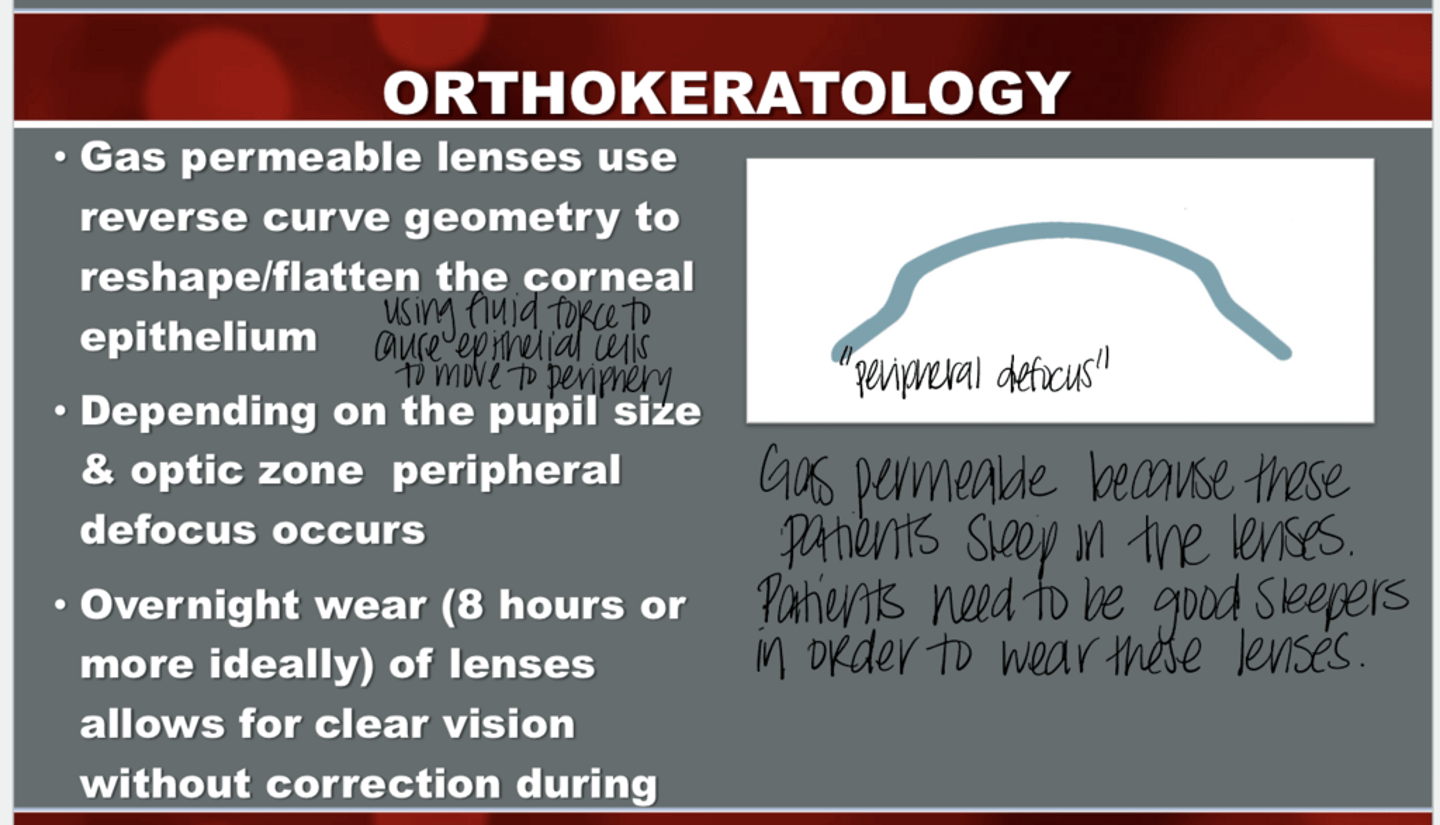
_______ wear of orthokeratology lenses allows for clear vision without day time correction
Overnight

Who is the ideal patient for orthokeratology correction?
-myopia up to -4.00D
-Flat K of 42.00 to 45.00
-Low or WTR astig

What are the RED FLAGS for orthokeratology use?
-More than 1.50D of ATR astigmatism
-More cyl power then sphere power
-A target flat cornea less than 38.00
How to get started in fitting an ORTHOK lens for myopia control?
-Determine a diagnostic lens from the fitting set based on refraction and keratometry/topography
-Evaluate elevation differences on topography
-Fitting guides and or online calculators can help
-OR order first lens empirically by using online calculator, providing HVID, refraction, and keratometry
True or False:
When fitting ORTHOK lenses, you should follow the fitting guide in order to select first lens based upon Rx, Ks, and HVID
true
Should you allow the patient to try to insert the lenses for the first time by themselves?
No -- you should insert them the first time
What should be the appearance of an orthok lens on the eye?
The lens should be well centered with a treatment zone that is smaller than the pupil with adequate edge lift
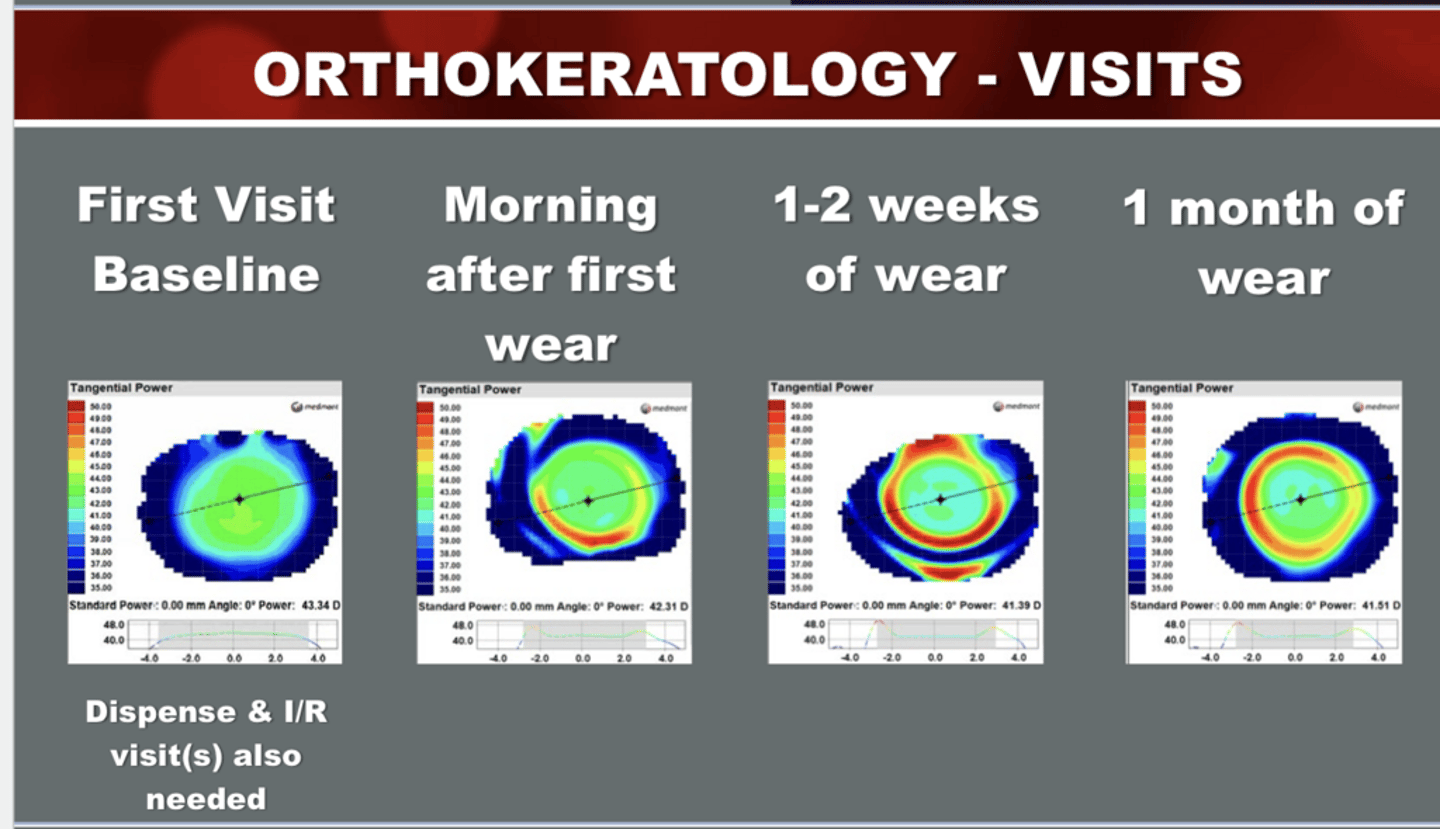
When do you typically need to see patients back for OrthoK F/U visits?
First visit baseline
Morning after first wear
1-2 wks of wear
1 month of wear
What are some CLs fitting tips for all pediatric patients?
-You should be the one inserting lenses for the first time! Not the patient or parent!
-Move quickly
-Talk directly to the patient. Let the kids feel in control if possible. Answer questions and meet them at their level of comfort.
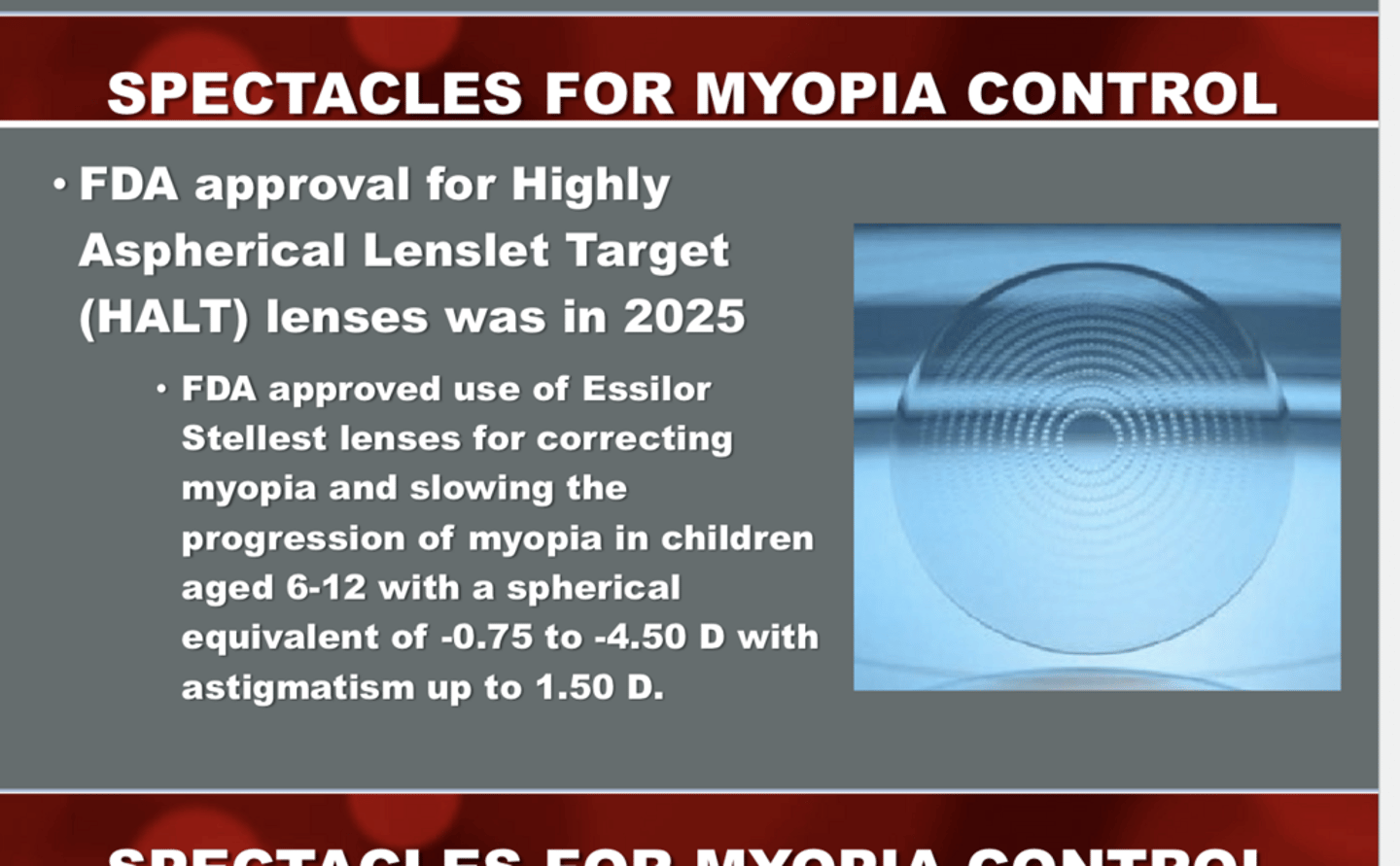
What specs were approved in 2025 for myopia control?
-Highly Aspherical Lenslet Target (HALT)
-FDA approved use of Essilor Stellest lenses

What are Essilor Stellest lenses?
Highly Aspheric Lenslet Target Lenses that correct and slow myopia progression in children aged 6-12 with a spherical equivalent of -0.75 to -4.50D with astigmatism up to 1.50D

What were the results of the Highly Aspherical Lenslet Target (HALT) Stellest Lenses Study?
-When compared to SV lenses over 24 months, reduced myopia progression by 0.64D.
-When compared to SV lenses over 24 months, reduced axial length growth by 0.24mm.
What did the ATOM1 Study compare?
Compared 1% atropine to a placebo
What were the results of the ATOM1 Study?
-Those with 1% atropine had 0.79D less progression than those with placebo
-Side effects made 1% atropine impractical
What did the ATOM2 Study compare?
Explored 0/5%, 0.1%, and 0.01% atropine
What were the results the ATOM2 Study?
All three concentration were effective, and the lowest dose had the least side effects and least rebound. 0.01% atropine recommended
What did the LAMP Study compare?
Evaluated 0.05%, 0.025% and 0.01% atropine
What were the results the LAMP Study?
Found that the effect of low dose atropine is conc-dependent with 0.05% showing least progression. Also found that the younger the child, the less effective the treatment.
True or False:
Without clinical trials, we cannot get a prepared, on label drug
true
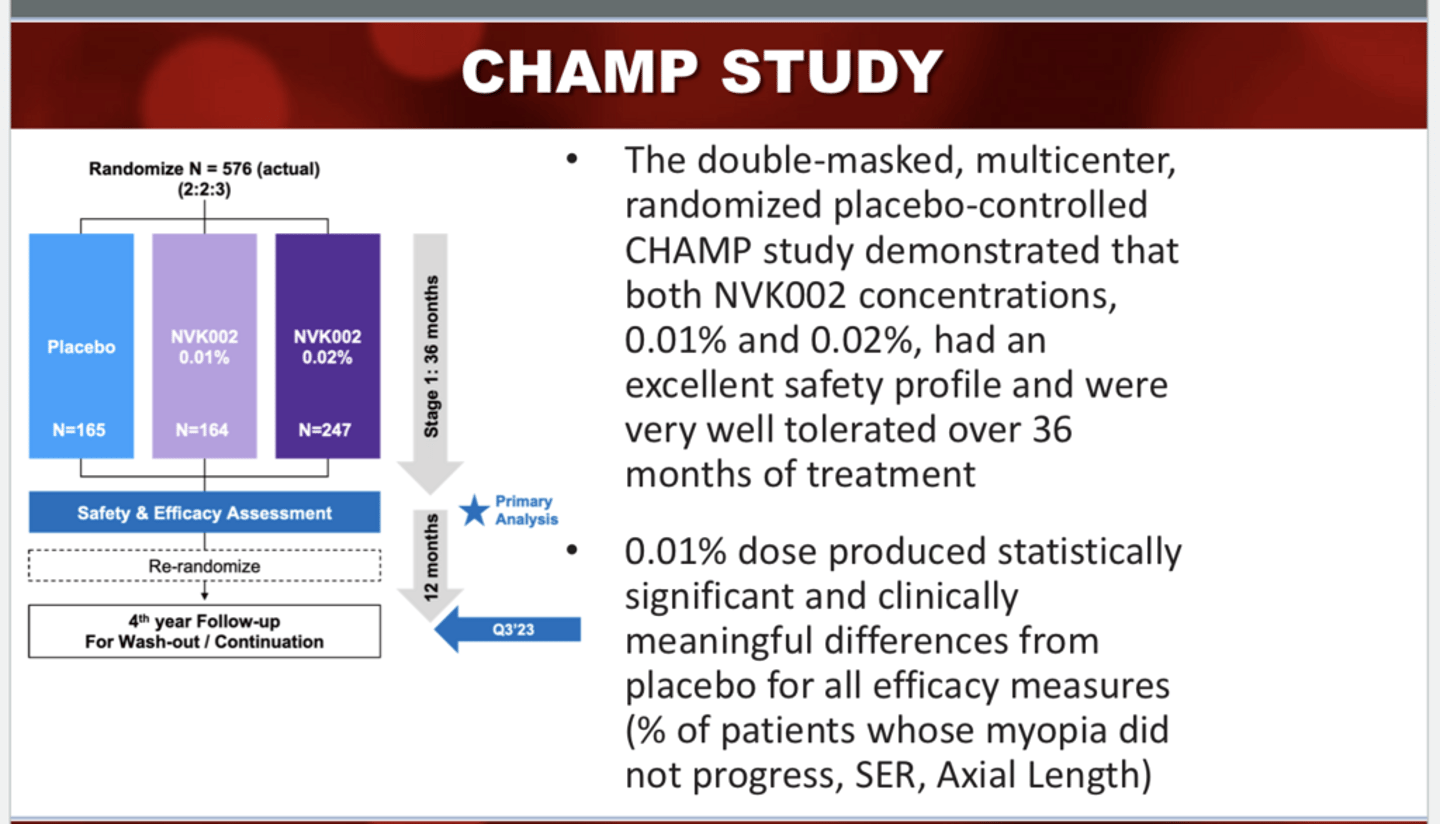
What did the CHAMP study show?
-Double masked, multicenter, randomized placebo controlled study
-NVK002 concentrations, 0.01% and 0.02% had an excellent safety profile and were very well tolerated over 36 months of treatment
-0.01% showed statistically significant and clinically meaningful differences from placebo for all efficacy measures
Are there studies that look at combining contact lenses with low dose atropine for myopia control?
Yes
How to pick between low dose atropine, OrthoK, and soft MF or dual focus lenses?
Depends on the patient
What are the advantages of low dose atropine for myopia control?
-myopes of any age
-parents can control the dose
-no restrictions d/t spec Rx or topography
-Must wear additional vision correction
What are the advantages of orthoK for myopia control?
-myopes less than -6.00D
-<1.75 of astigmatism
-Lenses do not leave home
-No lenses in eyes during waking hours -- great for athletes and swimmers!
What are the advantages of soft MF/dual focus lenses for myopia control?
-Myopes up to -7.00D
-Up to -0.75 of astig or less
-Those kids who are willing and able to handle their own care and application/removal