OCHEM EXAM ONE
 Call Kai
 Learn
Learn Practice Test
 Spaced Repetition
 Match
Match Flashcards
 Knowt Play
1/71

There's no tags or description
Looks like no tags are added yet.
Name | Mastery | Learn | Test | Matching | Spaced | Call with Kai | Chat |
|---|
No analytics yet
Send a link to your students to track their progress
72 Terms
methane
C H4
ethane
C2 H6
propane
C3 H8
butane
C4 H10
pentane
C5 H12
hexane
C6 H14
heptane
C7 H16
octane
C8 H18
nonane
C9 H20
decane
C10 H22
undecane
C11 H24
dodecane
C12 H26
eicosane
C20 H42
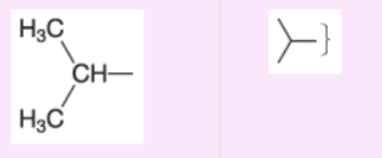
isopropyl
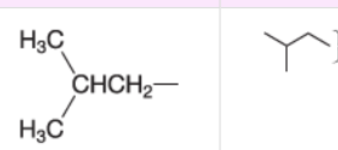
isobutyl

secbutyl

tertbutyl

neopentyl
principal quantum number
n = 1,2,3…
tells us how much ENERGY the orbital has (1s vs 2s)
describes how willing the electrons in that orbital are to leave
angular momentum quantum number
l = 0→(n-1)
tells us the SHAPE of the orbital (s=0, p=1, d=2)
magnetic quantum number
ml = -l → +l
tells us how many ORBITALS there are
n² = ml
2l + 1 = ml
nodes
nodes are where e- density = 0
orbitals have n-1 nodes
planer node
2p orbital
spherical node
3p orbital (consists of spherical and planar node)
best lewis structure
formal charge = 0
if there has to be formal charges, lowest # is better
neg formal charge should be on most electroneg atom
resonance structures
hybrid (combo of equally valid structures) will have partial bonds and partial charge
bond order = total bonds / attached atoms
charge = charge on each atom / # of atoms
hybridization (VBT)
look @ molecule and count e- groups around the atom
bonds (single, double or triple) count as one, lone pairs are one
sp³ = tetrahedral - 109.5
sp² = trigonal planar = 120
sp = linear = 180
ex) CH4 = sp³ (bc C has 4 bonds)
dihedral angle
angle btw atoms from rotating a plane
major resonance structures
lone pair next to a pi bond
pos charge next to a pi bond
lone pair next to pos charge
pi bond btw 2 atoms w diff electronegativity
molecular orbital theory (MO)
if e- sin waves add constructively, e- density will incr btw the nuclei (bond!)
if they add destructively, e- will decr btw the nucli (antibonding)
each bond (sigma or pi) has bonding and antibonding (*) orbitals
on energy level, antibonding is above bonding
checking if molecule exists with MO
if the bond order from MO (#e in bonding - #e in antibonding)/2
is the same as the bond shown in the lewis structure, then molecule exists
if BO from MO = 0 then molecule doesnt exist
paragmagnitism of O2
there are unpaired e- in the pi*2py orbital of O2, giving the paramagnietic (its affected by magnetic fields) properties to the molecule
frontier molecular orbital (FMO)
for rxn to occur, reactants have to overcome a significant energy barrier to get products
energy barriers exist bc of transition state - stablization of TS can allow rxn to happen, otherwise TS is very large
HOMO - highest occupied orbital
LUMO - lowest unoccupied orbital
after drawing MO, you can determine HOMO and LUMO → can see flow of e- bc HOMO goes into LUMO (can determine nucleophile and electrophile)
aliphatic hydrocarbons
alkanes, alkenes, alkynes
aromatic hydrocarbons
hydrocarbons in a benzene ring
formula for cycloalkanes vs unbranched alkane
cyclo: CnH2n
unbranched alkane: CnH2n+2
constitutional isomer
diff compounds with the same molecular formula
differ in atom connectivity (structural isomers)
diff than resonance because single bonds are broken and no curved arrows can be drawn
conformational isomers
rotation around a single bond = conformers
staggered newman projection
staggered has a 60 degree dihedral angle
if the two largest groups are 180 apart: anti
if two largest groups are 60 apart: gauche
largest groups HAVE to be on diff carbons for there to be gauche/anti
eclipsed newman projection
dihedral angle is 0
always has TORSIONAL strain
less stable than staggered
steric strain
large functional groups close together
nomenclature tips
same principle chain length = choose one with more substituents
if chains the same - number the chain so that the first point of diff is smallest number
3,3,5 trimethylpentane vs 5,5,3 trimethylpentane
if numbers still the same - lower number goes to first alphabetical group
cyclo, neo iso = prefixes INCLUDED
if noncylcic carbon chain has more Cs than the ring = treat it as a subsitituent
classification of carbons
primary carbon = bonded to 1 other carbon
secondary carbon = bonded to 2 other carbons
etc.
(classification of hydrogen depends on classification of the carbon it’s bonded to

ether (-oxy , - ane)

epoxide (-ene oxide)

aldehyde (-al)
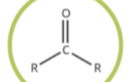
ketone (-one)

carboxylic acid (-aic acid)
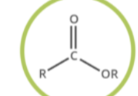
ester (-yl , -oate)

amide (-amide)

amine (-amine)

thiol
phenyl group
benzene ring acting as a substituent
can be represented by Ph-
alkyl groups
any alkane group as a substituent
can be represented by R
highly subsituted rings
use Ar-
aromatic ring acting as a substituent
(Ph is a specific type of Ar)
dotted vs solid lines
dotted = going AWAY
solid = coming TOWARDS
trend btw carbons and boiling pt
More carbons → higher boiling point because larger molecules have stronger London dispersion forces.
More branching → lower boiling point because branching decreases surface area/contact between molecules
melting pt
more symmetry = higher mp because the molecule can pack
even number of carbons = higher mp than odd number of carbons (when comparing adjacenty numbers)
lewis acid
accepts e- pair
lewis base
donates e- pair
nucleophile if it dontates e- pair to an atom thats NOT H
bronstead acid
proton donor
bronstead base
proton acceptor
always also a lewis base
curved arrows for lewis acid/base
gores from lewis base to lewis acid
strength of acid (pKa and Ka)
incr strength = DECR pka and INCR ka
equilibria in acid-base rxns
side with weaker acid and weaker base is favored
1) charge effect
pos charged compounds attract e- easier than neutral charged ones
pos charge makes compound more acidic
2) element effect
stronger acid = acidic proton is attached to an element thats more electroneg OR larger radius
3) hybridization effect
sp3 < sp2 < sp (incr acid strength)
sp is 50% s properties so therefore e-s are held closer to the nuecleus
want conj base to be more stable bc means smaller deltaG and therefore smaller pKa
4) resonance effect
resonance stabilization of conj base makes it more acidic
so if theres resonance structures - molecule is more acidic than one without any
5) polar effect
the more electronegative atoms = more partial pos charge to balance out a neg charge = stronger acid
these are electron-withdrawing groups
closer the electroneg group is to the acidic proton = greater effect on its acidity
electron withdrawing group order of strength
O2N
(CH3)3N
N (triple bond) C
F
Cl
Br
I
CH3O
phenyl
electron donating substituents
carboxy
trimethyl siyl
ethyl