BCG Matrix
 Call Kai
 Learn
 Practice Test
 Spaced Repetition
 Match
 Flashcards
 Knowt Play
1/18

There's no tags or description
Looks like no tags are added yet.
19 Terms
BCG
planning tool used to evaluate a firm’s Strategic Business Units (SBUs) or product lines based on their market growth rate and relative market share
Quadrants
4
Image
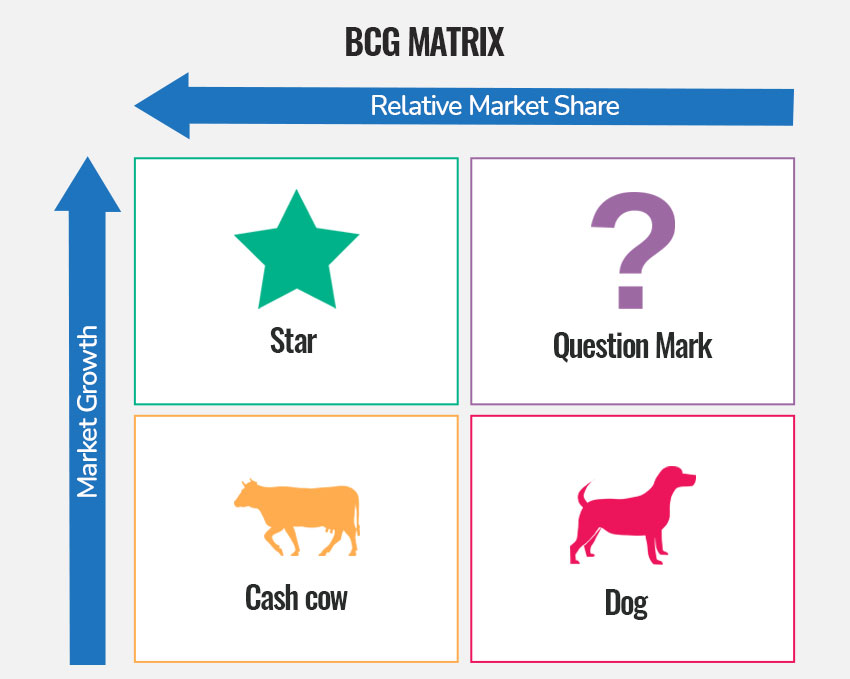
Purpose
helping top management allocate capital effectively
what units to harvest and divest
Market Share
as the one that holds the leading position over the competitors,
higher relative market share leads to higher cash generation
Market Growth Rate (Industry Attractiveness)
High-growth markets require significant cash reinvestment to fund expansion and marketing.
The industry is growing, the competitors and innovations, and potential consumers are coming into the industry.
The company must invest and adapt or lose their place.
Horizontal Axis of the BCG Matrix represents
Relative Market Share
(Internal competitive strength: SBU’s market share divided by the market share of its largest competitor)
Star
High Market Growth, High Relative Market Share.
Rapid growth, strong market position.
Generates high cash but requires heavy investment to sustain growth.
Net cash flow is typically neutral or slightly positive.
Cash Cow
Low Market Growth, High Relative Market Share.
Mature market leader.
Generates significantly more cash than it requires for reinvestment.
Primary source of profits to fund other SBUs.
Question Mark
High Market Growth, Low Relative Market Share.
High potential due to rapid market growth, but weak competitive standing.
Requires massive cash injection to build market share into a Star, or risk becoming a Dog.
Dog
Low Market Growth, Low Relative Market Share.
Weak competitive position in a slow-growth/declining market.
Generates low profits or losses; rarely generates substantial cash.
Build Strategy
Invest heavily to increase market share.
Applied primarily to Question Marks (to turn them into Stars) and Stars (to maintain leadership)
Hold Strategy
Invest just enough to maintain current market share and position. Applied to healthy Cash Cows to keep them generating steady cash flow.
Harvest Strategy
Invest enough for now, regardless of future standing.
Maximize short-term cash flow without regard to long-term market share. Applied to weak Cash Cows, Dogs, or failing Question Marks.
Divest Strategy
Liquidate or sell off the business unit to reallocate capital elsewhere. Applied primarily to Dogs or unpromising Question Marks.
Success Steps
Launch as a Question Mark
Invest heavily to become a Star
Transition into a Cash Cow as market growth matures
Eventually decline into a Dog.
Loss Strategy
A Star loses market share due to underinvestment and drops into a Question Mark, or a Question Mark fails to gain share and devolves directly into a Dog.
Nestle - Company
tar (Nescafé): Spot on. Instant and ready-to-drink coffee segments in Pakistan have been expanding rapidly among urban youth and professionals, and Nescafé holds high market share in that growing segment, requiring continued marketing investment.
Cash Cow (Nestlé Pure Life): Spot on. Packaged bottled water is a mature, low-growth market relative to its explosive expansion decades ago, but Pure Life commands massive market share and generates steady, reliable cash flow. ((Note: Nestlé MilkPak is also a classic Cash Cow for Nestlé Pakistan due to its dominance in the UHT milk market).)
Question Mark (Nesquik / New Specialized Beverages or Snacks): Accurate. Products fighting for shelf space in high-growth, highly competitive categories (like flavored milks, specialized health drinks, or snack items competing against local brands) require high cash injection with uncertain market dominance.
Dog (Maggi / Nestlé Raita
Beverae Industry
Star: Energy Drinks (Red Bull, Monster) & RTD Premium Cold Brews
Cash cow: Classic Carbonated Soft Drinks (Coca-Cola, Pepsi) & Mass-Market Bottled Water (Nestlé Pure Life / Dasani)
Question mark: Plant-Based Milks (Oat/Almond alternatives), CBD/Cannabis Beverages, or Functional Mushroom Waters
Dog: Diet/Low-Calorie Sodas from minor brands, or legacy regional soda flavors that lost cultural relevance