LING 333 Quiz #3
 Call Kai
 Learn
Learn Practice Test
 Spaced Repetition
 Match
Match Flashcards
 Knowt Play
1/50

There's no tags or description
Looks like no tags are added yet.
Name | Mastery | Learn | Test | Matching | Spaced | Call with Kai | Chat |
|---|
No analytics yet
Send a link to your students to track their progress
51 Terms
Cohort Effect
each generation acquired a different variant and keeps it as they age
Experimental Design Factors (3)
researcher manipulates the independent variable
participants are randomly assigned to conditions
can establish a causal relationship
What is the purpose of experimental design
desire to establish a relationship between both variable
Manipulation
must manipulate and decide what goes in the levels of the independent variable
Random Assignment
the condition the participants receive must be random
Non experimental
researcher measures or compares what already exists
everything is pre existing nothing is randomly assigned
no random assignment to conditions
can show association but not causation
When should you choose an experimental design?
when the intention is to establish a causal relationship
you have a hypothesis about a causal relationship between two variables
you are able to manipulate the independent variable
you can randomly assign participants to levels of the independent variable
all three must hold missing one → non-experimental
Quasi-experimental designs definition
the researcher manipulates the IV (delivers a treatment) but participants are NOT randomly assigned to conditions (if its impractical or unethical)
why do we have quasi-experimental designs
when random assignment is impractical or unethical
ex: intact classes, schools, or clinics
groups may differ from the start so causal claims are weaker; pretests, matching and statistical control help
Different Between Experimental, Quasi Experimental, Non-Experimental

What is Random Sampling
tells us who gets into the study
everyone in the population has an equal change of being selected
supports generalizing to the population
When is random sampling done and why
before participant completes the task
to make us confident that the study is generlizable
Random Assignment
who gets which condition/ decide which task participant completes
every participant has an equal chance of ending up in each group
makes groups comparable; supports causal claims
Relationship between Random Sampling and Random Assignment
you can have one without the other
can be an imbalance between both
ex: volunteers (not random sample) who are randomly split into 2 groups
When is NON-experimental design a good choice (4)
you are interested in a single variable
how high are vowels in dialect A
You want a non-causal relationship between two variables if two things are related
is there a correlations between speech rate and pitch
You want a causal relationship but you cant manipulate the IV or randomly assign participants (ethical or practical reasons)
does damage to broca’s area reduce speech production ability
your question is exploratory
which sounds are typologically most common across the worlds languages
Types of non-experimental design (3)
Cross-sectional
Correlational
Obervational
Cross Sectional
compare two or more “pre existing” groups (you don’t create the groups”
ex: whether speech differs with young vs old speakers
Correlational
see whether two variables are correlated
ex: speech rate and pitch
(more prevalent when both are numeric)
Obsevational
observe behavior in a natural or lab setting without manipulating anything
see if 2 things are different
ex: record casual conversations and count discourse markers
Ethnography
become apart of the community and study their language
different from a hypothesis
hypothesis is make on an ongoing basis
ex: go to a community in hopes on discovering something new
Control vs Generalizability
its a trade off
more control → stronger causal claims ut more artificial situation
combining methods (triangulation) helps ex: a lab experiment plus corpus data
internal validity
need to be confident the differences in the design is actually affected by the IV
can we be confident that the IV and not chance or extraneous variables produced the effect?
external validity
do the results generalize beyond this samble and setting
ex: from the lab to everyday speech
Triangulation
combining methods
List the Variables (2)
independent
dependent
Independent Variable
what you manipulate (experiment) or compare (non experimental)
you dont measure you manipulate/compare against
also: factor, predictor, treatment, or explanatory variables
the groups within the IV are its levels (ex: age groups)
ex: speech rate (2 levels: slow, fast)
Dependent Variable
what you measure
what you are measuring
also: response, measured, or outcome variable (frequencey/count)
ex: rating of speaker’s persuasiveness
Extraneous Variables
anything other than my defined variable = extraneous
any variable other than the IV and DV
they are not the problem themselves as long as we CONTROL them

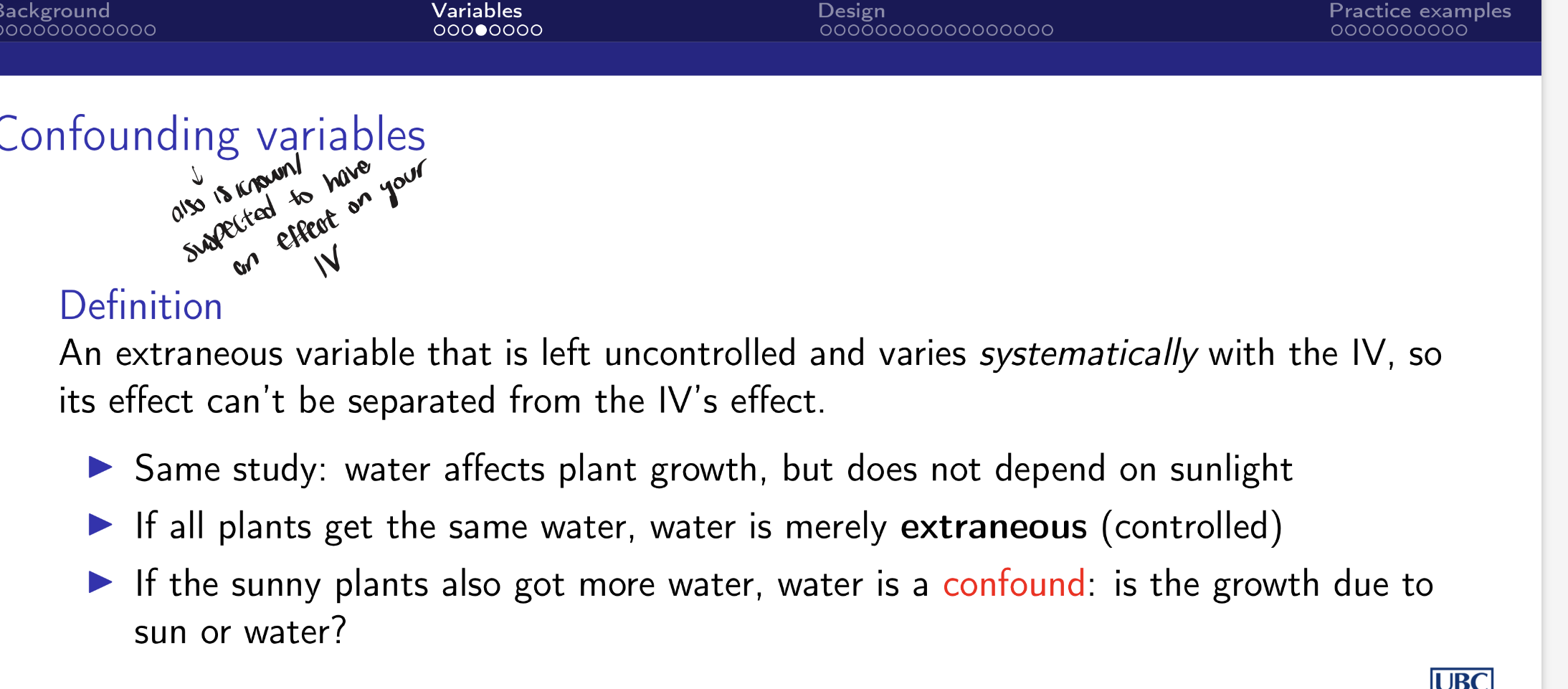
Confounding variables
also is known/suspected to have an effect on your IV
an extranous variable that is left uncontrolled and varies systematically withthe IV so its effect can’t be seperated from the IV’s effect
Lurking Variables
a (usually unmeasured) variable that influences both the IV and DV, creating a misleading association between them

Handing Extraneous Variables (5)
Hold constant
Randomzie
Counter Balance
Match or Block
Measure and include
Hold constant
same room, equipment and instructions for everyone
ex: 2 rooms for tracking exams one is very hot one is temperate → there will be effects from the room so put them all in the same one
Randomize
the best
random assignment spreads unkown differences evenly across groups co
counter balance
vary the order of conditions across participants (useful in within-subject designs)
order things differently
ex: 2 tasks to complete by the same person like fast and slow order the effect ex: 20 do fast first and 20 do slow first
match or block
pair participants on a relevant characteristic and split each pair across groups
define variables then try and block things
ex: IQ, define IQ then match 2 people with the same IQ they both go against each other
Measure and Include
record age, proficiency etc then add to the analysis
ex: age/proficiency they can’t control
collect background infothen include in the model so they are accounted for
Single-Factor Design
one independent variable (factor)
Univariate Design
one dependent variable
single-factor univariate design
one IV and one DV
Explain a within-subject design
each participant is exposed to all levels of the IV

Pros and Cons of Within-subject design
Pro: fewer pariticpants each person is their own baseline
Con: carryover effects (practice, fatigue, boredom, can figure out what is going on)
Between Subject Design
each participant is exposed to only one level of the IV

Pros and Cons of Between Subject
Pro: no carry over effect
Con: needs more participants; induvidial differences between groups
Within vs Between

counterbalancing in a within subject design
vary the order of the conditions across participants

Pretest-post test design
the classic controlled experiement
give a pretest to both groups
experimental group tgets the treatment; control group get “standard” material (a plecebo in clinical trials”
give a posttest to both groups
compare the change from pretest to posttest across groups
to establish cause and effet
establish the baseline for groups
pretest → interrvention → posttest
Factoral Design
has two or more IVs (factors)
crossed: every level of one factor is combined with every level of the other(s)
lets us study several IVs simultaneously in a single experiment
What does factorial design reveal
Main effect: the overall effect of one factor (averaging over the other)
Interaction: the effect of one factor depends on the level of another
notation: a “2×3” design has 2 factors, the first with 2 levels and the second with 3 → 6 conditions
Mixed design
a single experiment with both a within-subject factor and a between subject factor
ex: every listener hears slow and fast speech (within) and listeners are either L1 or L2 speakers (between)
not to be confused with mixed methods
Mixed Methods
combining quantitative and qualitative strands in one study
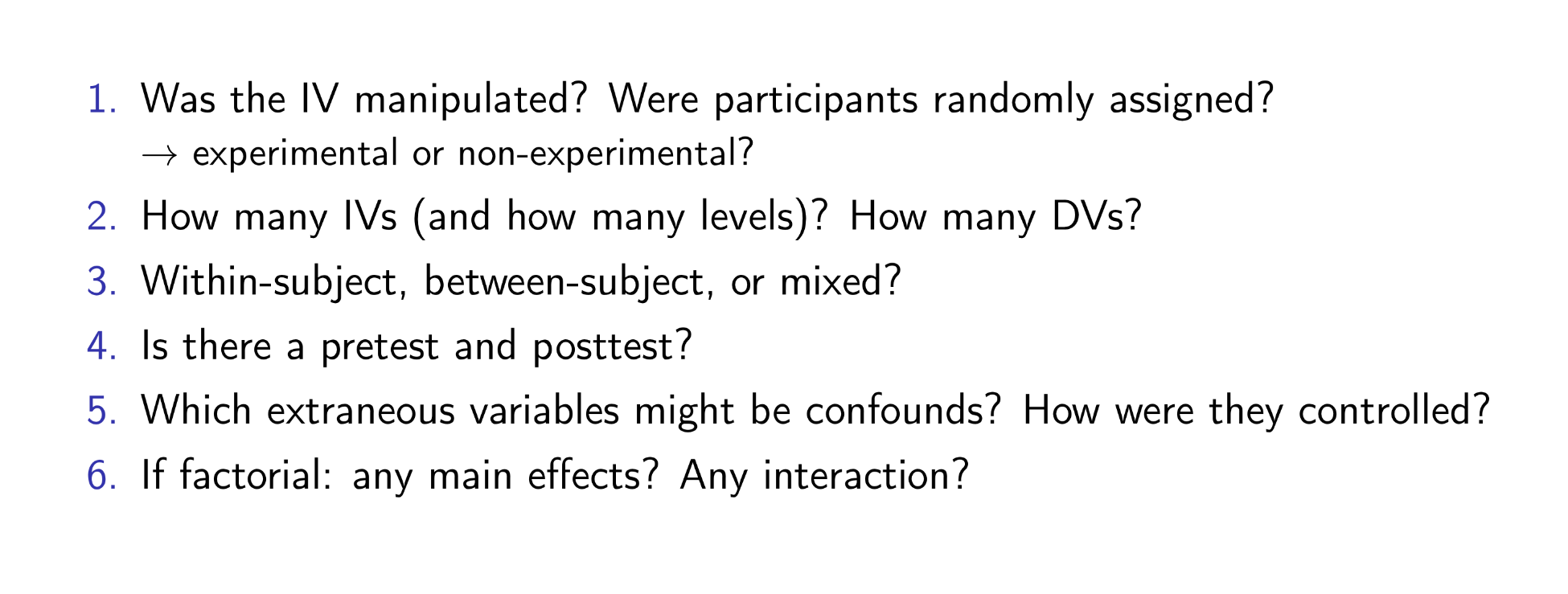
Checklist: Reading any Study’s design