1) carbohydrates
 Call Kai
 Learn
Learn Practice Test
 Spaced Repetition
 Match
Match Flashcards
 Knowt Play
1/33

There's no tags or description
Looks like no tags are added yet.
Name | Mastery | Learn | Test | Matching | Spaced | Call with Kai | Chat |
|---|
No analytics yet
Send a link to your students to track their progress
34 Terms
Carbohydrates
Organic compounds consisting of the elements carbon, hydrogen, and oxygen, categorized as hydrated carbon compounds with the general formula Cm(H2O)n.
Monosaccharides
The simplest and most basic form of carbohydrate that cannot be hydrolysed to simpler carbohydrates, with a general formula of (CH2O)n where n=3 to 7.
Aldose (Aldehyde Sugar)
A carbohydrate where the carbonyl group (C=O) is located at the beginning of the carbon skeleton, forming an aldo group.
Ketose (Ketone Sugar)
A carbohydrate where the carbonyl group (C=O) is nested within the carbon skeleton, forming a keto group.
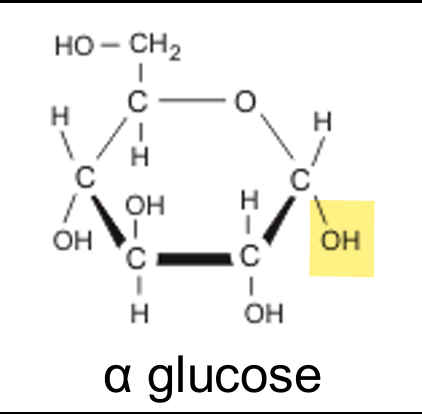
α-glucose
A glucose isomer in which the hydroxyl group (−OH) attached to carbon number 1 (C1) is positioned below the plane of the ring.
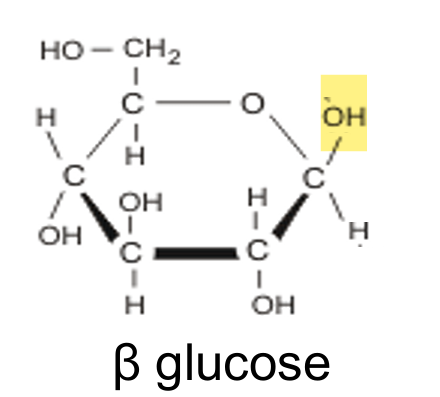
β-glucose
A glucose isomer in which the hydroxyl group (−OH) attached to carbon number 1 (C1) is positioned above the plane of the ring.
Isomerism
The phenomenon where compounds possess the same molecular formula but different structures and properties, such as glucose and galactose (C6H12O6).
Glycosidic bond
A covalent bond formed between two monosaccharides through a condensation reaction that involves the loss of one water molecule.
Condensation
The chemical process involving the removal of a water molecule to synthesize a glycosidic bond.
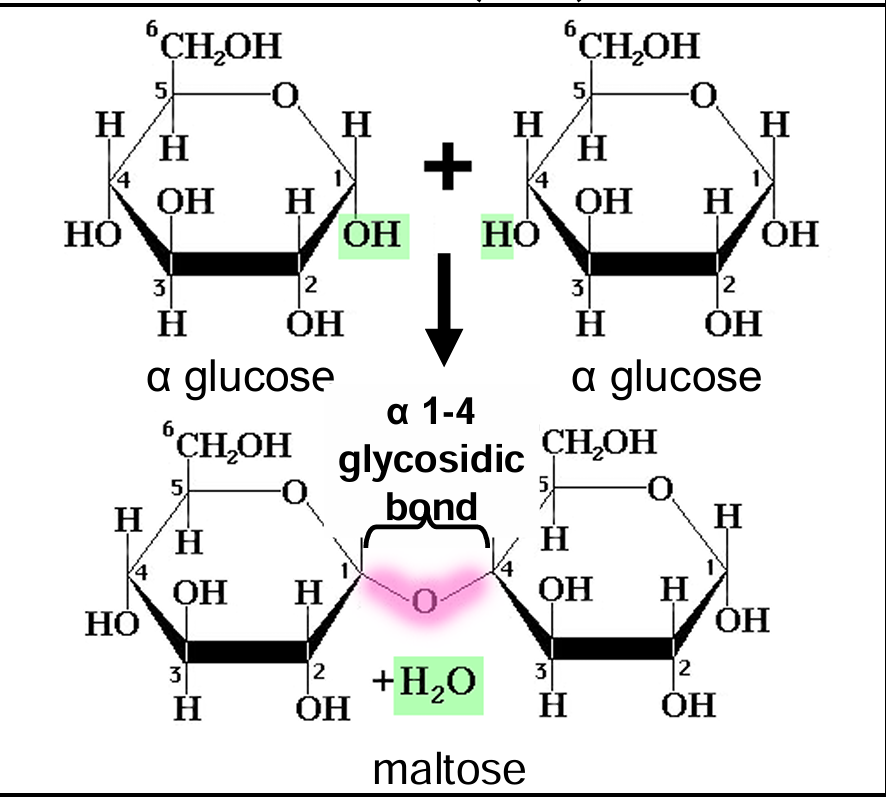
Hydrolysis
The chemical process involving the addition of one molecule of water to break a glycosidic bond.
Maltose
A disaccharide composed of two α-glucose monomers linked by an α(1−4) glycosidic bond; it is a sugar important in brewing beer.
Lactose
A disaccharide composed of glucose and galactose, commonly known as the sugar present in milk.
Sucrose
A non-reducing disaccharide composed of α-glucose and β-fructose linked by an α(1−2) glycosidic bond, used for transport in plants.
Reducing Sugar
A sugar that acts as a reducing agent by being oxidized; its ability is due to a free carbonyl group (C=O) in the linear form (includes all monosaccharides and most disaccharides).
Starch
A plant storage polysaccharide consisting of α-glucose monomers, made of unbranched amylose (20%) and branched amylopectin (80%).
Amylose
An unbranched polymer of α-glucose monomers linked by α(1−4) glycosidic bonds and coiled into a helix shape.
Amylopectin
A branched polymer of α-glucose monomers linked by α(1−4) bonds within branches and α(1−6) glycosidic bonds at branch points.
Glycogen
An extensively branched animal storage polysaccharide of α-glucose monomers with α(1−4) and α(1−6) glycosidic bonds, found in liver and muscle cells.
Cellulose
A plant structural polysaccharide made of β-glucose monomers linked by β(1−4) glycosidic bonds, where alternate monomers are rotated 180)∘.
Microfibril
Cable-like units with high tensile strength formed when parallel linear cellulose chains are held together by intermolecular hydrogen bonds.
Cellulose cell wall
A strong, rigid, and porous meshwork of microfibrils that encloses plant cells, protecting them from damage and osmotic stress while remaining freely permeable.
Chitin
A structural polysaccharide used in arthropod exoskeletons and fungal cell walls, similar to cellulose but with a nitrogen-containing appendage on the glucose monomer.
What distinguishes α -glucose from β-glucose?
The difference lies in the position of the hydroxyl group (−OH) attached to carbon number 1 (C1); in α-glucose it is positioned below the plane of the ring, while in β -glucose it is positioned above.
What is a glycosidic bond?
A covalent bond formed between two monosaccharides through a condensation reaction involving the loss of one water molecule.
What are the primary structures of starch?
Starch is a plant storage polysaccharide made of α-glucose monomers and consists of two types: amylose (unbranched) and amylopectin (branched).
Describe cellulose and its structural significance.
Cellulose is a plant structural polysaccharide made of β-glucose monomers linked by β(1−4) glycosidic bonds, providing high tensile strength in plant cell walls.
What is glycogen and its function in animals?
Glycogen is an extensively branched animal storage polysaccharide of α-glucose monomers, functioning as an energy reserve in liver and muscle cells.
How do you test for non reducing sugars
if a negative result for Benedict’s test is obtained for the test
solution, then
1. Boil equal volume of test solution with dilute
hydrochloric acid for about 1 minute to hydrolyse
disaccharide to monosaccharides.
2. Cool contents of tube.
3. Neutralise acidic content with sodium bicarbonate
solution.
4. Carry out Benedict's test for reducing sugar.
Presence of non-reducing sugar indicated by:
• A blue solution remains when Benedict’s test is first carried
out.
• After acid hydrolysis, Benedict’s test is carried out again: colour of final suspension depends on amount of sugar
present
What does the iodine test indicate regarding starch?
The iodine test indicates the presence of starch, producing a blue-black coloration when iodine solution interacts with the amylose helical structure to form starch-iodine complex
Step-by-step procedure for Benedict's test for reducing sugars
Place 2 cm3 of test solution in a test tube..
Add an equal volume of Benedict's reagent to the sample. Shake.
Heat the mixture in a BOILING water bath for about 5 minutes.
Observe the color of ppt: Green (trace) to yellow (low) to orange (medium) to brick-red (high).
Step-by-step procedure for iodine test for starch
Take 1cm³ of the test solution or material.
Add a few drops of iodine solution to the sample.
Observe the color change: orange to blue-black coloration indicates the presence of starch.
Cellulose synthase role
Cellulose synthase is the enzyme that synthesizes cellulose. Cellulose synthase is embedded in the cell membrane of plant cells. Multiple units of cellulose synthase are arranged together in a hexagonal structure which allows the simultaneous synthesis of multiple cellulose chains which form a microfibril.
How the structures of starch and glycogen make them good energy STORAGE molecules
1. They are helical molecules (as each α-glucose monomer is bent in one direction with respect to an adjacent monomer) This arrangement allows many α -glucose monomers to be packed per unit volume ➔ hence, they are a compact energy store
2. Most of their OH groups are involved in intramolecular hydrogen bonding within the helix and hence few OH groups available for hydrogen bonding with water. ➔Hence, they are insoluble in water and the Ψw of cells are unaffected by their presence (Property of starch/glycogen)
3. They are branched and thus they have multiple branch ends/ sites which hydrolytic enzymes can work on. Hence more glucose molecules can be released rapidly at the same time and more ATP can be generated by respiration per unit time.
4. They are large molecules ➔Hence, they are insoluble in water and the Ψw of cells are unaffected by their presence (Property of starch/glycogen)
How the structure of cellulose makes it a good STRUCTURAL molecule
1. Alternate glucose monomers are rotated 180 degrees with respect to each other and hence form a long, straight molecule with free OH groups projecting out in both directions which allow interchain hydrogen bonding between cellulose molecules that are parallel to each other➔ forming microfibrils Hence microfibrils have high tensile strength. (Property of cellulose)
2. As a macromolecule, cellulose has few OH groups available to hydrogen bond with water as most are involved in interchain hydrogen bonding. Thus only the surface of the microfibril has OH groups that can hydrogen bond with water. Hence cellulose is insoluble in water and the Ψw of cells are unaffected by its presence. (Property of cellulose)
3. The meshwork of microfibrils that form the cell wall a. have a porous structure and hence the cell wall is freely permeable to water and solutes and allows movement of substances across the cell wall. b. Are strong and rigid and distributes stress in all directions to prevent the plant cells from bursting due to osmotic stress.
4. Cellulases that hydrolyse cellulose are found in very few organisms. Thus, cellulose cannot be hydrolysed by most organisms and be used as a respiratory substrate. Hence it is a good structural molecule.