Acct 202- Final Exam
 Call Kai
 Learn
Learn Practice Test
 Spaced Repetition
 Match
Match Flashcards
 Knowt Play
1/58

There's no tags or description
Looks like no tags are added yet.
Name | Mastery | Learn | Test | Matching | Spaced | Call with Kai | Chat |
|---|
No analytics yet
Send a link to your students to track their progress
59 Terms
MANAGERIAL ACCOUNTING
period costs
- costs that are expensed in the period in which they are incurred
- examples: selling and administrative expenses
- found only on the Income Statement
product costs
- manufacturing costs
- direct materials, direct labor, and manufacturing overhead
- recorded as inventory
- expenses when the product is sold
- on the Balance Sheet as Inventory until the product is actually sold
- then it moves to the Income Statement as COGS
inventory accounts
COGM (calculation)
work in process inventory, beginning + total manufacturing costs = total cost of work in process - work in process, ending = ____________
COGS (calculation)
finished goods inventory, beginning + cost of goods manufactured = cost of goods available for sale - finished goods inventory, ending = ___________________
JOB ORDER COSTING
job order costing
- assigns costs to each job or batch of goods
- each job has some distinguishing characteristic such as a house that is custom built, a CPA firm's consulting engagement, or a print shop's batch of brochures
- the goal is to assign costs to the individual jobs
process costing
- used when companies manufacture a large volume of similar good such as cereal or paint
predetermined overhead rate
estimated annual overhead cost / estimated annual activity base = ________
- is then applied to the actual activity level to assign overhead to the individual jobs
- the estimated numbers are used to calculate the predetermined rate and then never used again
- use the predetermined overhead rate to assign overhead to work in process
over applied overhead
- if applied costs are greater than actual, the account will have a credit balance
- Manufacturing Overhead
Cost of Goods Sold
under applied overhead
- if actual costs are greater than applied costs, the account will have a debit balance
- Cost of Goods Sold
Manufacturing Overhead
determine the cost of a job (calculation)
CVP ANALYSIS
cost behavior
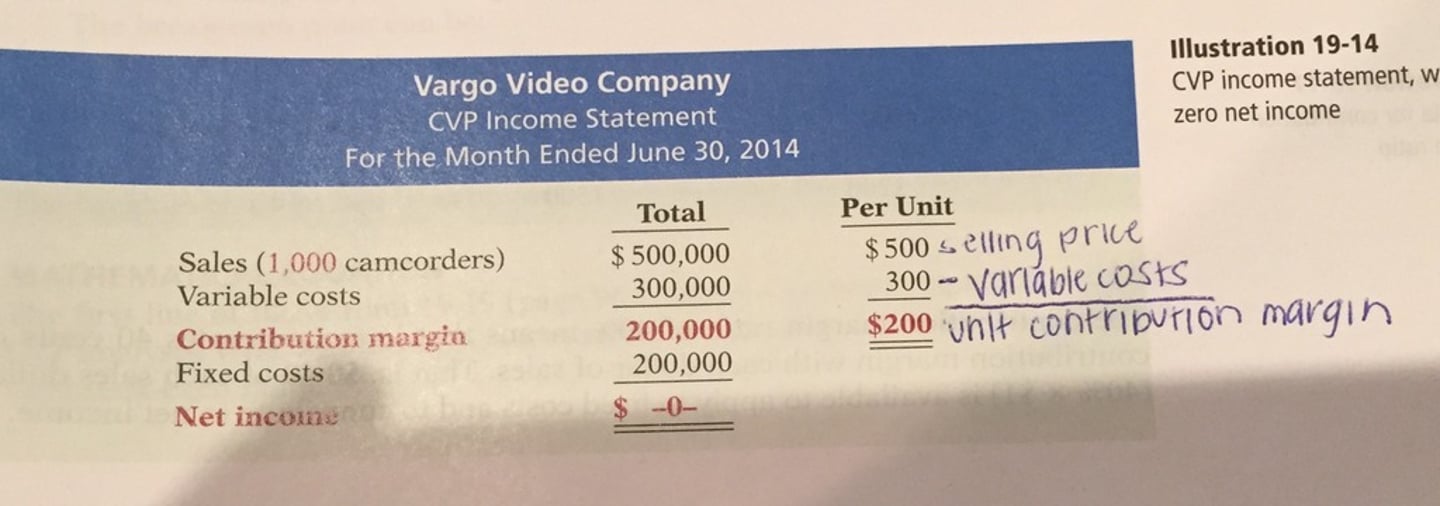
CVP income statement
- classifies all costs as either variable or fixed, and compute a contribution margin
- CM: can be stated as a whole dollar amount and/or as a per unit amount
- Sales - variable costs = contribution margin - fixed costs = net income
break-even point (calculation)
- the point where total revenue exactly equals total cost
- put in another way, it is the point where total contribution margin exactly equals total fixed costs
- net income is ZERO
- can be expressed in terms of sale units or sales dollars
- can be calculated using a mathematical equation or by using the contribution margin, or CVP graph
margin of safety
- the difference between actual or expected sales and sales at the break-even point
- actual (or expected) sales - break-even sales = MOS $
- margin of safety $ / actual (or expected) = MOS ratio
- the higher the number is, the greater the "cushion" is
INCREMENTAL ANALYSIS
opportunity costs
- the benefit given up from some course of action other than the one chosen
sunk costs
- costs that have already been incurred and will not change due to any current or future decision
- NOT relevant and should not be considered
relevant costs
- revenues or costs that are in the future and differ across alternatives
- these are the only factors to be considered
- costs and revenues that are in the past, or do not differ across alternatives can be ignored
special order (decisions)
- if a special order can be filled within existing plant capacity, then the only costs that are relevant are variable costs
- if the special price is greater than variable costs, the company should NOT be considered unless the plant is already at full capacity
make or buy (decisions)
- compares relevant costs to make some component part of product versus buying it from another company
- fixed costs are frequently affected by this decision, and so may be partially relevant
- also potentially relevant are opportunity costs- if the company is unable to take advantage of some other source of revenue because plant capacity is being consumed by production of the component part, then the lost revenues from the missed opportunity should be considered part of the cost to make the part
retain or replace (decisions)
- cost and book value of the old equipment are sunk costs and are not relevant (this includes depreciation)
- operating costs for both old and new equipment ARE relevant, as is the purchase price of the new and the proceeds from selling the old (if applicable)
sell or process further (decisions)
- the basic decision rule is: process further as long as the incremental revenue from such processing exceeds the incremental processing costs
eliminate an unprofitable segment (decisions)
- focus on relevant costs
- in this decision, fixed costs are frequently relevant, since they may have to be absorbed by the remaining segments or products
BUDGETING
basic definitions
master budget
- a set of interrelated budgets for a specified time period
- contains two types of budgets: operating and financial
- operating budgets: the individual budgets that lead to the preparation of the budgeted income statement
- financial budgets: focus on cash resources needed to fund operations and planned capital expenditures
- these include: the capital expenditure budget, the cash budget, and the budgeted balance sheet
cash budget (calculation)
- shows whether the expected amount of cash generated by operating activities will be sufficient to pay anticipated expenses during the period covered by the operating budget
beginning cash + cash receipts - cash disbursements (+/- financing section) =
static budget
- unchanging; doesn't allow for changes in activity level
- budget prepared at a single level of activity, generally the activity level that was used to develop the master budget
- the master budget is itself a static budget
- it is usually only appropriate for fixed costs, costs that remain the same IN TOTAL regardless of changes in activity level
flexible budget
- multiple static budgets prepared at different activity levels
budget
- a formal written statement of management's plans for a specified future time period, expressed in financial terms
- may be prepared for any length of time
- however, the most common budget period is one year
- many companies use continuous 12-month budgets, which drop the month just ended and add a future month
standard
- budget expressed on a per unit basis
- budgets are total amounts, so is basically the same thing, just expressed on a per unit amount
CORPORATIONS
journal entry for issuance of common stock
- when issuing par value common stock, the Common Stock account is credited for the amount of par value only. anything received above that amount is credited to Paid-in Capital in Excess of Par- Common Stock
- Ex. Issue 1,000 shares of $1 par value common stock for $5 per share
Cash 5,000
Common Stock 1,000
Paid-in Capital in Excess of Par- C/S 4,000
- to issue no par common stock, but which has a stated value, the entry is identical to the one above except that the account title changes to Paid-in Capital in Excess of Stated Value- Common Stock
- to issue no par common stock with no stated value, the entry is simply:
Cash
Common Stock
- sometimes companies issue stock in exchange for things other than cash. in this case, the transaction is recorded at the fair value of what is received or what is given, whichever is easier to determine. if a company's stock is actively traded on an organized exchange, there is no better determination of the fair value of the transaction than the current market price of the stock. on the other hand, if a company is not publicly held (not actively traded), then the fair value of what is received is likely more clearly determinable
- Ex. by agreement, a new company issues 1,000 shares of its $1 par value common stock as payment of the $10,000 bill from the attorney who handled the incorporation process
Organization Costs 10,000
Common Stock 1,000
PIC in Excess of Par- Common Stock 9,000
- IN CONTRAST: Ex. A company, whose stock is actively trading for $12 a share, is issuing 10,000 shares of its $5 par value stock to purchase land that is advertised for sale at $125,000. because the company's stock is actively traded, the market price of the stock is used to determine the price paid to purchase the land
Land 120,000
Common Stock 50,000
PIC in Excess of Par- Common Stock 70,000
journal entry for issuance of preferred stock
- preferred stockholders receive preferences over common stockholders with respect to dividends and the distribution of assets in the event of liquidation
- generally, preferred stockholders do NOT have voting rights
- every corporation must have common stock, but preferred stock is optional. therefore, when preparing the Stockholders' Equity of the balance sheet, Preferred Stock is always listed before Common Stock. (in both the PIC and the Additional PIC sections)
- the entry to record the issuance of preferred stock looks very similar to the entry for common stock with a *credit to Preferred Stock for the amount of par value and any excess credited to PIC in Excess of Par- P/S)
- although companies do not have to pay dividends at all, when they do, preferred stockholders have the right to receive a certain amount before common stockholders
- some preferred stock is referred to as cumulative. this means that preferred stockholders not only receive the current years dividends, but also any unpaid prior-year dividends before common stockholders receive any. when preferred stock is cumulative, undeclared dividends in a given period are called dividends in arrears. this is not a liability account because the company never has to pay a dividend unless it declares one. therefore, dividends in arrears can only be found in the notes of the financial statements
journal entry for cash dividends (common stock only)
- a dividend is a distribution of earnings by a corporation to its stockholders on a pro rata basis. the two most common types of dividends are cash and stock dividends. both types of dividends will result in a decrease in Retained Earnings
- dividends are NOT an expense. dividends are shown in the Statement of Retained Earnings as a reduction of Retained Earnings. dividends are paid on the number of shares outstanding.
- in order to pay a cash dividend, a corporation must have: 1. retained earnings 2. adequate cash 3. formal declaration of dividends
- three important dates with respect to dividends:
- declaration date: the date the board of directors makes a formal announcement of the dividend. the announcement commits the company to a legal obligation, meaning it must recognize a liability. the journal entry:
*Cash Dividends
Dividends Payable (PS. this is a current liability)*
- date of record: this date determines who will receive the dividend. stockholders of record as of this date receive dividend payments. NO JOURNAL ENTRY
- payment date: the date the company actually makes payment. debit Dividends Payable and credit Cash
- the cumulative effect of the declaration and payment of a cash dividend on the accounting equation of the corporation is that Assets and Stockholders' Equity (in particular, Retained Earnings) are decreased
journal entry for stock dividends
- sometimes companies issue shares of stock as a dividend instead of cash. this reduces Retained Earnings and increases Paid-in Capital. assuming it is a small stock dividend, the transaction is recorded at the fair value per share. The journal entry:
Stock Dividends market value
C/S Dividends Distributable par value
PIC in Excess of Par- C/S any excess
- NOTE common stock dividends distributable is a stockholders' equity account, NOT a liability
- stock dividends change the composition of stockholders' equity, but total equity remains the same. so the cumulative effect of the declaration and payment of stock dividends is no change of the corporations accounting equation
shares authorized
- the number of shares authorized by the state in the company's charter
- this number is larger than the number of shares actually issued
- in order to increase it, the company must amend its charter with permission from the state
shares outstanding
- to calculate the number of shares outstanding, you must subtract the number of Treasury Stock from the number of shares issued
shares issued
- these shares of stock have already been issued by the company and are simply transferred from one stockholder to another
- these transfers have no impact on a corporation's stockholders' equity
treasury stock
- sometimes companies buy back shares of their own stock. Reasons they may do this:
- to give to employees as part of a compensation plan or as bonuses
- because management believes the stock is undervalues in the market
- to use in the acquisition of other companies
- to reduce the number of shares outstanding and increase earnings per share
- to eliminate hostile shareholders
- treasury stock is accounted for using the cost method, debiting the cost of the shares purchased to an account called Treasury Stock
- this is a contra-stockholders' equity account which reduces total stockholders' equity
- because Treasury Stock is a contra-equity account, its normal balance is Debit
- Treasury Stock is shown "dead last" in the stockholders' equity section and subtracts from Total Paid-in Capital and Retained Earnings
- treasury stock is still considered issued stock, but it is not outstanding
- to calculate the number of shares outstanding, you must subtract the number of Treasury Stock from the number of shares issued
- if the number of shares issued and outstanding are the same, the company does not own any treasury stock
parts of stockholders' equity
- paid-in capital: the total amount invested in the company by stockholders in exchange for shares of stock
- retained earnings: is earned capital; consists of accumulated net income less any dividends paid
TOTAL S/E
retained earnings
- retained earnings represent the accumulated net income a company has earned and not paid out in the form of dividends. in the event that net losses exceed net income and the Retained Earnings account has a debit balance, it is referred to as a deficit on the balance sheet
prior period adjustments
- retained earnings can be subject to restriction, that is, it cam be unavailable for dividends. causes include: legal restrictions, contractual restrictions, and voluntary restrictions. when errors are discovered in financial statements after the books have been closed for the period, the correction is known as a prior period adjustment and is debited or credited directly to Retained Earnings
- Ex. Company finds that depreciation expense was understated in a previous period by $2,000
Retained Earnings 2,000
Accumulated Depreciation 2,000
- if depreciation had been overstated, the entry would be the opposite
Accumulated Depreciation 2,000
Retained Earnings 2,000
- prior period adjustments are reported on the Retained Earnings Statement as follows:
Retained Earnings, Jan 1, as reported $100,000
Correction for prior period depreciation error (2,000)
Retained Earnings, Jan 1, as adjusted $98,000
STATEMENT OF CASH FLOWS
usefulness and format
- the statement of cash flows explains where a company got its cash and where it spent its cash during the period. in other words, we are showing how the company got from last year's ending balance to this year's ending balance. only transactions that involve cash should appear in the statement of cash flows
this statement helps readers determine:
- the company's ability to generate future cash flows
- the company's ability to pay dividends and meet its obligations
- reasons for the difference between net income and net cash flows provided (used) by operating activities
- cash investing and financing activities during the period
cash flows, both receipts and payments, are classified as:
- operating activities: items that go into the determination of net income
- investing activities: related to the purchase or sale of investments or long-term assets like property, plant, and equipment
- financing activities: related to long-term debt like bonds or notes and to transactions with stockholders including issuance of stock and payment of dividends
significant noncash activities must be reported in a separate schedule underneath the body of the statement of cash flows or in a footnote to the financial statements. examples include:
- issuance of stock to purchase assets
- conversion of bonds into stock
- issuance of debt to purchase assets
- exchange of plant assets
preparation of the statement of cash flows is aided by the following:
- comparative balance sheets (two or more years presented side by side)
- current income statement
- additional data regarding how cash was provided or used during the period
activities that appear in each section
SOLE PROPRIETORSHIP
characteristics (sole proprietorship)
sole proprietorship equity
PARTNETSHIPS
characteristics (partnership)
partnership equity
formation of a partnership
allocation of income (calculation)