Patient Safety - From error to harm
 Call Kai
 Learn
Learn Practice Test
 Spaced Repetition
 Match
Match Flashcards
 Knowt Play
1/27

There's no tags or description
Looks like no tags are added yet.
Name | Mastery | Learn | Test | Matching | Spaced | Call with Kai | Chat |
|---|
No analytics yet
Send a link to your students to track their progress
28 Terms
What is the relationship between error and harm in healthcare?
Errors can lead to harm when they bypass multiple layers of defense within the healthcare system, resulting in adverse outcomes for patients.
What does the Swiss cheese model of accident causation illustrate?
That harm caused by a series of systemic failures where each layer of defense (cheese slice) has holes (opportunities for failure) that can align and lead to an accident.
Define latent conditions in the context of the Swiss cheese model.
Latent conditions are defects in the design and organization of processes and systems, that can lead to active failures.
Give examples of latent conditions.
poor equipment design
inadequate training
insufficient resources
unrecognized or accepted errors
Define active failures in the context of healthcare errors.
Active failures are errors whose effects are seen and felt immediately, such as pushing an incorrect button, ignoring a warning light or grabbing the wrong medication.
How do latent conditions lead to active failures?
Latent conditions create weaknesses in the system that can eventually lead to active failures when combined with immediate errors.
Why is it important to focus on bad systems rather than bad people in preventing harm?
Because errors are often the result of systemic issues, not individual negligence and improving the system can prevent errors and associated harm.
Can harm occur without a pinpointed error? Explain.
Yes, sometimes harm occurs even when no specific error can be identified, highlighting the importance of systemic improvements to prevent harm.
What is the role of latent errors in causing harm?
Latent errors are underlying system flaws that set the stage for active failures, and addressing these latent errors is crucial for preventing harm.
What are the different types of adverse events that can occur?
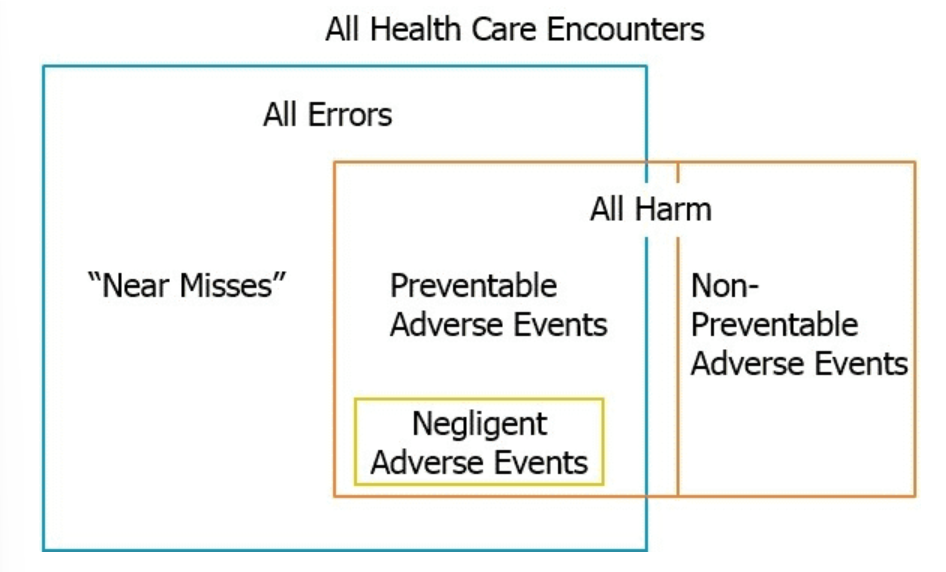
What is an unsafe act in healthcare?
An error or violation committed in the presence of a potential hazard that helps errors slip through an organization’s safety system and contribute to harm.
How are unsafe acts classified?
violations
errors; subcategorized to:
slips
lapses
mistakes
Define violations in the context of unsafe acts.
Violations are deliberate deviations from an operating procedure, standard, or rule, often without full recognition of the risks involved.
Define errors in the context of unsafe acts.
Failure to carry out a planned action as intended or application of an incorrect plan.
Define slips in the context of healthcare safety.
Slips are observable errors in action, such as accidentally pushing the wrong button.
Define lapses in the context of healthcare safety.
Lapses are mental errors, such as forgetting to carry out a planned action.
Define mistakes in the context of healthcare safety.
Mistakes are errors in decision-making or problem-solving, which can be rule-based (applying knowledge incorrectly) or knowledge-based (stemming from lack of knowledge).
What is the purpose of the substitution test in blame vs. accountability?
Helps distinguish between accidents/honest mistakes and reckless behaviour by asking if three other individuals with similar experiences would take the same action in the same situation.
Why is it important to accommodate the human condition in preventing patient harm?
Expecting providers to be perfect is not rational; human errors and violations will always occur, and blaming well-meaning individuals does nothing to prevent the majority of unsafe acts.
What does a “systems approach” to addressing medical errors involve?
On the condition under which providers and care teams work, redesigning workflow, adding defenses to avert errors, minimizing condition that lead to violations and implementing mechanisms to mitigate unsafe acts.
What is the traditional definition of harm in healthcare?
Harm in healthcare is traditionally defined as unintended physical injury resulting from or contributed to by medical care that requires additional monitoring, treatment or hospitalization or that results in death.
What are the three important criteria to meet the definition of harm in healthcare?
medical care causes the harm
harm leads to additional care
harm is physical
What are some limitations of the traditional definition of harm?
Missed other types of harm including psychological, lack or medical care, diagnostic error and errors that can cause future harm.
What additional types of injuries should be considered as harm from the patient’s perspective?
errors of omission
stroke due to failure in providing necessary care
psychological harm
rudely waking a patient at night without a medical reason
financial harm
How can effective safety systems reduce harm in healthcare?
Ensure proper procedures are followed
consistent adherence to safety protocols
can lower infection rates and other complications
Why is it important to redefine harm in healthcare?
Because if something is not considered harm, it is less likely to be prevented. A broader definition helps identify and address more types of harm.
How does focusing on harm rather than errors help improve patient safety?
Focusing on harm recognized that many complications of care are preventable and not necessarily tied to provider error, leading to broader safety improvements.
How does the notion of “preventable” harm evolve in healthcare?
As scientific knowledge and health systems improve, expanding the definition of what is “normal” or “unpreventable” changes.