Unit 9: Waves - Ch. 25 to Ch. 27
 Call Kai
 Learn
Learn Practice Test
 Spaced Repetition
 Match
Match Flashcards
 Knowt Play
1/29

Name | Mastery | Learn | Test | Matching | Spaced | Call with Kai |
|---|
No analytics yet
Send a link to your students to track their progress
30 Terms
Waves
Waves transport energy through space and time.
All waves begin as vibrations. One complete vibration will produce one complete wave.
Sound wave
Sound is energy that travels to our ears in the form of a pressure wave of compressed air
Sound waves are produced by the vibrations of large objects (a drum head, a bell…) and have low frequencies
Wave Description
A sine curve is a pictorial representation of a wave.
crests
The high points on a wave
troughs
The low points on a wave
amplitude
The distance from the midpoint to the crest (or trough) of the wave.
The amplitude is the maximum displacement from equilibrium.
wavelength (𝜆)
The distance from the top of one crest to the top of the next one (Or, the distance between successive identical parts of neighboring waves).
Frequency (𝑓)
The number of vibrations an object makes in a unit of time
Specifies the number of back-and-forth vibrations in a given time (usually one second).
A complete back-and-forth vibration is one cycle.
If a vibration takes one second, the frequency is one cycle per second; if two vibrations occur in one second, the frequency is two cycles per second.
The frequency of the vibrating source = the frequency of the wave it produces
The unit of frequency is called the hertz (Hz).
1 Hz = 1/s = s-1
period of vibration
The time (𝑇) needed to complete one vibration.
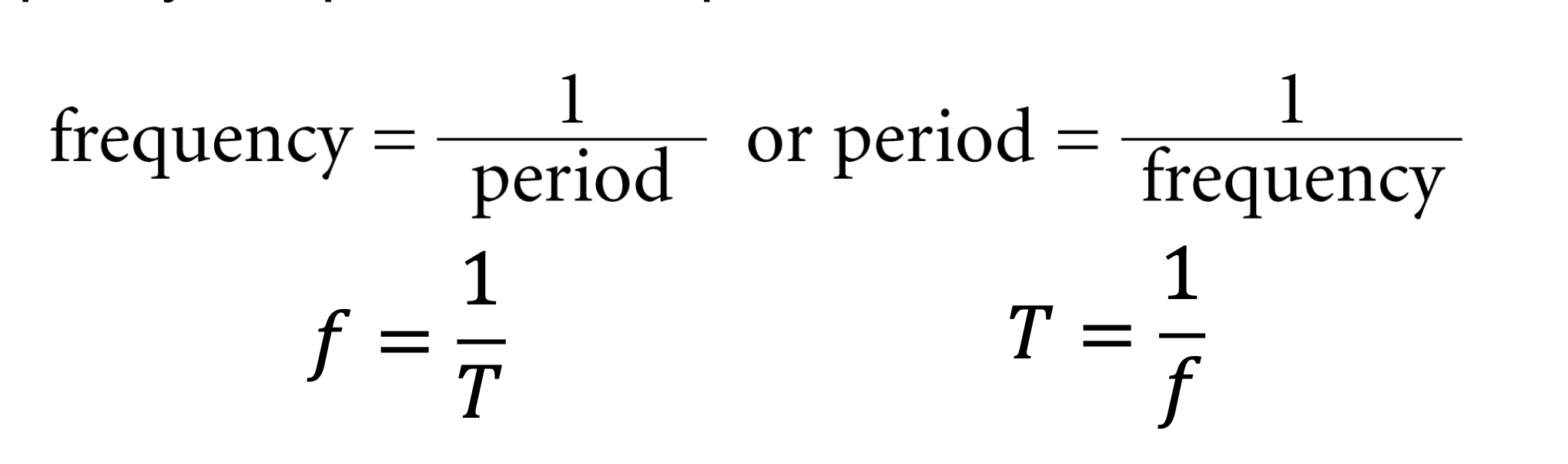
If the frequency of a vibrating object is known, its period can be calculated, and vice versa.
frequency and period are reciprocals of each other
Wave Speed
The speed of an object or a wave is defined as the distance moved, divided by the time needed to move that distance: 𝑣 = Δ𝑥/Δ𝑡.
For waves the “distance” we’ll use is the wavelength; the “time” is the period. So we have 𝑣 = 𝜆/𝑇 and since 𝑇 = 1/𝑓 we can say 𝑣 = 𝜆•𝑓
Where 𝑣 is the speed of the wave in m/s, 𝑓 is the frequency in 𝐻𝑧, and 𝜆 is the wavelength in meters.
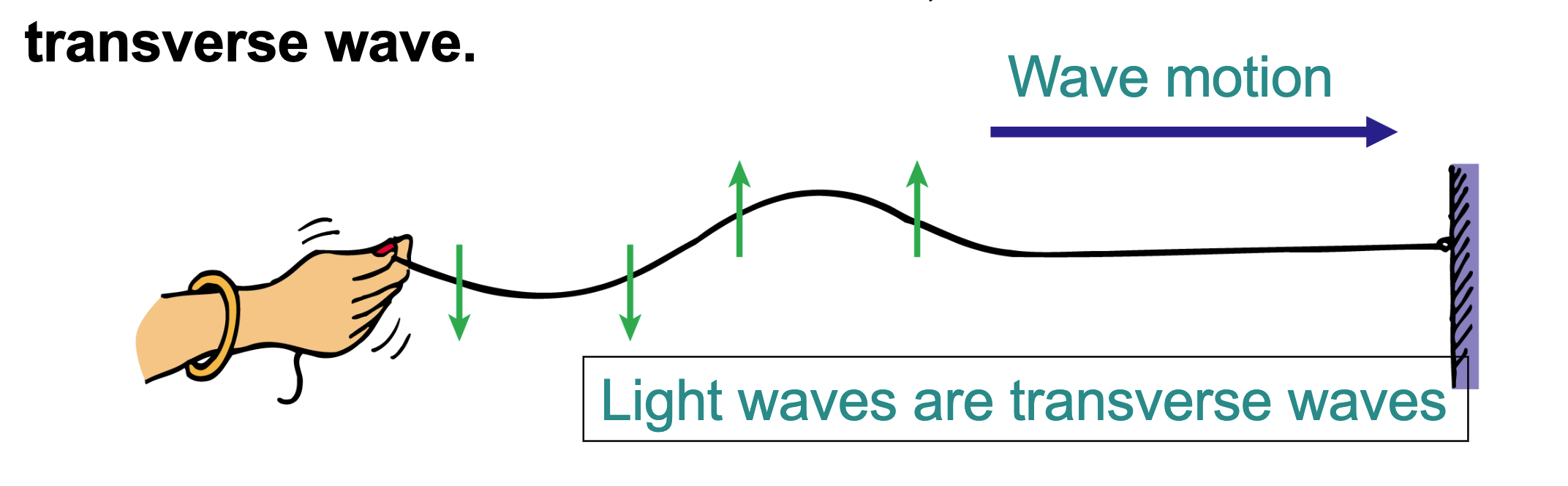
Transverse Waves
Whenever the motion of the medium is perpendicular to the direction in which a wave travels
Ex: Light
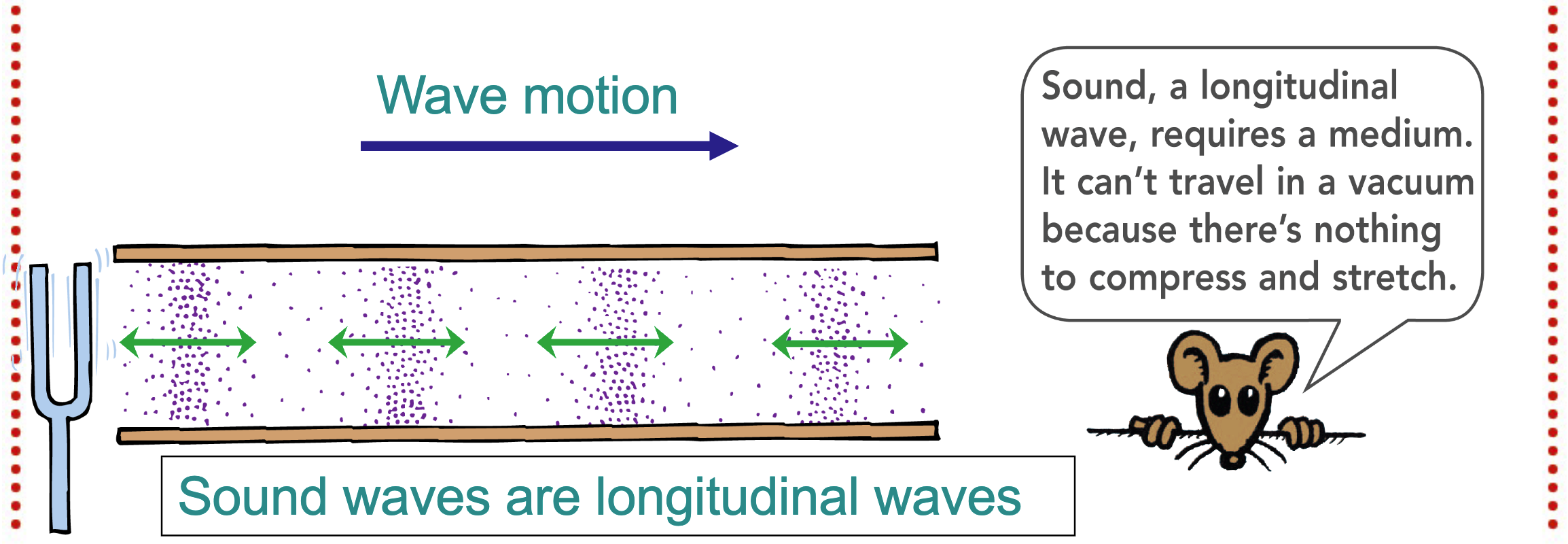
Longitudinal Waves
When the particles oscillate parallel to or along the direction of the wave
Ex: Sound waves
The Origin of Sound
The source of all sound waves is vibration.
This vibrating material then sends a disturbance through a surrounding medium (ex: air) in the form of longitudinal waves.
The frequency of the sound waves produced = the frequency of the vibrating source.
pitch
How we describe our subjective impression about the frequency of sound
Light
light consists of particles, photons, massless bundles of concentrated electromagnetic energy, that act like either waves or particles, depending on how we measure them.
light has a dual nature, part particle and part wave.
energy that is emitted by charged particles—generally electrons in atoms or ionized gas—accelerating or losing energy
How does light travel?
It travels as electromagnetic waves made of electric and magnetic fields.
The waves that make up light travel at the speed of light 𝑐 = 3.0×10⁸ 𝑚/𝑠 in empty space
appears to be the fastest speed possible in our universe.
electromagnetic spectrum
includes radio waves, microwaves, infrared, visible light, ultraviolet, X-rays and gamma rays.
The electromagnetic spectrum, ordered by increasing frequency and energy
the wave equation
electromagnetic waves obey the wave equation
the speed of the wave in empty space set to the speed of light 𝑐 (light travels more slowly through matter).
𝒄 = 𝒇𝝀
Where 𝑐 = 3.0×10⁸, 𝑓 is the frequency in 𝐻𝑧, and 𝜆 is the wavelength in 𝑚.
For light in empty space, knowing either the frequency or wavelength allows us to solve for the other.
infrared
Electromagnetic waves of frequencies just lower than the red of visible light
ultraviolet
Electromagnetic waves of frequencies just higher than those of violet
Energy of light
the energy of light depends not on brightness, but on frequency:
𝐸 = ℎ𝑓 = ℎ𝑐/𝜆
where 𝐸 is the energy in 𝐽; 𝑓 is the frequency in Hz; and ℎ = 6.626×10⁻³⁴ 𝐽 • 𝑠 is Planck’s constant
refraction
When a light wave crosses the boundary between two materials with different speeds of light, the wave bends.
Different colors of light travel at slightly different speeds in matter
In empty space, all EM waves travel at the same speed
generally cooler colors are slower than warmer ones, so are bent by different amounts; and so the light is split into the visible spectrum.
transparent
Materials that transmit light
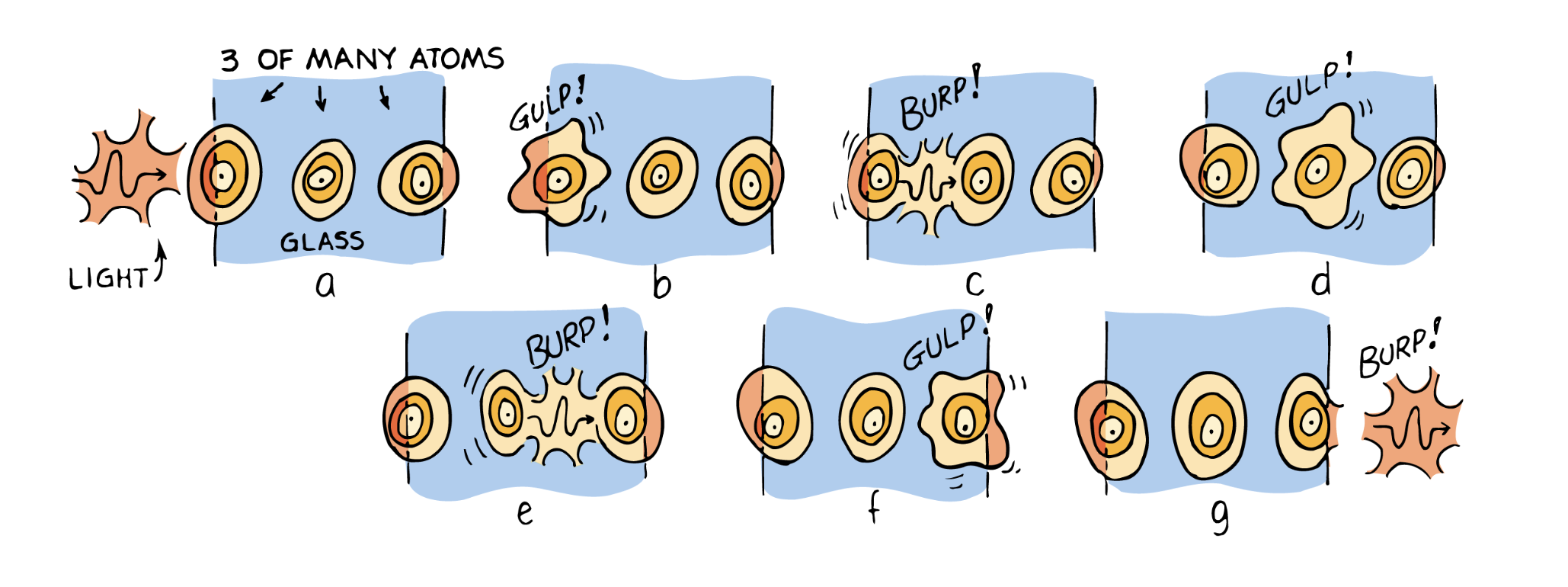
If the vibration frequency of the electrons doesn’t match the light frequency, the light passes through.
But sometimes the frequencies match, and electrons absorb the light and use its the energy causes electrons to vibrate.
The energy received by the atom can be either passed on to neighboring atoms by collisions or reemitted as light.
The longer the electrons hold onto the energy, the more likely the atom will collide with another and the energy is converted into heat.
When light emerges from a materials into the air, it returns to its original speed, c.
opaque
Materials that absorb light without reemission and thus allow no light through them
the vibrations caused by absorbing light are turned into heat: the materials become warmer.
Materials may be opaque to some electromagnetic waves, but transparent to others
Metals
can either absorb or reflect light.
metals are unable to absorb or transmit light, the only thing they can do is reflect it.
spectroscope
An instrument that can split the light up into its component colors, like a prism does, to be analyzed.
continuous/blackbody spectrum
Spectrum of light emitted by hot things
Hotter things emit bluer light and cooler things emit redder light
emission lines
The spectrum of an element in gaseous form appears not as a continuous band of color, but as a series of bright emission lines, each corresponding to a distinct frequency and energy of light
Much of the information that physicists have about atomic structure is from the study of atomic spectra.
The different electron orbits in an atom are like steps in energy levels.
An electron can absorb energy and be temporarily raised to a higher level.
When the electron returns to its original level, it releases energy in the form of light
fluorescence
electrons in molecules absorb high-energy light, lose some of the energy to heat, and re-emit the rest as lower-energy light
Phosphorescent
materials absorb light and slowly release it