intro to neuroscience exam 2
 Studied by 2 people
 Call Kai
 Learn
Learn Practice Test
 Spaced Repetition
 Match
Match Flashcards
 Knowt Play
1/162

Earn XP
Description and Tags
ch 4, 5, 6
Name | Mastery | Learn | Test | Matching | Spaced |
|---|
No study sessions yet.
163 Terms
what was the debate between Golgi and Cajal?
brain organization, is the brain just a bunch of parts or a greater whole?
what was Cajal’s argument?
neuron doctrine: brain is composed of discrete cells
what was Golgi’s argument?
Reticular theory: brain is a continuous network of fibers
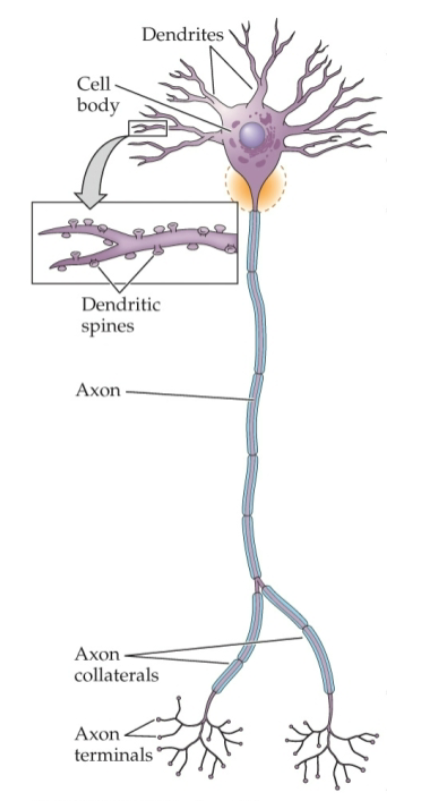
what are the basic parts of a neuron and their functions?
cell body or soma with a nucleus: houses the nucleus and receives and integrates incoming electrical signals from the dendrites
axon(long thin protrusion): transmit electrical signals
dendrites(tree)(thicker shorter protrusions): receive incoming electrical signals
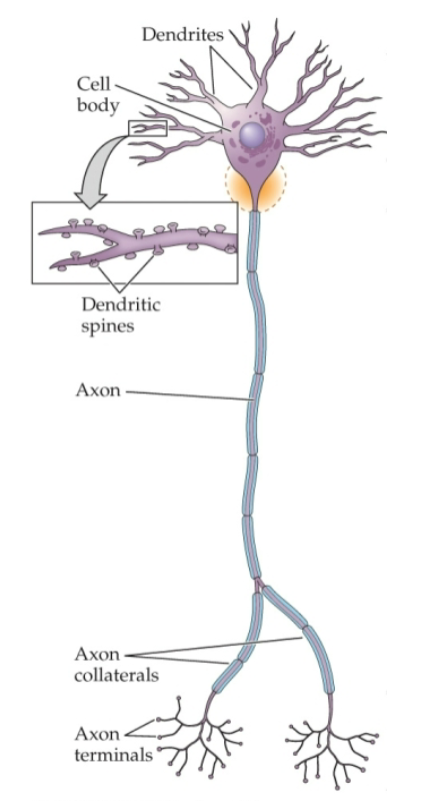
what is the role of the cell body(soma)
houses the nucleus and receives and integrates incoming electrical signals from the dendrites

what is the role of the axon
transmit electrical signals
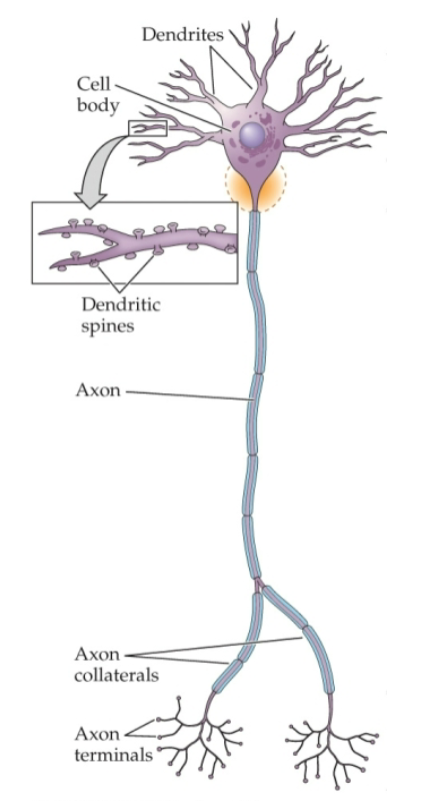
what is the role of the dendrites
receive incoming electrical signals
what are the types of glial cells
astrocytes
oligodendrocytes/schwann cells
microglia
what is the role of the astrocytes
helps control blood brain barrier and absorbs and release important biological compounds that
support neuronal and endothelial function
what is the role of oligodendrocytes/schwann cells
produces the myelin sheath that wraps around axons
what is the role of microglia
immune cells of the brain, removes clumps of proteins and dead dying cells
cajal
founder of modern neuroscience, won the debate about brain organization
golgi
italian physician and scientist who did the black reaction and found the golgi apparatus
black reaction
created by golgi, silver nitrate on fixed tissue, stains only a few random cells, but filled completely
neuron doctrine
created by cajal, brain is composed of discrete cells, Neurons signal to each other –brain can be
understood by action of its basic parts
reticular theory
created by golgi, brain is a continuous network of fibers, action of the whole is key
dendrite
thicker shorter protrusions, often with spines
soma
similar to dendrites
axon
long thin protrusion
law of dynamic polarization
dendrites → axon hillock → axon → axon terminals
input zone→integration zone→ conduction zone→output zone
axon hillock
where the end of the cell body and the first axon meet
interneuron
integrate and modulate neural signals
monopolar
only one short process extending from the cell body
bipolar
two distinct processes that extend from the cell body(soma)
glia
support cells
myelin
fatty, insulating layer, or sheath, that forms around the axons of many neurons
what is an injury current
electric current generated by damaged excitable tissue, such as a nerve, muscle, or the heart
what is membrane theory
created by Julius Berstein that stated:
cells act like leyden jars
When depolarized, voltage
reaches a threshold,
“discharging” an action
potential that is propagated
down the axon
main components of the integrate and fire model
-proposed by Lapique
-synaptic currents are added up to charge/discharge the membrane
-when threshold is reached (all are none action potential)
What were Adrian’s main findings about action potential production in single nerve fibers?
all or none principle: rate not shape
frequency is the code for stimulus intensity
what is spatial integration
more neurons synapsing at different locations in the dendrite
what is temporal integration
spikes come up more rapidly, and they can add up over time
how does spatial integration contribute to total synaptic input current
multiple inputs
how does temporal integration contribute to total synaptic input current
total influence = firing rate X synaptic weight
how does thinking relate to the dominant paradigm
pattern of firing rates within network
combination of excitation and inhibition
how does learning relate to the dominant paradigm
Permanent change in connections
Rewiring
how does feeling relate to the dominant paradigm
modulating connectivity
Sherrington
A scientist discovered that excitatory and inhibitory synapses that are modified with learning
Bernstein
scientist that discovered cells have graded membrane potentials, acting as charged capacitors (Leyden jars)
Adrian
scientist that discovered how to record from single axons
resting potential
inside nerve has negative voltage relative to outside
spike threshold
critical level of membrane depolarization that must be reached for a neuron to fire an action potential/spike
soups vs sparks
is synaptic input with chemicals(soups) vs. electrical(sparks)
activation dynamics
pattern of firing rates within network, determined by wiring, combo of excitation and inhibition
rate coding
proposes that the intensity or strength of a stimulus is encoded by the frequency or rate at which a neuron fires action potentials (spikes)
synaptic weight
determines the size or the effect per spike
what are the major techniques for recording brain activity
fMRI
EEG
Intracellular recording
amplifier
use small currents to alter much bigger externally supplied currents
micropipette
records small currents
in vitro
in glass(petri dish)
in vivo
in living organism
patch clamp
technique for recording intracellular recording
microwires
invasive, chronic recording of neural activity in live animals and sometimes in human patients (during surgery)
tetrodes
four electrodes
neuropixel silicon probes
chip technology, 100s of recording sites
fMRI
functional magnetic resonance imaging
BOLD
blood oxygen level dependent
charge
electricity that comes from charged particles
voltage
electric potential or electrostatic pressure
current
rate of flow of charge past a point
conductance
A measure of how easily electric current flows through a material
resistance
measure of an object’s opposition to the flow of electric current
charge in the water analogy
amount of water
current in the water analogy
current-I
voltage in the water analogy
pressure - V
conductance in the water analogy
width of pipe -g
resistance in the water analogy
narrowness of pipe - R (g=1/R)
what is ohm’s law
two forms: V=IR or I=gV
I
current
g
conductance
What are the two causes pushing ions to move across the membrane through selective ion channels?
the concentration gradient and the electrical gradient
How does a concentration gradient alter the formula for Ohm’s Law?
while the concentration gradient doesn’t do much and stays constant, the voltage changes rapidly
What is the reversal potential?
a point in which the voltage exactly cancels the concentration gradient and at this point, the current reverses between inward and outward
electrostatic gradient
Movement of charged ion due to differences in voltage between inside and outside of cell
concentration gradient
Ion diffusion due to different concentrations inside and outside cell
driving force
net gradient is the difference between the voltage and the reversal potential
driving force in equation
V-Erev
I_X = g_X(V-E_X)
net pressure equation
Erev
reversal potential
How can changing the relative conductance of multiple ion channels be used to control the membrane voltage?
increase in Na conductance: depolarization
Increase in G conductance: hyperpolarization
increase in CL conductance: stabilization/inhibition
How do Na and K voltage-dependent conductances cause action potentials?
The Na will be fast and the K will be slow because it depends on voltage and time
What technique allowed Hodgkin and Huxley to untangle the currents contributing to the action potential?
voltage clamp
What functional properties of action potential generation arise from the mechanisms?
voltage gated NA+ channel activation, delayed opening of K+ voltage gated channels
How does myelin speed up signal propagation?
it decreases capacitance between nodes and there is high density of Na at nodes of Ranvier, causing saltatory conduction
Squid giant axon
specialized neurons they have, with the largest diameter axons in the animal kingdom
overshoot
where V=0, phase of the action potential where the membrane potential temporarily becomes positive
Na hypothesis
reducing NA concentration reduces early phase, and the late phase is similar
after-hyperpolarization (AHP)
where Na and K become largely inactive, with Na completely inactive and K still lingering
voltage clamp
an experiment technique in which you set the desired voltage(like a thermostat) and wrap thin wire around a glass tube that measures voltage and injects a current to keep V constant
spike threshold
particular voltage where Na channels activate, which triggers an action potential
refractory period
happens right after a spike and K is open while Na inactivated and cannot spike again
activation gates
fast, opens fast when V is depolarized
inactivation gates
slow(like K), slowly closes(inactivates channel) when V is depolarized
channel subunits
individual protein components that assemble to form an ion channel
myelin
the sheath that wraps around axons
nodes of Ranvier
short periodic gaps found in the myelin sheath along a myelinated axon
saltatory conduction
the mechanism by which an action potential is rapidly transmitted along a myelinated axon
What were the main arguments around the discovery of chemical transmission?
sparks: favored electrical transmission at synapse
soups: scientists favoring chemical transmission
What sequence of steps results in a presynaptic action potential causing neurotransmitter to bind at receptors on the postsynaptic membrane?
Vesicles filled with neurotransmitter
are docked to the membrane
Action potential enters terminal
Ca enters via voltage-gated Ca
channels
Ca reacts with proteins binding
vesicles to membrane
Neurotransmitter has to be cleared
Post synaptic
Neurotransmitters diffuse across synaptic cleft
Transmitters bind to receptors on the post-
synaptic neuron
binding leads to opening of ligand-
gated ion channels
Current flows through channels
• Post-synaptic current (PSC)
Current causes change in post-synaptic
membrane voltage
• Post-synaptic potential (PSP)
What are gap junctions
(also known as electrical synapses) a type of synapse in which there is direct connection between the cells and no neurotransmitters are needed