APES Unit 1 Progress Check
 Call Kai
 Learn
Learn Practice Test
 Spaced Repetition
 Match
Match Flashcards
 Knowt Play
1/31

There's no tags or description
Looks like no tags are added yet.
Name | Mastery | Learn | Test | Matching | Spaced | Call with Kai | Chat |
|---|
No analytics yet
Send a link to your students to track their progress
32 Terms
What process is illustrated by the downward arrows from the atmosphere that show the conversion of nitrogen gas into usable forms available to producers?
Nitrogen fixation

What type of organism is required to complete the nitrogen cycle, including the process of denitrification?
Bacteria
The majority of the nitrogen on Earth can be found in what reservoir?
Atmosphere
A key component of the hydrologic cycle that powers the movement of water and is missing from the diagram?
the sun

What smaller reservoir of freshwater is missing from the diagram?
Ice caps

what is represented by the arrows in the food web?
The flow of energy

Which trophic level has the least available energy in kilojoules in this food web?
Killer whale

Based on the second law of thermodynamics, how much biomass of phytoplankton would be needed to produce 1 kg of large fish in this food web?
1,000 kg
Six white-tailed deer and six sika deer were enclosed in a pasture for observation during an eight-year study in central Texas. White-tailed deer are a native species to central Texas, while sika deer are a nonnative species to central Texas. White-tailed deer feed on flowering plants and the tips of trees and shrubs but do not eat grass. Sika deer feed on flowering plants, the tips of trees and shrubs, and grass. All other grazing animals were kept out of the pasture during the study. The number of sika deer more than doubled after the eight years, while the population of white-tailed deer decreased by 50 percent.
Which of the following statements best supports the results from the study?
The sika deer out-competed the white-tailed deer in consuming flowering plants and shrubs
In reef ecosystems, corals often have microalgae living inside them. The algae supply the corals with nutrients, and the coral give shelter to the algae. Which of the following interactions best describes the relationship between the corals and the algae?
Mutualism
Which of the following best describes an example of resource partitioning in an ecosystem?
Two different brid species feed from the same oak tree; one eats acorns and the other eats insects in the bark
Which of the following describes the most likely change to terrestrial biomes resulting from warmer average global temperatures?
The global distribution of midlatitude biomes, such as grasslands and temperate rain forests, would increase
Which of the following terrestrial biomes has the highest net primary productivity?
Tropical rain forest
Which of the following terrestrial biomes has the highest primary productivity per unit area?
Tropical rain forest
This biome contains a nutrient-rich environment created by falling leaves and trapped organic materials from the large trees, and it provides the ecosystem service of filtering pollutants from water.
freshwater wetlands
This biome is found in shallow waters off the coastline and is Earth's most biologically diverse marine biome.
coral reefs
This freshwater biome is characterized by fast-flowing water that can originate from underground springs or runoff, which carries sediment and organic material.
rivers
Which of the following biogeochemical cycles includes the processes of buffering ocean pH and photosynthesis?
the carbon cycle
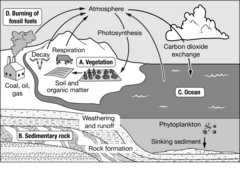
Which of the boxes represents a carbon source?
D: burning of fossil fuels

Which box represents a carbon sink that holds carbon compounds for the shortest period of time?
A
Which of the following statements is best supported by the diagram of the phosphorus cycle?
The phosphates absorbed by animal tissue through consumption eventually return to the soil
Farmers in a suburban coastal town started using no-till agriculture, a practice that reduces soil erosion from their farmland. Use the image above to determine which of the following long-term effects no-till agriculture will have on the ecosystem surrounding the farmland.
There will be less algal growth in the nearby ocean.
Based on the diagram, which of the following statements about the hydrologic cycle is true?
Water from the ocean evaporates ad condenses in the atmosphere

The total rate of photosynthesis in a given area
gross primary productivity
This rate of reaction can be measured in the dark by determining the amount of oxygen gas consumed in a period of time.
Cellular respiration
The energy available to consumers determined by subtracting the energy used by plants from the total energy transformed by the process of photosynthesis
Net primary productivity
Which of the following best describes the flow of energy in most terrestrial and near-surface marine ecosystems?
Producers use energy from the sun to make organic matter, such as sugars, from carbon dioxide and water and are then consumed by organisms higher in the food chain
Which of the following best describes a terrestrial ecosystem that will have the highest net primary productivity?
Warm temperatures, high rainfall, and consistent sunlight
Which of the following trophic levels represents a primary producer in an aquatic food chain?
Phytoplankton
Which of the following is the approximate number of kilocalories/meter2/yearkilocalories/meter2/year available to herbivores in that biome?
200 kilocalories/meter^2/year
Energy is transferred along food chains from one stage to the next. Which statement best explains how the energy is transferred?
If a primary producer stores 10,000 kcal of energy, then a tertiary consumer will have 10 kcal of energy available
Based on the food web shown above, which of the following correctly describes the flow of energy through the trophic levels from producers to quaternary consumers?
Brittlebrush, grasshopper, grasshopper mouse, rattlesnake, red-tailed hawk