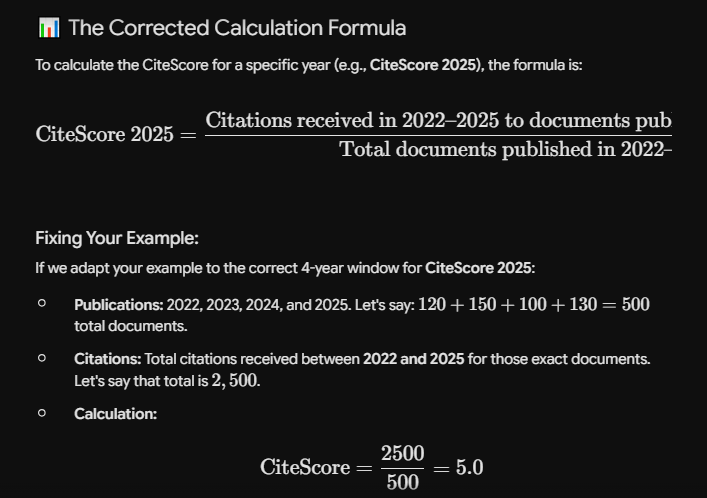
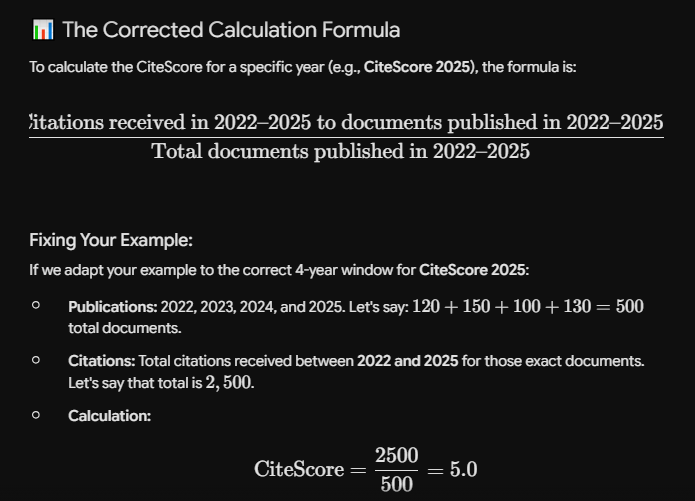
17- ✅What is the Cite Score of a Journal?
 Call Kai
 Learn
Learn Practice Test
 Spaced Repetition
 Match
Match Flashcards
 Knowt Play
1/10

Earn XP
Description and Tags
Source: https://www.youtube.com/watch?v=l4gzZgaqkqs
Name | Mastery | Learn | Test | Matching | Spaced | Call with Kai |
|---|
No analytics yet
Send a link to your students to track their progress
11 Terms
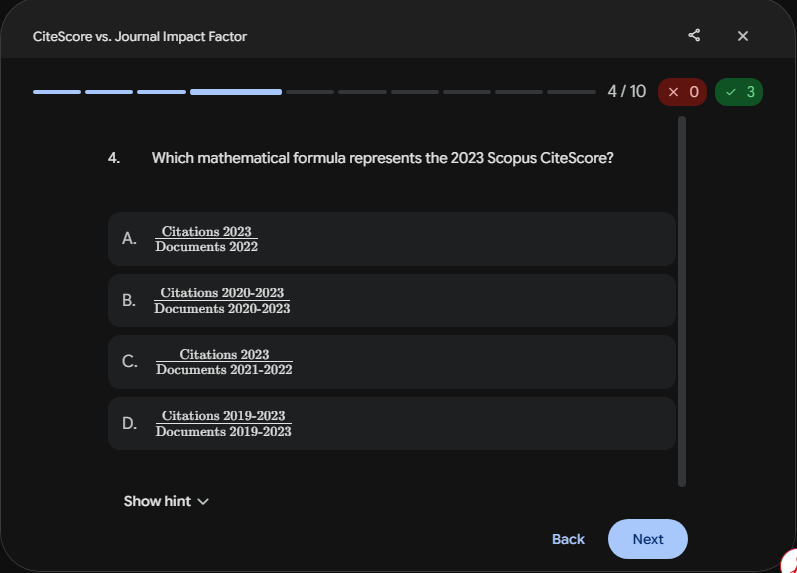
Which of the following correctly describes the time window used for the calculation of the 2023 Scopus CiteScore?
A. Citations in 2023 to items published in 2021-2022.
B. Citations in 2020-2022 to items published in 2023.
C. Citations in 2023 to items published in 2018-2022.
D. Citations in 2020-2023 to items published in 2020-2023.
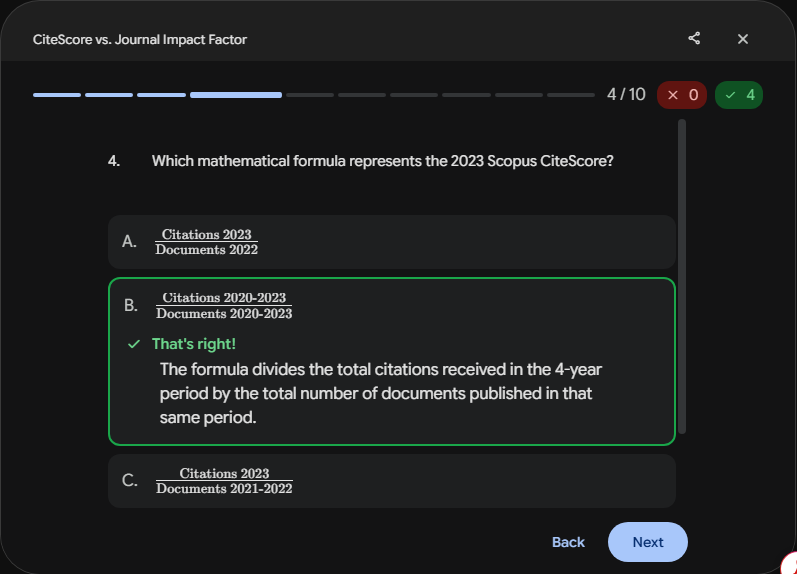
Answer: D. Citations in 2020-2023 to items published in 2020-2023.
Explanation: CiteScore uses a 4-year window that counts citations received in those 4 years to documents published in that same 4-year period.
In the calculation of the Journal Impact Factor (JIF), which document types are included in the denominator (citable items)?
A. Articles, Reviews, and Editorials.
B. Articles and Reviews.
C. All indexed document types.
D. Articles and Conference Papers.
Answer: B. Articles and Reviews.
Explanation: Clarivate limits the JIF denominator to 'citable items,' which specifically refers to substantive research articles and reviews.
What is the primary database used to retrieve the data for calculating the CiteScore metric?
A. PubMed.
B. Web of Science.
C. Google Scholar.
D. Scopus.
Answer: D. Scopus.
Explanation: CiteScore is a proprietary metric developed by Elsevier and is based exclusively on the Scopus database.
How does CiteScore handle different document types in its denominator compared to JIF?
A. CiteScore includes more types of documents.
B. CiteScore excludes book chapters.
C. CiteScore excludes conference papers.
D. CiteScore includes only peer-reviewed articles.
Answer: A. CiteScore includes more types of documents.
Explanation: CiteScore is more inclusive, counting articles, reviews, conference papers, book chapters, and data papers in the denominator.
A journal has a high number of 'Editorials' that receive many citations. Which metric is likely to be significantly higher for this journal?
A. Source Normalized Impact per Paper.
B. Journal Impact Factor.
C. CiteScore.
D. SCImago Journal Rank.
Answer: B. Journal Impact Factor.
Explanation: JIF includes citations to editorials in the numerator but excludes the editorials themselves from the denominator, inflating the score.
What is the update frequency of the 'CiteScore Tracker'?
A. Monthly.
B. Daily.
C. Annually.
D. Quarterly.
Answer: A. Monthly.
Explanation: The CiteScore Tracker provides a monthly update on the current year's progress before the final annual value is fixed.
In the context of JIF, why is the 'numerator' often considered 'broader' than the 'denominator'?
A. Citations to all documents count.
B. It includes self-citations.
C. It counts citations from Scopus.
D. It covers more database years.
Answer: A. Citations to all documents count.
Explanation: The JIF numerator includes citations to every document type, even if those document types are excluded from the denominator.
Which of these document types is included in the CiteScore denominator but generally excluded from the JIF denominator?
A. Research Articles.
B. Data Papers.
C. Review Papers.
D. Retractions.
Answer: B. Data Papers.
Explanation: CiteScore includes data papers as part of its 'all document types' approach, whereas JIF typically excludes them unless classified as an article.
If a journal published 100 items in 2021-2022 and received 500 citations in 2023, what is its 2023 Journal Impact Factor?
A. 2.500
B. 0.200
C. 5.000
D. 50.000
Answer: C. 5.000
Explanation: The JIF is calculated by dividing citations in the current year (500) by the items published in the previous two years (100).