sex determination
 Call Kai
 Learn
Learn Practice Test
 Spaced Repetition
 Match
Match Flashcards
 Knowt Play
1/20

There's no tags or description
Looks like no tags are added yet.
Name | Mastery | Learn | Test | Matching | Spaced | Call with Kai | Chat |
|---|
No analytics yet
Send a link to your students to track their progress
21 Terms
chromosomal sex
females are xx so all oocytes carry the x chromosome
in males sperm can carry an x or a y chromosome, therefore the sperm content determines the sex of the embryo
one gonad, 2 fates
what is the early embryonic gonad
when does sex differentiation occur
which ducts are female and male
which phenotype is the default
formation of ovaries or testes is an active gene directed process
early embryonic gonad is bi potential
sex differentiation at week 7 of development
wolffian- male, mullerian- female
development of male ducts is hormone dependent
• Female duct phenotype (Mullerian) is the default
- Predominates in the absence of foetal testis
- Remove bi-potential gonads, female reproductive system develops (Jost, 1953)
making of a male
what is male gonadal sex determined by
where is the transcription factor
where is it expressed start nd decreased
what can mutations of this cause
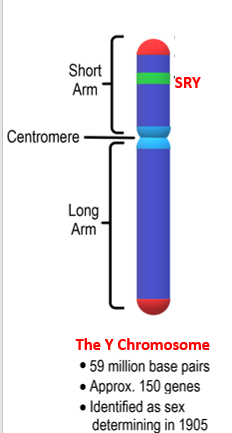
male gonadal sex is dtermined by inheritance of SRY
transcription factor on Y chromosome
starts to be expressed in the somatic cells of the genial ridge e10.5, decreases after e12.5 in mice
mutations in SRY in humans cause xy to xx reversal
expression of sry in xx mice result in testis formation and male phenotype
switched on by wt-1 and sf-1 proteins
SRY expression
where does it begin
begins at the centre of the developing testis and spreads out along it
expression starts in the central zona of gonad
then spreads across long axis of gonad in a wave
if sry not switched on in a 6 hour window the gonad will develop as an ovary
ovotestis formation
some mouse straisn undergo partial xy to xx sex reversal resulting in ovotestis formation
frequently has male testis tissue at centre and female ovarian tissue at poles of the gonad due to a failure of sry to spread along the gonadal axis
How do bipotential cells differentiate into sertoli cells
what is expressed in XY genes and what does this encode
how is the expression increased.
what does this new gene activate and what happens
what do they also supress
what do they also do to bipotential signalling cells
in XY genes the SRY gene is expressed an encodes a transcrition factor that activates SOX9 target gene
SRY and SF1 bind to a SOX9 enhancer to increase expression. once SOX9 reaches a threshold the system becomes self sustaining.
sox9 activates FGF9 expression. this creates a positive feedback loop with FGF9
They also
this continued signalling cause bipotential supporting cells to differetiatig nto sertoli cells
what hormones does the testis produce
testosterone: forms external male penis from urethral folds. wolffian duct becomes internal male reproduction system (epodidymis, vas deferems)
anti mullerian hormone: degeneration of mullerian duct
female
which gene is not present
what is identified in XY females and what does this disrupt and downregulate
what does this cause the formation of
what is expressed in the bi potential gonad.
no SRY gene
DAX1 is identified in XY females and disrupts SRY function.
it also downregulates testis Sf1 expresion.
Leads to the formation of a dysfunctional testis which cannot produce testosterone and thus the mullerian ducts predominate
WNT4 gene is expressed in the bi potential gonad. It is undetectable in the XY gonad. Maintianed in the XX gonad.
XX Wnt4 knock out mice have abnormal ovaries.
sex determination in the bipotential gonad
in xx and xy at 11.25dpc what transcripts and where in the gonad are they located
how is a male pathway initiated
how does this occur
what happens in xy gonads
how is the female pathway initiated
in both xx and xy gonads at 11.25dpc, fgf9 transcrips are detected near gonad surface. wnt4 trasncrips detected near the gonad mesonephric boundary.
genetic env switch initiates male pathway by creating an imabalance
in females, this occurs through upregulation of sox9
sox9 and fgf9 forms a positive feedback loop in xy gonads
•The balance between FGF9 and WNT4 signals is shifted in favor of FGF9, and the dominance of the male pathway is established.
In the absence of a feed-forward loop between SOX9 and FGF9 (as in XX gonads), WNT4 blocks Fgf9 initiating the female pathway
environmental influence on offspring sez
there is athermosensitive period of development in reptiles
snapping turtle egg incubation
below 22 or above 28- females
intermediate temps- males
american alligator egg incubation
above30- females
below 25- males
28.5- equal number
what are advantage of a skewed sex ration
sex allocation hypothesis
dominant males father most offspring
subordinate males dont mate
all females pregnant
But
Only females with high rank/bcs produce males which join dominant male
males born to nutritonlly restricted mothers are smaller as adults
females with good condition should opt to produce male
female with poor should opt to produce female
examples of manipulation of sex ratio bias
fig wasp
low pop density
in favour of male
they dispese to fertilise females in other colonies, maximise genetic potential and minimise inbreeding
ruff
poor food availability
sex bias in favour of female
so maximise offspring prod, dont waste foods on multiple male
examples in mammals
red deer
maternal dominance correlates offpring sex ratio
dominant females more male (dominance correlates w testoserone)
sex bias eliminated with high popdensity (as nutrional stress, increased confrontation to maintain dominant postition)
american opossum
maternal condition correlates offspring sex ratio
Marsupials move to the pouch 14 days after conception
– Mechanisms must act before conception or on very early embryo
non human primate
• – Maternal condition correlates offspring sex ratio
– Social structure is important
• Colobine monkey high ranking females have more males
• Opposite is true in baboons (matriarchal society)
in human
maternal diet high in sat fat or glucose- male
high in omega 6 polysunsaturated fatty acid- female
females gaining condition produce sons, losing produce daughters
env stressor in human
dioxin exposure of males at puperty- increased male offspring in adulthood
dichloroethylsulpide- decreased male to female ratio, decreased testosterone:gonadotrophin ratio in males and increased sperm dna damage. but sperm dna integrity linked ot ability to progress through female tract
psychological stres
decrease in male to female ratio
fema tract selecting speciifc sperm
female will select sperm from a particular male
heterospermic insemination cattle
sperm selection at UTJ
can mice sperm pass through the UTJ
what do they fail to exress
molecular recognition systems
mice sperm op unable to pass utj despite normal motility and morphology
fail to expres sperm surface protein (a- disintegrin and metalloprotease3)
implication for sperm viability assessent- these normal sperm would not reach oocyte
evidence forsperm selection via surface proteins
sperm surface marker
what is the name
what is it involved in
what does the expression correlate with
• Evidence from clinical investigation of human sperm for infertility treatment
• CD52 sperm plasma membrane glycoprotein
• CD52 involved in sperm binding to oviduct and zona pellucida
• CD52 expression correlates with sperm DNA integrity
• Female tract can select out a sperm with poor genetic integrity using CD52
difference of x and y chromosome sperm
• Nuclear content differs by 2.8-4% dependant on species
• Morphology differs subtly between X and Y sperm
– X sperm increased head, mid-piece and tail length
– Sperm morphology reflects DNA integrity
• Differentially expressed proteins
– Associated with cytoskeletal structures influencing motility
– Regulation of metabolism
• Individual sperm microRNAs
– Adopt unique 3D shapes for sperm recognition in oviduct
– Powerful modulators of gene expression
can females differentiate between x and y sperm
• Does sperm induce sex specific gene expression in the oviduct
• Inseminated X or Y sperm into contralateral oviducts of the same animal
• Sex specific oviductal responses seen by altered gene expression (microarray)
• 501 of 24,123 genes showed X & Y differential expression
• Immune response genes upregulated with Y-sperm
– Interferon regulatory factor (IRF7)
– Detects foreign DNA from pathogens via pattern recognition receptors (Toll-like receptors)