Diversity of Eukaryotic Chapter 11- Lophotrochozoa
 Call Kai
 Learn
Learn Practice Test
 Spaced Repetition
 Match
Match Flashcards
 Knowt Play
1/183

There's no tags or description
Looks like no tags are added yet.
Name | Mastery | Learn | Test | Matching | Spaced | Call with Kai | Chat |
|---|
No analytics yet
Send a link to your students to track their progress
184 Terms
Bilateral symmetry
mirror images along a central axis
anterior, posterior, dorsal, ventral
Key body axes in bilateral symmetry
Cephalization
____ is the evolutionary trend of concentrating sensory organs and nervous tissue at the anterior (front/head) end
locomotion
Cephalization is an adaptation for ____ (crawling, swimming, burrowing), because animals move head-first, anterior end encounters the environment first, concentration sensory organs there improves navigation.
bilateria
Evolution of ____: sensory processing, feeding, predator avoidance, centralized system
three embryonic germ layers
divergence in animals also based in part of the development of ____ and development of mount or anus from blastopore
endoderm, ectoderm
Diploblastic : ___
endoderm, ectoderm, mesoderm
triploblastic : ____
mouth forms second from blastopore
deuterostome : ____
mouth forms first form blastopore
protostome : coelom is formed by ingression and splitting by blastopore ____
mouth forms second to blastopore = anus
deuterostomes : mesoderm and endoderm form by infolding of endoderm, ____
Coelom
____ function:
functions as a cushion for internal organs
allows for independent organ development and movement
can act as a hydrostatic skeleton (flatworms)
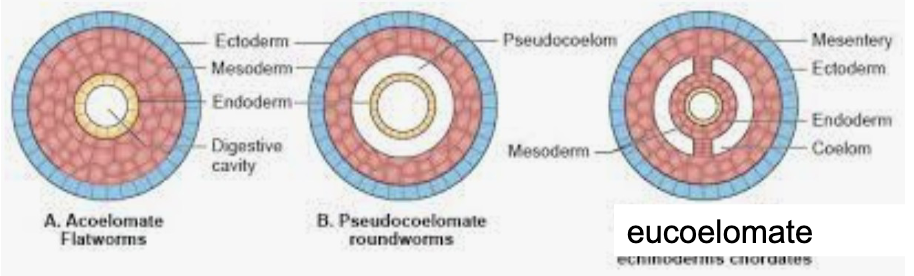
Eucoelomate
____ = true coelom, a body cavity completely lined by mesoderm
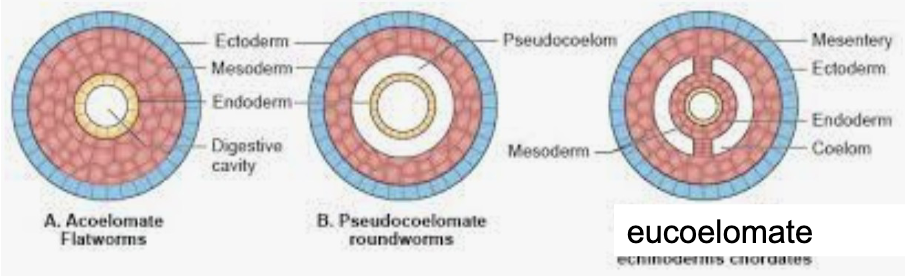
Pseudocoelomates
____ = body cavity is partially lined with mesoderm
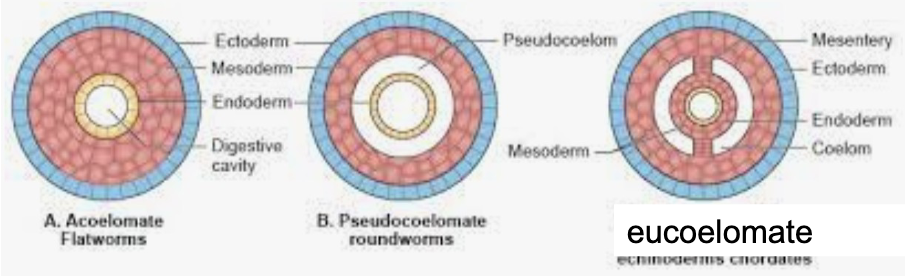
Acoelomates
____, lack a true coelom (a fluid-filled body cavity completely lined by mesoderm); mesenchyme provides hydrostatic support
molting
Ecdysozoa = ____
lophotrochozoa
____ = trochophore larvae, lophophore feeding, no molting
ciliated tentacles
lophophore is a feeding structure with ____.
propelled by cilia
Trochophore larvae is a larvae ____ (common in marine annelids + mollusks)
Larvae
____ is a sexually immature and morphologically distinct from parent
triploblastic lophotrochozoans
Flatworms “Platyhelminthes” are bilateral, acoelomate and ____
solid mesodermal tissue
In phylum platyhelminthes, which are acoelomate, the space between the digestive tract and body wall is filled with ____
marine, freshwater, and terrestrial
Phylum platyhelminthes there are ~ 15,000 free-living and parasitic species. What environment are these found in?
diffuse across cells due to their flat bodies
Platyhelminthes “flatworms” have no respiratory or circulatory systems instead they ____
small (<2-3 cm) and flat but some can be up to 20 cm long
Free living flatworms, endoparasitic flukes, and endoparasitic tapeworms are generally ____.
body is flattened along dorsal and ventral surfaces
Basic platyhelminthes architecture: bilateral symmetry and dorsoventrally flattened (= ____), definite head at the anterior end (“cephalization”), acoelomate, digestive tract is only internal cavity.
gases move via passive diffusion
Respiration/circulation (for lophotrochozoa) : no specialized structures for gas exchange (____): no circulatory system
large surface area
“flattened” body form of platyhelminthes provide a ____ for gas exchange
locomotion
____: outer circular and inner longitudinals body wall muscles act antagonistically against a hydrostatic skeleton.
ciliated epithelial cells
free living flatworms glide via ____ on ventral surface
adjust body movement; facilitate locomotion
outer band of circular muscles (____) and longitudinal muscles (____)
maintain shape and facilitate locomotion
dorsoventral muscles connect the dorsal and ventral tissues (____)
mesenchyme
____ fills space between the space between the body wall and digestive tract
anterior and paired cerebral ganglia and nerve cords
The nervous system of platyhelminthes is a “ladder-like” nervous system with an ____.
Galgion
____ = a mass of neurons
ocelli; auricle
Cephalization in free-living species have sensory structures on head e.g., light-sensitive eye spots (=____) and chemosensory cell (=____)
excretion of N-waste
Osmoregulations (controls balance of water + salts) and ____ in flatworms of platyhelminthes
flame + tube cells
Protonephridia (____) collect excess fluid and carry to excretory pores in the outer epidermis (similar in function to vertebrate kidney)
protonephridia
Osmoregulation by ____ in platyhelminthes
flame cell
beating of cilia draws interstitial fluid into the ____, then is filtered by a tubule, water + water passed through and excretory pure.
incomplete gut
Platyhelminthes have a ____ (single opening is the mouth and anus)
mouth > muscular pharynx > simple or branches intestine
Feeding in platyhelminthes: ____
food + nutrients reaches all cells
Branching increases surface area meaning ____
mid-ventral or anterior
mouth of platyhelminthes can be ____
sexual and asexual
Platyhelminthes have ____ reproduction
internal fertilization by exchange of sperm
Sexual reproduction in platyhelminthes: most flatworms are monoecious (= hermaphrodites) with ____.
fragmentation followed by regeneration
Flatworms can reproduce asexually by ____.
Class Turbellaria, Class Cestoda, ClassTrematoda, and Class Monogenea
Four major lineages of flatworms: ____
free-living in water and moist habitats
Class Turbellaria: ____.
middle of body’s ventral surface
Freshwater worms like Dugesia (Class turbellaria) mouth is near ____, at the end of a muscular tube like structure (=pharynx) which can be extended to catch prey.
flame cells
Freshwater worms have no anus, they use ____ for excretion
cilia over a mucous trail
Freshwater worms glide with ____. While most glife over substances, some marine species are effective swimmers.
penis fencing
Mating in some Turbellarian flatworms is called ____
father; mother
hermaphrodites with sharp double penis’s, they try to stab each other and the “winner” acts as the ____ while the “loser” acts as ____.
flukes
Class Trematoda = ____
vertebrates, arthropods, annelids and mollusks
Trematodes are endoparasites (e.g., intestinal tract) that parasitize ____.
host immune response and digestive enzymes
Endoparasitic flukes = resistant to ____
sensory and locomotive adaptations
Adaptive significance of endoparasitic lifestyle: lack ____ of free-living flatworms; anterior oral and ventral suckers.
endoparasitic tapeworms
Class Cestoda: ____
vertebrate host’s digestive tract
Class Cestoda: highly specialized endoparasites; adults live in ____.
suckers and hooks
Class Cestoda: body divided into an anterior scolex region bears ____ to attach to an intestinal wall of hosts.
mouth
Class Cestoda have no ____
proglottids
Class Cestoda: Scolex is followed by a long chain of units called ____ containing both ovaries and testes (monoecious).
no sex organs
Class Cestoda: Proglottids closest to the neck are immature = ____.
male and female sex organs
As proglottids move caudally, each develops ____, making it mature.
only eggs
Gravid proglottids = ____; this occurs after fertilization when other organs within the proglottid disintegrate and the proglottid becomes filled with eggs.
finger-like tissues (microtriches)
Adult tapeworms have no gut: the outer cells of a adult tapeworm have ____ that directly absorb digested food from the host’s intestine.
greatly increase surface area for absorption of food directly from host
Microtriches (microthrix=singular): projections from the outer tegument ____.
the segmented worm
Phylum Annelida - ____
deep sea environment
Phylum Annelida: marine polychaetes and beard worms (____), terrestrial earthworms, freshwater (mostly) leeches
16,000 species
Phylum Annelida ~ ____
collagen
Annelida have an outer cuticle of ____ secreted by epidermis
nutrient redistribution: nutrient recycling
Annelids are important in marine ecosystems. They are involved in ____ by burrowing and ingest and breakdown organic debris and contribute to ____.
native earthworms were displaced by invasive flatworms
In Scotland, fields flooded when ____.
metamerism
Key innovation with annelids: ___
repeating segments
Annelids are metameric: the body is a series of ____ or metameres (each metamere is similar in structure)
metamerism
Evolutionary significance of ____: permits greater flexibility, compartmentalization, complexity and larger size
septa
Annelids: Coelom is divided by ____ (partitions allow for independent movement of segments)
in (mostly) each segment
Components of excretory, circulatory, reproductive and nervous systems are found ____ - the complete gut (intestinal tract) runs all the way through the segments.
reduce large-scale internal circulation
Septa compartmentalize the coelom > ____.
diffusion alone insufficient
Annelids: Large body size and complexity make ____
blood stays in vessels
Annelids have closed circulatory system (____): animals have pairs of pumps or “hearts: (segmental pumps seen during dissection)
carries O2 picks of CO2
hemoglobin present in annelids that ___
nitrogenous wastes
blood transports: nutrients (food), ___ , O2 and CO2 .
forward (=anterior directions); rear (=posterior direction)
dorsal blood vessel carries blood ____ ; ventral blood vessel moves blood toward ____
diffusion
Capillaries handle exchange by ____ and connect dorsal and ventral vessels
hydrostatic skeleton
Annelid movement: the coelom acts as a ____ (fluid resists compression)
elongate segments; shorten segments
Annelid movement uses: Circular muscles (____), longitudinal muscles (_____), septa allow segments (metameres) to move somewhat independently.
muscle contraction; longitudinal contraction
Earthworms move using alternating waves of _____ using circular contraction (elongates and constricts segments) and ____ (shorten and thickens segment)
double or fused ventral nerve cord
Annelid nervous system: a pair of cephalic ganglia (“brain”) attaches to a ____ that runs the length of the animal with ganglia and nerve branches repeated in each metameree
skin and mouth
Sensory structures are in an annelids ____
increased metabolism
Annelid excretory system: increased activity requires ____ which requires more efficient excretory system to eliminate metabolic N-waste.
ciliated funnel that sweeps coelomic fluid into a coiled tubule
A pair of metanephridia in almost all segments is composed of a ____ that filters out toxic N-waste from fluid and capillary blood.
filter feeders, carnivores, herbivores, scavengers, deposit feeders (=detritivores), blood-sucking parasites (leeches
Many modes of feeding in annelids: ____
mouth (blastophore) and anus
Annelid digestion: complete gut with a ____.
compartmentalized into specialized regions
The gut of an annelid is ____ (e.g., mouth cavity, muscular pharynx, esophagus, crop, gizzard, intestine, etc.) depending on feeding habitat.
swimming trochophore
Annelid reproduction: following fertilization of a zygote: the embryo becomes a ____ larva that grows into an adult (e.g., marine polychaetes)
trochophore larva
Polychaetes have externally fertilized eggs that develop into ____
swim and/or crawl
A variety of polychaete lifestyles: ____; some with long chaete.
shoreline annelid
Nereis (common ____)