L1 - Intro to Lab Monitoring
 Call Kai
 Learn
Learn Practice Test
 Spaced Repetition
 Match
Match Flashcards
 Knowt Play
1/160

There's no tags or description
Looks like no tags are added yet.
Name | Mastery | Learn | Test | Matching | Spaced | Call with Kai | Chat |
|---|
No analytics yet
Send a link to your students to track their progress
161 Terms
What is indicated by a critical lab value?
Abnormal, life-threatening value
Name 7 factors that can result in lab errors
Improper handling or collection of the sample
Inadequate specimen
Technical errors
Faulty or outdated reagents
Food substances
Medications
Diagnostic or therapeutic procedures
Name two ways samples can be obtained
Phlebotomy and point-of-care testing
What is point-of-care testing?
A type of medical testing done at or near the site of patient care, rather than in a central laboratory.
What is another name for the Basic Metabolic Panel?
Chem-8
What lab values are included in a Chem-8 panel?
Sodium
Potassium
Chloride
Bicarbonate (CO2, not HCO3)
BUN
Creatinine
Glucose
Calcium
Sodium is an (intracellular/extracellular) (cation/anion)
extracellular; cation
What is hypernatremia, and some causes?
Where there is too much sodium in the blood >145 mEq/L
May be due to increased sodium intake or a decrease in fluid
What is hyponatremia, and some causes?
Where there is too little sodium in the blood
How does high blood glucose affect sodium levels?
It can cause pseudohyponatremia, making measured sodium appear lower than it really is because water shifts from cells into the bloodstream, diluting sodium
Give the corrected sodium equation
Sodium + ((glucose - 100 / 100) x 1.7)
Potassium is an (intracellular/extracellular) (cation/anion)
intracellular; cation
What is hypokalemia, and some causes?
Where there is too little potassium in the blood,
How do loop and thiazide diuretics cause hypokalemia?
Diuretics prevent reabsorption of Na+, meaning increased Na⁺ delivery to the collecting duct. This causes cells to reabsorb Na⁺ and secrete K⁺
What is hyperkalemia, and some causes?
Where there is too much potasssium in the blood, >5.1 mEq/L
May be due to metabolic acidosis, ACEs/ARBs, spironolactone, potassium supplements, etc.
Describe how the concentration of H+ ions affects potassium concentration.
Hypokalemia (vomiting/diarrhea): Loss of H⁺ makes blood alkaline → H⁺ leaves cells into blood → K⁺ shifts into cells.
Hyperkalemia (metabolic acidosis): Excess H⁺ in blood → H⁺ enters cells → K⁺ shifts out.
How do ACE inhibitors cause hyperkalemia?
↓ Angiotensin II → ↓ aldosterone → less K⁺ excretion
How do ARBs cause hyperkalemia?
Block angiotensin II receptors → ↓ aldosterone → less K⁺ excretion.
How does spironolactone cause hyperkalemia?
Aldosterone receptor antagonist → ↓ aldosterone binding → less K⁺ excretion.
Chloride is an (intracellular/extracellular) (cation/anion)
extracellular; anion
What are two abbreviations for bicarbonate?
HCO3 and CO2 (no subscript)
What are the differences between HCO3 and CO2 in their use?
HCO3: refers to base or bicarbonate. Used to assess blood gas disorders regarding acid-base
CO2: refers to bicarbonate measured on a Chem-8 to determine anion gap.
NOT the same use!!
What ions contribute to the acid-base status in the body?
Sodium, chloride, and bicarbonate
How are chloride (Cl⁻) and bicarbonate (HCO₃⁻) related in the blood?
They are inversely related. As one goes up, the other tends to go down, helping maintain acid-base balance.
What happens if chloride is excreted more by the kidneys?
Bicarbonate is retained → leads to alkalinity (metabolic alkalosis).
What happens if bicarbonate is excreted more by the kidneys?
Chloride is retained → leads to acidity (metabolic acidosis bc bicarb falls)
What is the anion gap?
A calculation used to estimate the unmeasured ions in the blood, mainly to help evaluate metabolic acidosis
Give the normal and elevated values for the anion gap
Normal AG:
High anion gap metabolic acidosis
Indicates excess acids in the blood. The H+ of the acid consumes bicarbonate and lowers bicarbonate's value, increasing the gap.
(Not due to chloride increasing)
Normal anion gap metabolic acidosis
Bicarbonate is lost because chloride rose, keeping AG normal. There is no extra acid, just more chloride to offset the loss of bicarbonate
Give the anion gap calculation
[Na+] - [Cl-] - [CO2]
Do NOT use corrected sodium or HCO3!
What is urea?
The end product of protein metabolism that is produced in the liver and excreted by the kidneys. Undergoes renal reabsorption
How does BUN indicate renal function?
Kidneys are responsible for excreting urea, and if BUN is elevated in the blood, it may indicate that the kidneys are not properly excreting it.
What are some other causes for high BUN?
High protein intake and low fluid
What is creatinine?
A product of muscle breakdown that is released into the blood and is renally excreted through glomerular filtration. Not reabsorbed in renal tubules
Why do extreme ages (infants and the elderly) and females decrease normal creatinine levels?
They have less muscle mass
How does creatinine indicate renal function?
If the kidneys are damaged, the GFR decreases. With less filtration, creatinine builds up in the blood.
It is produced at a constant rate, so it directly indicates renal function
Glucose concentration in the serum is determined by?
Carbohydrate intake, gluconeogenesis, and glycogenolysis
Glucose concentration in the serum is regulated by?
Insulin and glucagon
Where is 99% of calcium found? 1%?
bones and teeth; extracellular fluid
Describe calcium found in the ECF
Half of the calcium in the ECF is attached to proteins such as albumin. However, the unbound calcium is the active form
Why can total calcium appear falsely low when albumin is low?
Because ~50% of calcium is bound to albumin. When albumin decreases, bound calcium decreases, but ionized (active) calcium stays normal. Body function isn't altered
Does bound calcium become free (ionized) when albumin is low?
Nope. The body tightly regulates ionized calcium, so free calcium does not rise. Instead, the total calcium pool decreases
What is the equation for corrected calcium?
[measured Ca2+] + [(4-albumin) x 0.8]
Memorize the BMP stick diagram
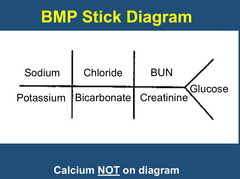
What lab values are included in a Chem-14 panel?
All components of a Chem-8 and 6 additional tests called Liver Function Tests
Reminder: What are the lab values included in a Chem-8 Panel?
Sodium
Potassium
Chloride
Bicarbonate
BUN
Creatinine
Glucose
Calcium
What are the lab values included in Liver function tests?
Aspartate aminotransferase
Alanine aminotransferase
Alkaline phosphatase
Total bilirubin
Total protein
Albumin
When are abnormally large amounts of AST released into the blood?
When damage to the heart or liver occurs. 4-5 times the upper limit indicates injury
When are abnormally large amounts of ALT released into the blood?
Occurs during liver damage rather than heart damage
Describe alkaline phosphatase
An enzyme found in the liver and bone; elevations usually point to liver disease or increased bone turnover
Relate high alkaline phosphate concentration and bone activity
Increased ALP in bone reflects high osteoblast activity, which could be due to bone growth, repair, or disease.
What is bilirubin?
A breakdown product of hemoglobin
What are the two different forms of bilirubin?
Unconjugated and conjugated
Describe unconjugated bilirubin
Reflects bilirubin prior to hepatic metabolism and conjugation.
Describe conjugated bilirubin
Bilirubin undergoes glucuronidation in the liver to make it more water-soluble
Name some reasons that unconjugated bilirubin could be elevated (increased bilirubin production or decreased conjugation)
Hemolytic anemia: means more RBCs are being destroyed and more unconjugated bilirubin is produced than the liver can process
Neonates: have immature livers that don't yet make enough of the enzyme to conjugate bilirubin
Hemolysis: excessive destruction of red blood cells, and the liver can't keep up
Gilbert Syndrome: a genetic condition where the liver has reduced activity of the conjugating enzyme
Name some reasons that conjugated bilirubin could be elevated (issue is usually with bile flow or excretion)
Gallstones: can block the bile ducts, preventing conjugated bilirubin from leaving the liver
Pancreatitis: swelling or inflammation of the pancreas can compress the common bile duct.
Heptocellular disease: impairs hepatocytes' ability to secrete conjugated bilirubin into bile.
What are the two main components of protein found in the blood?
Albumin and globulin. Reflects total concentration of protein, not individual values
What is albumin?
The most abundant plasma protein in the blood, made by the liver.
Describe some roles of albumin
Maintains oncotic pressure: keeps fluid inside blood vessels (prevents edema).
Transports substances: carries hormones, fatty acids, bilirubin, calcium, and drugs in the bloodstream.
Albumin levels affect ______-bound medications
highly
Why is albumin not a good short-term marker of nutrition?
It has a long half-life (~20 days), so its level changes slowly and reflects more chronic nutrition/liver status rather than acute changes.
What is prealbumin, and where is it made?
A plasma protein made in the liver with a short half-life (~2 days).
Why is prealbumin a better marker of acute nutritional status than albumin?
Because of its short half-life, prealbumin levels respond quickly to recent changes in protein intake.
How does albumin indicate liver failure?
If the liver fails, there will be no albumin produced
Memorize the LFT stick diagram

Name 6 additional common laboratory tests that aren't included on a Chem-8 or Chem-14
Phosphorus, magnesium, ammonia, GGT, amylase, and lipase
Describe phosphorus
Part of nucleic acids and ATP, needed for normal bone and tooth structure
How does renal function influence phosphorus levels?
Kidneys regulate phosphate by excreting or reabsorbing it.
How does bone metabolism influence phosphorus levels?
Bone resorption releases both calcium and phosphate into the blood; bone formation uses both calcium and phosphate, lowering their blood levels.
What triggers PTH release? How does PTH affect bone?
Low blood calcium stimulates the parathyroid glands to release PTH.
PTH stimulates osteoclast activity → bone resorption → releases both calcium and phosphate into the blood.
How does PTH affect the kidneys in terms of calcium and phosphate?
PTH makes kidneys reabsorb calcium (keep it) and excrete phosphate (lose it).
What is the net effect of PTH on blood calcium and phosphate?
Increases calcium and decreases phosphate, preventing calcium-phosphate precipitation in tissues.
Describe how calcium and phosphorus concentrations are related
Calcium and phosphate are inversely related due to PTH.
Low Ca²⁺ → PTH ↑ → Ca²⁺ rises, phosphate excreted (↓ PO₄³⁻).
High Ca²⁺ → PTH ↓ → Ca²⁺ falls, phosphate retained (↑ PO₄³⁻).
Magnesium acts as a cofactor in what?
In functions with ATP
Why is it important to normalize magnesium concentrations before correcting hypokalemia and hypocalcemia?
Low magnesium interferes with the body's ability to maintain potassium and calcium
What is ammonia?
Produced mainly in the liver when proteins and amino acids are broken down. Also made in the intestines by bacteria during digestion
What does the liver convert ammonia to in order to be safely excreted through the kidneys?
Urea
What could high ammonia levels indicate?
Liver failure, urea-cycle disorder, or Reye syndrome
Increased ammonia can lead to hepatic encephalopathy. What is this?
Where there is an accumulation of toxins in the blood due to liver dysfunction, it can affect brain function
What factors can increase Gamma-glutamyl transferase (GGT) levels?
Alcoholic liver disease, pancreatitis, and cholestasis
How can the GGT test help differentiate between liver and bone disease?
Elevated alkaline phosphatase (ALP) may indicate liver or bone disease. Gamma-glutamyl transferase (GGT) is more specific for liver function. To determine whether a high ALP is from liver or bone, compare it with the GGT level.
What is amylase?
An enzyme found in the pancreas that catalyses the breakdown of starch into carbohydrates and monosaccharides
High amylase levels can indicate?
Pancreatic disorders, salivary gland disorders, etc. It is not only specific to the pancreas
Since amylase isn't specific to the pancreas, what other lab value would be needed to confirm issues in the pancreas?
Lipase
What is lipase?
An enzyme that metabolizes triglycerides into free fatty acids and glycerol. Found in the pancreas and an increase is a marker for pancreatic disease
Compare the duration of the elevated lipase and amylase values
Amylase concentrations return to normal faster than lipase
Lipase concentrations remain elevated for longer than amylase
What two lab values are used to assess renal failure?
Increased levels of BUN and creatinine
What is the BUN: creatinine ratio?
Used to differentiate what type of renal failure (etiology) is occurring
A BUN: creatinine ratio < 10:1 indicates? (intrarenal)
There is damage inside the kidney itself. Tubules can be damaged and cannot reabsorb BUN effectively, and filtration can be impaired, preventing creatinine excretion. Creatinine rises more than BUN, creating a low ratio
Can a BUN: creatine ratio of
Yep, it can be due to low protein intake, meaning less urea is made, or severe diarrhea/vomiting.
These cause creatinine to be higher than BUN
A BUN: creatinine ratio between 10:1 and 20:1 indicates? (postrenal)
BUN reabsorption is normal, and creatinine remains properly filtered. Renal failure is not associated with the kidneys but may be due to post-renal obstruction (ureters, bladder, or urethra)
A BUN: creatinine ratio >20:1 indicated? (prerenal)
There is low blood flow to the kidneys. The kidney tries to conserve water and sodium to maintain blood pressure. BUN reabsorption increases, but creatinine is still filtered normally because it is not reabsorbed.
BUN rises more than creatinine → high ratio (>20:1).
What 3 markers are used to help determine liver failure?
Indirect/unconjugated bilirubin, albumin, and coagulation factors
Unconjugated bilirubin will be ________ in liver failure
increased
Albumin will be ________ in liver failure
decreased
Describe how coagulation factors indicate liver failure
Coagulation factors are made in the liver. If the liver is failing, prothrombin time and INR levels increase because blood takes longer to clot.
What values are included in a complete blood cell count?
Red blood cells, Platelets, and White blood cells
What is the role of RBCs?
To transport oxygen to tissues