AandP Help For Fatty
 Call Kai
 Learn
Learn Practice Test
 Spaced Repetition
 Match
Match Flashcards
 Knowt Play
1/30

There's no tags or description
Looks like no tags are added yet.
Name | Mastery | Learn | Test | Matching | Spaced | Call with Kai | Chat |
|---|
No analytics yet
Send a link to your students to track their progress
31 Terms
Plasma membrane
Provides a barrier for the cell; regulates movement of materials in and out of the cell

Cytoplasm
Region of cellular metabolism and other activities that maintain the cell

Cytosol
Transport substances between organelles and other cell structure

Centrioles
Participate in cell division

Cilia
Rhythmic movements propel fluid

Microvilli
Increase the plasma membrane surface area for absorption or secretion

Ribosomes
Provide attachment site for mRNA during protein synthesi

Rough endoplasmic reticulum (RER
site of protein synthesis

Smooth endoplasmic reticulum (SER
Site of lipid and
carbohydrate assembly

Golgi apparatus (complex
Prepares and packages cellular products for transport

mitochondria
ite where nutrients are broken down and ATP is produced during cellular respiration

peroxisomes
site where free radicals are detoxified.

lysosomes
Contains enzymes that breakdown materials brought into the cell, or releases enzymes out of the cell to digest

nuclear envelope
regulates movement of materials between cytoplasm and nucleoplasm

nucleoplasm
site of nucleic acids
(DNA and RNA)
N

nucleoli
site of RNA synthesis
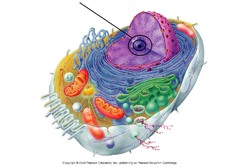
chromatin
DNA contains the genes, which control protein synthesis

How many types of cells are there?
roughly 200 types
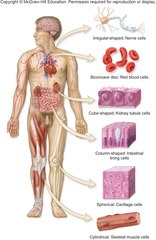
How do skeletal muscle look?
long and cylindrical

What do neurons look like?
star shaped, long and narrow while also branching off.

What do cheek cells look like?
Round and flat.
prophase
Chromosomes become visable, nuclear envelop dissolves, spindle forms

metaphase
Chromosomes line up in the middle of the cell

anaphase
the third phase of mitosis, during which the chromosome pairs separate and move toward opposite poles

telophase
the final phase of cell division, between anaphase and interphase, in which the chromatids or chromosomes move to opposite ends of the cell and two nuclei are formed.

cytogenesis
the origin and development of cells

G1
cell grows
G2
Final preparation phase. Cell checks for DNA errors and begins to form centrosomes. (Prepares for Mitosis)
Synthesis Phase (S Phase)
Part of interphase where DNA is replicated
karyokinesis
division of a cell nucleus during mitosis.
How many cells does the human body contain?
30-40 trillion (closer to 30)
