Chapters 8-12 Financial Accounting
 Studied by 6 people
 Call Kai
 Learn
Learn Practice Test
 Spaced Repetition
 Match
Match Flashcards
 Knowt Play
1/68

There's no tags or description
Looks like no tags are added yet.
Name | Mastery | Learn | Test | Matching | Spaced |
|---|
No study sessions yet.
69 Terms
Characteristics of current liabilities (1)
due within one year from the balance sheet date
obligations that use up current assets like cash
examples:
deferred revenue, sales tax payable, and current portion of LT debt
Characteristics of long term liabilities (1)
due in more than one year from the balance sheet date
companies prefer to report liabilities as long-term, rather than current, as it makes them seem less risky, which leads to lower interest rates and higher stock prices
Stated Rate
Used ONLY to calculate the actual Cash Interest Paid (Face Value $\times$ Stated Rate).
Market Rate
Used ONLY to calculate Interest Expense (Carrying Value $\times$ Market Rate)
Record interest accrual for current notes payable (1)
Issuance of note payable on Nov 1
Cash (Dr)
Notes Payable (Cr)
Accrued Interest on Dec 31
Interest Expense (Notes Payable x rate x months/12) (Dr)
Interest Payable (Cr)
(record interest incurred, but not paid)
Payment of note and interest at maturity
Notes payable (Dr)
Interest Payable (accumulated) (Dr)
Interest Expense (for current month) (Dr)
Cash (Cr)
employee payroll expenses (2)
Federal and State Income taxes
Employee portion of Social Security and Medicare (FICA taxes -7.65%)
employee contribution for health, dental, disability, and life insurance
Employee investments in retirement or savings plans
employer payroll expenses (2)
Federal and State Unemployment taxes (FUTA and SUTA)
Employer matching portion of Social Security and Medicare (FICA taxes- 7.65%)
Employer contributions for health, dental, disability, and life insurance
Employer contributions to retirement or savings plans
fringe benefits (additional employee benefits paid for by the employer)
Record employee salary expense and withholdings (0)
Salaries expense (starting payroll) (Dr)
Employee Income Tax Payable (Cr)
FICA Tax Payable (FICA tax rate x salaries expense) (Cr)
Salaries Payable (Take-home pay) (Cr)
to find income tax and FICA multiply each by the salaries expense and then take those numbers and subtracts from total to find salaries payable
Record employer-provided fringe benefits (0)
Salaries Expense (fringe benefits) (Dr)
Fringe Benefits Payable (to Blue Cross) (Cr)
Fringe Benefits Payable (to Fidelity) (Cr)
Record employer payroll taxes (0)
Payroll tax expense (total) (Dr)
FICA tax payable (FICA tax rate x salaries expense) (Cr)
Unemployment tax payable (rate x salaries expense) (Cr)
Effect of deferred revenues on accounting equation (1)
cash received in advance from a customer for products or services to be provided in the future
later when those services are provided or goods are delivered, deferred revenue is decreased and revenue is recognized
ex: gift cards, tickets, etc.
Liability account
increase: assets & liabilities
decrease: liabilities & increase: revenue
Receive cash for gift card (0)
Cash (Dr)
Deferred Revenue (Cr)
IS: no effect
BS: increase assets and increase liabilities
Record revenue from merchandise sales using a gift card (0)
Deferred Revenue (Dr)
Sales Revenue (Cr)
IS: increase revenue and increase net income
BS: decrease liabilities and increase stockholders equity
calculate sales tax (1)
sales tax collected from customers by the seller, representing current liabilities payable to the government
Cash (Dr)
Sales Revenue (price of good) (Cr)
Sales Tax Payable (price of good x sales tax rate%) (Cr)
reporting current portion of LT debt (1)
Debt that will be paid within one year from the balance sheet date
report the currently maturing long-term debt as a current liability in the balance sheet
reclassify long-term portion of note as current (0)
Notes Payable (long-term) (Dr)
Notes Payable (current) (Cr)
entry has no effect on total liabilities, simply reporting in different category
reporting lawsuit contingencies (2)
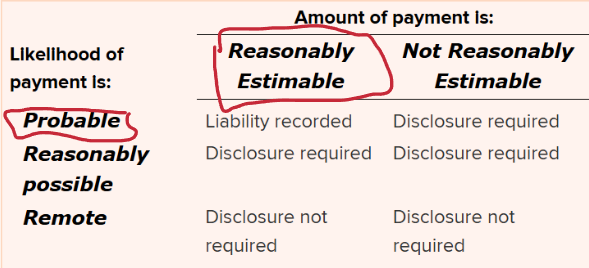
Uncertain situations that can result in a gain or loss for a company
Recorded ONLY if a loss is Probable and the amount is Reasonable Estimable (use the lowest number from the range)
record a contingent liability
Loss (Dr)
Contingent Liability (Cr)
record warranty liabilities and expenditures (1)
most common example of contingent liabilities
Probable and reasonably estimable
warranty liability is not always equal to warranty expense
Warranty Liability account is increased when the estimated warranty liability is recorded, but then is reduced over time by actual warranty expenditures
Warranty expense (Dr)
Warranty Liability (Cr)
Amount of estimated cost is found by
multiplying total months sales x % of sales for expected future warranty
Record actual warranty expenditures (0)
Warranty Liability (Dr)
Cash (Cr)
Amount is the real warranty claims
Warranty Liability will still have rest of amount in it
any balance remaining in warranty liability will expire at the end on the year and be written off if not used
debt financing (2)
borrowing money from creditors (liabilities)
advantage that interest on borrowed funds is tax-deductible
borrowing money from external sources with a contractual obligation to repay the principal amount plus interest over a specified period
equity financing (2)
obtaining investment form stockholders (stockholders’ equity)
recorded in the owners’ equity section
do not create a liability or interest expense
the process of raising capital by selling an ownership stake (shares) in a company to investors
calculate interest expense and carrying value of installment notes (2)
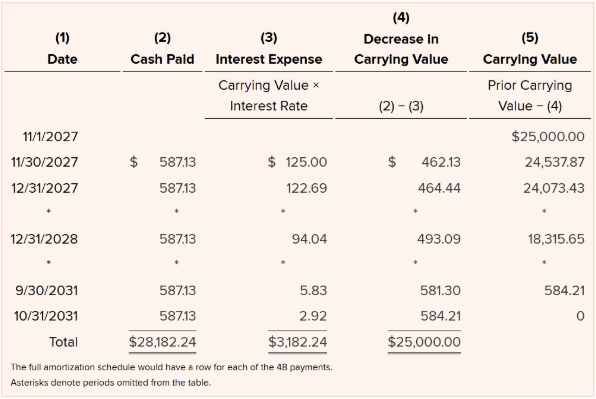
carrying value: the amount for which a liability is reported in the balance sheet
installment payment: includes both an amount that represents interest and an amount that represents a reduction of the carrying value
interest = principle (new) x rate x month/12
take payments and subtract interest, left with change in carrying value
carrying value-change in carrying value=new carrying value
issue a note payable (0)
cash (Dr)
notes payable (Cr)
pay monthly installment on note (0)
nov 30 (first month)
interest expense (P x R x T) (Dr)
Notes Payable (difference) (Dr)
Cash (monthly payment amount) (Cr)
dec 31 (second month)
interest expense (new P x R x T) (Dr)
notes payable (difference) (Dr)
cash (monthly payment amount) (Cr)
Notice that the amount of cash paid is the same for each payment but
The amount of interest expense is decreasing
The amount paid on the note's principal balance is increasing
recording leases (2)
WILL ASK FOR BEGINNING VALUE OF LEASE
Lease: a contractual arrangement by which the lessor (owner) provides the lessee (user) the right to use an asset for a specified period of time
number one method of external financing
recorded by the lessee:
lease asset (Dr)
lease payable (Cr)
obligation to make payments over the lease period
initial down payment is usually required
use present value table
number of total payments (y-axis) (n)
interest per payment (x-axis) (i)
make sure to divide by the amount of payments per year
find number on chart and multiple by payment
characteristics of bonds (2)
bond: a formal debt instrument issued by a company to borrow money
the issuing company is obligated to pay back to the investor
a stated principal, at a specified maturity date
periodic interest payments over the life of the bond (traditionally twice a year, every 6 months)
The stated interest rate is specified in the bond contract
The interest rate to be paid by the company to investors in the bond
The market interest rate is not specified in the bond contract
Implied rate based on the amount the investors pay to purchase a bond
secured bonds (0)
bonds that are supported by specific assets pledged as collateral
unsecured bonds (0)
bonds that are not supported by specific assets pledged as collateral
most bonds
term bonds (0)
bonds that require payment of the full principal amount at a single maturity date
most bonds
serial bonds (0)
bonds that require payment of the principal amount of the bond over a series of maturity dates
sinking fund (0)
an investment fund used to set aside money to be used to pay debts as they come due
callable (0)
a bond feature that allows the borrower to repay the bonds before their scheduled maturity date at a specified call price (usually just above face value)
protect the issuing company against future decreases in interest rates
convertible (0)
liability can be exchanged for common stock
issuing at a discount (0)
if the bonds stated interest rate is less than the market interest rate the bonds will issue below face amount
payments go towards making the bond face value (bring up)
issuing at a premium (0)
If the bonds stated interest rate is more than the market interest rate the bonds will issue above face value
payments go towards making the bond face value (bring down)
debt-to-equity ratio (2)
Total liabilities divided by stockholders' equity; measures a company's risk
The higher the ratio the higher the risk of bankruptcy
disadvantages of corporate form of business (1)
Double Taxation
Corporate income is taxed once on earnings at the corporate level and again on dividends at the individual stockholder level
More Paperwork
Intended to ensure adequate disclosure of the information investors and creditors need
rights of common stockholders (1)
Right to Vote
Stockholders vote on matters, including the election of corporate directors
Right to Receive Dividends
Stockholders share in profits when the company declare dividends.
The percentage of shares a stockholder owns determines his or her share of the dividends distributed
Right to Share in the Distribution of Assets
Stockholders share in the distribution of assets if the company is dissolved.
The percentage of shares a stockholder owns determines his or her share of the assets, which are distributed after creditors and preferred stockholders are paid
authorized stock (1)
number of shares available to sell, as stated in the company’s articles of incorporation
= issues + unissued
issued stock (1)
number of shares sold to investors; includes treasury shares
=outstanding + treasury
Outstanding stock (1)
number of shares that currently are held by investors; does not include treasury shares
only these shares receive dividends
issued - treasury stock
treasury stock (1)
a company’s own issued stock that it has repurchased
when resold, use the original repurchase price for the treasury credit and the difference goes to APiC
Additional Paid-in Capital (APiC)
the portion of the cash proceeds from issuing stock above par value
paid-in capital in excess of par
record issuance of par common stock (2)
cash (shares x amount per share) (Dr)
common stock (shares x par value per share) (Cr)
additional paid-in captial (difference) (Cr)
record issuance of no-par common stock (0)
cash (shares x amount per share) (Dr)
common stock (Cr)
calculate dividends for Preferred Stock (1)
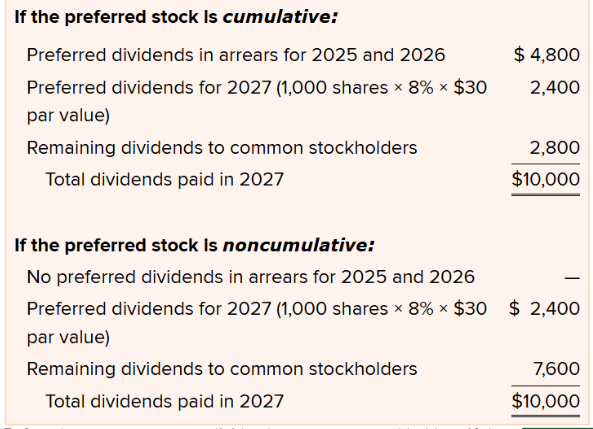
Dividends accumulate until the company decides to declare them
Preferred stock has preference over common stock in receiving dividends and in the distribution of assets in the event the corporation is dissolved
number of shares x par value x percent rate
if cumulative: take this number and multiply by number of years since last paid
if not cumulative: only use current years value
the rest of dividend amount goes to common stockholders after the preferred stockholders get theirs
calculate dividends for Common Stock (1)
find the total amount available (total dividends - preferred dividends)
For Dividends Per Share: then divide by the number of common shares outstanding
per share x outstanding shares (after preferred stockholders)
will be given per share value
record purchase of Treasury Stock (1)
Treasury Stock (shares x price bought for) (Dr)
Cash (Cr)
*the stock’s par value has no bearing on the balance sheet effect of treasury stock purchases*
Decreases stockholders' equity and cash
Normal debit balance
the IS is unaffected (only affects BS, with cash and stockholders equity both decreasing)
describe retained earnings and apply the Retained Earnings formula (2)
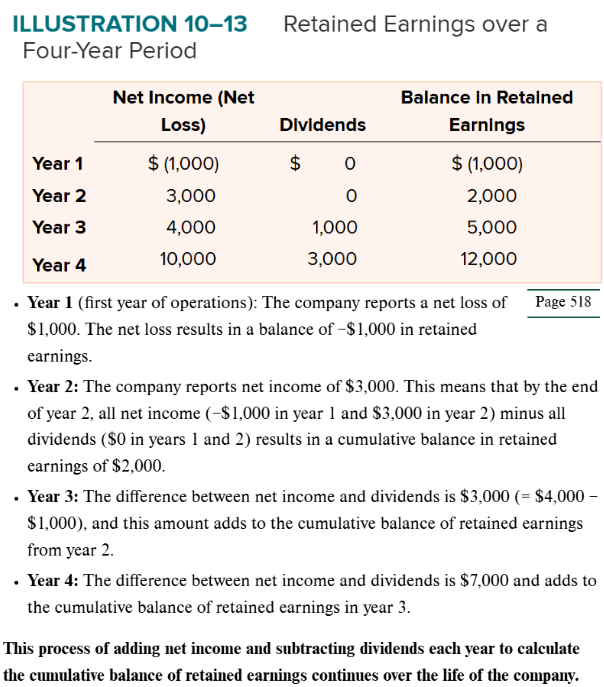
Retained earnings = All net income since the company began – all dividends since the company began
Dividends Dates (0)
Declaration date
The date the board of directors announces the next dividend to be paid
Created a binding legal obligation
On this date
Debit: Dividends
Credit: Dividends Payable
Record date
The date on which a company looks at its records to determine who the stockholders of the company are
no journal entry
Payment date
The date of the actual distribution of dividends on shares outstanding
Dividends are not paid on treasury shares
Debit: Dividends Payable
Credit: Cash
purpose of stock dividends and splits (1)
stock dividends: give people more stock if they already own it
drive down share price
reduces retained earnings and increases common stock (doesn’t affect stockholders equity overall) (transfers value from retained earnings to capital)
stock splits: split current value of the stock (2-for-1 split = double shares)
adjust par value
no journal entries required
drive down share price
get more shares at a lower price (ownership percentage doesn’t change)
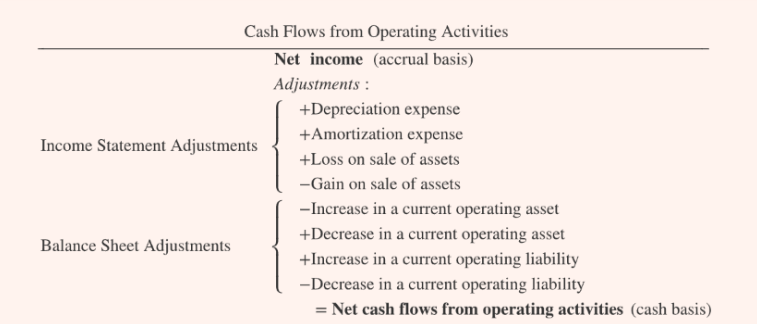
Indirect method
Begins with net income and then lists adjustments to net income in order to arrive at operating cash flows
only deals with operating section
add back depr. and amorit.
-gain and +loss
current assets
increase (-)
decrease (+)
current liabilities
increase (+)
decrease (-)
paying dividends
financing
receiving dividends
operating
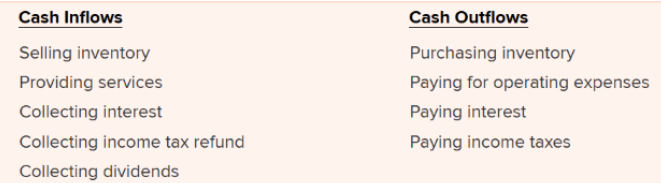
classify cash transactions as operating activities (4)
Transactions involving revenue and expense activities
Ex: collecting cash from customers or paying cash for inventory, salaries, and rent
classify cash transactions as investing activities (0)
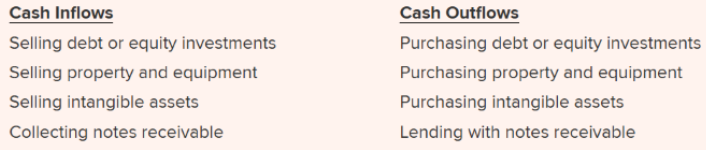
Transactions involving the purchase and sale of long-term assets and current investments
Companies periodically invest cash to replace or expand productive facilities such as buildings, land, and equipment
Stocks or bonds of other companies
classify cash transactions as financing activities (0)
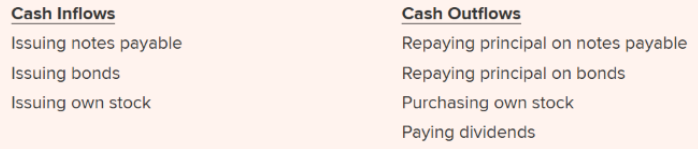
Transactions with lenders, such as borrowing money and repaying debt, and with stockholders, such as issuing stock, paying dividends, and purchasing treasury stock
It’s the lenders and stockholders who provide external financing to the company
purpose of Statement of Cash Flows (1)
to show activities involving cash inflows and cash outflow over a period of time
Cash inflow: cash received by the company during the period
Cash outflow: cash paid by the company during the period
Net cash flows: difference between cash inflows and outflows
Separately reports the net cash flow from operating, investing, and financing activities
purpose of the operating activities section of Statement of Cash Flows (1)
to show how much cash a company generates from its core business operations
helpings users assess its ability to generate sustainable cash to fund itself, pay debts, and invest
prepare the operating activities section (2)
use the indirect method
prepare the investing activities section (1)
FOLLOW THE CASH
The second step in preparing the statement of cash flows is to determine the net cash flows from investing activities
This section reports the actual cash received or paid for an asset, which is usually not the same as the change in the asset account reported in the balance sheet
Companies periodically invest cash to replace or expand productive facilities such as property, plant, and equipment
We can find a firm's investing activities by analyzing changes in long-term asset accounts from the balance sheet.

prepare the financing activities section (1)
FOLLOW THE CASH
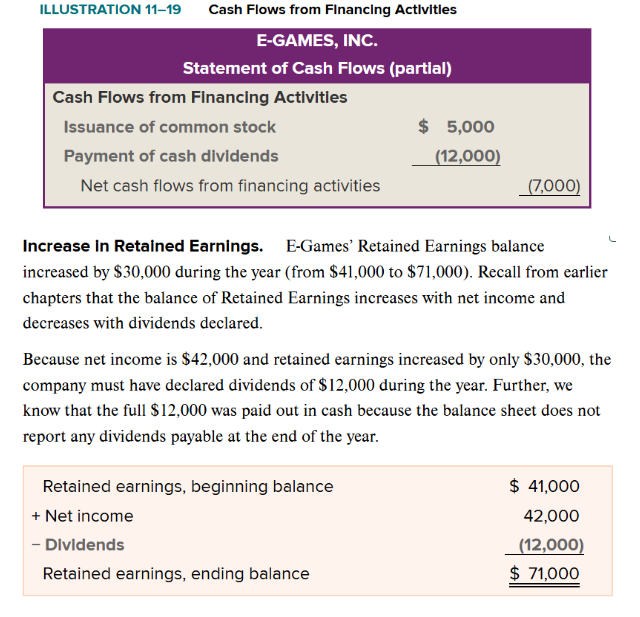
The third step in preparing the statement of cash flows is to determine the net cash flows from financing activities
To fund its operating and investing activities, a company must often rely on external financing from two sources- creditors and shareholders
In the financing activities section of the statement of cash flows, companies list separately cash inflows, such as borrowing money and issuing stock, and cash outflows, such as repaying amounts borrowed and paying dividends to shareholders
We can find a firms financing activities by examining changes in long-term liabilities and stockholders' equity accounts from the balance sheet
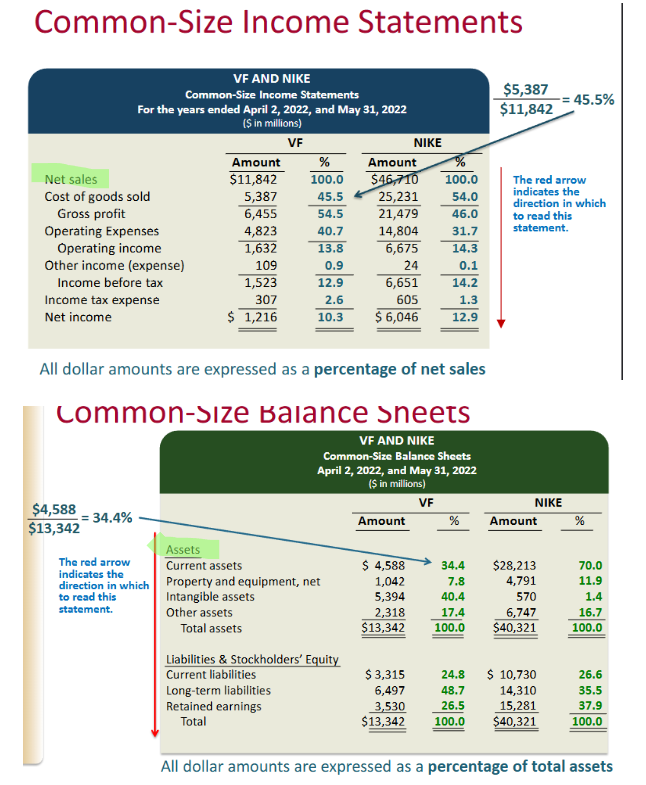
understand vertical analysis (2)
Expressing each item in a financial statement as a percentage of the same base amount measured in the same period
Income statement items expressed as a percentage of sales
Balance sheet items expressed as a percentage of total assets
In percentages instead of numbers
compare financial statements between companies of different size
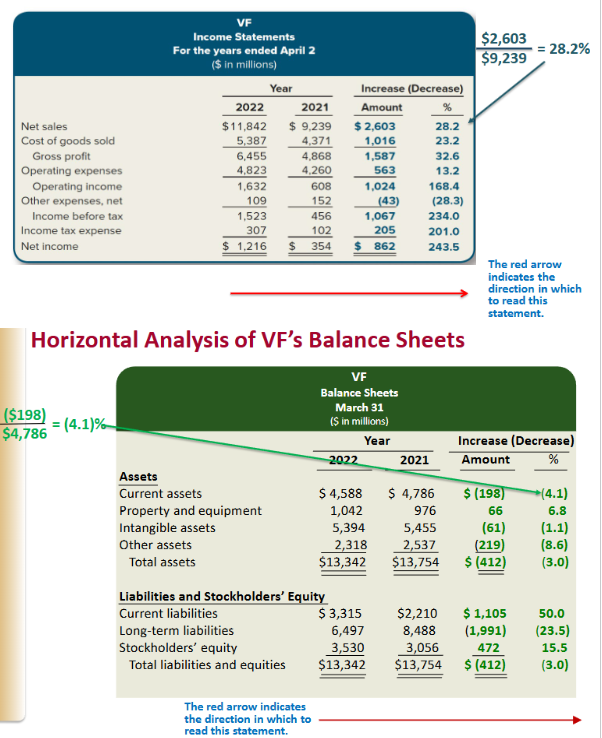
understand horizontal analysis (1)
Analyzing trends in financial statement data for a single company over time
Such as the amount of change and the percentage change, for one company over time
Find difference between years and then make that a percentage by dividing difference by older year
(new-old)/old
signals of low liquidity (2)
receivables turnover (low worse)
average collection (high worse)
inventory turnover (low worse)
average days in inventory (high worse)
current (low worse)
acid-test (low worse)
effect of transactions on liquidity ratios (1)
how does a transaction of current assets and current liabilities affect these ratios
current ratio: as assets and liabilities decrease, the ratio increases favorably to assets
growth stocks vs value stocks (1)
growth stock: shares focused on companies with high future earnings potential and revenue faster than the overall market
more risky
reinvests profits for expansion rather than paying big dividends
value stock: seeks established companies trading for less than their perceived worth
price earnings ratio is typically lower
higher dividend and less risky
price earnings ratio = stock price/earnings per share
comparing company earnings to earnings per share
earnings persistence (1)
current earnings that will continue or persist into future years
what do you currently do
different than one-time income items (not expected to persist)
conservative vs aggressive accounting (2)
Conservative:
Result in Reporting
Lower income
Lower assets
Higher liabilities
Aggressive:
Result in Reporting
Higher income
Higher assets
Lower liabilities