LUNG VOLUMES & CAPACITIES
 Call Kai
 Learn
Learn Practice Test
 Spaced Repetition
 Match
Match Flashcards
 Knowt Play
1/49

There's no tags or description
Looks like no tags are added yet.
Name | Mastery | Learn | Test | Matching | Spaced | Call with Kai | Chat |
|---|
No analytics yet
Send a link to your students to track their progress
50 Terms
Tidal volume (TV) Definition?
total volume inspired and expired with each breath during quiet breathing.
Tidal volume (TV) % and mL?
10% of total lung volume
350-500 mL
Inspiratory reserve volume (IRV) Definition?
the maximal volume of air that can be inspired after a normal tidal volume inspiration.
Inspiratory reserve volume (IRV) % and mL?
50% of total lung volume
3100 mL
Expiratory reserve volume (ERV) Definition?
the maximal volume of air that can be exhaled after a normal tidal exhalation.
Expiratory reserve volume (ERV) % and mL?
~15% of total lung volume
1200 mL
Residual volume (RV) Definition?
the volume of gas remaining in the lungs at the end of a maximal expiration.
Residual volume (RV) % and mL?
~25% of total lung volume
1200 mL
Forced expiratory volume (FEV) Definition?
the maximal volume of air exhaled in a specified period of time, usually in seconds
Inspiratory capacity (IC) Definition and Formula?
the maximal volume of air that can be inspired after a normal tidal expiration.
(IC= TV + IRV)
Inspiratory capacity (IC) % and mL?
~60% of total lung volume
3600 mL
Functional residual capacity (FRC) Definition and Formula?
the volume of air in the lungs after a normal expiration.
(FRC= ERV + RV)
Functional residual capacity (FRC) % and mL?
~40% of total lung volume
2400 mL
Vital capacity (VC) Definition and Formula?
the maximal volume of air that a person can forcefully expire after taking in a maximal inspiration.
(VC= TV IRV + ERV)
Vital capacity (VC) % and mL?
~75% of total lung volume
4800 mL
Total lung capacity (TLC) Definition and Formula?
the volume of air in the lungs after a maximal inspiration
(TLC= RV + VC or TLC= FRC + IC)
Total lung capacity (TLC) % and mL?
100% of total lung volume
6000 mL
What is the patient told to do when doing a spirometry test?
Maximal inhalation is followed by maximal exhalation
Define Body Plethysmography
Spirometry performed in an air-tight chamber to allow measurements of additional lung volumes
Body Plethysmography tests for what type of volume?
Residual volume
Closed Circuit Helium Dilution allows what to be calculated?
Functional Residual Capacity (the amount of air remaining in the lungs after a normal expiration)
Open Circuit Nitrogen Washout allows what to be calculated?
FRC can then be calculated by dividing the volume of nitrogen exhaled by the concentration of nitrogen in the lungs
Carbon monoxide diffusing capacity (Dlco) measures what?
measures all the factors that affect diffusion of gases across the alveolar–capillary membrane.
Transfer factor for carbon monoxide (Tlco) measures what?
the rate of reaction of carbon monoxide with hemoglobin as well as its diffusion across the alveolar–capillary membrane.
Diffusion coefficient (Kco) is defined as what?
the transfer factor per unit lung volume
FORCED VITAL CAPACITY (FVC) definition?
THE VOLUME OF AIR EXPIRED DURING A FORCED MAXIMAL EXPIRATION AFTER A FORCED MAXIMAL INSPIRATION
FEV1 reflects airflow in what kind of airways?
large airways
FEF Indicates airflow in what kind of airways?
small airways
Normal FEV1 %
> 80%
Mild obstruction FEV1 %
65-80%
Moderate obstruction FEV1 %
50-64%
Severe obstruction FEV1 %
< 50%
Decrease in FEV1: ___cc/year
Decrease in FEV1: 30cc/year
Decrease in FVC: ___cc/year
Decrease in FVC: 20 cc/year
What is the hallmark of COPD? What causes it?
Expiratory flow limitation (EFL) and arises because of the dual effects of permanent parenchymal destruction (emphysema) and airway dysfunction,
Smokers lose ~ ___ to ___ cc/year of FVC and FEV1
Smokers lose ~ 50-100 cc/year of FVC and FEV1
Restrictive lung disorders include what diseases?
Restrictive lung disorders include pulmonary fibrosis, adult respiratory distress syndrome, and pulmonary edema.
What gets decreased in Restrictive Lung Diseases?
Everything
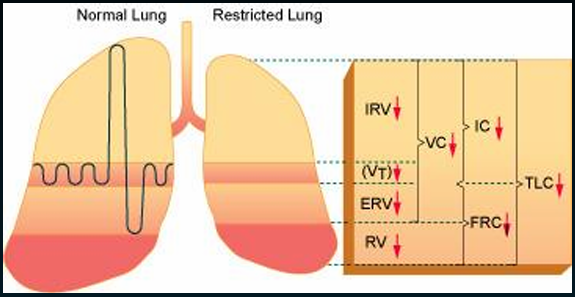
In obstructive diseases, what gets increased?
Residual volume (RV), functional residual capacity (FRC), and total lung capacity (TLC) ratio are increased. [Residual volume the most affected]
TLC Hyperinflation %
> 120%
TLC Mild restriction %
65-80%
TLC Moderate restriction %
50-64%
TLC Severe restriction %
< 50%
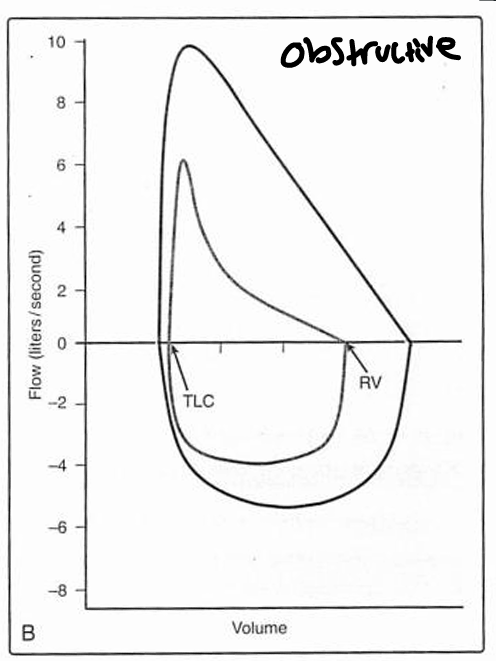
COPD: In asthma and emphysema, the curves are displaced to the _____ because of air trapping and/or hyperinflation, and the portion of the expiratory curve from the peak flow to residual volume is characteristically ________ due to airflow limitation.
In asthma and emphysema, the curves are displaced to the left because of air trapping and/or hyperinflation, and the portion of the expiratory curve from the peak flow to residual volume is characteristically concave due to airflow limitation.
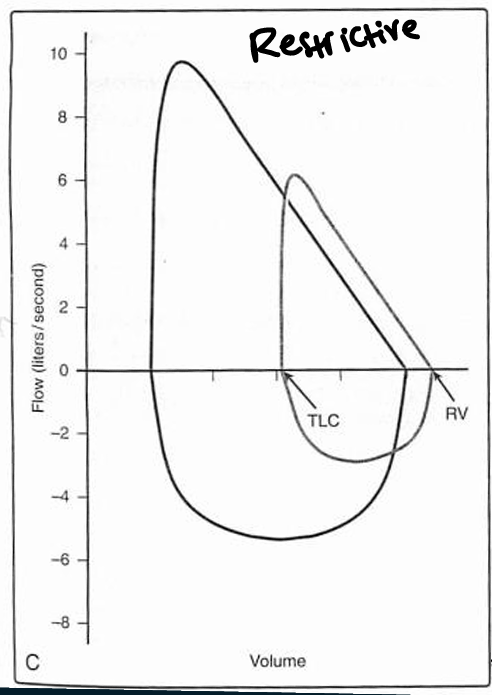
In restrictive disease, the shape of the inspiratory and expiratory curves is _______ but the reduced lung volumes shift the curve to the ________.
In restrictive disease, the shape of the inspiratory and expiratory curves is preserved but the reduced lung volumes shift the curve to the right.
Diffusion defect mild %
65-80%
Diffusion defect moderate %
50-64%
Diffusion defect severe %
< 50%
Causes of Decreased Diffusion?
Obstructive Disease (emphysema, CF), Interstitial lung diseases (sarcoidosis, IPF), Pulmonary vascular disease (pulmonary HTN, PE), Inflammation (alveolitis, pneumonitis), Anemia
..
..