Chapter 2.5: The Properties of Water Are Critical to the Chemistry of Life
 Call Kai
 Learn
Learn Practice Test
 Spaced Repetition
 Match
Match Flashcards
 Knowt Play
1/13

Name | Mastery | Learn | Test | Matching | Spaced | Call with Kai | Chat |
|---|
No analytics yet
Send a link to your students to track their progress
14 Terms
Specific heat
The amount of heat needed to raise 1 gram of water by 1 degree Celsius
This is naturally high in water and enables its existence in many organisms, buffering temperature
Heat of vaporization
The amount of energy needed for vaporization
This is naturally high in water and enables the cooling of living organisms due to its absorption
Density
The ratio of a substance’s mass to volume
This is lower in ice compared to water due to greater organization, which enables lakes to freeze top to bottom
Hydrogen bonds
Bonds between hydrogen atoms of different molecules; these can create cohesion (which holds water together for surface tension) and adhesion (which allows water to adhere to another surface)
Solvent
What dissolves a specific substance; these change distributions but do not break molecular structures
Water is a type of this, forming weak attractions with substances with polarity, thus dividing hydrophilic and hydrophobic reactions
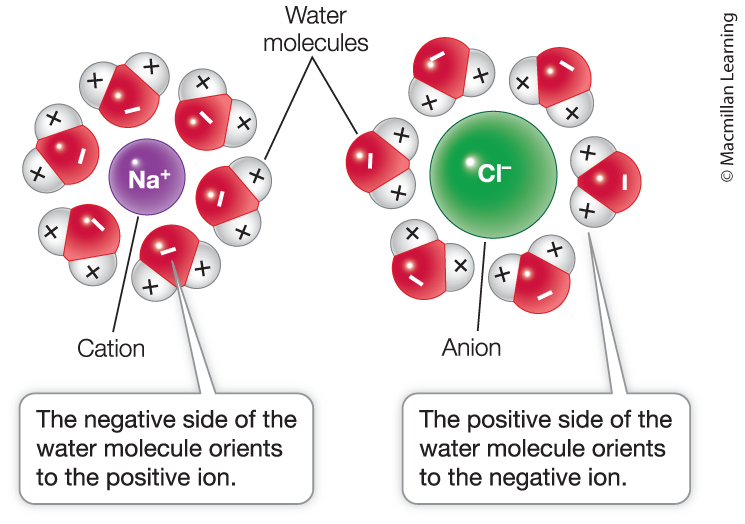
Hydrophilic
The tendency to be attracted to and dissolve in water; this is greater in polar molecules due to the creation of a hydration shell surrounding both ions
The sum of these forces against a bond’s strength determines dissolution
Common in biology
Hydrophobic
The tendency to not be attracted to and dissolve in water; this is seen in non-polar substances such as oil which do not form hydration shells
Amphipathic
Substances that are both hydrophilic and hydrophobic
Self-ionization
When H2O spontaneously ionizes into H3O+ and OH-
Occurs in very small amounts
Neutral solution
A solution in which the concentration of H+ (hydronium) ions is equal to the concentration of OH- (hydroxide) ions
Acids
These raise H+ concentrations relative to OH-
Can be strong or weak depending on substance’s resistance to allowing a free H+
Bases
These produce more OH- against H+ when as a result of dissociation, forming water with some of the H+ ions
Can be strong or weak depending on stability; OH- is just very unstable and easily absorbs an H+
Buffer
A solution that reduces the impact of acids or bases on pH relative to if they were not present at all
Acids adding H+ react with a negative ion in a buffer to form the original reactant, reducing the acid’s impact
Bases adding OH- react with the H+ in a buffer to form water, reducing basic impact
Required in living systems, seen in blood to have a constant pH
pH
The negative log of the concentration of H3O ions
Neutral substances have concentrations of 10-7 H3O M
Acidic substances have concentrations greater than 10-7 H3O M, resulting in a lower number
Basic substances have concentrations less than 10-7 H3O M, resulting in a greater number