ASCP BOC comprehensive guide
 Call Kai
 Learn
Learn Practice Test
 Spaced Repetition
 Match
Match Flashcards
 Knowt Play
1/300

There's no tags or description
Looks like no tags are added yet.
Name | Mastery | Learn | Test | Matching | Spaced | Call with Kai | Chat |
|---|
No analytics yet
Send a link to your students to track their progress
301 Terms
What is used for the aseptic technique of collecting blood?
Scrub site for at least 30 secs with providine-iodine scrub
What is the donor criteria for ALLOGENIC donation?
>16 years old
<99.5F temperatures
90-180/50-100 BP
HGB >12.5
HCT >38%
Minimum 110 lbs
donor criteria for AUTOLOGOUS donation
No age limit
HGB >11 g/dL
HCT >33%
Collection >72 hours prior
Purpose of washed red cels
to prevent allergic response to plasma proteins (IgA deficient)
Purpose of leukocyte reduced red cells
prevents febrile nonhemolytic reactions, HLA alloimmunization and CMV transmission
What is important to know about FFP?
must be ABO compatible
collected from males, female collection can result in TRALI
Glycolysis
Glucose breakdown for energy
Gluconeogenesis
Glucose synthesis from non-carb sources
Glycogenesis
glucose storage as glycogen
Insulin
beta cells of islets of langerhens
DECREASE glucose by stimulating glucose uptake
Glucagon
alpha cells of pancreas
INCREASE glucose by stimulating glycogenolysis
Type 1 Diabetes Mellitus
Autoimmune destruction of pancreatic beta cells → Absolute insulin deficiency
Auto antibodies present
Juveniles
DKA
Type 2 Diabetes Mellitus
Insulin resistant with progressive beta-cell dysfunction
Mild symptoms
Late-onset
HHNS
Common symptoms of DM
The 3 Ps
Polyphagia
Polyuria
Polydipsia
Lab Findings in Uncontrolled DM
Increased blood & urine glucose
Increased urine specific gravity
Increased Ketones, BUN, osmolality, cholesterol, triglycerides
Decreased bicarbonate and blood pH
Diabetic ketoacidosis DKA
Type 1 DM
Rapid
Fruity breath → increased ketones
Metabolic acidosis → Kussmaul-Kien respirations
Hyperglycemic Hyperosmolar Nonketoic Syndrome HHNS
Type 2 DM
Gradual
severe neurological symptoms
NO ketones
Severe dehydration and hyperosmolality
What is the only non-reducing sugar?
Sucrose
Measurement of ketones
detects acetoacetate
uses nitroprusside
Glycated hemoglobin (HbA1c)
Reflects average blood glucose over 2-3 months
measures percentage of hemoglobin binded to glucose
can be falsely decreased due to RBC disorders (anemia, hemolysis, hemoglobinopathies)
Fructosamine
Reflects average blood glucose over 2-3 weeks
Measures glycated serum proteins (albumin)
Fasting Glucose Pre-Diabetes RI
100-125 mg/dL
DX of HbA1c for DM
>6.5%
Normal HbA1c RI
<5.7%
Chylomicrons
Transport dietary (exogenous) triglycerides
Think OUTSIDE source
VLDL
Transport endogenous triglycerides
Think INSIDE source
LDL
Transport cholesterol to tissues
“LOUSY” cholesterol
HDL
Transport cholesterol out of tissues
Healthy cholesterol
Apo-A
Major protein for HDL
Apo-B48
Major protein for Chylomicrons
Apo-B100
Major protein for VLDL & LDL
Measured using enzymatic methods
Total cholesterol and triglycerides
Hypercholesterolemia
Elevated total cholesterol & LDL-C
Hypertriglyceridemia
Elevated triglycerides
Mixed hyperlipidemia
Elevated cholesterol & triglycerides
Artherosclerosis
Buildup of plaque in the arteries
VLDL calculation
Triglycerides/5
LDL calculation
Total cholesterol - HDL - VLDL
Triglycerides must be less than 400
Pre-hepatic jaundice
hemolytic anemia
increased red cell destruction → increased unconjugated bilirubin → increased urine urobilinogen
NORMAL liver function
Hepatic jaundice
cirrhosis, viral hepatitis
increased unconjugated bilirubin → increased urine urobilinogen
increased conjugated bilirubin → increased urine bilirubin
liver dysfunction
Post-hepatic jaundice
obstructive jaundice causing conjugated & unconjugated bilirubin to not be metabolized properly (cholestasis)
increased conjugated bilirubin → increased urine bilirubin
decreased urine urobilinogen
clay colored stool
Heme breakdown pathway
Heme → biliverdin → bilirubin → conj. bilirubin → urobilinogen → urobilin → stercobilin
Gilbert’s syndrome
benign
mutation in UGT1A1 gene
mild increase in unconjugated bilirubin
Type 1 Crigler-Najjar syndrome
More severe with ZERO function in UGT1A1 gene
NO conjugated bilirubin
kernicterus without treatment
Dubin Johnson syndrome
defective in hepatic transport
ABCC2 mutation → MRP2 deficiency
increased conjugated bilirubin
BLACK GRANULES ON LIVER
Rotor syndrome
impaired retake of bilirubin
SCLO1B1/B3 mutation → OATP1B1/B3 deficiency
increased conjugated bilirubin
NO BLACK GRANULES ON LIVER
Isoelectric point
pH at which net charge is zero
An amino acid is a zwitterion when….
pH = pI
What can happen if you use plasma samples instead of serum when looking at an SPE?
There is a fibrinogen peak migrating between gamma and beta fractions
Albumin
Largest protein fraction
Regulator of osmotic (oncotic) pressure and transport protein
Alpha-1 antitrypsin
90% of alpha-1 fraction
DECREASE → absence of alpha-1 fraction due to SERPINA1 mutation
Alpha-1 fetoprotein
Screens for fetal distress or abnormalities
INCREASE → neural tube defects (spina bifida)
DECREASE → down syndrome
Alpha-2 globulins
Haptoglobin
binds free hemoglobin
DECREASED → transfusion rxn & hemolysis
Ceruloplasmin
transports copper
DECREASED → wilson’s disease (Kayser-Fleishcer rings)
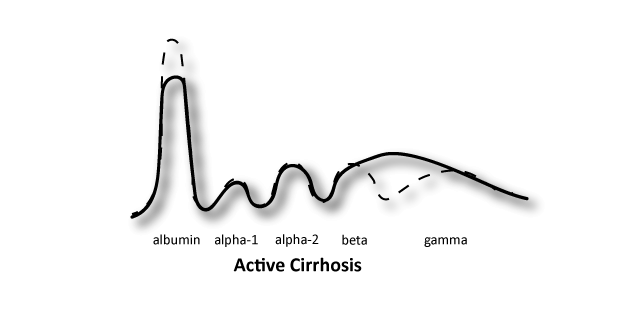
Active cirrhosis SPEP
Beta Gamma bridge
IgA BUILDS THE BRIDGE
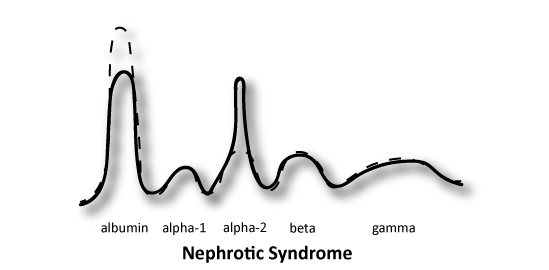
Nephrotic Syndrome
DECREASED albumin
INCREASED alpha-2
ALBUMIN LEAKS, ALPHA 2 STAYS
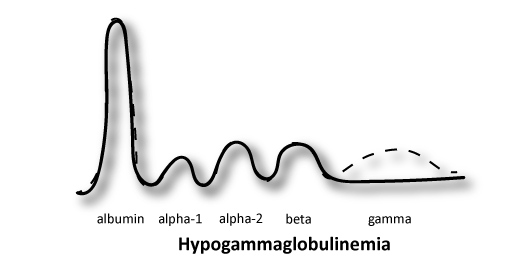
Hypogammaglobulinemia
DECREASED gamma
Think any immune deficiency of gamma globulins (IgG,IgA,IgM)
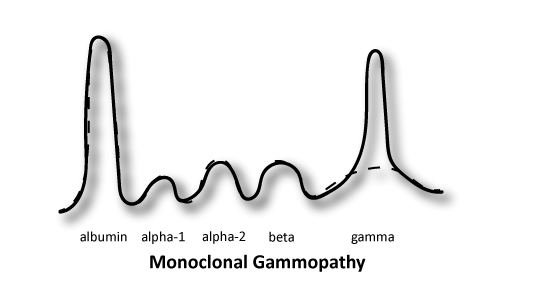
Monoclonal gammopathy
large spike in GAMMA region
Associated with Multiple myeloma, lymphoma, CLL, etc
Basic metabolic panel
Sodium, Potassium, Chloride, CO2, Calcium, BUN, Creatinine, glucose
Comprehensive metabolic panel
Sodium, Potassium, Chloride, CO2, Calcium, BUN, Creatinine, Glucose, Albumin, ALP, AST, Total protein, bilirubin
Electrolyte panel
Sodium, Potassium, Chloride, CO2
Hepatic function panel
Albumin, ALT, AST, ALP, bilirubin, total protein
Lipid panel
Total cholesterol, LDL-C, HDL-C, triglycerides
Renal function panel
Sodium, Potassium, CO2, calcium, glucose, Creatinine, BUN, albumin, phosphate
The rate of migration in protein electrophoresis is dependent on…
Size, shape and charge of a molecule
Acute inflammation SPEP
INCREASE alpha-1 & alpha-2 fractions
Inflammation raises the Alphas
BUN RI
6-20 mg/dL
Urea
major waste product of protein breakdown
ammonia → urea
eliminated via kidneys
Pre-Renal Azotemia
BUN & Ratio INCREASED
Excess protein/protein breakdown, dehydration, CHF
Renal Azotemia
BUN & Creatinine INCREASED
AKI, CKD, Glomerulonephritis
Post-Renal Azotemia
BUN, Creatinine & Ratio INCREASED
Urinary obstruction
Ammonia specimens
Put on ice and separate plasma ASAP
***Ammonia hates waiting****
AFP Tumor marker
Hepatocellular carcinoma (liver cancer)
CEA Tumor marker
Colorectal cancer
CA-125 Tumor marker
Ovarian cancer
CA 19-9 Tumor marker
Pancreatic cancer
PSA Tumor marker
Prostate cancer
Beta-hCG Tumor marker
Testicular cancer
CA 15-3
Breast cancer
Respiratory Acidosis
pH decrease, CO2 increased
COPD, hypoventilation
Cant breathe CO2 out
Respiratory Alkalosis
pH increased, CO2 decreased
hyperventilation, anxiety, hypoxia
Breathing too much
Metabolic acidosis
pH and HCO3- decrease
DKA, Diarrhea
losing too much base/bicarbonate, increased ketoacids
Metabolic alkalosis
pH and HCO3- increase
Vomiting
losing too much acid
Hyponatremia
Vomiting/Diarrhea
Excess water
Hypernatremia
Dehydration
Hyperaldosteronism (increases renal reabsorption)
cushing’s syndrome
Major cation of intracellular fluid
Potassium (K+)
Major anion of extracellular fluid
Chloride (Cl-)
ANION → A negative ION
Major cation of extracellular fluid
Sodium (Na+)
Hyperkalemia
Diabetic acidosis
Hemolysis
Addison’s disease
Hypokalemia
Vomiting/Diarrhea
Hypochloremia
Vomiting/Diarrhea
Hyperchloremia
Dehydration
Diarrhea
What test is used to diagnose cystic fibrosis?
Sweat chloride test
Sweat collected by iontophoresis
Osmolality
measure of total concentration of dissolved particles in a solution
Calcium
PTH & Vitamin D → increase absorption
Calcitonin → inhibits reabsorption
Vitamin D deficiency
Rickets
Hyperosmolality
thirst sensation → increased ADH → DKA, HHNS, DI
Hypoosmolality
thirst suppression → decreased ADH → SIADH
Uncompensated blood gas
pH abnormal
One (pCO2 or HCO3) is abnormal
Partial compensation of blood gases
All components abnormal
Complete compensation of blood gases
Normal pH
Abnormal pCO2, HCO3-