AH 3175E M2: Air Quality
 Call Kai
 Learn
Learn Practice Test
 Spaced Repetition
 Match
Match Flashcards
 Knowt Play
1/121

There's no tags or description
Looks like no tags are added yet.
Name | Mastery | Learn | Test | Matching | Spaced | Call with Kai | Chat |
|---|
No analytics yet
Send a link to your students to track their progress
122 Terms
What is the leading environmental cause of DALYs for both females and males?
Air pollution
What is the significance of air exposure compared to food and drink consumption?
Person inhales 30 m³ (35 pounds) of air/day = 6x more than amount of food & drink consumed
Significant opportunity for exposure to agents in air through inhalation pathway
Can air be polluted both outdoors and indoors?
Yes - air may be polluted both outdoors & indoors
Homes draw outdoor air in
Some northeast apartments do not have forced air in
What is the significance of bad air quality on health?
Lung disease = leading cause of death in U.S.
Chronic Obstructive Pulmonary Disease (COPD) = major cause of disability in U.S.
Asthma = most chronic illness in children
Leading cause of hospital admissions for children
Bad air quality → exacerbates symptoms
What is a major historical air quality event in the UK that occurred in 1952?
What was it a result of?
How many acute deaths did it lead to?
Great London Fog of 1952
Result of industrial activity + atmospheric conditions
4000 acute (sudden) deaths
What disaster resulted from the release of highly toxic methyl isocyanate in India in 1984?
How many acute deaths did it lead to?
Bhopal Disaster of 1984
4000-16000 acute deaths
What is the normal movement of warm air?
What is a temperature inversion?
How does it affect pollution?
Warm air = close to surface + cold air = above → warm air rises as altitude increases
Temperature inversion = layer of cold air trapped at surface w/ warm air layer above
Prevents vertical movement of air → pollution kept near surface
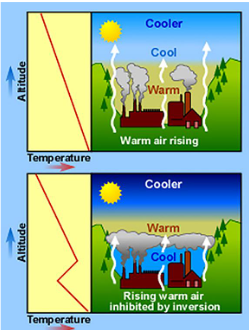
What type of landform is especially susceptible to temperature inversions?
Valleys → due to absence of crosswinds dissipating clouds
No circulation to push clouds away

What season are temperature inversions more frequent?
What usually warms up the ground air?
What happened in Great London Fog?
Winter = ground cools down → cools air close to ground → temperature inversion
Morning sun = breaks through mist & heats ground → warms air close to ground → breaks temperature inversion
Too much smoke (black soot, stick particles of tar, gaseous sulfur dioxide) accumulated close to ground → sun unable to break through → air stayed cool & static
What is smog?
Smog = fog w/ soot = “smokey fog”
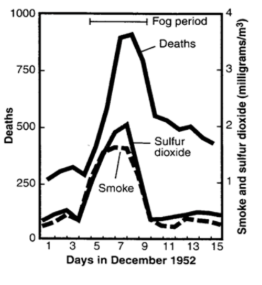
Explain what is happening in this graph depicting the number of deaths and levels of smoke during the days in December 1952 during the Great London Fog
Increased sulfur dioxide + smoke → increased deaths

What 2 groups were most affected during the Great London Fog?
Elderly & Infants
What were 2 factors that contributed to major historical air quality events?
During what season(s) did they most often occur?
Home heating
Industrial activity
During Fall/Winter times
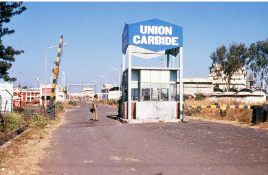
What happened to lead to the 1984 Bhopal Disaster?
How many tons of methyl isocyanate was released into surrounding areas?
How many deaths and injuries did the methyl isocyanate exposure lead to?
Union Carbide = pesticide manufacturing plant in Bhopal, India
Methyl isocyanate = intermediate compound in pesticide synthesis → stored 40 tons
Poor factory condition → water introduced to methyl isocyanate tank → increased pressure in storage tank
30 tons released → surrounding areas
3000 deaths + 200,000 injuries
What act of federal legislation was enacted in 1955 to address air pollution?
What was the issue with this act?
Air Pollution Control Act (1955) = authorized U.S. Public Health Service:
Conduct air pollution research & control measures
Technical assistance → communities facing air pollution
Collect air quality data
Air Pollution Control Act did NOT have federal powers to enforce air quality standards
What book captured public’s attention to chemical pollution in 1962?
Silent Spring by Rachel Carson
What river caught on fire in 1969?
Cuyahoga River caught fire → caught public attention
What agency was established by President Richard Nixon in 1970?
Environmental Protection Agency (EPA) = protect human health by protecting air, water, and land

What act in 1970 led to a major shift in U.S. air pollution regulation?
What standards did the act set?
What are the 5 individual pollutants that the standards include?
Clean Air Act of 1970 → dramatic expansion of air quality standard enforcement
National Ambient Air Quality Standards (NAAQS) → standards for stationary pollution sources
Carbon monoxide (CO), lead (Pb), nitrogen dioxide (NOx), ozone (O3), Particulate Matter (PM) and PM2.5, and sulfur dioxide (SO2)
What did the Clean Air Act of 1970 improve?
Health-based approach
Engineering/technical controls & economic considerations
Stationary & mobile sources
Monitoring & modeling activities
Federal & state permit programs
Economic incentives & emission trading
Special topics - acid rain, ozone depletion, catastrophic releases
What are Title 3 “Hazardous air pollutants”?
List of toxic air pollutants (188) regulated by industry categories
Consideration of residual risk & susceptible populations
What are the 2 broad classes of air pollutants the Clean Air Act of 1970 establish?
Criteria Pollutants (CAPs)
Hazardous Air Pollutants (HAPs)
What are 3 important properties of criteria pollutants?
Ubiquitous = emitted from variety of sources (from both mobile & stationary sources)
Omnipresent = pose greatest overall threat to human health
Presupposition = adverse health effects = NOT cancerous & dose-response relationship exhibits threshold dose
What are the 6 major criteria pollutants?
Particulate matter (PM)
Sulfur dioxide (SO2)
Nitrogen Dioxide (NO2)
Ozone (O3)
Carbon monoxide (CO)
Lead (Pb)
What is the difference between primary standards and secondary standards of National Ambient Air Quality Standards (NAAQS)?
What have these standards led to?
Primary standards = protect public health w/ adequate safety margin + health of sensitive populations (asthmatics, children, & elderly)
Secondary standards = protect public welfare from adverse effects (visibility impairment, environmental effects on vegetation, soils, wildlife)
National improvements in air quality based on [criteria pollutants]
What is the number 1 source of the following?
Carbon Monoxide
Nitrogen Oxides
VOCs (not a criteria pollutant!)
Sulfur Oxides
Particulates
CO → Transportation
NO2 → Transportation
VOCs → Transportation
SO2 → Fuel combustion stationary sources
PM & PM25 → Fuel combustion stationary sources
What are State Implementation Plans (SIPs)?
What does it outline?
What can the EPA use if the state fails to meet the SIP?
State Implementation Plans (SIPs) = must be submitted by individual states once EPA establishes/revises NAAQs
Outlines specific local emission controls, permits, & rules to be enforced
Fails to meet plan → EPA steps in with Federal Implementation Plan (FIP)
What are “Market-Based” Trading of Pollution Credits?
“Market-Based” Trading of Pollution Credits = system of earning “credits'“ for releasing low pollution levels
Sold through brokers to older/more polluting companies that have not made sufficient capital investment → upgrade pollution control technologies
What is the overall trend for the following since 1970:
GDP
Vehicle miles
Population
Energy Consumption
CO2 emissions
Aggregate emission
GDP → increased
Vehicle miles → increased
Population → increased
Energy Consumption → increased
CO2 emissions → increased (small)
Aggregate emission → decreased
How do Hazard Air Pollutants compare to Criteria Pollutants in:
Sources
Toxicity?
More toxic
Carcinogenic
What are some examples of Hazardous Air Pollutants?
Benzene, Formaldehyde, Cadmium, Vinyl chloride, Methyl isocyanate
Are strategies used to regulate Criteria Pollutants & Hazardous Air Pollutants the same?
No - due to differences in sources and toxicity
What type of air pollution is the Great London Fog an example of?
Criteria Pollutants → Particulate matter + Sulfur oxide emissions
What type of air pollution is the Bhopal Disaster an example of?
Hazardous Air Pollutants → Methyl isocyanate
How is pollution transported?
What direction across the U.S. do pollutants travel in?
What system does this follow?
Pollution transported by weather systems
West → East (Also applies to China → South Korea)
Storm Systems

What does the EPA monitor for Criteria Air Pollutant Standards?
EPA monitors which counties in violation of Criteria Air Pollutant standards
Describe adherence of CT and greater Northeast to ozone standards & particulate matter
Connecticut and the surrounding Northeastern states persistently fail to meet or have nonattainment of the federal health and safety limits for clean air.
What kind of system and type of terrain transport pollution?
Slide 58-62
Slide 58-62
What is “normal air” made of?
N2 (78%)
O2 (21%)
Noble gases (He, Ne, Ar, Kr)
CO2 (0.04%)
What are 5 important natural sources of air pollution?
Windstorms → dust clouds
Salt evaporation along coasts
Production of biological materials (Ex. Organic material from plants)
Forest fires
Volcanic eruptions
What are anthropogenic sources of air pollution?
What are some examples?
What are 5 mitigating solutions?
Anthropogenic sources of air pollution = human sources of air pollution
Agriculture
‘Area’ sources (Commercial, residential)
Energy production
Industry
Transportation
Mitigating solutions:
Alternate energy & conservation strategies
Urban & industrial planning
Process changes
Recycling
Top of stack/end of tail pipe
What are environmental implications of air pollution?
Ozone/smog
Acid rain
Upper atmosphere ozone depletion
Aesthetic/visibility → regional haze
Climate/greenhouse effect
Accidental toxic releases
Polluted air
What are health implications of air pollution?
Respiratory symptoms + lung disease
Cardiovascular effects (Ex. hypertension)
Central Nervous system effects
Organ damage
Death
What is carbon monoxide formed through?
What are 2 conditions that favor carbon monoxide emissions?
Incomplete combustion of hydrocarbon fuels
Conditions:
< optimal O2 levels
< combustion temperatures

What are examples of carbon monoxide health effects @ low vs. high concentrations?
Low concentrations:
Fatigue
Chest pain in people w/ heart disease
High concentrations:
Impaired vision & coordination
Headaches, dizziness, & confusion
Nausea
Fatal @ high exposures
Describe the carbon monoxide mechanism of toxicity
CO = 200x affinity for binding Hb in blood than O2
Interferes blood’s ability to transport + transfer O2
What should you do if power goes out?
DO NOT use natural gas stove to heat home
Ensure generator = outside NOT in garage
DO NOT run car in garage
What is the primary source of SO2?
Combustion of sulfur species in coal-fire power plants
What do sulfur dioxides oxidize further into?
Sulfur dioxides → aerosols/particulate matter
What are 2 major forms of nitrogen-oxide species?
•NO and •NO2
What is the primary source of •NO?
Combustion reactions → •NO = byproduct
What are the implications of SOx and NOx on acid rain?
SO2 + NO2 emissions → air
Pollutants → acid particles → transported long distances
Acid particles = fall on Earth as dust, rain, snow, and other materials
Acid rain particles → harmful effects on soil, forests, streams, & lakes

What does SO2 and NO2 cause in health?
Throat & lung irritation
Aggravation of asthma & chronic bronchitis symptoms
What is the difference between strastpheric and tropospheric ozone?
Stratospheric ozone = layer above, includes ozone layer
Ozone (O3) = protects planet from UV-B & UV-C light
Prevents UV light from reaching Earth’s surface
Tropospheric ozone = lowest layer of Earth’s atmosphere where weather occurs
Ozone (O3) = potent respiratory irritant = strong oxidant = common to disinfect drinking water in water treatment plants
What is the main component of photochemical smog?
Ozone (O3)
From photochemical reactions b/w NO2 + VOCs
What is our most likely scenarios of exposure to tropospheric ozone?
Outside on low air-quality days during daylight
Occupational exposures (Ex. water treatment plant, heavy use of old photocopiers)
How do chloro-fluoro-carbons (CFCs) destroy ozone?
CFCs = rise to stratosphere
UV light → breaks Cl free from CFC molecule
Cl destroys ozone catalytically
What is ozone catalytically destroyed by in the stratosphere?
Chlorine
What is the “Leaky Bucket” concept in stratospheric ozone depletion?
Leaky bucket = stratosphere = how ozone balance is maintained
Higher [ozone-depleting substances] → Larger holes in bucket
Equilibrium = re-established → ozone level lowers
![<p>Leaky bucket = stratosphere = how ozone balance is maintained</p><ul><li><p>Higher [ozone-depleting substances] → Larger holes in bucket </p></li><li><p>Equilibrium = re-established → ozone level lowers</p></li></ul><p></p>](https://assets.knowt.com/user-attachments/c99e322b-01a0-4cc0-9980-83b30e3c8fdb.png)
What was the Vienna Convention for the Protection of the Ozone Layer of 1985?
Framework for efforts to protect ozone layer
Recognized need to protect O3 layer
Established regular meetings for ozone layer issues
Established framework for scientific research
Took place during same year Ozone Hole discovered
What was the Montreal Protocol on Substances that Deplete the Ozone Layer of 1987?
International agreement = supplements Vienna Convention
Regulates production/consumption of ozone depleting substance
Required reporting production + consumption of ozone depleting substances + re-examined control measures
Established 4-year assessment process
Meeting took place same year Cl = cause of stratospheric ozone depletion
What is the difference between the stratospheric and tropospheric ozone layers?
Stratospheric ozone → O3 = absorbs & protect planet from UV-B (sunburns + cancer) and UV-C (germicidal) light
Tropospheric ozone = O3 = no purpose = potent respiratory irritant
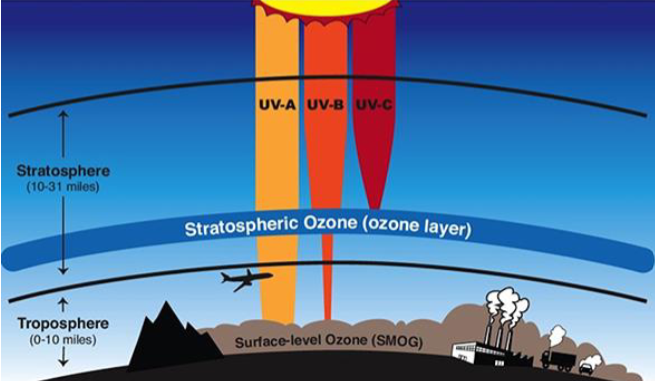
What is the main component of photochemical smog?
Ozone = produced by photochemical rxns b/w NO2 + VOCs
What are VOCs?
VOCs = organic compounds w/ higher vapor pressure
Automobiles = important source through partial fuel combustion
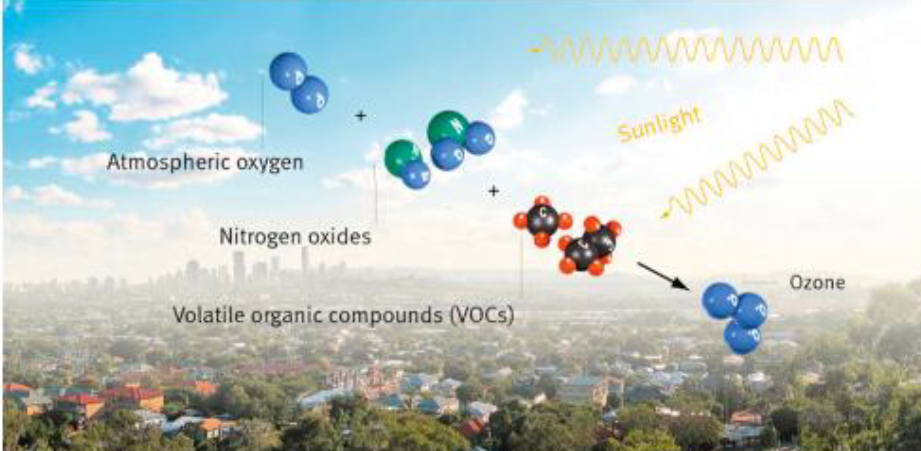
Explain what is happening in this diagram
VOCs combine with O2 and NO2 + photon of light → produce O3 (Ozone)


Explain what is happening in this diagram of Tropspheric Ozone Formation
Occurs only when there is light outside (UV radiation)

What are 4 health effects of ozone exposure?
Difficulty breathing
Mucous membrane irritation
Increased risk of respiratory infections
Acute exposure → respiratory pain, bronchoconstriction, lung edema
What state and region have nonattainment of ozone and particulate matter standards?
CT and Northeast region
EPA = monitors which counties = violation of Criteria Air Pollutant Standards

What are aerosols?
What is particulate matter (PM)?
What is the difference?
Aerosols = collection of suspended particles + surrounding gases
Particulate matter (PM) = mixture of solid particles + liquid droplets in air
Varying sizes + chemical compositions
Aerosols INCLUDE surrounding gas
PM DOES NOT INCLUDE surrounding gas
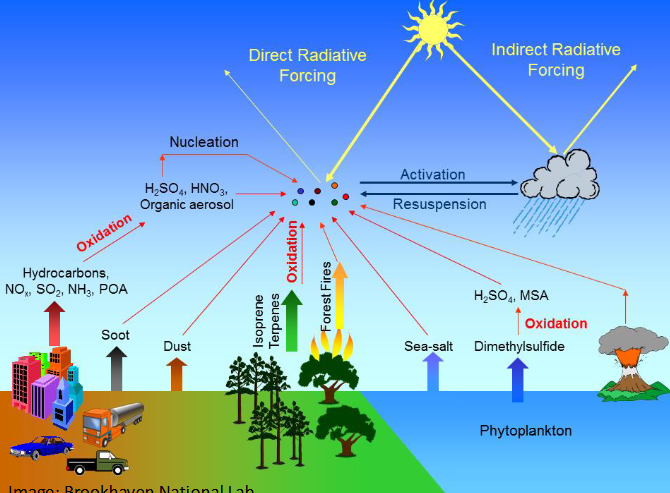
What are 8 sources of particulate matter?
Bubble Bursting
Forest Fires
Primary biological aerosols
Dust
Volcanic Ash
Secondary Organic Aerosol (SOA)
Secondary Organic Aerosol
Combustion Aerosol
Tire degradation → PM

What produces dramatically more particulates than gasoline vehicles?
Diesel vehicles = 20x more than gas
Diesel vehicles sold in EU/US have diesel particle filters

Combusion particulates are _______ assemblages and can deliver numerous _________ to the lung.
Complex; toxicants
Exposed to all compounds stuck to exterior
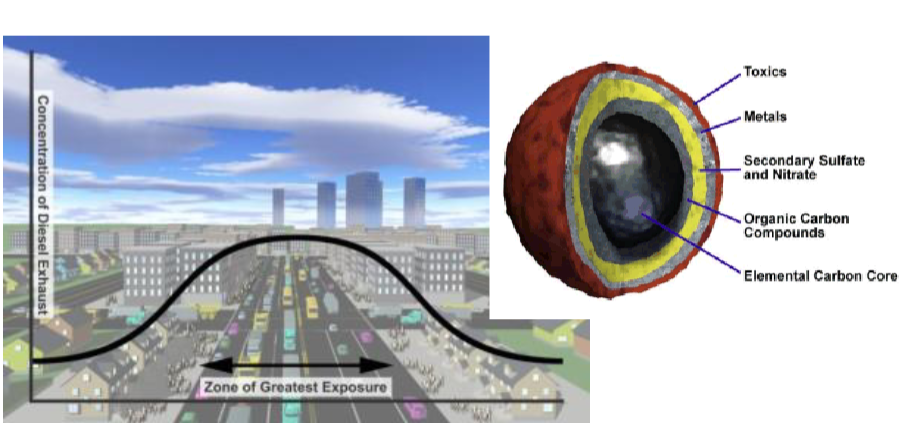
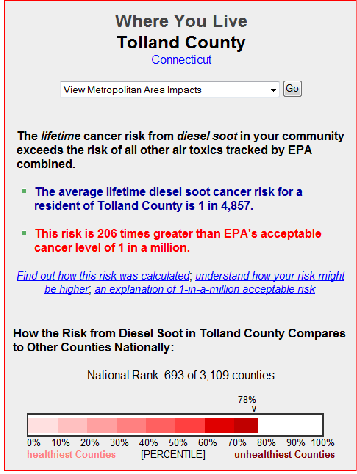
Our county + CT frequently exceeds NAAQS for ozone and particulate matter (True/False)
True → pollution from cities + manufacturing from Midwest + East Coast Cities + I-95
What 2 sizes are Particulate Matter divided into?
What 2 additional categories can it be divided into?
PM2.5 → diameter < or equal to 2.5 micrometers
PM10 → diameter > or equal to 2.5 micrometers, but less than or equal to 10 micrometers
Fine particles (0.1 micrometer - 2.5 micrometers)
Ultrafine particles (0.01 micrometers - 0.1 micrometers)
What size of PM is a greater health concern?
PM2.5 + smaller → can be inhaled into lungs
If not dissolved → difficult to be cleared efficiently
If dissolved → exposure to intoxicants
Sources of particulate matter are _________
Diverse
What are 4 ways the lead was eliminated from gasoline?
What did this also indirectly help with?
Prevent early fuel ignition in engine
“Knocking”
Protected + lubricated “valve seats” to prevent early wear
Discovered alternative anti-knock agents (MTBE + ethanol)
Various changes in engine design (Wear-resistant materials + engine oil)
Indirectly allowed improvements in CO + NOx vehicle emissions
What is the significance of implementing catalytic converters in vehicles?
What is oxidized vs. reduced in catalytic converters?
Modern catalytic converters = “Three-way converters”
Eliminate unburned escaped fuel (hydrocarbons)
Control CO
Control NOx
Hydrocarbon + NOx = ingredients for ozone formation
CO interferes with blood oxygen transport
NOx = acid rain
Hydrocarbons + CO = oxidized → CO2
NOx = reduced → N2

What is the significance of implementing scrubbers in power plants?
Scrubber systems = installed in power plant systems → remove SO2 from flue gas
Removes 95-99% of SO2 from power plant flue gas → reduce impact of coal on acid rain

What has changing from coal-fired power plants to natural gas-fired power plants done?
Methane = natural gas = cleaner-burning fuel than coal
More complete combustion (less carbon particulates)
Lower sulfur content (less SO2 emissions + particulates)
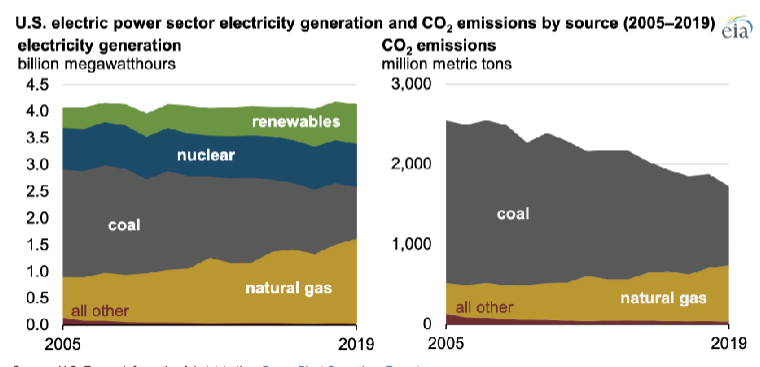
About how much of our time do we spend indoors?
What kind of environments trap pollutants? Why? 2 reasons
75-90%
Indoor environments trap pollutants = 2-5x higher levels than outside
“Air Tightening” of buildings reduce heating/cooling needs
Lower outside air infiltration rate → not as much ventilation
Off-gassing from synthetic building materials
Synthetic smell from materials
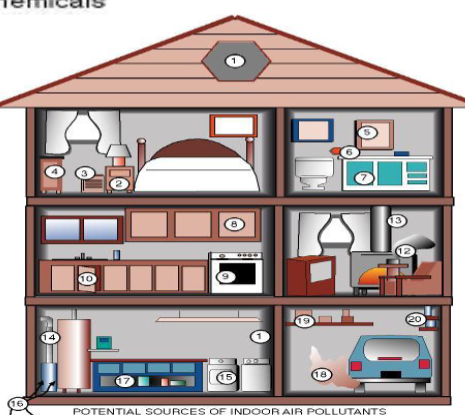
What are 2 important indoor air pollutants?
Asbestos pipe insulation
Radon infiltration
What are 6 sources of indoor air pollution?
Combustion by-products
Microorganisms + allergens
Formaldehyde + VOCs
Asbestos
Tobacco Smoke
Radon
Others
What are 2 important reasons that indoor air pollution should be a concern?
Biological allergens = dust mites, cockroaches, animal dander, protozoa, insects, algae, pollen = hypersensitivity pneumonitis → cough, dyspnea, fatigue, allergic rhinitis, asthma
Tobacco smoke = indoor smoking irritation, congestion, inflammation
What has the change in air exchange rate since the 1970s-1980s to after 1980s?
Decrease in air exchange rate
There are specific federal laws regulating indoor air quality of public buildings (True/False)
What must private residences rely on to improve indoor air quality?
What are some examples of mitigation strategies?
False
Must rely on education
Mitigation strategies = removing indoor pollution sources, increasing ventilation, air cleaning (filtration)
What is Sick Building Syndrome?
What buildings can be designed as a “sick building”
Sick Building Syndrome = symptoms associated w/ time spent in specific buildings
Respiratory tract irritation, skin irritation, headache, dizziness, nausea, fatigue, issues w/ concentration
Symptoms diminish/cease when leaving building
Cannot be traced to specific pollutants/sources within building
If more than 20% of occupants report SBS symptoms
What percentage of global population use open fires or insufficient stoves (w/o chimneys) using kerosine, biomass, or coal (Harmful sources of air pollution)?
What groups are more exposed to this in low-income countries?
According to WHO: ~1/3 global population (2.3 billion people)
Women & children = burdened w/ domestic responsibilities
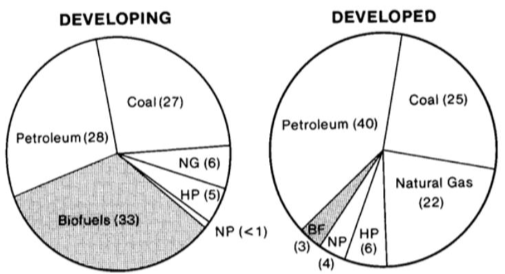
What health-damaging pollutants does indoor smoke contain?
Particulate matter
Carbon monoxide
Nitrogen oxides
Sulfur Oxides (Coal)
Formaldehyde
Carcinogens (benzo[a]pyrine + benzene)
Which of the fuel sources are worst for PM and CO formation?
A. Wood
B. Coal
C. Oil
D. Gas
Wood

Which of the fuel sources are worst for SOx formation?
A. Wood
B. Coal
C. Oil
D. Gas
Coal

What are 3 examples of ways to monitor air pollution exposure?
Aerodyne specializes in monitoring systems using mobile monitoring vehicle
Fresh Air Wristband = wearable air pollutant sample
Stationary + portable multipollutant monitors
What are 4 different levels of exposure of air pollution?
Acute exposure = contact w/ substance occurs once/short time
Acute toxicity = adverse effects shortly after exposure (hours-days)
Chronic exposure = contact w/ substance for long time (>1 year)
Chronic toxicity/health effect = health condition over long period of time
What are the 4 factors that affect the type and extent of injury?
Injuries can be ____ or ____
Concentration of pollutant
Dose received by individual
Duration of exposure
Physiochemical properties of chemical
Injuries can be acute or chronic
What must the respiratory system provide to combat air pollution?
Exposure pathway for systemic exposures + respiratory system exposure
What are the 3 primary divisions of the airway?
Nasopharyngeal
Tracheobronchial
Alveolar region/gas exchange surfaces

Particles are removed by region of airway based on ______
What happens to approximate size of deposited particles as you go deeper down the respiratory tract?
Size
Approximate size decreases
