Unit 4 Muscle Physiology
 Call Kai
 Learn
Learn Practice Test
 Spaced Repetition
 Match
Match Flashcards
 Knowt Play
1/96

There's no tags or description
Looks like no tags are added yet.
Name | Mastery | Learn | Test | Matching | Spaced | Call with Kai | Chat |
|---|
No analytics yet
Send a link to your students to track their progress
97 Terms
3 Types of muscle
Cardiac
Skeletal
Smooth
Properties of cardiac muscle
Involuntary and striated
Properties of skeletal muscle
Striated and voluntary
Properties of smooth muscle
Involuntary, not bundled like other muscle types
Contractility
Ability of muscle to generate force through contraction
Excitability
Ability of muscle to respond to a stimulus
Extensibility
Ability of a muscle to stretch beyond resting without causing damage
Elasticity
Ability of a muscle to return to its original length at rest after stretching
Primary function of each type of muscle
To produce force
Skeletal - locomotion
Smooth - to move substances such as blood or urine within the body or out of the body
Cardiac - to produce blood flow
Secondary function of skeletal muscle
maintain posture
stabilize joints
generate heat through shivering
How are skeletal musces attached to bone?
Tendons
Muscle contraction generates force on ________ which then causes the joint to move
tendons
Muscle origin vs insertion
Origin - the part of a tendon that remains immobile during muscle movement and is usually closer to the midline of the body
Insertion - the part of a bone that moves during muscle action and is usually more distant from the midline of the body
Agonist vs antagonist muscle, + example
Agonist - prime mover of an action, which initiates contraction
Antagonist - act on the same joint to produce opposite action
Ex. when the bicep contracts, the tricep relaxes. As a result, the bicep is the agonist, and the tricep is the antagonist in this case
Muscle cells are referred to as muscle _______
fibers or myofibers
Smallest component of a muscle
Muscle fiber
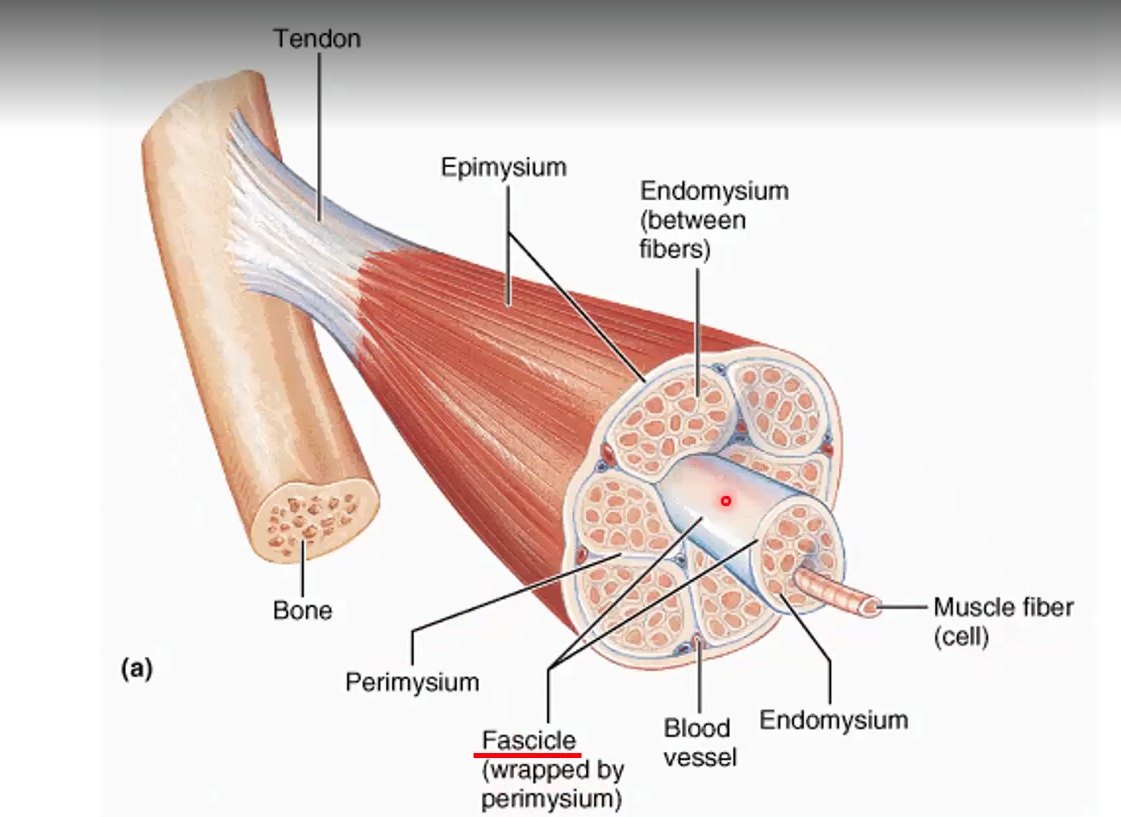
Bundles of muscle fibers are called ______
fasicles
Fasicles are surrounded by what protective layer?
Perimysium
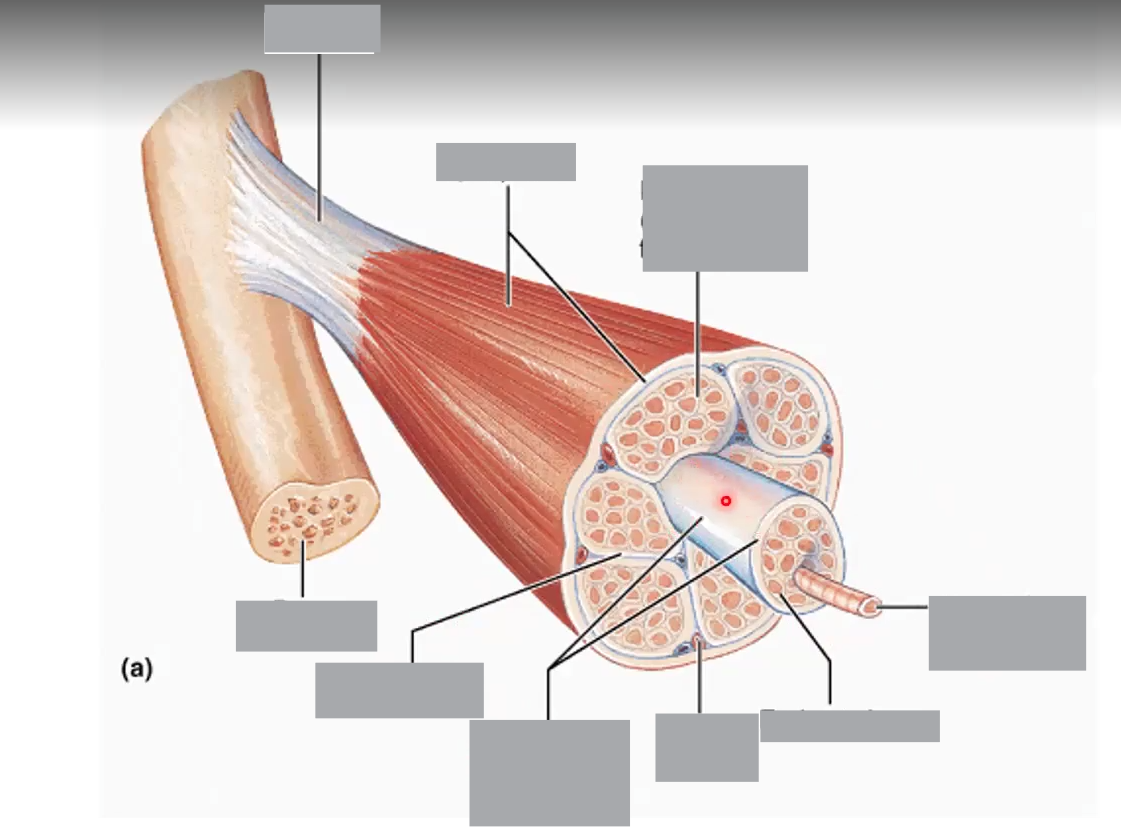
Label all parts of the muscle structure
What are the two ways that fasicles can be arranged? What is the function of each form?
Parallel/fusiform - to generate a range of motion
Pennate (angled) - to generate power
True or false: Myofibers have a single nuclei
False
Sarcolemma
Membrane of a muscle cell
T-tubule
Tubule that transverses the interior of the myofiber
Sarcoplasmic reticulum
Stores calcium, located in close proximity to the t-tubule
Sarcomere
Functional unit of muscle contraction
Thin filament
Actin, which composes part of myofilaments
Thick filament
Myosin, which comprises part of myofilaments
Sarcomeres are defined from end to end by __________ to _________
Z-disc to Z-disc
What causes the striated appearance of muscles?
Sarcomeres
Do smooth muscles have sarcomeres? Why?
No, because sarcomeres are the basis for striation, and smooth muscles are not striated
The distance between z discs _________ during contraction
Shorten
The I band of a muscle is comprised of _______
actin only
The H band of a muscle sarcomere is comprised of _________
Myosin only
The A band of a sarcomere is comprised of __________
the overlap of actin and myosin (I and H bands)
True or False: all sarcomere bands except the A band shorten
True
Main component(s) of the thin filament
Actin, bound to tropomyosin, which holds troponin sites
Primary component(s) of the thick myofilament
Made of thick bundles of myosin with myosin head regions that bind to actin and ATP
ATP binds to which filament of the sarcomere? At what specific part?
Thick filament at the myosin head
4 steps of cross-bridge cycling
ATP binds to myosin head, triggering the detachment of the two filaments from eachother
ATP is hydrolyzed into ADP and P, resulting in the myosin head being energized to the high energy state (cocked)
Myosin head binds to actin filament, forming cross bridge
The P generated earlier is released, causing the power stroke to occur
How is cross-bridge cycling regulated?
The calcium released from muscle sarcoplasmic reticulum binds to troponin on the thin filament, which causes the connected tropomyosin to change shape and reveal the myosin binding site of actin
What 2 things are absolutely necessary for muscle contraction?
ATP and Ca2+
Motor unit
A motor neuron and all of the muscle fibers it innervates
True or false: a single muscle fiber receives multiple axon terminals from its motor neuron
false, it only recieves a single
All or none principle
When a motor neuron is activated, ALL of the muscle fibers it innervates (motor unit) will be depolarized and contract
Innervation ratio
Ratio of motor neurons to muscle fibers
The innervation ratio for an eye muscle would be ________ than the innervation ratio for a calf muscle
much lower, such as 1:20 in the eye compared to 1:2000 in the calf
True or False: the muscle fibers within a motor unit are spread throughout a muscle instead of being concentrated in one spot
True
True or False: All muscle fibers in a particular motor unit are the same type of fiber
true
Where is calcium in a muscle cell stored?
Sarcoplasmic reticulum
Before cross-bridge formation, calcium binds to _______ which moves _____ so that the myosin head of the thick filament can bind
troponin, moves tropomyosin
What type of channel is the acetylcholine receptor of a muscle cell?
Ligand-gated channels
How does a somatic motor neuron action potential lead to sarcomere contraction eventually?
Action potential in motor neuron leads to release of acetylcholine
Acetylcholine binds to nicotinic receptors of sarcolemma, causing sodium to diffuse in and an action potential release
Action potential travels through TRANSVERSE TUBULES
Action potential eventually reaches the sarcoplasmic reticulum, where calcium is then released
Calcium from sarcoplasmic reticulum binds to troponin, moving tropomyosin, and allowing myosin head to bind to actin
How does a muscle relax?
Action potential has to cease
Acetylcholin is degraded by acetylcholinesterase
Calcium release channels of sarcoplasmic reticulum closes
Calcium is pumped back into the sarcoplasmic reticulum to facilitate muscle relaxation via the Ca2+-ATPase pumps
Myasthenia gravis
An autoimmune disease that attacks acetylcholine receptors, resulting in muscle weakness
True or False: Myasthenia gravis affects muscles with a higher innervation ratio more than those with a smaller one, such as the eye muscles.
False, it tends to affect the eyes first because there are only a handful of muscle fibers per neuron
What ion is primarily responsible for membrane depolarization during muscle contraction?
Calcium
What happens when the voltage gated Ca2+ channel undergoes a change in structure during depolarization?
Ca2+ is released from the sarcoplasmic reticulum
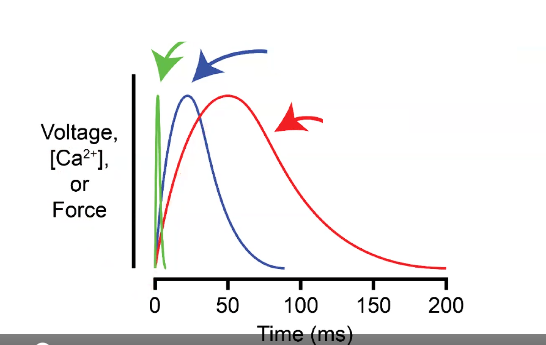
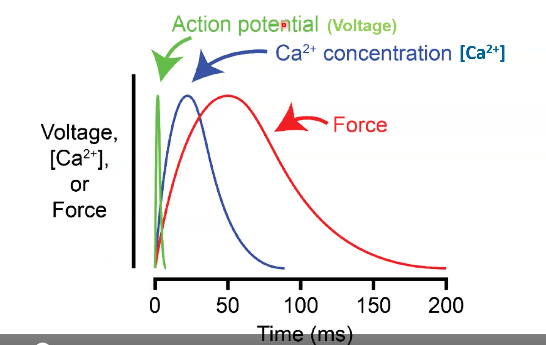
Label each color as force, calcium, or voltage
Tetanus
When relaxation is incomplete between APs as a muscle is repetitively stimulated, with the force increasing with each action potential until maximum force is reached
Length-tension relationship of a muscle
The length of a sarcomere determines myofilament overlap, which determines the amount of relative tension. The optimal length will maximize overlap between thin and thick filaments, which maximizes the amount of cross bridges formed
Why does a very low sarcomere length weaken the relative tension of a muscle, even though there is more overlap between the thin and thick filaments?
Too much overlap disrupts the spacing of the thin and thick filaments, which leads to disruption of cross bridge formation and force drops off
3 Types of muscle contraction
Isometric - muscle length stays constant, load is greater than the force of contraction, NO MOVEMENT
Concentric- muscle shortens with contraction, force of contraction exceeds the load
Eccentric - muscle lengthens with contraction, load may exceed force of muscle contraction
4 determinants of isometric force
How often muscle is activated
Number of motor units recruited
Muscle size/cross section size
Sarcomere length
Force-velocity curve of muscle
Heavy loads result in less muscle shortening over a smaller amount of time - LESS VELOCITY WITH MORE FORCE
When the velocity of a muscle is at zero, the load is at its _________
greatest
3 Types of energy systems for muscle contraction (+time spans
Phosphagen (seconds)
Glycolytic (minutes)
Aerobic system (unlimited, using fat)
Sprinting would PRIMARILY use the ______ energy system
Phosphagen
a 1500 meter or 1 mile run would PRIMARILY use what energy stem?
Glycolytic system
A marathon run would primarily use what energy sysem?
Aerobic respiration
True or False: All three energy systems operate regardless of the activity causing muscle contraction (ex. sprinting, marathon, etc.)
True, they all operate but at different rates depending on the activity
Phosphogenic system
Uses creatine phosphate to rapidly convert ADP to ATP
Byproducts of aerobic metabolism
CO2
H2O
Heat
VO2 max
a measure of cardiovascular fitness - maximum rate of energy that your body can consume and use during intense exercise
VO2 max depends on what factors?
Age
Training
Body weight
Slow twitch muscle fiber characteristics
Slow to fatigue
Red appearance
Lots of capillaries
Many mitochondria
Aerobic respiration is much more common
Common in endurance muscles
Fast twitch fibers (2a)
Fast to contract
Highly aerobic, with many mitochondria
Fatigue resistant
Fast twitch fibers (2x)
Have a white appearance
Anaerobic
Fewer capillaries
Large glycogen stores
Sprinting muscles
The thickest of the 3 muscle fiber types are _________
Fast twitch glycolytic
The smallest diameter of the 3 fiber types are ________
Type 1 slow oxidative
The widest Z line thickness of the 3 muscle fiber types is _________
Slow oxidative (type 1)
The narrowest Z line thickness of the 3 muscle fiber types is ________
Fast glycolytic (Type 2x)
How many different fiber types do humans have?
3
Stem cells two characteristics that are unique
They can self renew
They can differentiate into mature cell
Satellite cells (muscle)
Skeletal muscle stem cells that play a role in supporting/repairing muscle
True or false: Satellite cells are typically not quiescent cells
False, they are usually quiescent until they are repairing muscle
Duchenne muscular dystrophy
The most common form of muscular dystrophy, caused by dystrophin gene mutation on the x chromosome so it is more common in boys
Dystrophin function
To provide structural stability to muscle cell membrane
Why is dmd more common in boys than girls?
Boys only get one x, and the disease is recessive so inheriting an x chromosome with the mutation leads to having the disease in boys. Girls, however, can be carriers of the disease without symptoms if they inherit an X with the mutation
DMD symptoms
Muscle weakness and muscle mass loss, muscle is replaced by fat fibrotic tissue, vastly reduced life expectancy, often leads to cardiovascular issues eventually
How are cardiac muscles different than skeletal muscles?
Cardiac muscle fibers are shorter in length
Cardiac muscle cells have gap junctions to connect the cells as one unit during action potential
Syncitium meaning
When many cells behave as one unit, such as the heart!
How are calcium channels different in the heart than skeletal muscle?
The voltage gated calcium channels of the T tubule trigger calcium to be released from the sarcoplasmic reticulum
Smooth muscle vs other muscle cells
Have no sarcomeres
Much higher actin to myosin ratio (16:1)
Actin filaments are attached to dense bodies
Which muscle cell involves actin filaments attached to dense bodies?
Smooth muscle
Which type of muscle cell does not have sarcomeres?
Smooth muscle cells
Calmodulin function in smooth muscle
Calmodulin binds to calcium to activate myosin kinase which allows the myosin head to be phosphorylated and thus active
How is smooth muscle contraction different than skeletal and cardiac muscle contraction?
Smooth muscle contraction is regulated via calmodulin binding to calcium and the subsequent phosphorylation of myosin via a myosin kinase that activates the myosin head to be able to bind to the thin filament
Cross bridges are released when a phosphatase takes the phosphate off of the myosin head instead