3.6.4 Homeostasis - WATER POTENTIAL
 Call Kai
 Learn
Learn Practice Test
 Spaced Repetition
 Match
Match Flashcards
 Knowt Play
1/10

There's no tags or description
Looks like no tags are added yet.
Name | Mastery | Learn | Test | Matching | Spaced | Call with Kai |
|---|
No analytics yet
Send a link to your students to track their progress
11 Terms
urine system
.
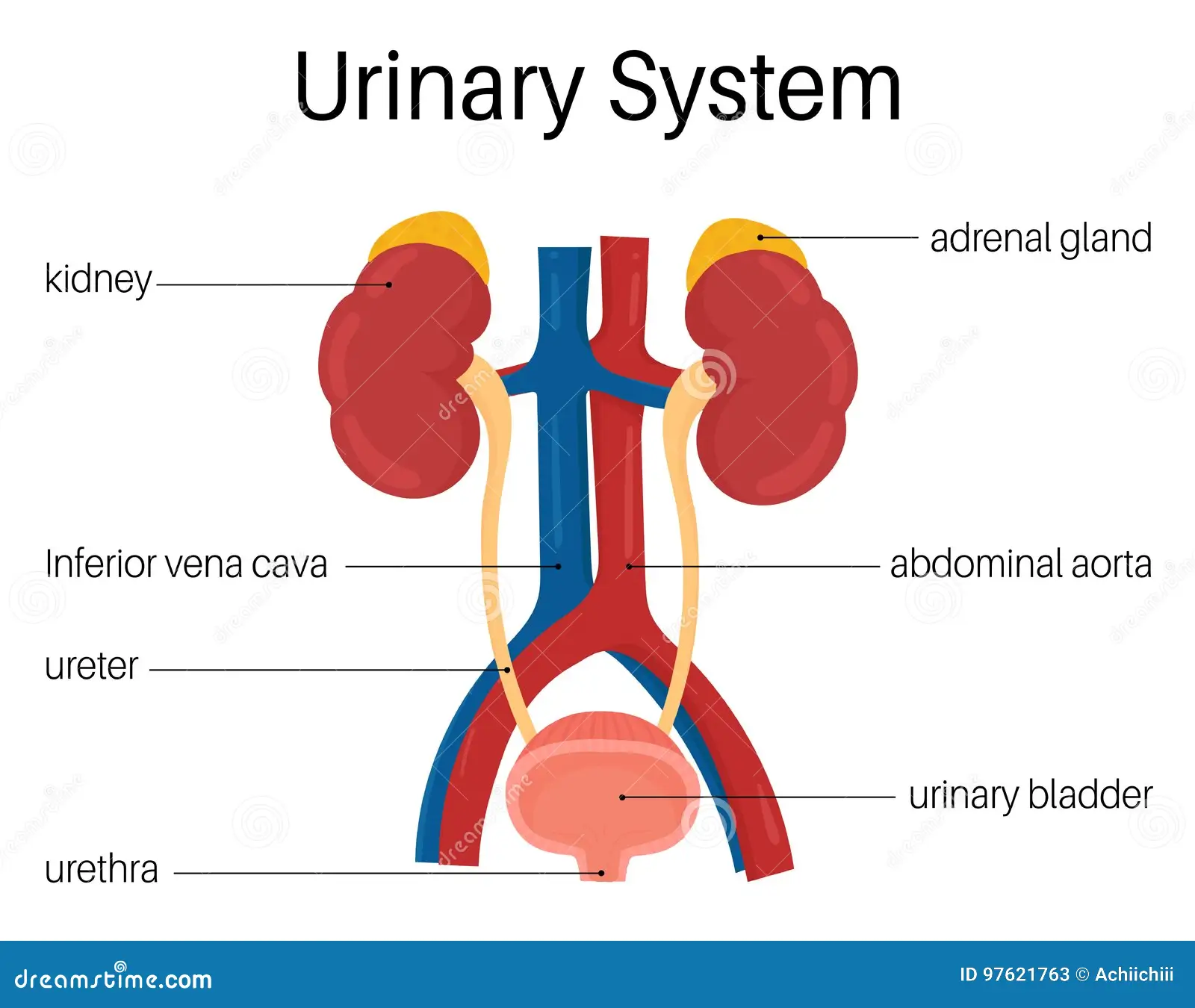
kidney structure
filters waste products out of blood + reabsorbs useful solutes

structure of nephron
wide afferent arteriole entering + narrow efferent arteriole leaving
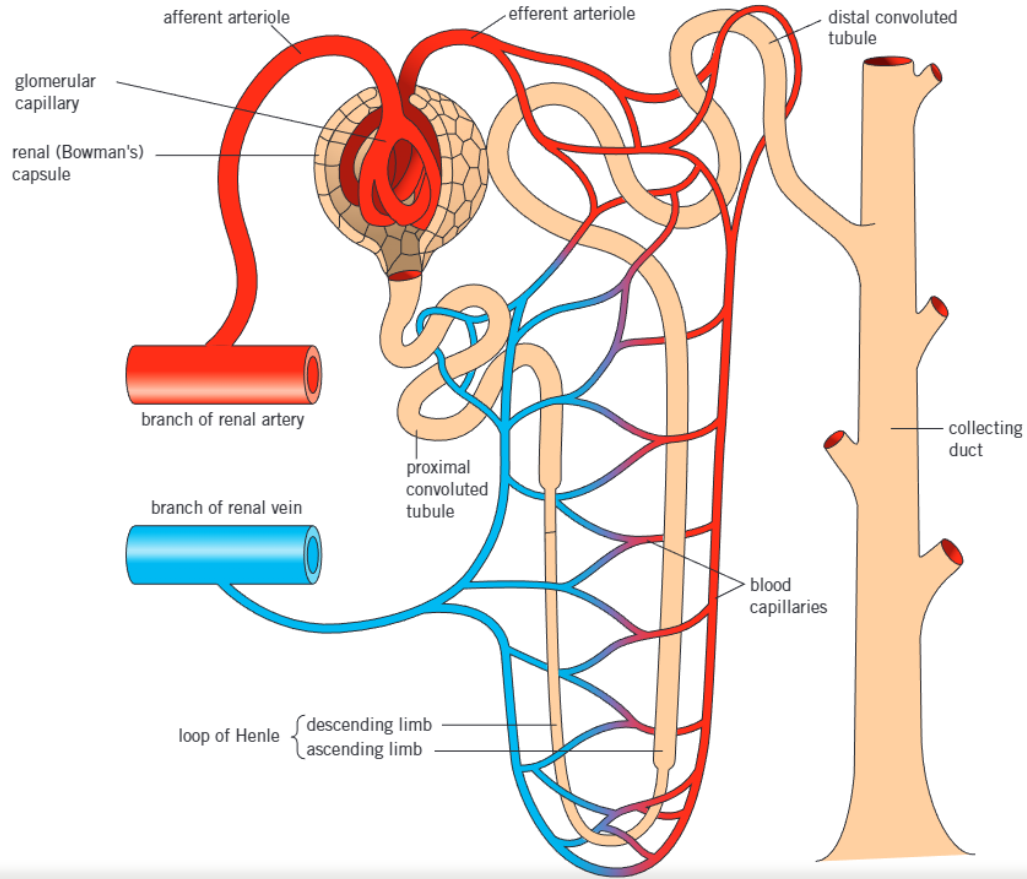
ultrafiltration
-in Bowman’s capsule
1) high hydrostatic pressure in glomerulus forces small molecules out of capillary such as glucose + urea
2) this passes through basement membrane into Bowman’s capsule
3) there are podocytes and pores in capillary endothelium to allow substances to be filtered through
4) large molecules (proteins) cannot pass through so remain in blood
5) small molecules form glomerular filtrate
selective reabsorption of glucose + water
-in proximal convoluted tubule
1) useful molecules are reabsorbed into blood
2) carrier protein co-transports Na+ and glucose into epithelial cells
3) then Na+ absorbed into blood by active transport + glucose absorbed into blood by facilitated diffusion
4) water enters blood by osmosis as water potential of blood is lower than the filtrate
adaptations of proximal convoluted tubule
-microvilli = large surface area for co-transporter proteins
-many mitochondria = produce ATP for active transport of glucose
-many carrier proteins = for active transport
maintaining Na+ gradient in medulla
-in loop of Henle
1) Na+ ions pumped out of ascending limb by active transport into medulla
2) ascending limb is impermeable to water so water remains in limb + water potential of medulla decreases
3) near the bottom of the ascending limb, Na+ ions then diffuse out, further lowering medulla water potential
4) so water moves out of descending limb by osmosis + Na+ ions enter it, making glomerular filtrate more concentrated + decreasing its water potential
5) so water in medulla is reabsorbed into the blood
length of loop of Henle
longer loop = Na+ or Cl- ions absorbed from filtrate in ascending limb so conc of Na+ ions increases in medulla so increases water potential gradient so more water reabsorbed into blood by osmosis from loop of Henle so more concentrated urine
reabsorption of water
in distal convoluted tubule + collecting duct
-water moves out of DCT + collecting duct by osmosis and is reabsorbed into blood
role of ADH
stored and secreted by posterior pituitary gland
-binds to receptors on membrane of collecting duct and make the cells more permeable to water by inserting aquaporins in membrane
DEHYDRATION
-decrease in water potential of blood
-osmoreceptors in hypothalamus trigger release of ADH from pituitary gland - water moves out osmoreceptors into blood by osmosis causing them to shrink
-ADH increases permeability so more ADH produced so more water reabsorbed into blood by osmosis so smaller volume of urine produced + more concentrated urine produced
-OPPOSITE FOR HYDRATION