Lecture 4- Action Potential
 Call Kai
 Learn
Learn Practice Test
 Spaced Repetition
 Match
Match Flashcards
 Knowt Play
1/23

There's no tags or description
Looks like no tags are added yet.
Name | Mastery | Learn | Test | Matching | Spaced | Call with Kai | Chat |
|---|
No analytics yet
Send a link to your students to track their progress
24 Terms
Voltage-gated ion channels
open/close by membrane potential changes
Why is the membrane potential at rest relative negative?
Although Na+ wants to come inside, there are only a few Na+ channels open. There are many K+ channels open, and K+ leaves the cell. This is why resting potential is negative
Action Potential
The electrical signal used for neural communication
What is action potential
It is the active response to a neuron when it is depolarizing ( becoming more positive)
Why are voltage gated channels important to action potential
because every part of action potential is dependent on these voltage gates
What are the parts of action potential
threshold
upstroke
downstroke
afterhyperpolarization
relative refractory period
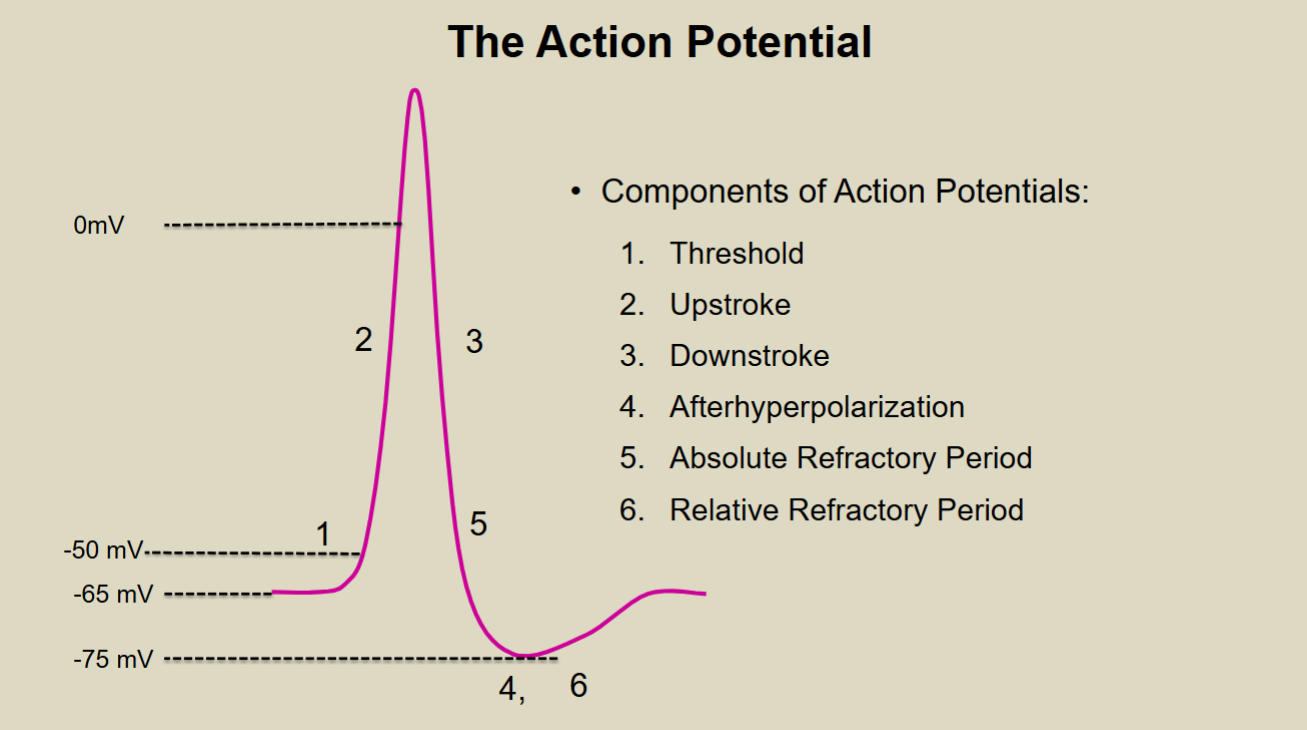
What is action potential caused by? (threshold)
Ions flowing through the voltage gated channels. There is an early inward current of sodium (na+) and late outward current of potassium (k+)
Explain threshold
at equalibrium Na+ influx is balanced by k+ eflux. At threshold there is more na+ ions entering. This triggers the voltage gated channels to open, and as more voltage gated channels (self-regenrative) are opening the causes an increase in na+ influx (ALL OR NOTHING AT THIS POINT)
Upstroke
Strong na+ influx, weak K+ efflux (due to k+ channels not being open yet)
Downstroke
strong K+ efflux (potassium channels are open – strong driving force), weak Na+ influx (sodium channels have inactivated – weak driving force) Neuron repolarizes
Afterhyperpolarization
K+ is slow to open and slow to close. This is why the cell becomes even more negative (hyperpolarizes) despite the cell reaching its original starting state (POTASSIUM EFLUX)
Inactivation
Dependent on the voltage of the surroundings
Deactivation
passive recovery to recover from depolarization
Give example of inactivation
The Na+ channels are inactivated by a ligand because the inside of the cell becomes too positive at one point, so a ligand comes to attach to the ion channel.

Give example of deactivation
They open when depolarized and stay open until neuron gets back into resting potential

Absolute Refractory Period
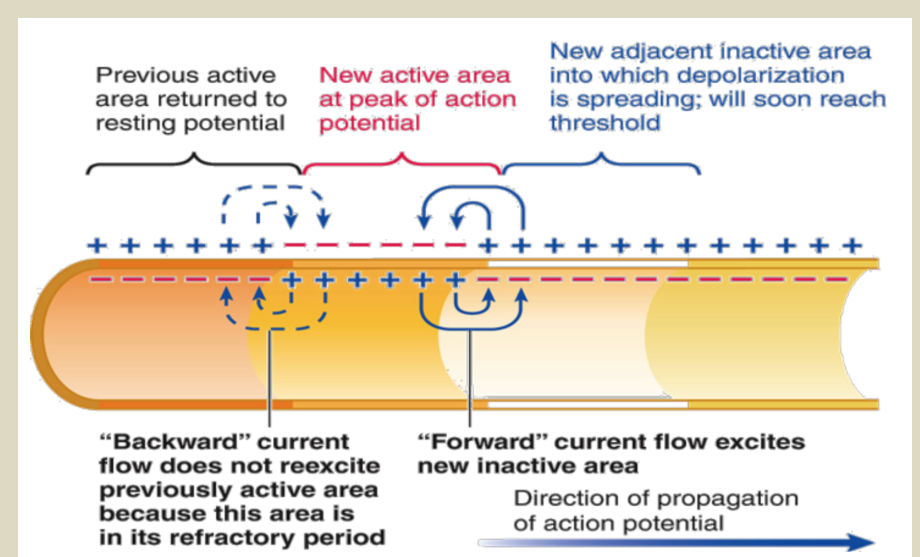
Occurs when sodium channels are inactivated, during this time an action potential is impossible to occur again

Relative Refractory Period
follows after the Absolute Refractory Period. time after an Action
Potential when enough Na channels have recovered from inactivation to trigger an action potential, but K efflux is still active so the cell is hyperpolarized
Can action potential trigger during relative refractory period
YES! more stimulus is required through to trigger action potential
why are refractory periods important to neural activity
because it ensures that action potential only goes downstream (in ab. refractory period AP cannot be triggered)
Important points
-ions that flow during action potential is relatively small compared to the total ions surrounded inside and outside the neuro
-little effect on the total number of ions
-Resting ion concentrations are rapidly re‑established by the movement of ions
Properties of Action Potentials
Initiated at the axon hillock
• Threshold potential
• All or none
• Non-decremental
• Refractory periods
• Very rapid
Why is myelin important for action potential
speeds up
Where are voltage gated channels mainly located
Voltage gated channels are restricted mainly to breaks in the myelin
called Nodes of Ranvier
Mutliple Scelrois
When myelin is damaged, cannot properly send the action potential signals.APs conducted more slowly or
unreliably. APs may fail to be conducted to the
axon terminal