Synthesis Notes - Industrial Processes
 Call Kai
 Learn
Learn Practice Test
 Spaced Repetition
 Match
Match Flashcards
 Knowt Play
1/37

There's no tags or description
Looks like no tags are added yet.
Name | Mastery | Learn | Test | Matching | Spaced | Call with Kai | Chat |
|---|
No analytics yet
Send a link to your students to track their progress
38 Terms
Syllabus
-Haber Process (NH3)
-Contact Process (H2SO4)
-Soaps and detergents
-Plastics (covered during the organic chemistry topic)
-Ethanol (from ethene and by fermentation)
-Biodiesel (base catalysed and enzyme catalysed)
-Ethyl ethanoate
Haber Process
The Haber process is a method of synthesising ammonia developed by the German Chemist Fritz Haber
The process is immensely important in the production of fertilisers
N2(g) + 3H2(g) ← → 2NH3(g) ΔH = -92.4 kJmol-1
Rate considerations - haber
The rate of the reaction will be increased by the use of:
High temperatures
( ^ velocity of particles and hence rate of collisions)
( ^ proportion of collisions where EK > EA)
High pressures
( ^ rate of collisions)
Catalyst
(Fe/FeO/Fe3O4/K2O/Al2O3)
(Decrease EA, increase proportion of collisions where EK > EA)
Yield considerations - haber
The yield of the reaction will be increased by the use of
High pressures
(Favour reaction producing the least gaseous particles eg forward)
Low temperatures
(Favour the exothermic forward reaction)
Cost considerations - haber
The cost can be minimised by the use of low pressures and temperatures
Actual reaction conditions - haber
The reaction conditions used to provide the best balance of rate, yield and economic considerations are:
Moderate temperature of 400-500 °C
(balance of rate, yield and cost)
Relatively high pressure of 200 atm
(High pressure increase rate and yield, but even higher pressures would be too expensive to maintain)
Catalyst
(Fe/FeO/Fe3O4/K2O/Al2O3)
(^ rate without affecting yield)
Contact processes
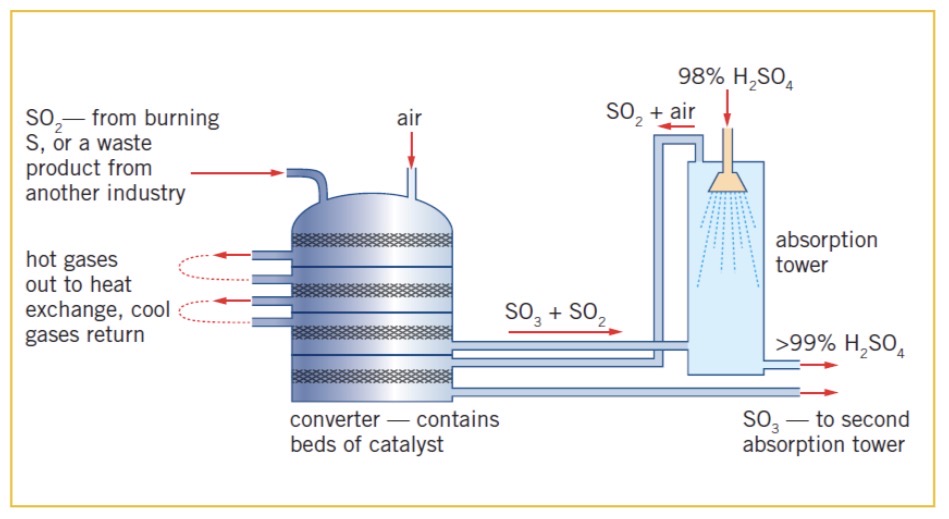
The contact process is a method for producing sulfuric acid
The majority (~75 %) of the sulfuric acid produced is used in fertiliser production
Step 1: S(s) + O2(g) → SO2(g) OR 4FeS2(s) +11O2(s) → 2Fe2O3(s) + 8SO2(g)
Step 2: 2SO2(g) + O2(g) ← → 2SO3(g)
Step 3: SO3(g) + H2SO4(l) → H2S2O7(l)
H2S2O7(l) +H2O(l) → 2H2SO4(l)
They key to the efficiency of the process is the reversible reaction carried out at step 2
2SO2(g) + O2(g) ← → 2SO3(g) ΔH = -196 kJmol-1
Contact process: Rate considerations
The rate of the reaction will be increased by the use of:
High temperatures
( increase velocity of particles and hence rate of collisions)
( increase proportion of collisions where EK > EA)
High pressures
(increase rate of collisions )
Catalyst (V2O5)
( decrease EA, proportion of collisions where EK > EA)
Contact process: yield considerations
The yield of the reaction will be increased by the use of:
High pressures
(Favour reaction producing the least gaseous particles eg forward)
Low temperatures
(Favour the exothermic forward reaction)
Contact process: cost considerations
The cost can be minimised by the use of low pressures and temperatures
Contact process: actual reaction conditions
The reaction conditions used to provide the best balance of rate, yield and economic considerations are:
Moderate temperature of 400-450 °C
(balance of rate, yield and cost)
Low pressure of 1-2 atm
Decrease cost more than makes up for decrease rate and yield)
Catalyst (V2O5)
^ rate without affecting yield
Green Chemistry
In addition to the economic efficiency of a chemical synthesis process, synthesis reactions should also be designed to minimise the impact on the environment
Green chemistry aims to reduce the impact of chemical industry on the environment by:
Preventing pollution (preventing the production of harmful chemicals)
Where this is not possible, treating chemicals to make them safe prior to disposal
Where this is not possible, disposing of untreated chemicals safely
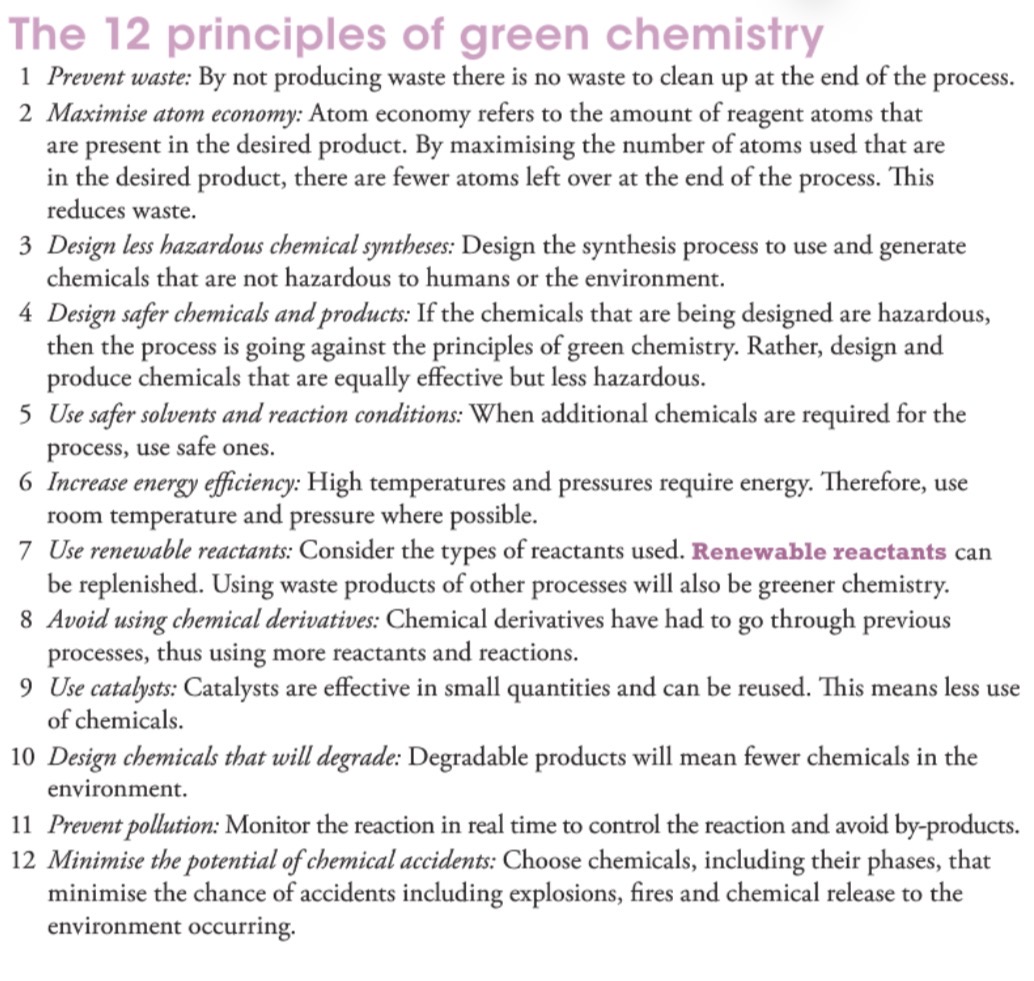
The 12 principles of green chemistry were developed to assist in designing chemical synthesis processes that are as environmentally friendly as possible
Atom economy
One method of measuring the environmental efficiency of a chemical process is its atom economy
It measures the percentage of the reactants effectively utilised to produce products
atom economy = mass of atoms in desired product x 100/ mass of atoms in the reactant
Fats and oils
Fats and oils are both examples of lipids, a class of compound produced by living organisms
They are both large non-polar molecules called triglycerides
Fats are solid at room temperature, while oils are liquids at room temperature
Fats are generally animal derived saturated triglycerides, while oils are generally plant derived unsaturated triglycerides
Fats and oils are important reactants for organic synthesis processes such as soap and biodiesel production, in addition to their uses in the food industry
Structure and synthesis of triglycerides
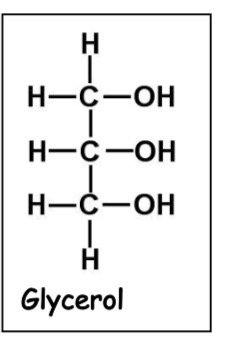
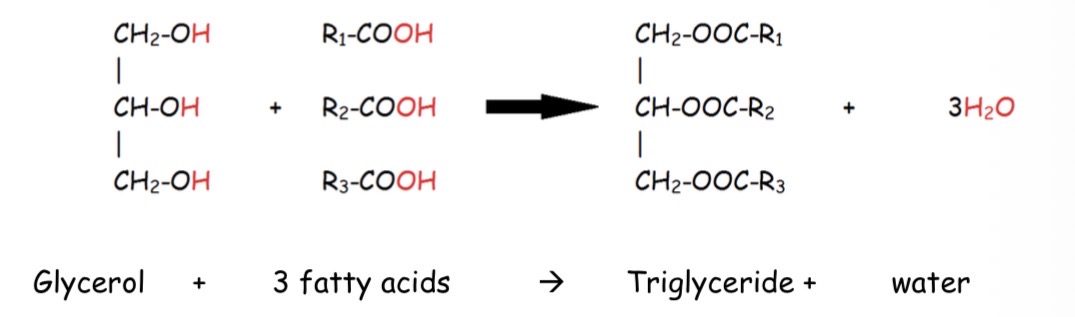
Triglycerides are triesters that are synthesised in a condensation (esterification reaction) between a glycerol molecule and three fatty acids
Glycerol is the common name for propan-1,2,3-triol
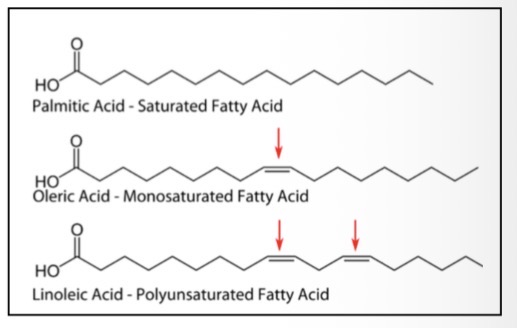
Fatty acids are long chain (~C8-C20) carboxylic acids
They are classified as saturated or unsaturated (mono-or poly-) based on the presence/absence of double bonds within the carbon chain
Fats and oils are synthesised in the condensation reaction shown below, which involves the formation of three ester links
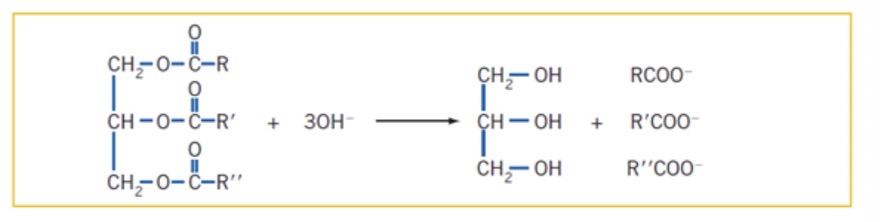
Fats and oils can be broken down in a hydrolysis reaction, which is the reverse of the above reaction
synthesis of soaps and detergents
Soaps and detergents are both cleaning agents known as surfactants or emulsifying agents
Emulsifying agents are compounds that able to keep two normally immiscible substances together in the same phase
They can be used to clean non-polar substances such as fats and oils from surfaces with water

Saponification
Soaps are the salts of long chain fatty acids
They are produced by the hydrolysis of triglycerides in the presence of a base to form soap and glycerol (the process is called saponification)
Animal fats are boiled in sodium hydroxide solution and salt is added, causing the soap to precipitate from the solution
The glycerol can be recovered by distillation
The soap produced in the reaction has a long non-polar hydrocarbon “tail” that can interact with non-polar compounds by dispersion forces and a charged carboxylate “head” that can interact with polar compounds (like water) by ion-dipole forces
Limitations of soaps (hard water)
The water in some areas (particularly in WA) has a high concentration of metal ions such as Ca2+, Mg2+ or Fe2
This is called hard water
Soaps are ineffective in hard water as the metal cations are able to combine with soap ions to form a precipitate known as soap scum in the reaction:
M2+(aq) + 2R-COO-(aq) → M(R-COO)2(s)
Soap scum can be hard to remove from surfaces, leading to stains around sinks and basins and blocked drains
When washing with hard water, more soap is required as many soap molecules are removed as a precipitate
Detergents
Detergents are designed to have a similar structure and to work in the same way as soaps, without forming insoluble precipitates
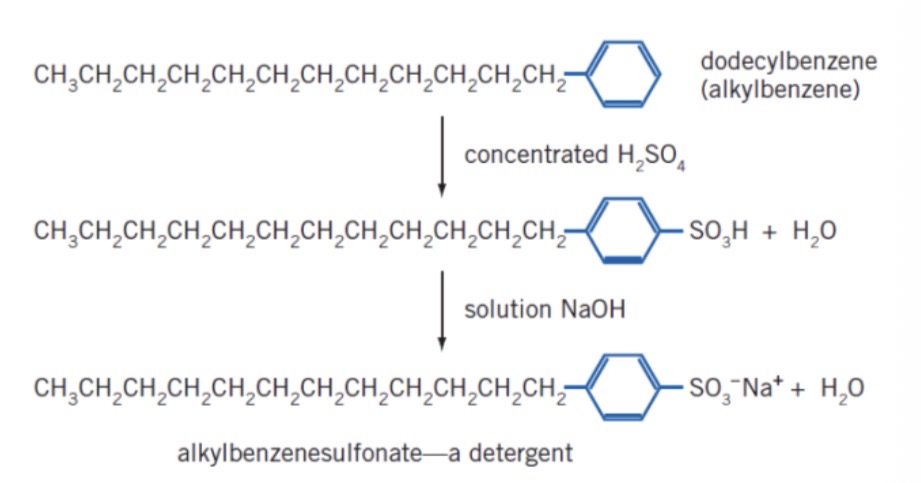
In detergents, the carboxylate (COO-) group is replaced with a sulfonate (SO3-)
While still an effective surfactant, sulfonate ions will not form scum in hard water
Detergents can be produced by reacting an alkylbenzene with concentrated sulfuric acid, then with sodium hydroxide
The non-polar hydrocarbon tail of the molecule can interact with non-polar compounds by dispersion forces and the charged sulfonate “head” that can interact with polar compounds (like water) by ion-dipole forces
Cleaning action of soaps and detergents
Unless a surfactant is added, water is extremely ineffective at cleaning non-polar substances such as fats and oils from surfaces
This is because water is immiscible with fats and oils due to the differences in polarity
Adding soap or a detergent to water allows the fats/oils and water to be present in the same phase
Both soaps and detergents work through the formation of micelles
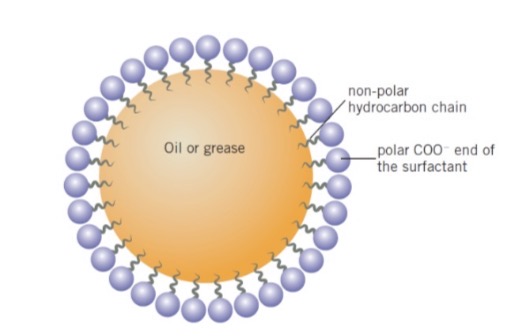
When soaps and detergents are added to water, their non-polar hydrocarbon tails are able to dissolve non-polar oils and grease (due to dispersion forces), while the ionised head is able to dissolve in water (due to ion-dipole forces)
This results in the formation of “micelles”, with a blob of oil/grease surrounded by soap/detergent molecules, orientated with their tails facing inwards and their heads outwards
The formation of micelles is aided by agitation and the use of hot water
Biofuels
Biofuels are fuels that are produced from biomass
They are produced as a renewable, less environmentally harmful, low sulfur alternative to fossil fuels
Common biofuels include ethanol and biodiesel
Ethanol can be used in special engines designed for ethanol only, or it can be blended with petrol and used in petrol engines
Biodiesel can be used in diesel engines, either alone or blended with diesel from crude oil
Ethanol- synthesis by fermentation
Ethanol from fermentation is considered a biofuel, as it is produced from biomass
Approximately 93% of ethanol (including all ethanol for alcoholic beverages) is produced in this manner
Sources of biomass for the production of alcoholic beverages include grains (wheat, rye, barley, corn etc), fruits (apples, pears, grapes) and sugar cane
Ethanol for biofuels is typically produced form corn, wheat or sugar cane
The exact process varies, depending on the source of biomass
The use of starch products (corn/wheat etc) requires the use of enzymes to convert the starch into simpler sugars such as sucrose
Producing ethanol from sucrose is a two-step process catalysed by enzymes produced by yeast, with both stages occur in a single reaction vessel
Step 1. Hydrolysis of sucrose
In the first reaction, the disaccharide sucrose is hydrolysed into the monosaccharides glucose and fructose (both are isomers of C6H12O6), catalysed by the enzyme invertase

Step 2: fermentation
In the second reaction, glucose and fructose are converted to ethanol and carbon dioxide by the enzyme zymase

Ethanol-synthesis by fermentation: reaction conditions
in enzyme catalysed reactions, the reaction conditions must be chosen to keep the enzyme within its working temperature and pH range, to prevent the enzymes from becoming denatured and losing their activity
Temperature: 25-37°C:
(Lower temperatures reduce reaction rate)
(Higher temperatures cause enzymes to denature)
pH: 3-5:
(Yeast enzymes are active in this range)
(Low pH inhibits bacterial growth)
Low O2 concentration:
(Higher O2 concentration causes yeast to respire aerobically)
(This produces CO2 and H2O instead of CH3CH2OH)
Ethanol-synthesis by hydration of ethene
Ethanol can be synthesised either by fermentation, or by the hydration of ethene
Ethanol produced by hydrating ethene is not technically a biofuel
Hydration of ethene is the quickest method of producing ethanol for industrial use

Ethanol-synthesis by hydration of ethene: reaction condiitons
Moderate temperature (~300°C):
low temp ^ yield and decrease cost
High temp ^ rate
Moderate/High pressure (60-70 atm):
high pressure ^ rate and yield
Low pressure decrease cost
Catalyst (H3PO4):
^ rate without affecting yield
Ethyl ethanoate (not a biofuel)
Ethanol produced by the hydration of ethene is often used to produce ethyl ethanoate
Ethyl ethanoate is industrially important as a highly useful solvent
It is used in nail polish remover, adhesives, varnishes and in many industrial processes
It has a low toxicity for an organic solvent
It is produced by the acid catalysed esterification of ethanol and ethanoic acid (called Fischer esterification)
The ethanol is produced by the hydration of ethene (which is itself produced by cracking hydrocarbons)

Reaction Conditions (for Fischer esterification)
H2SO4 catalyst used:
( ^ rate without affecting yield)
Ethanol added in excess:
( ^ yield and decrease cost (ethanol is cheaper than ethanoic acid)
Biodiesel
Diesel from crude oil consists of long hydrocarbon chains (C8-C20)
Biodiesel molecules are a similar length, but consist of the methyl or ethyl esters of fatty acids
It is produced by the transesterification of triglycerides (TGs)
Waste vegetable oil from restaurants is the most common source of TGs for the process
The reaction can be catalysed by a strong base or with an enzyme
The reaction of trigylcerides with methanol (the most common alcohol used) to produce Biodiesel in the form of fatty acid methyl esters (FAMEs) is shown below
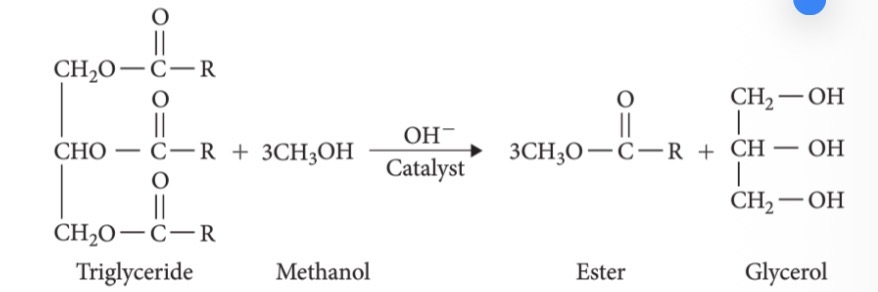
Base catalysed method
The base catalysed method is used for almost all commercially produced biodiesel
Base catalysed method: reaction conditions
Water is removed from oils to prevent the hydrolysis of triglycerides into glycerol and free fatty acids (FFAs)
If this occurs, the FFA can react with the base catalyst to form soaps
If FFAs are present above ~4%, they must be converted to FAMEs in an acid catalysed reaction, to prevent saponification
The reaction uses a low initial temperature, but eventually produces high temperatures due to its exothermic nature
It is performed in a sealed reaction vessel to prevent the loss of methanol by boiling
Alcohol is added in excess to increase yield (yield can be up to 98%)
Following the reaction, the biodiesel top layer can be separated from the glycerol bottom layer, washed and dried
Enzyme catalysed method
Enzyme catalysed methods use lipases, a class of enzymes responsible for breaking down fats to catalyse the reaction
While the process is considered greener, it has a number of disadvantages that make it economically uncompetitive, preventing its use industrially
Advantages of enzyme catalysed transesterification
Prevents saponification, thereby increasing yield
Converts FFAs into FAMEs, removing need for pretreatment
Can be performed at milder temperatures and pH
Uses less energy, due to lower temperatures and simpler refining process
Disadvantages of enzyme catalysed transesterification
Lower reaction rate than base catalysed reaction
High cost of lipases compared to bases
Difficulty recovering lipases following reaction