16 Pain Management of the Dental Patient
 Call Kai
 Learn
Learn Practice Test
 Spaced Repetition
 Match
Match Flashcards
 Knowt Play
1/52

There's no tags or description
Looks like no tags are added yet.
Name | Mastery | Learn | Test | Matching | Spaced | Call with Kai | Chat |
|---|
No analytics yet
Send a link to your students to track their progress
53 Terms
Transduction (at nociceptors in the mouth), transmission (electrical), AND projection (to the brainstem)
Where do local blocks act to modulate pain?
Maxillary and mandibular nerve
What are the primary nerves we need to consider for pain of dental procedures?
Transduction (in skin, muscles, etc), electrical transmission, modulation (in spinothalamic tract), projection (to brainstem), perception (in cortex)
note: the word "transduce" means to turn to an electrical form, so the body is receiving stimuli thru touch and it is being converted to electrical impulses so it can be electrically transmitted in the second step
What is the pathway of pain to the brain?
1. increases sensitivity (lowers threshold)
2. buds new receptive terminals
3. receptive field expands (small area of pain may spread if not treated)
4. recruitment of silent (quiescent) nociceptors
How does pain change with repeated stimulation to the CNS?
Chronic pain
This type of pain comes from repeated or amplified stimulation, like those that come with axonal changes, spinal cord changes (windup), and brainstem, thalamic, and cortical changes (these 3 cause central sensitization)
Chronic/Maladaptive pain
Anxiety/depression/fear, more severe degree of CNS injury, and secondary healing problems from initial injury can contribute to what type of pain?
Opioids
What is the first line of pain treatment for dental procedures?
Only a few days post op, NOT LONGTERM
How long should you use opioids for dental pain management?
Opioids
This medication works centrally and peripherally to decrease the magnitude of the acute pain signal
NSAIDs
This medication is an EXTREMELY effective analgesic ESPECIALLY for dental disease, but also works as an antiinflammatory
Few real contraindications for short term use (remember long term more causes GI irritation and renal problems)
NSAID has fewer contraindications for *long term or short term* use?
NSAIDs
What medication is commonly used in combination with opioids?
1. patients who AREN'T stable (essential to stabilize patient first)
2. hypotensive, cold patients
3. renal, GI toxicity with poor perfusion
What are some contraindications for using NSAIDs
Oral nerve blocks
This medication is good for regional anesthesia in oral surgery, reducing the amount of inhalant anesthetic needed, AND provides continued post op analgesia by preventing wind up
1. rostral maxillary (infraorbital)
2. caudal maxillary
3. rostral mandibular (mental)
4. caudal mandibular (inferior alveolar)
Name the 4 dental nerve blocks
Rostral maxillary (infraorbital)
Which dental nerve block blocks:
bone, teeth, intraoral soft tissue from *maxillary 3rd premolar rostral* to the midline
Caudal maxillary block
Which dental nerve block blocks:
bone, teeth, and intraoral soft tissue from *last molar rostral* to the midline, including ipsilateral soft and hard palatal mucosa and bone
Rostral mandibular (mental) block
Which dental nerve block blocks:
bone, teeth, and intraoral soft tissue from the *mandibular 2nd-3rd premolar rostral* to the midline
Caudal mandibular (inferior alveolar) block
Which dental nerve block blocks: bone, teeth, and intraoral soft tissue from the *mandibular 3rd molar rostral* to the midline
MAXILLA: rostral maxillary (infraorbital)
MANDIBLE: caudal mandibular (inferior alveolar)
Which block is the easiest to access on the maxilla? How about the mandible?
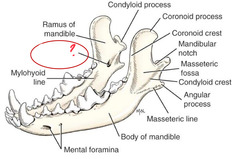
Mandibular foramen (caudal mandibular) = inferior alveolar nerve block
What is this? And what block goes here?
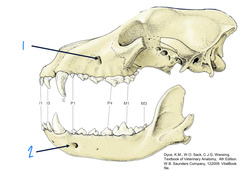
Infraorbital foramen (rostral maxillary) = infraorbital nerve block
What is 1? And what block goes here?
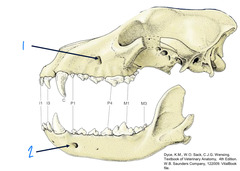
Middle mental foramen (rostral mandibular) = mental nerve block
What is 2? And what block goes here?
Maxillary
What is 2? What nerve, if you block it, will approximately block this location?
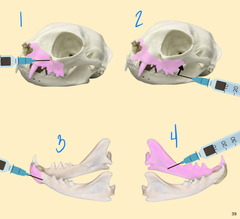
Middle mental
What is 3? What nerve, if you block it, will approximately block this location?
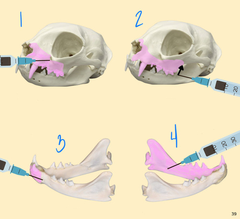
Inferior Alveolar (the mandibular foramen is the site of the inferior alveolar nerve block)
What is 4? What nerve, if you block it, will approximately block this location?
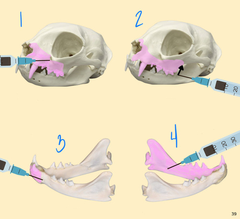
Bupivacaine
What are the best drugs to use for oral nerve blocks?
2 mg/kg of animal is NOT TO BE EXCEEDED
What is the MAX total dose for bupivacaine for dental blocks?
Bupivacaine and ropivacaine
What drugs (oral blocks) can you NOT combine with lidocaine?
0.2-0.3 mL/site
What volume of local blocks is typically injected for cats and small dogs with dental blocks?
0.5 mL/site
What volume of local blocks is typically injected for medium dogs (15-25 kgs) with dental blocks?
1.0 mL/site
What volume of local blocks is typically injected for large dogs (26-40 kgs) with dental blocks?
1.5 mL/site
What volume of local blocks is typically injected for giant dogs (over 40 kgs) with dental blocks?
25 ga, 5/8 inch for patients under 15 kg, 22 ga, 1/2 inch for patients over 15 kg
What is the most common needle and syringe for performing oral nerve blocks?
ASPIRATE
What is CRUCIAL to do before injecting oral nerve blocks?
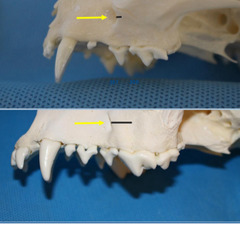
Walk needle dorsal to 4th premolar, or the distal root of 3rd maxillary premolar to find foramen
Where do you find the foramen to inject infraorbital block?
Caudal maxillary block
What block is this?
Caudal maxillary block
This block is done by inserting the needle in a ventral to dorsal direction into the soft palatal mucosa where it meets the bone, just caudal to the second mandibular molar to block the maxillary nerve before it reaches the infraorbital foramen
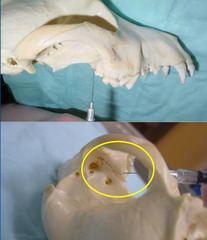
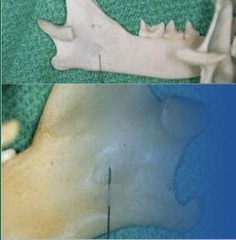
Top image: feline maxilla with a much shorter infraorbital canal
Bottom image: dog maxilla with a longer canal
If you inject the orbit and go too far into the foramen with cats, you may see strabismus and temporary blindness
What is the difference between these two images? What is it showing you?
Caudal maxillary block
Small to medium sized brachycephalic patients do not require WHICH KIND of mental block?
Infraorbital foramen
What is circled in green in this cat?
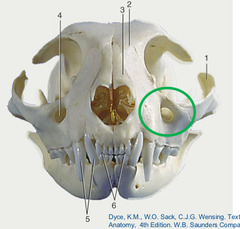
Rostral maxillary block (infraorbital)
What nerve block is this?
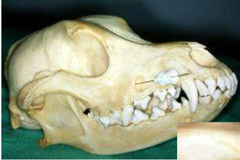
Rostral mandibular/mental block
Which block is this?
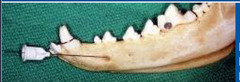
Rostral mandibular/mental block
Which block is this?
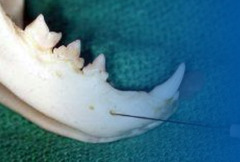
ECG arrhythmia and heart may stop beating --> do lipid emulsion therapy and CPR to treat
What happens if you inject an artery or vein because you didn't aspirate for a dental nerve block?
Caudal mandibular/inferior alveolar block
Which block is this, approached extraorally and directed thru the skin
Helps to lower the dose you need of opioids and is synergistic bc it works at different receptors
Why would you add ketamine (NMDA) and gabapentin to opioids?
Ketamine = injectable NMDA antagonist
Amantadine/Memantine = oral NMDA antagonist
What is the difference between Ketamine and Amantadine/Memantine?
Ketamine, Amantadine, memantine
These medications attenuate (reduce) excitatory neurotransmission in the brain and spinal cord to prevent/treat CNS sensitization and prevent/reverse opioid tolerance/hyperalgesia
Gabapentin and Pregablin
These medications have activity at the alpha 2 delta subunit of Ca channels to decrease CNS excitation and transmission of nociceptive impulses
Anti-hyperalgesic (because they prevent overall sensitization and helps other forms of pain management work better)
Gabapentin and Pregablin are *anti-hyperalgesic* OR *analgesic*
Mild sedative and anxiolytic effect for SHORT TERM
What is Gabapentin and Pregablin excellent for?
Ketamine and Gabapentin
What medications can be used to decrease wind up mental pain?