Lect4: Biological Molecules, Enzymes & Energy
 Call Kai
 Learn
Learn Practice Test
 Spaced Repetition
 Match
Match Flashcards
 Knowt Play
1/103

There's no tags or description
Looks like no tags are added yet.
Name | Mastery | Learn | Test | Matching | Spaced | Call with Kai | Chat |
|---|
No analytics yet
Send a link to your students to track their progress
104 Terms
What are the major functions of proteins in cells?
Proteins:
Move materials
Send signals
Provide structure
Transport molecules
Carry out chemical reactions
What are enzymes?
Proteins that speed up (catalyze) chemical reactions in cells.
How do enzymes speed up chemical reactions?
They lower the activation energy needed for the reaction to occur.
Why are enzymes important at body temperature?
Many reactions happen too slowly on their own at body temperature. Enzymes allow them to occur fast enough to support life.
What is an example of an enzyme-assisted reaction involving glucose?
Glucose + O₂ → CO₂ + H₂O + energy
What are proteins made of?
Amino acids, which are the monomers (building blocks) of proteins.
What is the general structure of an amino acid?
A central carbon bonded to:
Amino group (–NH₂)
Carboxyl group (–COOH)
Hydrogen (H)
R group (side chain)
What makes one amino acid different from another?
The R group (side chain) varies between amino acids and gives each one its unique properties.
How many different amino acids are used to make proteins?
20 different amino acids.
What are non-essential amino acids?
Amino acids that your cells can make on their own. Most amino acids (11) are non-essential.
What are essential amino acids?
The 9 amino acids your cells cannot make, so they must come from your diet.
What are conditionally essential amino acids?
Amino acids that can be made by cells, but sometimes not fast enough to meet the body's needs, so getting them from food can be important.
What is a peptide bond?
A covalent bond that joins two amino acids together.
How is a peptide bond formed?
Through dehydration synthesis, where two amino acids join and a water molecule (H₂O) is removed.
What is a polypeptide?
A long chain of amino acids connected by peptide bonds.
How do amino acids form a polypeptide chain?
Amino acids → dehydration synthesis → peptide bonds → polypeptide chain
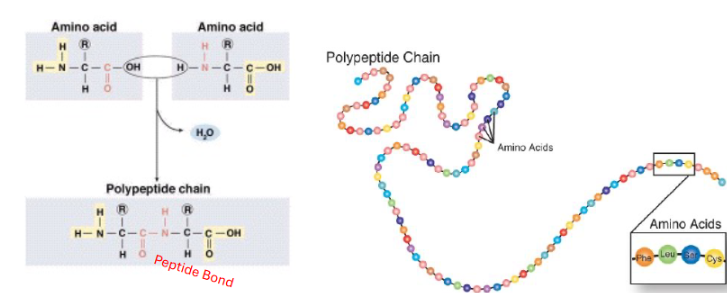
What happens after a polypeptide chain is made?
The polypeptide folds into a specific 3D shape, becoming a functional protein.
Why is a protein's shape important?
A protein's shape determines its function. Proper folding allows the protein to do its job.
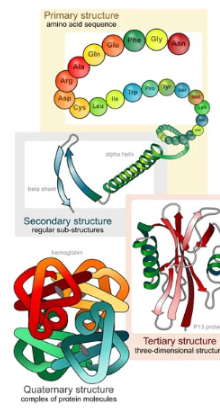
What are the main levels of protein structure shown here?
Primary: amino acid sequence
Secondary: local folding (α-helices & β-sheets)
Tertiary: overall 3D shape of one polypeptide
What is an enzyme's active site?
The specific region where the substrate binds and the reaction occurs.

How does a folded enzyme interact with a substrate?
The substrate binds to the active site → enzyme-substrate complex forms → reaction occurs → products are released.
What are cofactors?
Non-protein substances that help proteins/enzymes function properly.
Where do most cofactors in the body come from?
From the diet, especially vitamins and minerals.
What are examples of cofactors?
Minerals such as copper (Cu) and iron (Fe)
Vitamins, especially B-complex vitamins
What are examples of B vitamins that act as cofactors?
B1 (Thiamine) → TPP: carbohydrate breakdown for energy
B2 (Riboflavin) → FAD/FMN: electron transfer during ATP production
B3 (Niacin) → NAD⁺/NADP⁺: carries electrons/H⁺ during metabolism
B6 (Pyridoxine) → PLP: helps process amino acids/proteins
How does vitamin C function as a cofactor?
Its active form, ascorbate, helps enzymes make collagen for connective tissues.
What are the two main steps for breaking down dietary proteins?
Denaturation – protein unfolds
Cleavage – polypeptide is cut into smaller peptides/amino acids
What happens to proteins in the stomach?
The stomach's acidic, low-pH environment denatures (unfolds) proteins.
What does it mean to cleave a polypeptide?
To cut the polypeptide into smaller peptides or individual amino acids.
What happens after proteins are broken down?
The resulting small peptides and amino acids are absorbed in the intestines.