2.5 Physiologic rest position
 Call Kai
 Learn
Learn Practice Test
 Spaced Repetition
 Match
Match Flashcards
 Knowt Play
1/72

There's no tags or description
Looks like no tags are added yet.
Name | Mastery | Learn | Test | Matching | Spaced | Call with Kai | Chat |
|---|
No analytics yet
Send a link to your students to track their progress
73 Terms
what are the requirements for something to be referred to as physiologic or phsyiological in dentistry?
characteristic or conforming to the innate function of a tissue or organ
organic processes or to functions in an organism or in any of its parts
opposite of pathologic
what is the physiologic rest position?
the natural, comfortable position of the mandible when a person is in an upright position and at rest
what is the position of the lips, muscles and joints of the face at the physiologic rest position?
Lips are slightly touching each other, small distance of about 2-5mm between the front teeth
muscles that control the jaw movements are in a state of balance and minimal activity
condyles (jaw joints) are in a neutral, unstrained position
What is occlusion?
the way the upper and lower teeth come together when you close your mouth, the static relationship between the biting surfaces of the mouth
what is physiologic occlusion?
when teeth come together in harmony with the functions of your chewing system, bite is aligned properly and allows for efficient chewing.
Physiologically balanced occlusion takes into account aesthetic and the function of the temporomandibular joint and the neuromuscular system.
what is articulation?
contact relationship between the biting surfaces of the teeth furing function. how the upper and lower teeth come together and interact when you chew or perform other oral functions.
Focuses on the static and dynamic contact between the occlusal surfaces of the teeth.
what are the basic positions of the mandible?
centric relation
centric occlusal
myocentric occlusion
retruded contact position
centric position
what is centric occlusion?
a maxillomandibular relationship, independent of tooth contact, in which the condyles articulate in the anterior superior position against the posterior slopes of the articular eminences; in this position, the mandible is restricted to a purely rotary movement’ maxillomandibular relationship, the patient can make vertical, lateral or protrusive movements; it is a clinically useful, repeatable reference position
where do the condyles articulate in centric relationship?
in articular eminence
what is the more retruded physiologic relationship?
centric relation
what is centric occlusion?
occlusion of the upper and lower teeth when the mandible is in centric relation, may or may not be same as maximal intercuspal psoition
what is maximal intercuspal position?
It is when the teeth fit perfectly together, regardless of the centric relationship
what is myocentric occlusion?
terminal point in space where, with the mandible in its rest position, subsequent uniform muscle contraction (unlike in maximal muscle tonus) will raise the mandible along the myocentric trajectory
Its a position between centric occlusion and centric relation
what is retruded contact point?
The occlusal relationship that occurs when the condyles are in their most retruded position in the joint cavities.
In retruded contact position there is no ability for lateral moveement
What is centric position?
position of the mandible when the jaws are in centric relation
what are the border occlusions?
protrusive occlusion
lateral occlusion
balanced occlusion
what is protrusive occlusion?
Occlusion of the teeth when the mandible is protruded forward
The frontal teeth have an edge-to-edge relationship, meaning they meet each other directly
distal teeth experience disocclusion, they are not in contact with opposing teeth in natural dentition
what is lateral occlusion?
occlusal contact of teeth on the side toward which the mandible is moved
what is lateral occlusion also known as?
working articulation, working bite or working bite relation
what is the working and non-working side of lateral occlusion?
working side is the side toward which the mandible moves during lateral excursion (sideway movement)
non-working side is the mandible that moves towards the medial line during lateral excursion
is there any occlusions during lateral excursion?
there is no occlusal contacts on the non-working side but in complete dentures there can be occlusal contacts
what is balanced occlusion?
occlusal contact on both sides of the mouth, both in the front and back
this occurs in different jaw positions, including the centric position (when teeth come together in correct bit) and eccentric position
what is eccentric positions?
it includes the protrusive positions (lower jaw pushed forward) and lateral positions on both working and balances sides
balanced occlusion is optimal for stability of complete dentures, ensuring that they fit well and function properly
what is canine guidance?
a mutually protected articulation that involves the vertical and horizontal overlpa of the canine teeth
what is purpose of canine guidance?
to disengage the posterior teeth during the sideways movements of the lower jaw
what is group function?
another type of contact relation between the upper and lower teeth, occurs during lateral movements on the working side
it is where multiple teeth make simultaneous contact to distribute occlusal forces
what is dental occlusion?
when teeth line up with eahother
what is malocclusion?
when teeth don’t line up together
what is angles classification of occlusion?
class I (normal occlusion or neutrooclusion)
Class II (distoclusion)
Class III (mesiooclusion)
Class IV (no longer used)
What is Class I neutrooclusion?
mesiobuccal cusp of maxillary first permanent molar aligning with the mesiobuccal groove of the mandibular first molar
it is a dental relationship with normal anterposterior relationship
what is dental dysplasia?
overcrowding and tooth rotation caused but there not being enough space for the teeth to align properly
what is class II distoclusion?
mesiobuccal cusp of the mandibular first molar is aligned with the buccal groove of the maxillary first molar.
this is because the lower jaw is positioned behind the upper jaw in one or both sides of the mouth
Convex facial profile
what can be a cause of class II distoclusion?
Can be caused by overcrowding of teeth which happens when the lower jaw is smaller
What is class III mesioocclusion?
mesiobuccal cusp of maxillary first molar occludes interdentally between the permanent first and second mandibular molar
occurs when the lower jaw is positioned in front of the upper jaw in one or both sides of the mouth
can be subdivided by unilateral mesial occlusion where one side of the lower jaw is further forward compared to the upper jaw
Concave facial profile
what is class III mesiooclusion often accompanied by?
an anterior crossbite, where the lower front teeth are in front of the upper front teeth when biting down
what is Class IV?
occlusal relations of the dental arches are in distal occlusion in one lateral half and in mesial occlusion in the other. this classification is no longer used
what can Class II be divided into (subdivisions)?
proclined maxillary anterior
Retroclined maxillary anterior
what are subdivisions of class III mesiooclusion?
skeletal - down to bone structure
Pseudo class - due to habitual activities
What is a bite?
act of incising or crushing between the teeth
What are the different types of malocclusions?
overbite
underbite
crossbite
open bite
deep bite
crowding
what is overbite?
upper front teeth overlap significantly with the lower front teeth
what is underbite
lower front teeth protrude in front of the upper front teeth
what is crossbite?
upper teeth sit inside the lower teeth instead of outside
what is open bite?
gap between the upper and lower front teeth when the back teeth are closed
what is deep bite?
upper front teeth excessively cover the lower front teeth
what is crowding?
there isn’t enough space for all the teeth, causing them to overlap or twist
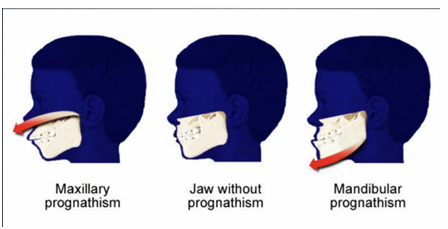
what is prognathism?
condition where the upper or lower jaw protrudes forward
what are the two types of prognathism?
maxillary and mandibular
what is masticatory apparatus?
the organs and structures involved in chewing
what does the masticatory apparatus include?
teeth, supporting structures, joints that connect skull and lower jaw, mandible, muscles that help with positioning and movement, tongue, lips cheek and oral mucosa
what is the main function of the masticatory apparatus?
mastication and digestion (chewing food to break it down to give more surface are for digestive enzymes to work on)
Speech (forming sounds and speech production)
Aesthetic (appearance and alignment of the teeth and jaw contribute to the overall aesthetic of the face
what is mastication?
teeth and supporting structures work together to break down food into smaller particles, this increases surface area of the food, making it easier for digestive enzymes to act upon it.
what is masticatory dimensional cycle?
movement of the mandible during chewing process, consists of three phases: opening, closing and grinding
what are protective reflexes?
nausea and vomiting are natural reflexes that help protect the body
what does the masticatory unit consist of?
SUPPORTING PART - tooth, peridontal ligamnet, bond
MOTOR PART - muscles
NEURO-SENSORY PART - nerve
TROPHIC PART - blood
what is masticatory reflexes?
process of communication between the muscles involved in chewing and the central nervous system
what does masticatory reflexes consist of?
Masticatory unit to CNS - when chewing signals sent from masticatory muscles to CNS to let the CNS know about the movement of muscles involved in chewing
CNS to masticatory unit - signal gets sent to masticatory unit from CNS which are instructions to help regulate the force and coordination of the muscle contractions involved in chewing
what is Physiological articulation cycles?
also known as mastication cycles, pathway of mandible during chewing, it ha three phases: opening, closing and intercuspal phase
explain the three phases of physiological articalution phase?
OPENING - mandible is depressed as the teeth and condyle move down and out
CLOSING - mandible is elevated, during early closing, it moves laterally to the desired chewing side
ICP (INTERCUSPAL PHASE) - reached during rest of the closing phase. the chewing condyle moves slightly forward and medially , known as BENNET MOVEMENT. condyle of the nonchewing side lags behind
how many chews are there per food swallow in articulation cycle?
15 chew per food swallow
what is the average vertical clearance during chewing in the articulation cycle?
Vertical clearance is space or distance between the upper and lower teeth during mastication, ensures teeth do not collide prematurely
16-20mm
what is lateral displacement during chewing in the articulation cycle?
Lateral displacement during chewing refers to the side-to-side movement of the jaw as food is processed.
It is around 3-5 mm
What is articulation?
the enunciation of words and sentences in speech
what is speech articulation consist of?
production of individual sounds in connected discourse
movement and placement of the organs involved in creating meaningful sounds
speech function performed through the movements of the lower jaw, lips, tongue and soft palate
what do the components of speech include?
respiration
audition
neurologic integration (speech production is coordinated by CNS)
Articulation (sound that is transformed into meaningful words which is aided by tongue, lips, palate, teeth and mandible)
Resonation (modification of sound in the pharynx, oral cavity, nasal cavity and paranasal sinuses)
Phonation (air from lungs travels through trachea which vibrates vocal cords in the larynx)
what is speech aid?
any therapy or instrument used to improve speech quality
what is speech aid prosthesis?
removable device that helps people who have defects in their soft palate
how do speech aid prosthesis’ help patients?
it extends into the pharynx and separates the oropharynx and nasopharynx, this separation is important in speaking and swallowing
By completing the palatopharyngeal sphincter, the prosthesis helps improve the function of the soft palate.
What should be the main factors when looking into aesthetics of teeth?
shape
size
shade
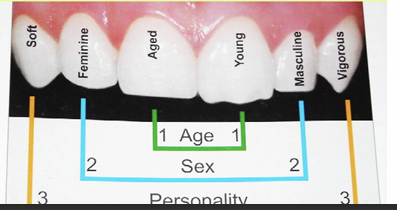
What are Flush and Fisher’s SPA Factors?
Sex: male or female
Personality: soft or vigorous
Age: old or young, with mamelons (small bumps on teeth) in younger individuals
How is the perfect size for a tooth determined?
divide the cervicoincisal length of tooth by the mesiodistal width
optimal width/length ratio for central incisor is 0.75 to 0.8
ratio below 0.75 indicates a narrower tooth, ratio above 0.8 indicates a wider tooth
What should the shape of female and male teeth look like?
Feminine smiles tend to have rounded incisal angles, open incisal and facial embrasures
Masculine smiles often show close incisal embrasures with prominent incisal angles
what is the golden proportion for teeth?
ratio of 1.618 : 1 : 0.618
proportion that is calculated by dividing the width of each central incisor, lateral incisor, and the canine by the total width of all 6 maxillary anterior teeth