leadership final 1
 Call Kai
 Learn
Learn Practice Test
 Spaced Repetition
 Match
Match Flashcards
 Knowt Play
1/374

There's no tags or description
Looks like no tags are added yet.
Name | Mastery | Learn | Test | Matching | Spaced | Call with Kai | Chat |
|---|
No analytics yet
Send a link to your students to track their progress
375 Terms
What criteria determine which applicant is hired?
Technical skills, Based on job or function specific knowledge
Technical skills
Nuts and bolts of doing a job
Ability to get the job done
What criteria determine which employee is promoted?
Ability to manage people
o Strong team skills
o Ability to build and manage
relationships
Person factors are characteristics that give
individuals their unique identities.
Situation factors are
elements outside us
that influence what we do, the way we do it,
and the ultimate results of our actions.
often results from the interaction of these interdependent factors.- The Person–Situation Distinction
Individual behavior
We need to understand the ___among both factors to be effective.- The Person–Situation Distinction
interplay
The Organizing Framework for Understanding and Applying OB
Inputs
Individual Level
Diversity, Personality, Values
The Organizing Framework for Understanding and Applying OB
Inputs
Group Level
group structure, group roles, team responsibilities
The Organizing Framework for Understanding and Applying OB
Inputs
Organizational Level
structure, culture
The Organizing Framework for Understanding and Applying OB
Processes
Individual Level
emotions and moods, motivation, perception, decision-making
The Organizing Framework for Understanding and Applying OB
Processes
group Level
communication, leadership, power and politics, conflict and negotiation
The Organizing Framework for Understanding and Applying OB
Processes
Organizational Level
human resource management, change practices
The Organizing Framework for Understanding and Applying OB
Outcomes
Individual Level
attitudes and stress, job performance, citizenship behavior, withdrawal behavior
The Organizing Framework for Understanding and Applying OB
Outcomes
Group Level
team performance
The Organizing Framework for Understanding and Applying OB
Outcomes
Organizational Level
Productivity, Survival
Using the Organizing Framework for
Problem Solving
Select the most effective solution considering:
Selection criteria, Consequences, Choice process, Necessary resources
Using the Organizing Framework for
Problem Solving
Select the most effective solution considering:
Selection criteria (such as its
effects on bottom-line profits, its
impact on others, its impact on the reputation with customers or the
community, the organization’s values, and ethical implications)
Using the Organizing Framework for
Problem Solving
Select the most effective solution considering:
Consequences (such as the
trade-offs between who wins and
loses, ideal versus practical options, perfection versus excellence,
and superior versus satisfactory results)
Using the Organizing Framework for
Problem Solving
Select the most effective solution considering:
Choice process (may be an
individual, team, or third-party
decision, and if more than one person is involved, the decision-
making method must be determined)
Using the Organizing Framework for
Problem Solving
Select the most effective solution considering:
Necessary resources (what do you need to
implement the
solution)
Personal Attitudes
Represent our feelings or opinions about people, places, and objects.
cognition, affect, and behavior are
closely related
Cognitive Dissonance represents the psychological discomfort a person experiences when they
experience inconsistency between two or more attitudes (cognitions), or between behavior and attitudes
Reduce Cognitive Dissonance by…
Changing attitudes, behaviors, or both.
o Belittle the importance of the inconsistent
behavior.
o Find consonant elements that outweigh
dissonant ones.
Our personal attitudes effect behavior via
our intentions…

Ajzen’s Theory of Planned Behavior
Some workplace attitudes are more ___than others. The following
four are especially powerful:
potent , Organizational Commitment, Employee Engagement, Perceived
Organizational Support, Job Satisfaction
Which attitude is…_____ job satisfication
An affective or emotional response toward various facets of one’s job
Which attitude is…
An affective or emotional response toward various facets of one’s job.
In other words, it is the extent to
which an individual likes his or her job
Which attitude is…
The extent to which employees give____. employee engagement
give it their all to their work roles
employee engagement And includes the feeling of:
Urgency
o Being focused
o Intensity
o Enthusiasm
Which attitude is…
The extent to which an employee- Organizational commitment
identifies with an organization and is committed to its goals.
Which attitude is…
The extent to which employees believe that the organization: perceived organizational support
Values their contributions.
o Genuinely cares about their
well-being.
The four attitudes are related to
important work outcomes
Organizational Commitment Leads to…
o
Greater employee retention
o Greater motivation in pursuit of
organizational goals
Employee Engagement Leads to…
o Increased customer loyalty and
satisfaction
o Increased employee
performance
o Increased employee well-being
o Financial performance
Perceived Organizational Support
Leads to…
Increased organizational commitment
o Job satisfaction
o Organizational citizenship behavior
o Task performance
o Lower turnover
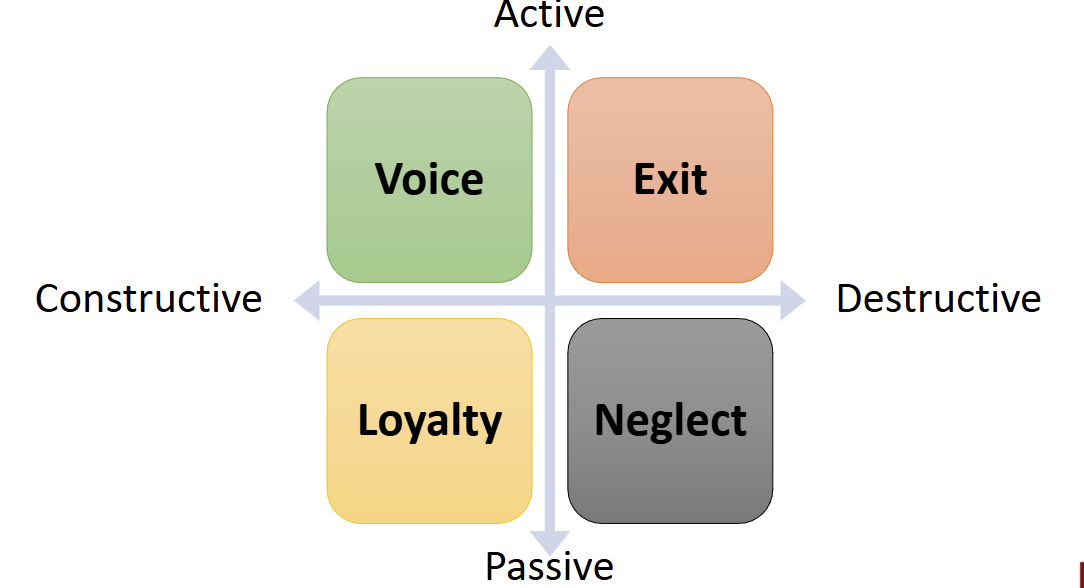
Responses to Dissatisfaction
Counterproductive Work Behaviors
• Actions that ___________ including stealing,
behaving aggressively toward
coworkers, or being late or absent
actively damage the organization
Outcomes Linked With Job Satisfaction
Attitudes
Motivation
o Job Involvement
o Withdrawal Cognitions*
o Perceived Stress*
Outcomes Linked With Job Satisfaction
Attitudes
Behaviors
Job Performance
o Organizational Citizenship Behavior
(OCB)
o Counterproductive Work Behavior (CWB)*
o Turnover*
now we move to
personality and how combinations of traits
and attitudes come together with different
meanings and results!
It helps us predict how someone will act, what jobs/skills they might be good at, and why we understand some people better than others.
Person-Job Fit Theory
Proposes that the fit between personality type and occupational environment determines satisfaction and turnover
How Does Who I Am Affect My Performance?
We all
differ along a vast number of personal
attributes…
How we differ has been shown to influence how we approach each of the following:
Work
o Solving problems
o Conflict
o Interactions with co-worker
relatively fixed to relatively flexible in order
important individual differences at work
intelligence, cognitive abilities, personality, core self evaluations (self-efficacy, self-esteem, locus of control, emotional stability), attitudes and emotions
individual level work outcomes
job performance, job satisfication, turnover, organizational citizenship behaviors, counterproductive work behaviors
Personality Traits
Traits_______ in behavior
summarize regularity
Personality Traits
Traits __________ behaviors
predict other, more specific
Personality Traits
Traits ____behavior
explain
Traits summarize regularity in behavior
Achievement Oriented
o Diligent, purposeful, goal-oriented
Traits predict other, more
specific behaviors
Achievement Oriented
o Comes to work on time
o Completes assignments thoroughly
Traits explain behavior
Achievement Oriented
o Bob works hard because completing a difficult task is
rewarding for him
Big 5 (Five Factor Model or FFM)- Respondents are scored along a
continuum
Big 5 (Five Factor Model or FFM)-
Big 5 traits explain up to
75% of personality
Big 5 (Five Factor Model or FFM)-
Which predict performance most across
occupations…do you remember?
Conscientiousness and Emotional Stability
Big 5 (Five Factor Model or FFM)-
Which predict performance most across
occupations…do you remember?
Conscientiousness and Emotional Stability
Predicts behaviors because of effect on attitudes
and motivation
Extroversion - positives
+ Assertive, influential in group
settings
+ Sociable & likeable
Extroversion - negatives
May generate status conflicts
Agreeableness-positives
+ Likely to build good
relationships, cooperate
+ High emotional competency
Agreeableness-negatives
May lack ability to make tough calls
Conscientiousness -positives
+ Organized, good planner, hard working
Conscientiousness -negatives
- May lack spontaneity, flexibility, change orientation
Emotional Stability - positives
+ Calm under pressure
+ Able to keep team focused on task even under stress
Emotional Stability- negatives
-May not understand or empathize with others’ emotional reactions
Openness - positives
+ Eager to entertain alternative points of view, think “big picture”
+ Eager to learn new information, skills, etc.
Openness - negatives
- May be indecisive as a decision maker
Conscientiousness
o Best
personality predictor of job performance
Extraversion
o Predicts
performance on jobs involving a social component
Extraversion
Occupational Differences
Engineers
____
Salespeople
____
Low on Extraversion; High on Conscientiousness, High on Extraversion, Low on Conscientiousness
Openness
o Predicts _____
o Predicts ____
performance in school (learning situations), willingness to look for and learn a new job after downsizing
High Extraversion, Emotional Stability, & Agreeableness
o Managers more likely to
complete an overseas job assignment
Trait Activation Theory
Although personality predicts our
‘regular’ (or comfortable)
behavior, some situations may alter our behavior…
Strong Situations Situation strength is the degree to which
norms, cues, or standards dictate appropriate behavior
Trait Activation Theory Some situations, events, or interventions
‘activate’ a trait more than others
Strong Situations Situation strength is the degree to which norms,
cues, or standards dictate appropriate behavior
Weak =
Strong =
Hanging out with friends, natural
Teaching, cues/norms dictate how we behave
Locus of Control describes how much
personal responsibility someone takes for their behavior and its consequences.
External Locus of Control example:
o
Things happen to me
o I blame others for failures
o I can’t control the future
Internal Locus of Control example
o I make things happen
o I can determine my future
o I accept personal responsibility for failures
external Locus of Control
In the workplace…
More anxious
o Earn less, receive smaller raises
o Less motivated by incentives
internal Locus of Control
In the workplace…
Higher motivation
o Higher expectations
o Exert more effort when given
difficult tasks
If we think of the “Big 5” as the desirable traits that we look for…
Then we know there is also a “dark side” of traits that we want to be aware
of
The Dark Triad-
These ________ are relevant to ______
socially undesirable traits , organizational behavior.
The Dark Triad-
These traits can literally harm an _____________. Sustained high levels of these traits can cause __________________
organization’s financial performance, derailment of careers and personal lives as well.
psychopathy
impulsive, emotionally cold, remorseless,
machiavellanism
manipulative, self-interested, domineering
narcissism
grandiosity, perceived superiority, entitlement
Machiavellianism- The Dark Side
oTend to be manipulative of others
o Use “hard” tactics to influence others
o Cynical worldview
o Amoral
o Tend to seek leadership for personal power
rather than collective good
o Fixed Pie, Zero-sum mentality, win at all costs
Machiavellianism- Where to Leverage?
Strong motivation to lead
o They tend to be influential and persuasive
o They are able to build political connections
o They are flexible in how they approach
tasks such as negotiation
o Positively relates to job performance in
unstructured settings, negative otherwise
Narcissism- The Dark Side
Vanity
o Superiority
o Exploitative
o Entitlement
o Exhibitionism
o Crave authority
Narcissism- Where to Leverage?
Can lead to higher organizational creativity
o Often has strong vision formation
o Can be very charming/charismatic
o Positive to CEO performance***
o Positive to CWB
Psychopathy- The Dark Side
Cold affect
o Antisocial tendencies
o Thrill-seeking
o Superficial charm
o Stress immunity
Psychopathy-Where to Leverage?
Positive to CEO performance***
o Positive to police officer task
performance***
o Positive to CWB
Psychopathy (Option 2)- The Dark side
Lack of concern for others
o Enjoyment in others’ failures or harm
o Lack of guilt or remorse
o Cold affect
o Antisocial tendencies
o Thrill-seeking
o Superficial charm
o Stress immunity
Psychopathy (Option 2)- Where to Leverage?
404
One general tenet to remember in your career is that
we are teams of
PEOPLE – that have bigger lives,
emotions, stressors, etc.
With that in mind, better understanding people, how they work, how they react, etc. will help us be better leaders!
It helps us lead with_______– and we’ve already learned why those job attitudes matter!
empathy, create job satisfaction and employee engagement
Cognitive Ability
The ability to learn, or potential to learn, and acquire new knowledge and skill
Cognitive ability tests are among the best predictors of
task performance across jobs and settings