8. Waves and Sound (3rd exam)
 Call Kai
 Learn
Learn Practice Test
 Spaced Repetition
 Match
Match Flashcards
 Knowt Play
1/26

There's no tags or description
Looks like no tags are added yet.
Name | Mastery | Learn | Test | Matching | Spaced | Call with Kai | Chat |
|---|
No analytics yet
Send a link to your students to track their progress
27 Terms
What are waves?
A disturbance that transfers energy
What are mechanical waves?
Waves are created by oscillating matter, and their movement is what drives the wave forward.
Mechanical waves fundamentally need a medium to travel and cannot travel in a vacuum.
They move in transverse, longitudinal, and compressional waves.
What are electromagnetic waves?
Produced when electrically charged particles accelerate and interact with other particles.
No particles are oscillating in an electromagnetic field, but photons spread and generate a wave.
Moves only in a transverse wave.
What are the types of mechanical wave?
Transverse and Longitudinal
What are transverse waves?
Transverse waves cause particles to move across or crosswise to the path of the wave.

What are longitudinal waves?
Longitudinal waves cause particles to move along or lengthwise in the same direction as the wave.

What do mechanical and electromagnetic waves have in common?
They transmit energy but NOT matter

What’s the name of the part the arrows are pointing to on a wave?
crest

What’s the name of the part the arrows are pointing to on a wave?
trough
What is amplitude?
Maximum displacement from equilibrium

What’s wavelength?
Distance from Crest to Crest

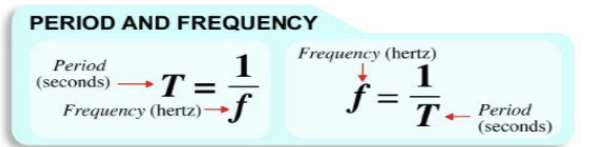
What’s a period and its formula?
Time for one wave. T= time for N waves/ N
What’s frequency and its formula?
Number of waves per unit time. T= N/ Time for N waves
1 hertz (Hz)= ?
1 wave/sec
The ___, or the time it takes to complete one wavelength, is related to ___.
period, frequency
A high amplitude means the sound is ___, a low amplitude means the sound is ___.
loud, quiet
Frequency is determined by the ___ and ___ by the ___.
source, speed, medium
Moving toward the source=
Moving away from the source=
higher frequency (pitch), lower frequency
When two waves interfere…
They add together to become one wave and split into the wave they were before when they come apart

What’s constructive interference?
wave crests align to create a larger wave

What’s destructive interference?
A crest meets a trough to cancel each other out. fbeats= |f1 - f2|

What are beats?
A result of the interference of two sound waves with slightly different frequencies. This interference creates a pattern of alternating loud and quiet regions, which we perceive as a fluctuating loudness.

What’s forced vibrations?
The motion of a vibrating system that occurs due to externally applied forces
What’s resonance?
When the frequency of an external force matches the natural frequency of an object.
What’s a standing wave?
A vibration of a system in which some particular points remain fixed while others between them vibrate with the maximum amplitude.

What’s a node?
a point along a standing wave where the wave has minimum or zero amplitude
What are antinodes?
maximum motion