Unit 2 - Water, Weak Interactions, Order + Chaos
 Call Kai
 Learn
Learn Practice Test
 Spaced Repetition
 Match
Match Flashcards
 Knowt Play
1/46

Earn XP
Description and Tags
Biochem Exam 1
Name | Mastery | Learn | Test | Matching | Spaced | Call with Kai | Chat |
|---|
No analytics yet
Send a link to your students to track their progress
47 Terms
water is referred to as…
the medium for life
where did life evolve and how?
life evolved in water due to the protection it provides from UV light
organisms typically contain what range of percentages of water?
70-90%
a typical cell is what percentage of water?
70%
biochemical reactions occur in what type of solutions?
aqueous
how is water important to proteins, nucleic acids, and membranes?
water is a critical determinant of the structure and function of proteins, nucleic acids, and membranes
covalent bonds are stronger than noncovalent bonds
true
define a covalent bond
when two nonmetal atoms share one or more pairs of electrons
draw a water molecule with its partial charges

is water polar or nonpolar?
polar
what intramolecular bonds are formed within water?
covalent bonds are formed between oxygen and hydrogen, these bonds are strong
what intermolecular bonds are formed between water molecules?
hydrogen bonds form from one water molecule to another
hydrogen bonds are not unique to water
true
hydrogen bonds are formed between what two atoms (what are the general names for them)?
hydrogen acceptors (usually a very electronegative atom like O or N)
hydrogen donors (usually hydrogen bonded to another electronegative atom)
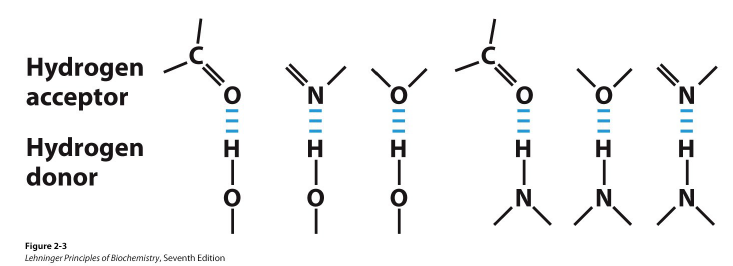
hydrogen atoms bonded to this atom DO NOT participate in hydrogen bonding, why?
carbon (C-H bond is not very polar)
what does not dissolve in water?
things that do not make hydrogen bonds (ex: oils)
nonpolar gases are poorly soluble in water
pure water is slightly…
ionized
describe O-H bonds
they are polar and can dissociate
what are the products that water forms?
a proton (H+) and a hydroxide ion (OH-)
dissociation of water is a rapid, reversible process
true
most water molecules remain…
un-ionized (meaning they don’t dissociate)

describe where equilibrium lies with this reaction and why
equilibrium lies to the left (low Keq) because the neutral water molecules are more energetically stable than the ionized products
oxygen is extremely…
electronegative
what type of molecule is water a good solvent for?
a charged or polar molecule
what is the maximum number of hydrogen bonds per one water molecule?
4
are hydrogen bonds strong or weak?
weak!!
why are weak, noncovalent interactions important?
they allow molecular surfaces to interact temporarily and repeatedly
weak, noncovalent bonds can be easily…
broken
think of an example when noncovalent bonds need to be broken
noncovalent bonds are needed when DNA needs to be opened up in order to be replicated
hydrogen bonds between adenine and thymine as well as guanine and cytosine can be broken and reformed easily because they are weak
when two atoms bond how do their charges change?
they acquire partial charges (ex: when oxygen and hydrogen bond, their full negative and positive charges become partial)
what is the hydrophobic effect?
when nonpolar molecules group together in the presence of water
give an example of the hydrophobic effect
oil droplets in chicken soup
what is the second law of thermodynamics?
the total entropy of a system and its surroundings always increases in a spontaneous process
how does entropy of water and entropy of the system change based off the aggregation of nonpolar groups in water?
the entropy of water decreases because water has to become more ordered around the new, big, nonpolar group
the entropy of the system increases because the water molecules that were ordered around the separated nonpolar groups become disrupted, leading to more chaos
the hydrophobic effect powers…
membrane formation by phospholipids
protein folding
how does the hydrophobic effect favor protein folding?
proteins fold in aqueous solutions and become more ordered
when proteins fold, what entropy change occurs, why?
there is a loss of entropy because proteins are becoming more ordered
if the pH is altered, what does this change for the organism?
alterations in pH result in drastic changes in the electrostatic environment (where electrical charges accumulate) of the organism
alterations in pH alter which interactions?
weak interactions that maintain the structure of biomolecules
an acid is a proton _________ and a base is a proton ________
donor, acceptor
define titration
the process of gradually adding known amounts of reagent to a solution to see how the reagent reacts with the solution (and monitoring the results)
what is Ka
the equilibrium constant
a larger Ka indicates a _______ ______, while a small Ka indicates a ________ _______
stronger acid, weaker acid
what does it mean if pH = pKa
then the acid is half protonated and half deprotonated
buffers tend to resist a change in…
pH
what two things act as a buffer?
acid-base conjugate pair