Lipids Chapter
 Call Kai
 Learn
Learn Practice Test
 Spaced Repetition
 Match
Match Flashcards
 Knowt Play
1/85

Earn XP
Description and Tags
FND300
Name | Mastery | Learn | Test | Matching | Spaced | Call with Kai | Chat |
|---|
No analytics yet
Send a link to your students to track their progress
86 Terms
Lipid solubility
generally insoluble in water
soluble in non polar solvents
Lipids are composed of
glycerol esters of fatty acids
Types of lipids
oils and fats
oils are liquid at room temperature
fats are solid at room temeprature
Sources of vegetabel oils
soybeans, canola, palm, coconut, olive
Fat sources
from animals
butter and lard
Lipid qualities
carry fat soluble vitamins
increase mouthfeel, texture and taste
increase obesity and chronic disease
Fatty acids composition
made of hydrocarbon with carboxylic group at one end (the alpha end)
this is acidic end
omega end contains a methyl group
Forms of fatty acids
saturated (no double bonds)
unsaturated (containing one or more double bond within the hydrocarbon chain
Short chain fatty acids
<10 carbons
butyric acid (C4:0)
found in gut as a product of fibre fermentation
Medium chain fatty acids
12-16 carbons
lauric acid = c12:0
found in coconut oil
Long chain fatty acids
>18 carbons
includes steric acid (C18:0)
oleic acid (C18:1)
linoleic acid (C18:2)
Gamma linolenic acid
C18:3 w 6 with the double bond being introduced at the 6th carbon
alpha linolenic acid
C18:3 w 3
first souble bond introduced at the third carbon from the omega end
Cis formation
2 hydrogens are on the same side of the double bond
most fats are normally found in this configuration
Trans fatty acids
H is on opposite sides of the double bond
found naturally in meat and dairy
often formed due to hydrogenation of oils in processed foods
This is more common in the diet than the from meats
creates a shape similar to saturated fatty acids
Non conjugated fatty acids
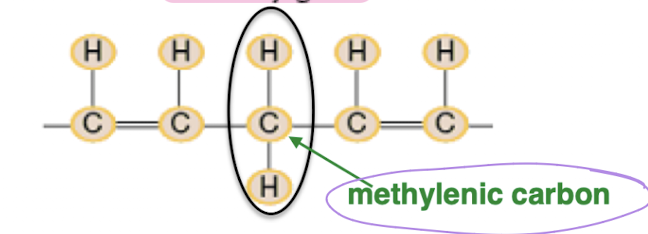
alpha methylene group is between two double bonds
conjugated Fatty acid
1 single bond between a pair of double bonds
Melting point
temperature at which a solid turns in to a liquid
higher MP is more solid at room temperature
Short chain FA - MP
lower MP than longer chain
due to lower molecular weight
will melt faster than long chain
Melting points of FAs from lowest to highest
Lauric (C12) → Palmitc (C16) → Steric (C18)
Saturation and MP
higher unsaturation results in a lower melting point
more liquid at room temperature
saturated FAs have molecules packed more tightly together and therefore a higher MP
unsaturated FA have double bonds which gives a bend and molecules cannot interact strongly enough and therefore have a lower MP
Order of melting points by saturation
lowest = linolenic acid (18:2)
Middle = oleic acid (C18:1)
Highest = stearic acid (C18:0)
Cis FA vs Trans FA Melting points
Trans have a higher MP because they are more tightly packed together
Cis FA have the kink in them which prevents them from binding as closely
therefore there is a lower MP
Melting point order based on cis vs trans orientation
Lower (oleic acid) - cis
higher (elaidic acid) -trans
Melting points of saturated vs trans vs cis at similar chain length
Lowest = Oleic acid (C18:1 - Cis)
Middle = Elaidic acid (C18:1 - Trans)
Highest = Stearic acid (C18:0) - saturated
Melting point is highest in the saturated FA and lowest in the Cis unsaturated
Carotenoid FA composition
mostly trans isomers and conjugated double bonds
increase in the cis isomer due to isomerization of the trrans isomer during processing
PUFAs
synthesized through a series of desaturation and elongation reactions
Arachadonic acid, Docosapentaenoic acid, docosahexaeonic acid, eicosapentanoic acid are all essential
importance of AA, DPA, EPA, DHA
cell membrane components
precursors for eicosanoids and docosanoids which act as hormones
Omega-6 Desaturation and elongation
Linoleic acid
D-6 desaturase
Y-linolenic acid
Elongase
D-5 Desaturase
Arachadonic acid (AA)
Elongase
Elongase
D-6 Desaturase
B-oxidation
Docosapentaenoic acid (DPA n-6)
Linoleic acid
becomes DPA and AA
from veg oils (sunflower, grapeseed)
cannot be synthesized so must be obtained in the diet
makes Omega-6
Desaturation of Omega 3
a-linolenic acid.
D-6 desaturase
Steradonic acid
Elongase
D-5 desaturase
Eicosapentaenoic acid (EPA)
elongase
Docosapentaenoic acid (DPA n-3)
elongase
D-6 desaturase
B-oxidation
Docosapentaenoic acid (DHA)
EPA and DHA
humans can synthesize both from a-linolenic acid (ALA)
but this is very inefficient
only 9% is converted to DHA for women
<5% ALA conversion to DHA for men
High concentrations are found in fatty fish
Health Benefits of w-3 FAs
Fetal development of the brain and retina
anti-inflammatory and anti-oxidative stress effects bring about improved cardiovascular function
maintain brain function and prevent alzheimers disease
w-3 and w-6 FAs ingestion
incorporated into cell membranes of tissues
precursors for synthesizing signalling molecules important for
cell growth and development
inflammation
Overconsumption of w-6 FAs
arachidonic acid become precursor for pro-inflammatory mediators like eicosanoids, prostaglandins, thromboxanes, leukotrienes
overconsumption can lead to heart disease
EPA and DHA produce anti-inflammatory cell mediators
beneficial to consume less w-6 FAs
Should aim for a ratio of 4:1 (omega-6:omega-3)
Hydrogenation
addition of hydrogen to double bonds in FA chains
increases the saturation
Solid fat
full saturation/hydrogenation
Semi-solid fat
partial saturation/hydrogenation
Uses of hydrogenation
margerine manufacturing
liquid fat is converted into a spreadable, plastic, semisolid fat
increased oxidative stability to lower rancidity and create a longer shelf life
Hydrogenation process
oil mixed with nickel catalyst
heated to 160-220 degrees celcius
Exposed to H+ up to 60psig
degree of saturation is monitored by a refractive index
hydrogenated oil is cooled and the catalyst is removed via filtration
partial hydrogenation
produces fats with firmness, plasticity and spreadability
production of trans FA (amounts depending on the degree of hydrogenation)
trans fat effects
increased low density lipoprotein (LDL) cholesterol
Decreased high density lipoprotein (HDL) cholesterol
increased risk of atherosclerosis and heart disease
use of partially hydrogenated fats
baked goods, processed foods
deep fried snacks
Lipid oxidation
involves oxidation of unsaturated FA
leads to oxidative rancidity in food (off flavours)
reduces the nutritional value
some oxidation in products may be toxic
some oxidation products can be favourable
Desirable lipid oxidation
flavour production in aged cheeses
Auto-oxidation
occurs because of light, oxygen and emzymes
reactions occur between unsaturated FAs (free or within triglycerides) and oxygen
3 steps of lipid oxidation
initiation
propagation
termination
Initiation reaction
X* + RH → R* + XH
Propagation Reaction
R* + O2 → ROO*
ROO* + RH → ROOH + R*
R* then loops back and the reaction occurs again
2ROOH → RO* + ROO* + H2O
Termination Reaction
R*, RO*, ROO* → Stable, non propogating species
Initiation stage of oxidation
presence of a catalysist is required to oxidize the unsaturated FA (RH)
usually reactive oxygen species known as a singlet oxygen (X*)
H is abstracted from position alpha to FA double bonds to produce R* (fatty acid with free radical)
Easiest from methylenic carbon in non-conjugated FA
Singlet oxygen
excited state of molecular oxygen with higher energy and reactivity
Propogation stage
R* reacts with oxygn to produce peroxy radicals (ROO*)
ROO* then abstract H from a-methylenic groups of other unsaturated FA (RH) to make hydroperoxides (ROOH) and new free radicals R*
New R* reacts with oxygen and propogation is repeated
hydroperoxides are stable and decompose immediately to form other free radicals, ROO* and RO* (alkoxy radicals) which continue propagation steps
Unsaturated FA in reactions
RH
Singlet oxygen in reaction
X*
Fatty acid with free radical in reaction
R*
Peroxy radical in reaction
ROO*
Hydroperoxides in reactions
ROOH
Alkocy radical in reactions
RO*
Termination in lipid oxidation
propatation results in lots of free radicals which absorb oxygen
as the concentration of the free radicals increases they cobine with other radicals to form non-radical products
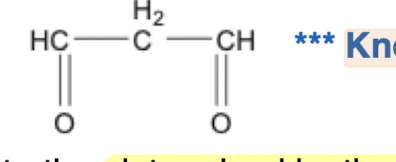
Malondialdehyde (MDA)
end product of lipid oxidation
MDA concentration
determined by the thiobarbituric acid reactive substances (TBARS) assay
MDA reacts with thiobarbituric acid (TBA) to form MDA-TBA2 adduct with its bright pink
amount of pink chromogen is determined by measuring the amount of absorbance at 530-540nm and comparing this against a standard curve
Factors that influence lipid oxidation
fatty acid composition
oxygen concentration
temperature
surface area
water activity
pro-oxidants
antioxidants
Fatty acid composition effect on lipid oxidation.
increase in the number of a-methylene groups = increased oxidation rate
FFAs are more reactive than triglycerides
faster when not esterfied
cis double bonds are more reactive than trans double bonds
Oxygen concentration effect on lipid oxidation
O2 is abundant: the rate of oxidation is independent of O2 concentration
O2 is low: rate of oxidation is proportional to O2 levels
Temperature effect on lipid oxidaition
high T results in an increase in oxidation rate
as temperature increases O2 solubility decreases so O2 effect becomes negligible
Surface area effect on lipid oxidation
oxidation rate increases according to surface area of the lipid exposed ot the air
smaller surface areas have less interaction with O2
modified atmosphere packaging replaces O2 with N2 gas
water activity effect on lipid oxidation
Aw <0.1 = high oxidation rate because the foods are exposed to the O2 in air
Aw 0.3 = oxidation is inhibited since small amounts of water reduces the catalytic activity of metal catalysts, quenches free radicals and minmizes the access of O2 to the lipid
Aw 0.55-0.85 = high oxidation rate due to greater mobility of reactants such as O2 and catalysts
Pro-oxidants
enhance or promote oxidation
transition metal ions (Cu2+, 1+, Fe3+, 2+)
heavy metals in plant oils, animal tissues, egg, milk
introduced by soil, processing or storage equipment
directly interacts with the unsaturated FA
activates O2 to give singlet oxygen and a peroxy radical
Radient energy (UV, Sinlight)
Pro oxidant mechanism
accellerates the hydroperoxide breakdown by direct interaction with unsaturated FAs
activates molecular oxygen to give singlet oxygen and a peroxy radical
Anti-oxidants role
delay onset or reduce the rate of oxidation by
Inhibiting or inactivating the formation of free radicals
interrupting propagation
Antioxidants inbibiting or inactivating free radical formation
aim ot prevent oxidation before it starts
eg. B-carotene, lycopene, other caratenoids
reacts with singlet oxygen to make an unreactive triplet oxygen
the carotenoid gets excited but it converts back to normal and releases heat
Carotenoids
red, orange and yellow pigments found in chloroplasts and chromopolasts
basic structure of conjugated double bonds
single and double bonds alternate on the backbone
lipid soluble
xanthophyll contains oxygen but carotene contains no oxygen
precursors of vitamin A
especially B-carotene (growth, vision, development)
B-carotene
precursor to vitamin A
red-orange pigment
singlet oxygen quencher
carrots, squash, sweet potato, dark leafy greens, cantaloupe, watermelon
Beta-cryptoxanthin
xanthophyll carotenoid
orange-yellow pigment
present in orange, tangerine, papaya, peaches, mango, guava
hydroxylated derivative of B-carotene
precursor of vitamin A
lycopene
red carotene pigment
present in tomatoes, pink grapefruit, apricots, papaya
content increases significantly during tomato ripening and continues after harvest with heat treatment
trans to cis isomerization induced by heating
Nutritional importance of the trans to cis isimerization induced by heating
breaks down cell membranes so lycopene can be released
cis are more soluble and can be absorbed more efficiently in the intestinal lumen
cooking tomatoes in oil makes them more bioavailable because H it is lipid soluble
Inhibitory propagation
inhibit the propogation step
compete with the unsaturated FA and react with the peroxy radical instead
the antioxidant radical (A*) is stable
slows or stops the oxidation after it has started
Butylated hydroxyanisole (BHA) and butylated hydroxytoluene (BHT)
soluble in oils
used along side main antioxidants
good H+ donors and are stabilized by resonance with no positions reacting with molecular oxygens
antioxidants that act by inhibitory propagation
a-tocopherol (TH2) function
Reacts with the ROO* to create ROOH + TH*
TH* is stable and can quench another peroxy radical
can also react with itself to regenerate TH2
effective antioxidants at low concentration but at high concentration it is a pro-oxidant
a-tocopherol
most biologically available form of vitamin E
fat soluble and found in most vegetable oils
olive oil, coconut oil, almonds, avocados
animal fats contain small concentrations that comes from vegetables in their diet
Vitamin E content
extraction of oil helps to preserve it
levels are depleted when it is exposed to conditions that promote lipid oxidation
Food processing that leads to a-tocopherol loss
drum drying seeds causes losses through exposure to air and heat which uses its vitamin E content
Retorting does not affect a-tocopherol activity because it is an anaerobic process and therefore the a-tocopherol does not use its antioxidant activity when being processed
Seed oil extracting and processing
uses hexane solvent but most of it is recovered and removed but small amounts remain in the product
can government has determined that consumer exposure to the solvent is not harmful to human health at the current levels of exposure
Omega-6 balance
we currently consume too many omega 6 and need to balance through increasing omega 3
repeating uses of the same oil leads to changes in the oil which can lead to inflammation through creation of pro-oxidants
peroxides are created
UPFs
cookies, cakes, donuts, chips etc
UPF contain seed oils, sugar, salt, additives and preservitives
over consumption of UPF is associated with poor health outcomes